

North East Valley started as a small community to the north of Dunedin’s main settlement. The Valley’s Presbyterians, cut off from Dunedin by the Water of the Leith and Lindsay’s Creek, had to make quite an expedition to services at Knox Church and so petitioned for their own church. In 1884, Reverend David Borrie was inducted as permanent minister. He worshipped with his parishioners in the North East Valley Borough Council chambers, and set about organising and fundraising for a new church. The newly formed building committee appointed James Hislop as architect. Thomas Newton won the tender with his contract price of £1475.
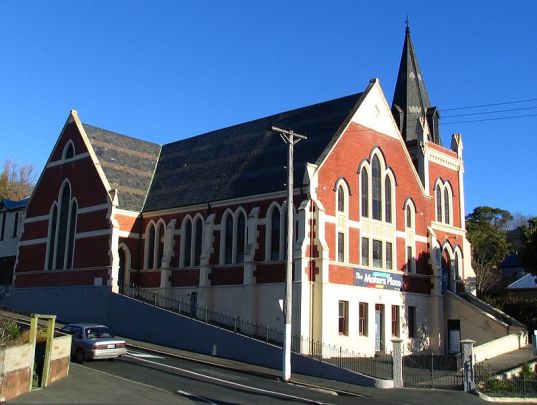
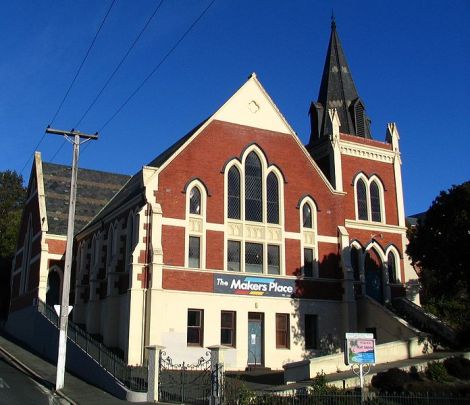
Dr Salmond laid the foundation stone on 15 November 1884. Early English in style, the slate-roofed brick and Oamaru stone North-east Valley Presbyterian Church was completed in 1885. The Otago Daily Times reported that the congregation had built ‘a handsome and commodious church,’ with seating for 350 people and noted that:
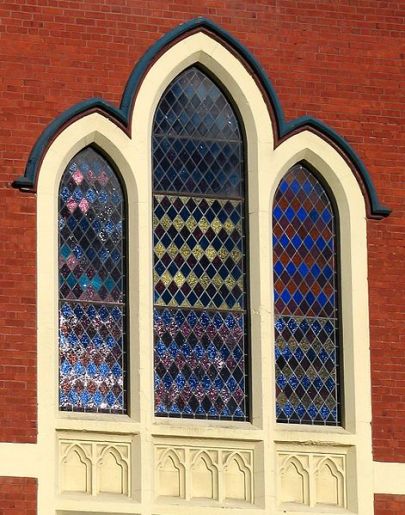
‘A … pulpit platform and choir space has been erected at the eastern end of the church. The pulpit stands under a … Gothic arch... The roof is lofty, with its principals resting on Oamaru stone corbels … carved in a variety of designs. The whole of the windows are glazed with obscured glass, except a wheel light in the eastern gable, which is glazed with coloured glass...’
Two temporary classrooms were partitioned off the west end of the nave. They were removed when the Sunday school was built. Kauri and rimu were the principal building timbers.
By the early years of the twentieth century, the congregation was growing. The growth is reflected in the building programme - a Sunday school hall was built in 1901. In 1911, Dunedin architect Edmund Anscombe was commissioned to extend the church, providing seating for 700, adding two classrooms under the nave and a spire. Dunedin businessman and valley resident Robert Glendining presented the church with a bell. In 1913, a pipe organ was installed and was opened by Jesse Timson, then the organist of First Church.
During World War Two, the church remained open during the day to provide a place of solace and comfort. The bell was rung at noon ‘to remind people to pray for victory and peace.’ On Armistice Day 1950, a plaque to those of the congregation who had died in the war was dedicated. Various changes and additions to modernise the building occurred in the 1940s and 1950s. The church was renamed St David’s Presbyterian Church in 1976, in honour of the first minister Reverend David Borrie. Over 200 people attended centenary celebrations in 1983. In 2014, St David’s remains a place of worship for North East Valley residents.
List Entry Information
Status
Listed
List Entry Status
Historic Place Category 2
Access
Private/No Public Access
List Number
4734
Date Entered
25th September 1986
Date of Effect
25th September 1986
City/District Council
Dunedin City
Region
Otago Region
Extent of List Entry
Extent includes the land described as Lot 5 DP 546 (RT OT73/163), Otago Land District, and the building known as St David’s Presbyterian Church (Former), thereon, including the attached hall. Refer to the extent map tabled at the Heritage New Zealand Pouhere Taonga Board meeting on 11 September 2014.
Legal description
Lot 5 DP 546 (RT OT73/163), Otago Land District
Status
Listed
List Entry Status
Historic Place Category 2
Access
Private/No Public Access
List Number
4734
Date Entered
25th September 1986
Date of Effect
25th September 1986
City/District Council
Dunedin City
Region
Otago Region
Extent of List Entry
Extent includes the land described as Lot 5 DP 546 (RT OT73/163), Otago Land District, and the building known as St David’s Presbyterian Church (Former), thereon, including the attached hall. Refer to the extent map tabled at the Heritage New Zealand Pouhere Taonga Board meeting on 11 September 2014.
Legal description
Lot 5 DP 546 (RT OT73/163), Otago Land District
Construction Professional
Name
Newton, Thomas
Type
Builder
Biography
No biography is currently available for this construction professional
Name
Anscombe, Edmund
Type
Architect
Biography
Anscombe (1874-1948) was born in Sussex and came to New Zealand as a child. He began work as a builder's apprentice in Dunedin and in 1901 went to America to study architecture. He returned to Dunedin in 1907 and designed the School of Mines building for the University of Otago. The success of this design gained him the position of architect to the University. Five of the main University buildings were designed by Anscombe, as well as Otago Girls' High School and several of Dunedin's finest commercial buildings including the Lindo Ferguson Building (1927) and the Haynes building. Anscombe moved to Wellington about 1928 and was known for his work as the designer of the Centennial Exhibition (1939-1940). Anscombe had travelled extensively and had visited major exhibitions in Australia, Germany and America. The practice of Edmund Anscombe and Associates, Architects, had offices in the Dunedin, Wellington and Hawkes Bay districts, and Anscombe's buildings include the Vocational Centre for Disabled Servicemen, Wellington (1943), Sargent Art Gallery, Wanganui, and several blocks of flats including Anscombe Flats, 212 Oriental Parade (1937) and Franconia, 136 The Terrace (1938), both in Wellington. As well as being interested in the housing problem, Anscombe held strong views concerning the industrial advancement of New Zealand. (See also http://www.dnzb.govt.nz/dnzb/ )
Name
Hislop, James (1859-1904)
Type
Architect
Biography
‘James Hislop (1859-1904) was born in Glasgow and came to New Zealand at a very early age. He was educated at North East Valley School and received his architectural training in the office of Mason and Wales. He also spent two years with the Public Works Department, as district manager of Nelson. In 1880 he entered into business with W.H. Terry who retired three years later. He established his own practice in Dunedin and later entered into a partnership with Edward Walter Walden. In 1889 Hislop designed and supervised the erection of the South Seas Exhibition among a number of prominent buildings both in Otago and elsewhere in the country.’ ‘Among the significant buildings designed by James Hislop, or by the Hislop and Walden partnership are Crown Milling Co. building, Miller Place, Dunedin (c.1880); New Zealand Steam Shipping Co. office, Dunedin; DIC, Christchurch; Evans and Co. Mill, Timaru; National Bank, George Street, Dunedin; Napier Abattoirs (1902); Hallenstein Building, The Octagon; Dunedin City Abattoirs.’ Hislop moved to Wellington around 1903, where he died as the result of an accident in 1904. Source: Heritage New Zealand Review Report for Ferntree Lodge, List No. 368, 27 Jun 2017, Heather Bauchop.
Construction Details
Start Year
1901
Type
Addition
Description
Sunday school
Start Year
1911
Type
Addition
Description
Extensions to church. Spire and bell added.
Start Year
1913
Type
Modification
Description
Pipe organ installed
Start Year
1948
Type
Modification
Description
Sound system installed
Start Year
1952
Type
Modification
Description
Gas heating installed
Start Year
1954
Type
Modification
Description
Hearing aids installed
Start Year
1959
Type
Modification
Description
‘Lower Hall’ converted to church lounge. Ceiling lowered, kitchen upgraded and toilets built beneath the main entrance steps
Start Year
1884
Finish Year
1885
Type
Original Construction
Construction Professional
Name
Newton, Thomas
Type
Builder
Biography
No biography is currently available for this construction professional
Name
Anscombe, Edmund
Type
Architect
Biography
Anscombe (1874-1948) was born in Sussex and came to New Zealand as a child. He began work as a builder's apprentice in Dunedin and in 1901 went to America to study architecture. He returned to Dunedin in 1907 and designed the School of Mines building for the University of Otago. The success of this design gained him the position of architect to the University. Five of the main University buildings were designed by Anscombe, as well as Otago Girls' High School and several of Dunedin's finest commercial buildings including the Lindo Ferguson Building (1927) and the Haynes building. Anscombe moved to Wellington about 1928 and was known for his work as the designer of the Centennial Exhibition (1939-1940). Anscombe had travelled extensively and had visited major exhibitions in Australia, Germany and America. The practice of Edmund Anscombe and Associates, Architects, had offices in the Dunedin, Wellington and Hawkes Bay districts, and Anscombe's buildings include the Vocational Centre for Disabled Servicemen, Wellington (1943), Sargent Art Gallery, Wanganui, and several blocks of flats including Anscombe Flats, 212 Oriental Parade (1937) and Franconia, 136 The Terrace (1938), both in Wellington. As well as being interested in the housing problem, Anscombe held strong views concerning the industrial advancement of New Zealand. (See also http://www.dnzb.govt.nz/dnzb/ )
Name
Hislop, James (1859-1904)
Type
Architect
Biography
‘James Hislop (1859-1904) was born in Glasgow and came to New Zealand at a very early age. He was educated at North East Valley School and received his architectural training in the office of Mason and Wales. He also spent two years with the Public Works Department, as district manager of Nelson. In 1880 he entered into business with W.H. Terry who retired three years later. He established his own practice in Dunedin and later entered into a partnership with Edward Walter Walden. In 1889 Hislop designed and supervised the erection of the South Seas Exhibition among a number of prominent buildings both in Otago and elsewhere in the country.’ ‘Among the significant buildings designed by James Hislop, or by the Hislop and Walden partnership are Crown Milling Co. building, Miller Place, Dunedin (c.1880); New Zealand Steam Shipping Co. office, Dunedin; DIC, Christchurch; Evans and Co. Mill, Timaru; National Bank, George Street, Dunedin; Napier Abattoirs (1902); Hallenstein Building, The Octagon; Dunedin City Abattoirs.’ Hislop moved to Wellington around 1903, where he died as the result of an accident in 1904. Source: Heritage New Zealand Review Report for Ferntree Lodge, List No. 368, 27 Jun 2017, Heather Bauchop.
Construction Details
Start Year
1901
Type
Addition
Description
Sunday school
Start Year
1911
Type
Addition
Description
Extensions to church. Spire and bell added.
Start Year
1913
Type
Modification
Description
Pipe organ installed
Start Year
1948
Type
Modification
Description
Sound system installed
Start Year
1952
Type
Modification
Description
Gas heating installed
Start Year
1954
Type
Modification
Description
Hearing aids installed
Start Year
1959
Type
Modification
Description
‘Lower Hall’ converted to church lounge. Ceiling lowered, kitchen upgraded and toilets built beneath the main entrance steps
Start Year
1884
Finish Year
1885
Type
Original Construction
Historical and Associated Iwi / Hapū / Whānau
Completion Date
26th June 2014
Report Written By
Heather Bauchop
Information Sources
Chisholm, 1898
James Chisholm, Fifty Years Syne: A Jubilee Memorial of the Presbyterian Church of Otago, J. Wilkie and Co., Dunedin, 1898
St David’s Presbyterian Church, 1982
Presbyterians in North East Valley, St David’s Presbyterian Church, Dunedin, 1982.
Other Information
This place was identified as significant under previous legislation with different information requirements. It remains significant under the current legislation. There is opportunity under our legislation and policies to add to this information. Further information about this place may be available from the Otago/Southland Office of Heritage New Zealand Pouhere Taonga. A fully referenced upgrade report is available on request from the Otago/Southland Area Office of Heritage New Zealand. Please note that entry on the New Zealand Heritage List/Rarangi Korero identifies only the heritage values of the property concerned, and should not be construed as advice on the state of the property, or as a comment of its soundness or safety, including in regard to earthquake risk, safety in the event of fire, or insanitary conditions.
Historical and Associated Iwi / Hapū / Whānau
Completion Date
26th June 2014
Report Written By
Heather Bauchop
Information Sources
Chisholm, 1898
James Chisholm, Fifty Years Syne: A Jubilee Memorial of the Presbyterian Church of Otago, J. Wilkie and Co., Dunedin, 1898
St David’s Presbyterian Church, 1982
Presbyterians in North East Valley, St David’s Presbyterian Church, Dunedin, 1982.
Other Information
This place was identified as significant under previous legislation with different information requirements. It remains significant under the current legislation. There is opportunity under our legislation and policies to add to this information. Further information about this place may be available from the Otago/Southland Office of Heritage New Zealand Pouhere Taonga. A fully referenced upgrade report is available on request from the Otago/Southland Area Office of Heritage New Zealand. Please note that entry on the New Zealand Heritage List/Rarangi Korero identifies only the heritage values of the property concerned, and should not be construed as advice on the state of the property, or as a comment of its soundness or safety, including in regard to earthquake risk, safety in the event of fire, or insanitary conditions.
Current Usages
Uses: Religion
Specific Usage: Church
Uses: Religion
Specific Usage: Church Hall/Sunday School
Current Usages
Uses: Religion
Specific Usage: Church
Uses: Religion
Specific Usage: Church Hall/Sunday School
Location
Sign up to hear more
Get the latest heritage news, features and events delivered
straight to your inbox.
