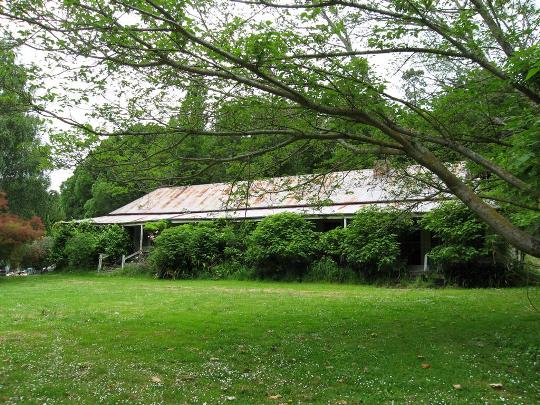
'The Cottage', situated in the grounds of Te Aute College, Pukehou, was once the residence of Allen Williams (1852-1945), the nephew of one of the driving forces behind the establishment of Te Aute College, Samuel Williams (1822-1907). 'The Cottage' is the last remaining of a number of houses that once existed to accommodate various members of the Williams family and others who worked on Te Aute College land during Samuel Williams' time at the College (1854-1907).
SAMUEL WILLIAMS
Samuel Williams was born in Cheltenham, Gloucestershire, England on 17 January 1822. His parents were influential early missionaries to New Zealand Henry (1792-1867) and Marianne Williams (1793-1879).
Educated in New Zealand at mission schools at Paihia and Waimate, Samuel took over his father's farm at Pakaraka in 1836 at the age of 16 in partnership with his brother Edward (1818-1909). In 1844 he entered St John's College, Waimate, as a candidate for holy orders. When the College moved to Tamaki he became senior bursar and assisted Bishop G A Selwyn with the administration of the College farm and finances. He was ordained deacon in 1846, just ten days before he married Mary Williams, his cousin, daughter of William and Jane Williams.
In 1847, during the illness of Octavius Hadfield, Samuel was sent by Bishop Selwyn and the Church Missionary Society to take charge of the Otaki mission. While in Otaki Samuel organised a system of Maori schools including boarding accommodation for 100 Maori boys, and a mission school. Governor George Grey, a guest at the Otaki Mission House during Samuel's time there, was impressed with Samuel's work in Otaki and asked him to found a school in the Hawke's Bay:
If you will consent to go to Hawke's Bay, the Government will give you 4,000 acres as an endowment for educational work and endeavour to induce the Maori people to give the same. I will do my best to help forward your work in every possible way. The condition is that you yourself must take charge of the work and take up your abode amongst the Maoris in the district.
The Education Ordinance Act of 1847 made Government grants to the various missionary denominations to establish, staff and run elementary boarding schools for Maori. As Grey indicated to Samuel, schools could be partly funded by endowments of land with contributions from the Crown and Maori, and be supported by annual government grants.
Thus began the Williams family's involvement with Te Aute College, its endowment lands and the surrounding area.
THE EARLY SCHOOL
Samuel had agreed to found the school if he had the support of Bishop Selwyn and the Church Missionary Society (CMS). Bishop Selwyn and the Central Committee of CMS were supportive and in 1853 Samuel made periodic visits to Pukehou to select appropriate Crown land and hold discussions with local Maori over blocks they would be willing to contribute to the school. In 1854, accompanied by his wife and infant daughter Lydia, Samuel moved to Pukehou to found the school.
The family initially lived in a pataka (storehouse) until a two roomed raupo hut was erected. It would be number of years before the family would have more comfortable accommodation and before other Williams' family members would settle alongside.
Samuel's school, originally called the Ahuriri Native Industrial School, began with 12 pupils who had followed him from Otaki. The students initially stayed in the local Maori settlement until Samuel erected another raupo hut close to his own for them to occupy. A book commemorating 150 years of Te Aute College notes that a Chapel at the local Maori settlement served as classroom and that the first students were 'given instruction in 'the three Rs' and Rev Williams gave religious instruction in Maori'. The students also helped Samuel break in the rough land, planting and harvesting crops such as potato. Samuel's concern that this was to the detriment of students' studies and some parents' objections to this manual work would come to influence the direction Samuel would take the school in the future.
For a time, Samuel managed to run the school at the same time as breaking in the endowment lands that he hoped could become a productive source of income for the school. However it would be a number of years before the lands would serve this purpose and without this source of income he immediately faced difficulty keeping the school afloat financially. Initially promised £300 of Government funding for the school, the funds were subsequently reduced and Samuel found that they were inadequate to meet even the college's basic needs. A large fire destroyed the woolshed and barn, which Samuel had advanced money for, along with many of the farm tools. These factors contributed to the closure of the school in 1859.
While Samuel had made some progress with the endowment lands by the time of the school's closure in 1859 it was after this that he was able to concentrate on the endowment lands and eventually make them a source of income to support the school. Though this meant there was no school for a number of years it is nevertheless a significant period in Te Aute College history, as the author of a 1951 history of Te Aute College notes 'there would possibly have been no Te Aute College today had there not been such a period of consolidation'.
THE ENDOWMENT LANDS
The endowment lands of Te Aute College were originally granted in four parcels:
Crown Grant to Bishop of New Zealand, Granted 10 June 1857, 1745 acres issued under 'The New Zealand Native Reserves Act, 1856'
Crown Grant to Bishop of New Zealand, Granted 10 June 1857, 1408 acres issued under 'The New Zealand Native Reserves Act, 1856'
Crown Grant to Bishop of New Zealand, Granted 7 July 1857, 4244 acres issued under 'The Waste Lands Act, 1856'
Crown Grant to Bishop of New Zealand, Granted 28th November 1866 382 acres issued under 'The Crown Grants Act (No. 2) 1862'.
These grants were made up of land gifted by both the Crown and Maori. Te Ika Nui o Te Moana (Te Hapuku) and other local rangatira gifted 1745 acres (Te Aute No. 1 Block) and 1408 acres (Te Aute No. 2 Block) to the Crown on 31 March 1857 as an endowment for, and site of, a school. The grant of 4244 acres comprised approximately 4000 acres of land donated by the Crown and 244 acres, which was given by the Crown in exchange for 870 acres of the 1408 acres of land gifted by Maori (Te Aute No. 2 Block).
Evidence from Maori indicated that their understanding was that the school would be for the benefit of local Maori children. However, Reverend Octavius Hadfield, in correspondence with Secretary for Crown Lands Alfred Domett, argued that as the bulk of the donated land was derived from the Crown there was a duty to ensure that as wide a proportion of the public benefited from the education trust as possible. Subsequently land donated by the Crown along with the land exchanged with the land donated by Maori was granted for the education of both races (as well as Pacific Island children), rather than for Maori alone. According to the Secretary of Crown Lands this change of purpose was made with the 'cognisance, if not the acquiescence, of the Bishop of Wellington,' in whose trust the grants were held. There was apparently no consultation with the Maori donors before this variation to their gift was made. Similar Maori deeds of gift for education were made in Wairarapa, Otaki, and elsewhere in the 1850s. These gifts were also unilaterally amended by the Crown, so that instead of endowing a school for local Maori, their purpose became far more generalised. The additional grant of 382 acres made in 1866 was also for the education of Maori and Pakeha.
The first trustees to control Native Educational Trusts in the Wellington region, including that for the school at Te Aute, were appointed in 1862. The Te Aute Trust Board had attempted to lease the whole of the endowment lands but they were largely unsuccessful, with only a small portion of the lands farmed for a few months large parts of the estate lay dormant for four years. Subsequently in 1863 they asked Samuel to be trustee for the lands. Preferring to act on behalf of the trustees, with responsibility to report regularly to them, Samuel agreed to accept the position if they gave him a 'free hand' in developing the endowment lands. In December 1863 he was given power of attorney giving him the freedom he needed to develop the lands. Samuel continued to manage the endowment lands for the trustees until 1869 when they decided to lease the land, giving Samuel first right of refusal. Samuel took on the lease and continued to lease the endowment lands for many years, with the final lease expiring several years after his death in 1907. His executors continued to manage the endowment lands under the terms of the lease until it expired. After this, the endowment estate was divided up into 23 farms and offered for tender in January 1916. A 850 acre portion was not leased and was used as a college farm for the education of Te Aute students.
Though later supported by family members such as Allen Williams in his efforts to break in the land he leased or owned, initially Samuel took on the work on the Te Aute endowment lands himself, with James Coleman as overseer (1860-1865). From 1860-1865, they cleared the fern, laid down grass, fenced and increased the stock. By 1869 all the land but a block of 1748 acres had been fenced.
A number of controversies would surround the management of the endowment lands by Samuel Williams. He was criticised for not providing education to the children of the donors of the land, or indeed anyone else, for many years (it being some time before the estate became a productive endowment). The school was also later criticised for providing education for Maori children from outside of the district, rather than for the descendents of the donors. In addition, during the 1890s and early 1900s the Liberal Government and other opponents of large estates believed that the land could have been more beneficially managed for the Te Aute College Trust Board if the endowment lands were broken up and leased in smaller parcels. As a result of the various criticisms levelled over the years, the management of the endowment lands was the subject of a number of high-level inquiries. This included a Royal Commission in 1869, a Select Committee of the Legislative Council in 1875, the Public Petitions Committee of the Legislative Council of 1877, the Native Affairs Committee of 1877, and the Royal Commission on the Te Aute and Wanganui School Trusts of 1906.
Samuel, in his evidence to the 1906 Commission, noted the personal investment he made in the endowment lands was for the College and not for his or his family's financial benefit:
I would like to mention that my rents, you will observe, crept up gradually every seven years upon my own money invested in the property. Now, as a matter of business, I would never dream of taking a place for seven years that required a lot of money spending on it. However, as the school got the benefit, I did not mind. But in the ordinary way I certainly would not take a lease on for seven years, and spend money on the place to improve the property, and then pay for the enhanced value due to my improvements. The Government has some very valuable educational reserves in Dannevirke. They let these reserves on a twenty-one years lease at 1s. per acre, and the tenant is refunded or can claim all he has expended on improvements on a renewal of the lease. Now this is widely different from my position, but I did what I did for the school, and I would not have done it for anybody else, as a matter of business. As I said on one of the previous Commissions, I could have obtained, if such had been my wish, a far more valuable property than the Te Aute Estate for less money than I spent on improving the estate. I could have taken the Te Aute School property for myself for a very small sum of money. To use a colonial phrase, I could have gridironed the place; I could have picked its eyes out and paid ¼d. an acre, which was the Government rental, for the intermediate pieces, and then gradually, as has been done by other people, made it my own property at from 5s. to 10s. per acre. I mention this as I have been charged with acting in a selfish way in the matter; otherwise I would not have alluded to it. Instead of buying when land was cheap - much of my money being locked up in the College estate - I had subsequently to pay many times as much for the land I bought for my family.
Though the Commission made several recommendations, including that in the future the lease of endowment lands be put up for public auction, Samuel's management of the estate and the nature of his tenancy were vindicated. The Report of the 1906 Royal Commission stated that:
The trustees have, in our opinion, had the good fortune to secure in Archdeacon Williams, first a manager, and later a tenant, who has always been deeply interested in the welfare of the school, and pledged to see the objects of the trust fulfilled.
Though Samuel was still alive for the publication of the Commission's report it seems likely that by this time he had met his own measure of success with the endowment lands growing viable, reporting a profit of £600 in 1872, and the school reopening in the same year.
The endowment lands would support the school in a number of ways. John Thornton, Headmaster of Te Aute College between 1878-1912, in his evidence to the Commission noted that Samuel provided the school with free milk and offered reduced prices on meat from the estate. The school was also dependent on rent from the estate which, as Samuel's evidence indicated, went up as he improved the land. In addition to this, Woods, in her biography of Samuel, notes that many of the houses he built for extended family in the future, such as 'the Cottage', were on Te Aute College land and comments that it should be noted that he required the occupants to pay rent to the Te Aute Trust Board.
REOPENING THE SCHOOL
The trustees of the Te Aute Trust Board, not wanting to pass over control to the Minister of Education, did not take advantage of funding available for buildings and teachers' salaries though the Native School Act 1867 and its 1871 amendment. Instead, with the intention that the funds could be repaid now the endowments lands had been made viable, funds were borrowed to erect new school buildings. Designed by Government Architect, Mr Clayton the buildings were erected by R H Holt of Napier and completed in June 1872.
The school re-opened in 1872 under headmaster James Reynolds, the Church Missionary Society having agreed to fund the master's salary. With the students having had little or no prior instruction Reynolds limited his teaching to primary school subjects, in particular the English language. As he had in the early school, Samuel gave religious instruction to students in Maori. The College made good progress, the roll growing from 15 in 1872 to 39 by 1878. At this time John Thornton took over as headmaster.
In close consultation with Samuel, Thornton decided to give the College an academic focus. In 1863, Henry Taylor, the first full-time inspector of schools, had recommended the practice of using pupils' time on manual labour merely to make a school self-supporting cease and Samuel, as has already been already noted, was concerned about students doing manual work at the detriment to their studies. The pair modelled the school on the English Grammar school system, preparing the ablest boys for the matriculation examination of the University of New Zealand.
The book commemorating 150 years of Te Aute College comments that 'in the quarter century they led Te Aute it reached a peak of achievement never surpassed before or since'. One only needs to look at some of the graduates of the College to see the contribution their efforts made: Sir Apirana Ngata, Peter Buck and Maui Pomare. The inspiration of the Te Aute College Students' Association, of which Ngata, Buck and Pomare were key members, is said to be Thornton's and Samuel's religious discussions with senior pupils. Samuel was the first president of the Association, which in 1909 incorporated with other Maori Secondary Schools in the Auckland District forming the Young Maori Party. The 'Young Maori Party' was catalyst for national reform. The entry of Sir Apirana Ngata, Sir Peter Buck and Sir Maui Pomare into politics turned Government's attention to tackling at least some of the problems of the declining Maori community. Throughout, Ngata's early years in politics he looked to his mentors Williams, Thornton and Te Aute College for support.
Though not built for school purposes 'the Cottage' was built on College land and is one of only two buildings remaining that date from this period of the College. The other is the Chapel Thornton had erected as a memorial to the work Samuel had done for the College in 1900. It has since been substantially modified. The school buildings from this period were destroyed by two fires, one on 6 March 1918 which destroyed the Headmaster's residence, the first assistant master's residence, and school dormitories and another on 17 March 1919 which destroyed the main schoolroom. As earlier introduced 'the Cottage' also has a connection to the later history of the College used, after Allen Williams' death in 1945, as housing for a number of College Principals, dormitory accommodation for students and accommodation for school and teaching staff.
INCREASED WILLIAMS FAMILY PRESENCE
It was after the reopening of the College in 1872 that the Williams family presence in the area increased. Woods, in her biography of Samuel, notes that after his father's death in 1867, there were 'increasing signs of a wish to become a provider for his extended family' noting that 'it is as if Samuel now made up his mind that no relative of his would ever be in any kind of want if he could possibly prevent it'. However as Samuel indicated in his evidence to the Commission he had held off purchasing land in the area to his and his family's detriment. It was only once the College was better established that Samuel began to purchase land and take on leases for other properties and provide jobs and houses for his family.
Samuel began by taking on leases of land adjoining the Te Aute College endowment lands. Then, in the mid to late 1870s, with the aim of draining Roto-a-tara lake and surrounding swamp, he purchased land from Maori owners and 1300 acres from W Rathbone. Two early attempts to dam the lake were unsuccessful but his third attempt with nephew Allen Williams as chief assistant proved successful. The lake was drained by diverting the Waipawa River and blasting through the limestone rock beneath the area. As the drained land subsided large numbers of moa bones were exposed. Many of these bones were recovered by a Mr. Hamilton who was able to construct one complete skeleton of a moa. The diverting of the river and draining of the lake benefited many other flood-prone lands in the vicinity and was celebrated at the time as a pioneering achievement, one source noting that, aside from his work at the College, the draining of the lake can be considered Samuel's greatest contribution.
This land, and 1600 acres of land known as 'Pukekara' that Samuel had purchased from William Douglas in 1874, would make up Samuel's freehold property in Pukehou known as Te Aute Station. Allen Williams would manage this land for Samuel from 1875-1907.
Born in the Bay of Islands on 27 January 1852 Allen Williams' parents were Samuel's brother Edward (1818-1909) and sister in law Jane Williams (1823-1906). Edward Williams was a prominent Bay of Islands Resident Magistrate and later a Native Land Court Judge.
Allen arrived in Hawke's Bay around 1870 at the age of 18 years. In 1871 he went to Pukehou and learnt about sheep farming from Samuel. Seeing his potential Samuel suggested that Allen look at a piece of land that had come on the market that he would purchase for him to manage if suitable. Allen managed this property 'Kereru Station' until it was sold in 1875, the year he married the governess Annabel (Bella) Milne Buchanan (1842-1888), and returned to Pukehou to manage Te Aute Station.
Annabel Buchanan had been governess to Samuel's children. Allen and Annabel Williams had five children; Nell, Gordon, Douglas, Mabel and Muriel. Annabel Williams was seven years older than Allen, and she died in 1888. Allen Williams later married Eliza Amy Gardiner (1856-1935), who died in 1935 . They had no children together, and of the children of Allen's first marriage, only Gordon and Muriel outlived their father.
After Samuel's death in 1907 the Te Aute Station was subdivided into four properties named 'Drumpeel', 'Penlee', 'Kutere' and 'Te Aute'. Allen inherited 'Drumpeel' which was farmed by his son until 1946, and then grandson until it was sold out of the family in 1964. Allen also inherited 'Clareinch' a portion of Samuel's Mangakuri estate near Elsthorpe. Allen Williams continued to work in Pukehou until his retirement in 1920.
As noted earlier after his father's death Samuel showed signs of wanting to provide for his extended family. Allen's daughter, Muriel, however suggests another reason for his actions. Mary and Samuel had seven children, three of whom died in childhood, two of which were sons. Muriel, noted the impact of this on the relationship between her father and his uncle, commenting that Willie, the surviving son, was delicate and that farming held no appeal for him and that as a result her father 'took the place of a son to his Uncle'.
Even if Samuel felt some special affection for Allen many other family members were also provided for at Pukehou, and further a-field. Allen's father Edward, at the suggestion of Samuel, moved to Pukehou on his retirement in the late 1880s. Samuel built him 'Roxton' a colonial bungalow near the store and railway station. In 1886 Samuel invited Edward's son Arthur Williams, to join him at Pukehou as his assistant ministering to Hawke's Bay Maori. In 1893, on Arthur's marriage, Samuel built him a house between the College and the village church.
Little is known about 'the Cottage' in which Allen and his family lived, particularly what it was like in 1875 on his arrival back in Pukehou. Allen's daughter notes that 'the Cottage' was added to making it into the long bungalow facing north that can be seen today. However she gives no details about when these additions were made or what 'the Cottage' looked like originally. More is known about the setting for 'the Cottage' at this time. Two small buildings were situated nearby, 'the Whare' as accommodation for the cadets Allen employed on the farm and 'The Office' used as accommodation for staff on the Station. It was within walking distance of Samuel's home, 'the House', and his father Edward's house, 'Roxton'. Woods, in her biography of Samuel notes that:
[Roxton] was linked to Samuel's by a pleasant path through woods. A short stroll up the hill drive behind Samuel's house brought one to the comfortable bungalow built for Allen ...The path linking the three houses was a favourite walk for the older Williamses in leisured moments while the younger members of the family played tennis, went riding or bathed in the Roxton 'dam'.
Many William's family descendants were born, grew up or died in the area as such the site of the three houses was subject to a number of significant events in the William's family's lives. For example two known large family gatherings took place there, the Golden Wedding of Edward and Jane in 1893 and of Samuel and Mary in 1896.
Samuel's generosity to his family was not limited to providing housing or land in Pukehou. As we have already seen he provided Allen with an opportunity to manage his own station by purchasing Kereru and he would later do the same for Allen's daughter Muriel, providing her fiancé, Bertie Faulkner, Gerlad Kemp and two cousins with Wairakaia Station in Poverty Bay.
CONTRIBUTION TO LOCAL MAORI COMMUNITY
Samuel's benevolence was not limited to Te Aute College and his extended family. Samuel also contributed much to the local Maori community. One example comes from the draining Roto-a-tara lake. Samuel recognised that by draining the lake he was depriving local Maori of one of their sources of food, including ducks and pipis. As compensation Samuel assisted them to develop small farms. Woods tells that these small farms included 'growing wheat melons and pumpkins as well as running sheep and cattle'. Samuel also returned the land he leased from Maori in much the same way as he did with the College endowment lands. He improved the land and then handed it back to local Maori owners with no charge for the improvements. Woods, in biography of Samuel tells of other specific examples where Samuel assisted Maori into farming and of his other contribution to the Maori community such paying the salaries of district nurses in Maori settlements.
The benevolence of Samuel was a legacy he carried from his parents, and was one that he wished to continue after his death. In 1901 Samuel established the Henry and William Williams Memorial Trust Fund. This Trust, set up to continue Christian missionary work among the Maori people, continues to disperse funds today.
COMPARISONS
Given the contribution of the Williams family to the early settlement of New Zealand it is not surprising that there are a number some registered structures associated with the Williams family. However most items on the Register are largely relate or commemorate the settlement and missionary work of Henry and William Williams and their descendents in Northland. The registrations that relate to the Williams family include:
NORTHLAND
Williams Memorial Church of St Paul, Paihia
Category I historic place, (Register No. 3824)
Opened in 1926, the Williams Memorial Church commemorates Paihia's origins as one of the earliest and most influential Church Missionary Society (CMS) Stations in New Zealand. Its construction was funded by Williams family descendants, commemorating the centennial of the first church on the site, constructed by their missionary forebears.
Ruins - William Williams House, Paihia
Category II historic place, (Register No. 403)
Original construction 1832
Canon P T Williams House, Paihia
Category II historic place (Register No. 3830)
In approximately 1920, when the Church Missionary Society sold limited amount of land, Canon Percy Williams bought this land, and demolished the Carleton's house (Lydia Carleton nee Williams, Henry Williams daughter, and husband Hugh Carleton had a house on the site) and built the house that presently exists on the site.
Mary Williams Garden, Paihia
Category II historic place (Register No. 7278)
Associated with Canon P T Williams House, Paihia (Register No. 3830)
Henry Williams Memorial - Paihia
Category II historic place, (Register No. 3836)
A large monument commemorating Henry Williams, erected in 1875-1876 by Maori linked to the Anglican Maori Church.
Choat House (Puketona), Kerikeri
Category I Historic Place, (Register No. 66):
Residence of Edward Marsh Williams until move to Pukehou.
The Retreat (dwelling), Pakaraka
Category I historic place, (Register No. 70).
The Retreat, an early Northland residence erected for Henry Williams and his wife Marianne between 1850-1852, is nationally significant for its links with early missionary activity in New Zealand and Henry Williams in particular. The dwelling, including its service wing, contains evidence of early colonial construction techniques.
Holy Trinity Church (Anglican), Pakaraka
Category I historic place, (Register No. 65).
Opened in 1873, the church was constructed by Henry Williams' wife and family as a memorial to his life. It is a well-preserved example of timber Gothic Revival architecture.
Pouerua, Parakaka
Category II historic place, (Register No. 2569).
The home of Henry Williams Junior, son of Henry Williams.
Store/Stable 'Ludbrook', Pakaraka
Category II historic place, (Register No. 3846).
Associated with Pouerua, Parakaka (Register No. 2569).
GISBOURNE
The Vicarage (Te Rau Kahikitea) Gisborne
Category I historic place, (Register No. 812)
Erected in 1876, the two-storey building was constructed for Archdeacon W Leonard Williams. The homestead was used as a family home and for the theological instruction of Maori candidates for the Anglican clergy. It is one of the earliest surviving houses in Gisborne and an unusual example of Carpenter Gothic architecture in the region.
HAWKE'S BAY
Christ Church (Anglican), Pukehou
Category I historic place, (Register No. 1036):
The oldest church in the Waiapu Diocese and Hawke's Bay province. It is associated with Archdeacon Samuel Williams, and J Ormond. For many years it was the centre of religious life at Te Aute College. The church has considerable architectural merit as an elegant example of Gothic Revival architecture, enhanced by two principal stained glass windows.
Christ Church (Anglican) Pukehou is the only item on the Register that could be said to represent the settlement of the Williams family in the Hawke's bay. However it is only linked to Samuel Williams and not the other family members that came to settle around his property in Pukehou. While it discusses his presence in the area it can provide little knowledge of the family's settlement in the area or the work he and his family did to develop the land. Finally, though, because of its use until the College Chapel was built in 1901, it has links to the early history of Te Aute College, it is more closely aligned with Samuel Williams' missionary work than the development of the school.
The Chapel also on College grounds, commemorates the contribution of Samuel to Te Aute College, to Maori and to the Church, and could be said to have a stronger association with Te Aute College than Christ Church, as it is on College lands and continues to be used by the College today. However it was declined for registration in 1986 on the grounds it had been substantially modified. The Chapel also tells little of the wider Williams' family settlement at Pukehou and their contribution to land development in the Hawke's Bay.
'The Cottage' is a rare remaining example of Samuel's benevolence to his extended family and situated in Te Aute College lands and near the lands he owned and leased it can also tell the story of his contribution to the Te Aute College, the local Maori community and of he and his family's contribution to land development in the region.
In recent years Te Aute Trust Board Incorporated has been considering options for the building, including its demolition or relocation. Today 'the Cottage', has largely been abandoned, and at risk of demolition from neglect but with conservation work it could be retrievable. NZHPT has had ongoing discussions with representatives of the Te Aute Trust Board with a view to retaining the building on site. NZHPT has committed to assisting the Te Aute Trust Board secure funding for a restoration project.