

List Entry Information
Status
Listed
List Entry Status
Historic Place Category 1
Access
Private/No Public Access
List Number
4909
Date Entered
18th May 1989
Date of Effect
18th May 1989
City/District Council
Auckland Council
Region
Auckland Council
Extent of List Entry
Extent includes part of the land described as Lot 1 DP 183581 (RT SRS NA127B/674), North Auckland Land District, and the building known as Magistrates’ Court (Former) thereon.
Legal description
Lot 1 DP 183581 (RT SRS NA127B/674), North Auckland Land District
Status
Listed
List Entry Status
Historic Place Category 1
Access
Private/No Public Access
List Number
4909
Date Entered
18th May 1989
Date of Effect
18th May 1989
City/District Council
Auckland Council
Region
Auckland Council
Extent of List Entry
Extent includes part of the land described as Lot 1 DP 183581 (RT SRS NA127B/674), North Auckland Land District, and the building known as Magistrates’ Court (Former) thereon.
Legal description
Lot 1 DP 183581 (RT SRS NA127B/674), North Auckland Land District
Why is this place significant?
Historic Significance
Historical Significance or Value This historic place was registered under the Historic Places Act 1980. This report includes the text from the original Building Classification Committee report considered by the NZHPT Board at the time of registration. The number of crimes heard by Auckland Magistrates doubled between 1900 and 1910. In 1907 the Public Works Department acquired land for a Court to be constructed facing the Quadrant alongside an existing Court building. The earlier building was then used as Land and Deeds offices. It is at this lowest level of the judiciary that people generally come into contact with the Courts. The District or Magistrates Court building was, for 75 years, the arena for this interchange and consequently played an important role in Auckland's social history. The 1978 Royal Commission on the Courts recommended that the Magistrates Courts be renamed District Courts and be given a wider jurisdiction. This came into effect in 1980 and the term Magistrate is no longer in use. The courtrooms of the Magistrates (later the District) Court have long been insufficient for the volume of cases heard in Auckland and in 1988 the District Court moved to new premises.
Physical Significance
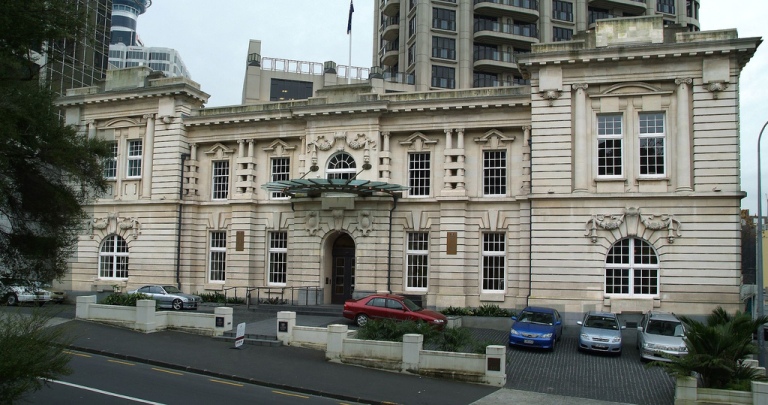
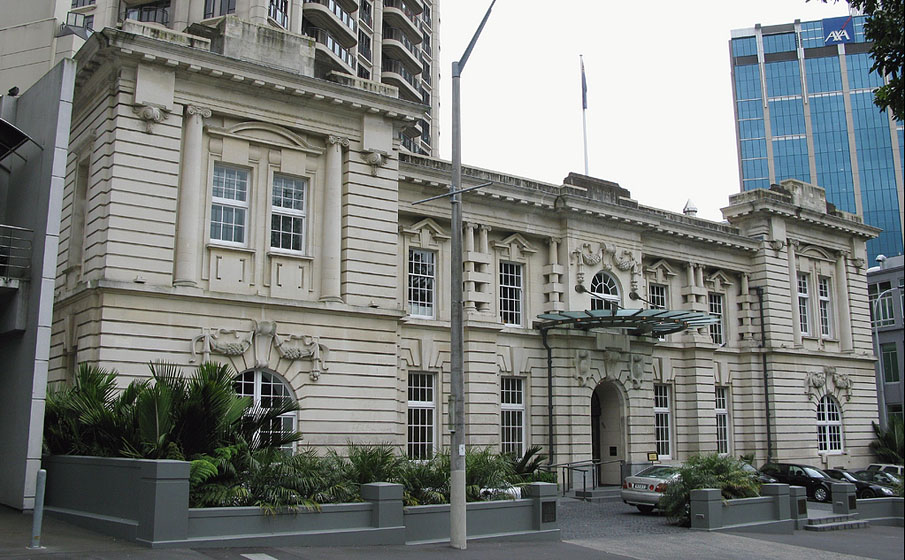
This historic place was registered under the Historic Places Act 1980. This report includes the text from the original Building Classification Committee report considered by the NZHPT Board at the time of registration. ARCHITECTURAL QUALITY: In the late nineteenth and early twentieth centuries (when British Imperial consciousness was at its zenith) architects in Britain sought to develop an architectural style expressive of Britain's position at the centre of a large Empire. By the turn of the century a free interpretation of the work of British architects of the late seventeenth and early eighteenth centuries (such as Sir Christopher Wren) was widely accepted, because of its exuberance and distinctively British character, as the architectural expression of British imperialism. Architects throughout the British Empire worked in the style. John Campbell was one of them and the Auckland District Court building designed under his aegis is a fine example of the style. Like other Edwardian Baroque designers, Campbell and Paton combined Baroque elements in a very free manner. The elements which they used are ultimately inspired by seventeenth and eighteenth century Baroque architecture of England. The heavy striation of the ground floor of the facade of the District Court building is, for example, characteristic of Vanbrugh's Baroque buildings such as Blenheim Palace (cI705). Similarly, the colour of the Oamaru stone facing of the building invites comparison with that of the Portland stone favoured in England for the construction of Baroque buildings. Campbell and Paton use such elements, however, in an unrestrained and playful manner. The proportions of the building as defined on its main facade with a very high ground floor and short first floor does not adhere to the tenets of classical architectural proportion. Examples of such Baroque playfulness in the handling of classical architectural elements are becoming increasingly rare. The building is representative of a very productive period in the history of the architectural division of the Public Works Department. It is one of many state buildings designed during a boom in public works initiated by the Liberal Government but brought to an end by the First World War. The District Court building (and the Auckland Post Office, 1908-12) are, however, distinctive. Their Oamaru stone facades contrast with the striped brickwork of Government buildings erected under Campbell's aegis in Wellington such as the Public Trust Office. J J and E J Clark's prizewinning design for the Auckland Town Hall may have set the precedent for the use of Oamaru stone in the construction of Baroque civic buildings in Auckland. Architecturally significant features remain in the interior of the District Court building. Some of the original detailing is still intact. The Australian Conservation Architect, Clive Lucas, has described the building as a 'Wonderful example of Edwardian architecture in the manner of Sir Edwin Lutyens who no doubt inspired the design.' He went on to say that work of this quality is rare in Australasia and he could not think of an example as fine. (Clive Lucas to Dinah Holman, 8 September 1988) TOWNSCAPE/LANDMARK SIGNIFICANCE: The Courthouse defines a visual boundary between Albert Park and the commercial Queen Street Valley. The scale of the buildings and the narrow streets and lanes enhance the predominantly pedestrian nature of the distinct enclave around High Street. Various views of the building are afforded by the curve of Kitchener Street. The building also faces open space and good medium and distance views can be seen from directly in front of the building. The construction of the building on Kitchener Street conforms to Felton Mathew's original plan for the City of Auckland. In that plan all the major civic buildings were to be constructed along Victoria and Waterloo Quadrants. The siting and orientation of the Supreme (or High) Court and the District (or Magistrates) Court are mirror images about a central axis defined by Princes Street.
Why is this place significant?
Historic Significance
Historical Significance or Value This historic place was registered under the Historic Places Act 1980. This report includes the text from the original Building Classification Committee report considered by the NZHPT Board at the time of registration. The number of crimes heard by Auckland Magistrates doubled between 1900 and 1910. In 1907 the Public Works Department acquired land for a Court to be constructed facing the Quadrant alongside an existing Court building. The earlier building was then used as Land and Deeds offices. It is at this lowest level of the judiciary that people generally come into contact with the Courts. The District or Magistrates Court building was, for 75 years, the arena for this interchange and consequently played an important role in Auckland's social history. The 1978 Royal Commission on the Courts recommended that the Magistrates Courts be renamed District Courts and be given a wider jurisdiction. This came into effect in 1980 and the term Magistrate is no longer in use. The courtrooms of the Magistrates (later the District) Court have long been insufficient for the volume of cases heard in Auckland and in 1988 the District Court moved to new premises.
Physical Significance
This historic place was registered under the Historic Places Act 1980. This report includes the text from the original Building Classification Committee report considered by the NZHPT Board at the time of registration. ARCHITECTURAL QUALITY: In the late nineteenth and early twentieth centuries (when British Imperial consciousness was at its zenith) architects in Britain sought to develop an architectural style expressive of Britain's position at the centre of a large Empire. By the turn of the century a free interpretation of the work of British architects of the late seventeenth and early eighteenth centuries (such as Sir Christopher Wren) was widely accepted, because of its exuberance and distinctively British character, as the architectural expression of British imperialism. Architects throughout the British Empire worked in the style. John Campbell was one of them and the Auckland District Court building designed under his aegis is a fine example of the style. Like other Edwardian Baroque designers, Campbell and Paton combined Baroque elements in a very free manner. The elements which they used are ultimately inspired by seventeenth and eighteenth century Baroque architecture of England. The heavy striation of the ground floor of the facade of the District Court building is, for example, characteristic of Vanbrugh's Baroque buildings such as Blenheim Palace (cI705). Similarly, the colour of the Oamaru stone facing of the building invites comparison with that of the Portland stone favoured in England for the construction of Baroque buildings. Campbell and Paton use such elements, however, in an unrestrained and playful manner. The proportions of the building as defined on its main facade with a very high ground floor and short first floor does not adhere to the tenets of classical architectural proportion. Examples of such Baroque playfulness in the handling of classical architectural elements are becoming increasingly rare. The building is representative of a very productive period in the history of the architectural division of the Public Works Department. It is one of many state buildings designed during a boom in public works initiated by the Liberal Government but brought to an end by the First World War. The District Court building (and the Auckland Post Office, 1908-12) are, however, distinctive. Their Oamaru stone facades contrast with the striped brickwork of Government buildings erected under Campbell's aegis in Wellington such as the Public Trust Office. J J and E J Clark's prizewinning design for the Auckland Town Hall may have set the precedent for the use of Oamaru stone in the construction of Baroque civic buildings in Auckland. Architecturally significant features remain in the interior of the District Court building. Some of the original detailing is still intact. The Australian Conservation Architect, Clive Lucas, has described the building as a 'Wonderful example of Edwardian architecture in the manner of Sir Edwin Lutyens who no doubt inspired the design.' He went on to say that work of this quality is rare in Australasia and he could not think of an example as fine. (Clive Lucas to Dinah Holman, 8 September 1988) TOWNSCAPE/LANDMARK SIGNIFICANCE: The Courthouse defines a visual boundary between Albert Park and the commercial Queen Street Valley. The scale of the buildings and the narrow streets and lanes enhance the predominantly pedestrian nature of the distinct enclave around High Street. Various views of the building are afforded by the curve of Kitchener Street. The building also faces open space and good medium and distance views can be seen from directly in front of the building. The construction of the building on Kitchener Street conforms to Felton Mathew's original plan for the City of Auckland. In that plan all the major civic buildings were to be constructed along Victoria and Waterloo Quadrants. The siting and orientation of the Supreme (or High) Court and the District (or Magistrates) Court are mirror images about a central axis defined by Princes Street.
Construction Professional
Name
Paton, Claude
Type
Architect
Biography
Claude Paton (1881 -1953) was born in Scotland and arrived in New Zealand in 1904. He received some architectural or draughting training in Glasgow which enabled him to gain employment with the Public Works Department in 1906 as an architectural draughtsman. Although Paton was never given the title of architect he was an influential force in the Department. He carried particular weight during the last decade of John Campbell's tenure as Government Architect; both were committed to the Edwardian Baroque style. Paton retired from the Public Works Department as a senior draughtsman in 1946.
Construction Details
Start Year
1910
Type
Designed
Start Year
1911
Type
Other
Description
Tendered November 1911
Start Year
1912
Finish Year
1913
Type
Original Construction
Construction Materials
The basecourse of the courthouse is constructed of Coromandel Tonalite and the three main facades are faced with Oamaru limestone. (See Hayward, 1987, p.44)
Construction Professional
Name
Paton, Claude
Type
Architect
Biography
Claude Paton (1881 -1953) was born in Scotland and arrived in New Zealand in 1904. He received some architectural or draughting training in Glasgow which enabled him to gain employment with the Public Works Department in 1906 as an architectural draughtsman. Although Paton was never given the title of architect he was an influential force in the Department. He carried particular weight during the last decade of John Campbell's tenure as Government Architect; both were committed to the Edwardian Baroque style. Paton retired from the Public Works Department as a senior draughtsman in 1946.
Construction Details
Start Year
1910
Type
Designed
Start Year
1911
Type
Other
Description
Tendered November 1911
Start Year
1912
Finish Year
1913
Type
Original Construction
Construction Materials
The basecourse of the courthouse is constructed of Coromandel Tonalite and the three main facades are faced with Oamaru limestone. (See Hayward, 1987, p.44)
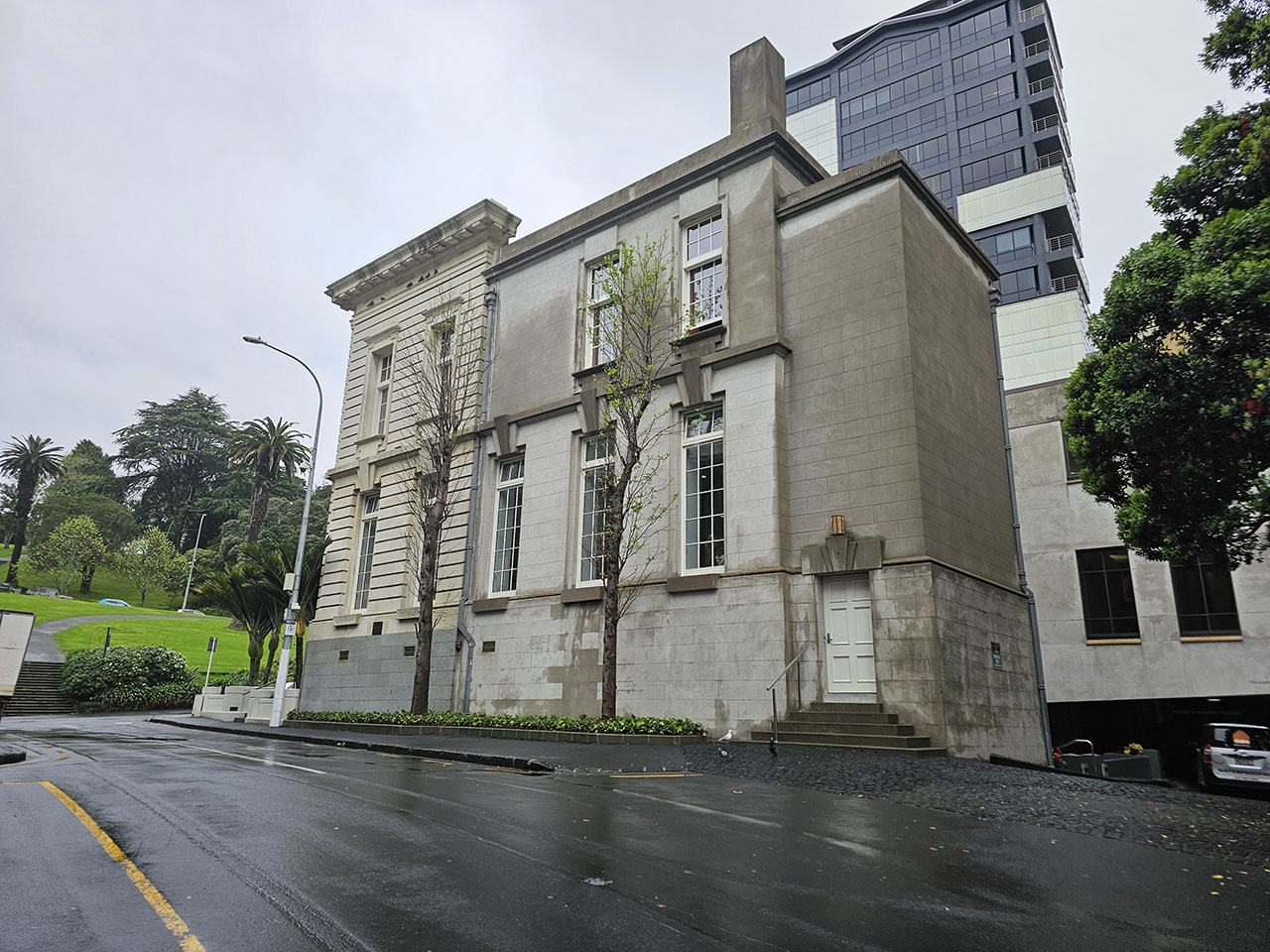
This historic place was registered under the Historic Places Act 1980. This report includes the text from the original Building Classification Committee report considered by the NZHPT Board at the time of registration. ARCHITECTURAL DESCRIPTION/STYLE: The building has an 'H' plan. Waiting rooms, cells and offices were located between the two end pavilions. The main offices were situated in the side pavilions. The building is two stories in height and the main facade has a rusticated ground floor. Some parts of the first floor of the main facade are also rusticated. The pavilions on that facade have some arched windows with oversize scroll keystones. The arch in the central entrance position is flanked by cartouches whereas those in the end pavilions and the centre of the first floor are enhanced with festoons. Windows on the main facade of the end pavilions are framed by Ionic columns and those in between are set between rusticated paired columns supported by piers. The blocks of some of the rusticated columns are a continuation of alternate courses of stone from the pavilions. A string course, which forms the sills of the first floor windows and a base for the columns, articulates the two floors on the main facade. The side and end pavilions have stepped parapets and a tablet motif, supported by decorative brackets, is incorporated over the facsia. The style of the building is Edwardian Baroque. MODIFICATIONS: The courthouse is now connected by a passageway to the group of buildings behind it. These buildings stretch through to High Street. The main facade is virtually unaltered. The layout and partitions within the building have been altered slightly and in some of the spaces suspended ceilings and air conditioning have been added. Sprinklers and modern light fittings have also been added.
This historic place was registered under the Historic Places Act 1980. This report includes the text from the original Building Classification Committee report considered by the NZHPT Board at the time of registration. ARCHITECTURAL DESCRIPTION/STYLE: The building has an 'H' plan. Waiting rooms, cells and offices were located between the two end pavilions. The main offices were situated in the side pavilions. The building is two stories in height and the main facade has a rusticated ground floor. Some parts of the first floor of the main facade are also rusticated. The pavilions on that facade have some arched windows with oversize scroll keystones. The arch in the central entrance position is flanked by cartouches whereas those in the end pavilions and the centre of the first floor are enhanced with festoons. Windows on the main facade of the end pavilions are framed by Ionic columns and those in between are set between rusticated paired columns supported by piers. The blocks of some of the rusticated columns are a continuation of alternate courses of stone from the pavilions. A string course, which forms the sills of the first floor windows and a base for the columns, articulates the two floors on the main facade. The side and end pavilions have stepped parapets and a tablet motif, supported by decorative brackets, is incorporated over the facsia. The style of the building is Edwardian Baroque. MODIFICATIONS: The courthouse is now connected by a passageway to the group of buildings behind it. These buildings stretch through to High Street. The main facade is virtually unaltered. The layout and partitions within the building have been altered slightly and in some of the spaces suspended ceilings and air conditioning have been added. Sprinklers and modern light fittings have also been added.
Historical and Associated Iwi / Hapū / Whānau
Information Sources
Appendices to the Journals of the House of Representatives (AJHR)
Appendices to the Journals of the House of Representatives
Auckland Star
Auckland Star
Auckland Weekly News
Auckland Weekly News
Hayward, 1987
Bruce W. Hayward, 'Granite and Marble: a guide to building stones in New Zealand', Geological Society of New Zealand Guidebook, No.8
Metro
Metro
New Zealand Herald
New Zealand Herald, 12 July 1932, p. 6; 28 September 1933, p. 6.
Richardson, 1988
Peter Richardson, 'An Architecture of Empire: The Government Buildings of John Campbell in New Zealand', MA Thesis, University of Canterbury, 1988
Barr, 1922
J Barr, The City of Auckland 1840-1920, Whitcombe, 1922
Fraser, 1986
Bryce Fraser (editor), The New Zealand Book of Events, Reed Methuen, Auckland,1986
Hight, 1914
James Hight and H Bamford, The Constitutional History and Law of NZ Whitcombe and Tombs, 1914
Mulholland, 1979
Raymond Douglas Mulholland, Introduction to the NZ Legal System, Butterworths, Wellington (1st ed 1972; 2nd ed 1976; 3rd 1979)
Other Information
A copy of this report is available from the NZHPT Northern Region office Please note that entry on the New Zealand Heritage List/Rarangi Korero identifies only the heritage values of the property concerned, and should not be construed as advice on the state of the property, or as a comment of its soundness or safety, including in regard to earthquake risk, safety in the event of fire, or insanitary conditions.
Historical and Associated Iwi / Hapū / Whānau
Information Sources
Appendices to the Journals of the House of Representatives (AJHR)
Appendices to the Journals of the House of Representatives
Auckland Star
Auckland Star
Auckland Weekly News
Auckland Weekly News
Hayward, 1987
Bruce W. Hayward, 'Granite and Marble: a guide to building stones in New Zealand', Geological Society of New Zealand Guidebook, No.8
Metro
Metro
New Zealand Herald
New Zealand Herald, 12 July 1932, p. 6; 28 September 1933, p. 6.
Richardson, 1988
Peter Richardson, 'An Architecture of Empire: The Government Buildings of John Campbell in New Zealand', MA Thesis, University of Canterbury, 1988
Barr, 1922
J Barr, The City of Auckland 1840-1920, Whitcombe, 1922
Fraser, 1986
Bryce Fraser (editor), The New Zealand Book of Events, Reed Methuen, Auckland,1986
Hight, 1914
James Hight and H Bamford, The Constitutional History and Law of NZ Whitcombe and Tombs, 1914
Mulholland, 1979
Raymond Douglas Mulholland, Introduction to the NZ Legal System, Butterworths, Wellington (1st ed 1972; 2nd ed 1976; 3rd 1979)
Other Information
A copy of this report is available from the NZHPT Northern Region office Please note that entry on the New Zealand Heritage List/Rarangi Korero identifies only the heritage values of the property concerned, and should not be construed as advice on the state of the property, or as a comment of its soundness or safety, including in regard to earthquake risk, safety in the event of fire, or insanitary conditions.
Former Usages
General Usage: Law Enforcement
Specific Usage: Courthouse
Former Usages
General Usage: Law Enforcement
Specific Usage: Courthouse
Location
Sign up to hear more
Get the latest heritage news, features and events delivered
straight to your inbox.
