

In the mid nineteenth century, Okarito was a thriving port and supply centre as a result of intense but short-lived gold activity in the area. At its height, Okarito had a population of 5,000. A school, 150 square feet (13 square metres) was opened near the wharf at Okarito on 21 May 1867, with J H La Motte Ralfe as First Master. From 1879 to 1900 the teacher was Mr J O Wilson, and during this time there were frequent issues with the building flooding. In 1901 it was determined that the school should be shifted to a drier, vacant, site owned by the Council and tenders were put out for the removal and re-erection of the school. Mr B Dickens won the contract and the school was ‘practically rebuilt’ on its new site. Anna Patrick (Dolly) was the teacher at this time. At the time of its shift and rebuild, the school building was described as ‘one of the oldest buildings on the West Coast’.
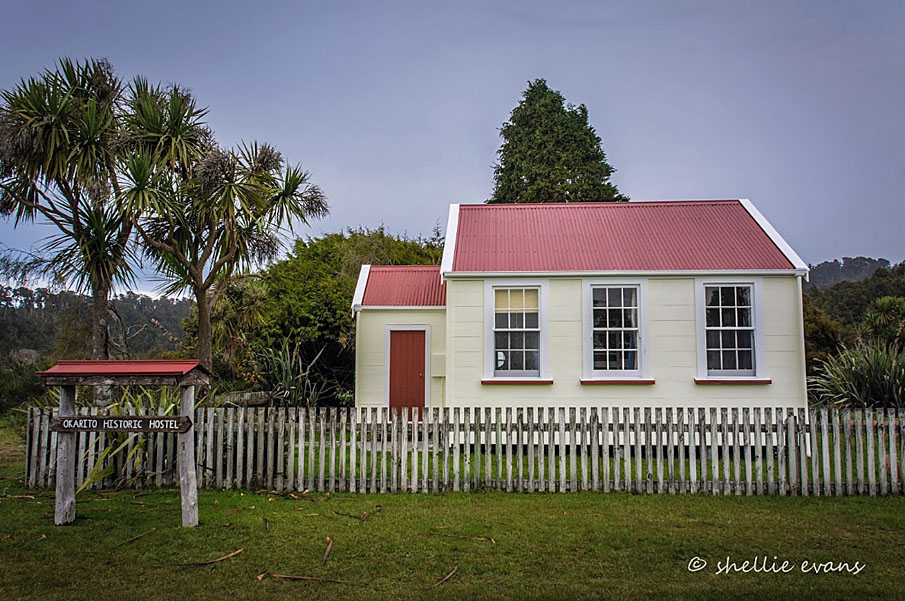
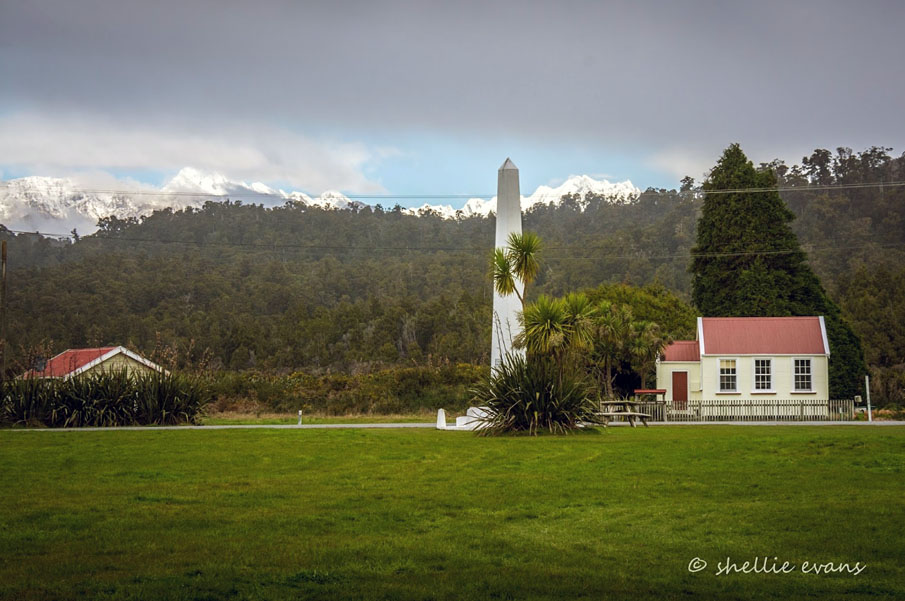
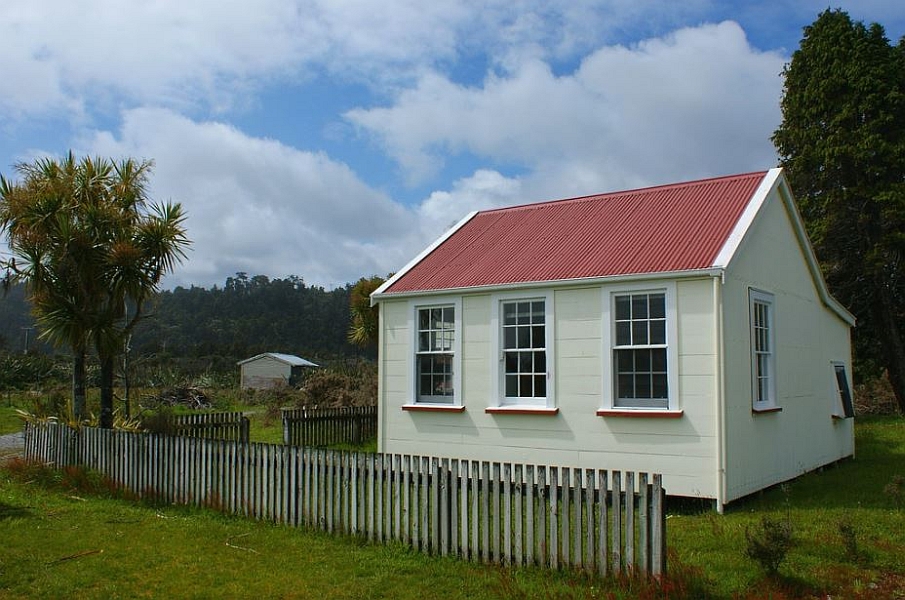
Okarito School (Former) is a single storeyed timber building, rectangular in plan with an entrance porch on the north-east side and an adjoining lean-to and a shed and toilet extension to the south rear. The exterior walls comprise weatherboards of various types and corrugated steel cladding. There is a set of three double-hung sash windows along the north elevation and one each to the east and west. The roof is corrugated steel. The interior comprises two main rooms. Both the walls and ceiling are lined with tongue and groove panelling.
Some time before 1926 a porch with small bell tower was added to the east elevation. The school continued to operate, though there were several breaks in continuance, one in 1923-4 and another in 1927. Okarito’s population dwindled through the 1920s and 1930s and the school eventually closed in 1946. In 1958 the site was put into reserve status but the building was in a dilapidated state. In around 1960 there were only four permanent residents in Okarito. With the help of the Greymouth branch of the Youth Hostel Association (YHA), a major restoration project was undertaken and the building was opened as a YHA shelter in 1960. Between 1960 and 1990, the shelter was the only place for travellers to spend a night in Okarito. In 1990 the building’s structural frame and foundations, exterior cladding and roof were largely rebuilt. Modern kitchen facilities were installed and rear lean-to with shed and outside toilet was added. Between 1990 and 2010 the Okarito Community Association ran the Okarito School House as accommodation. It remains popular as bookable bunk accommodation through the Department of Conservation.
List Entry Information
Status
Listed
List Entry Status
Historic Place Category 2
Access
Private/No Public Access
List Number
5047
Date Entered
21st September 1989
Date of Effect
21st September 1989
City/District Council
Westland District
Region
West Coast Region
Extent of List Entry
Extent includes the land described as Res 157, Okarito School House (NZ Gazette 1990 p. 2079), Westland Land District and the building known as Okarito School (Former) thereon.
Legal description
Res 157, Okarito School House (NZ Gazette 1990 p. 2079), Westland Land District
Status
Listed
List Entry Status
Historic Place Category 2
Access
Private/No Public Access
List Number
5047
Date Entered
21st September 1989
Date of Effect
21st September 1989
City/District Council
Westland District
Region
West Coast Region
Extent of List Entry
Extent includes the land described as Res 157, Okarito School House (NZ Gazette 1990 p. 2079), Westland Land District and the building known as Okarito School (Former) thereon.
Legal description
Res 157, Okarito School House (NZ Gazette 1990 p. 2079), Westland Land District
Construction Details
Type
Addition
Description
Covered entrance porch added on east elevation
Period
Prior to 1926
Start Year
1990
Type
Restoration
Description
Exterior restoration/partial replacement of materials, addition of rear lean-to
Start Year
1901
Type
Original Construction
Description
Present building constructed, partly using materials from an 1860s school house.
Construction Details
Type
Addition
Description
Covered entrance porch added on east elevation
Period
Prior to 1926
Start Year
1990
Type
Restoration
Description
Exterior restoration/partial replacement of materials, addition of rear lean-to
Start Year
1901
Type
Original Construction
Description
Present building constructed, partly using materials from an 1860s school house.
Historical and Associated Iwi / Hapū / Whānau
Completion Date
8th April 2015
Report Written By
Robyn Burgess
Other Information
This place was identified as significant under previous legislation with different information requirements. It remains significant under the current legislation. There is opportunity under our legislation and policies to add to this information. Further information about this place may be available from the Southern Regional Office of Heritage New Zealand Pouhere Taonga. Please note that entry on the New Zealand Heritage List/Rarangi Korero identifies only the heritage values of the property concerned, and should not be construed as advice on the state of the property, or as a comment of its soundness or safety, including in regard to earthquake risk, safety in the event of fire, or insanitary conditions. A fully referenced upgrade report is available on request from the Southern Regional Office of Heritage New Zealand
Historical and Associated Iwi / Hapū / Whānau
Completion Date
8th April 2015
Report Written By
Robyn Burgess
Other Information
This place was identified as significant under previous legislation with different information requirements. It remains significant under the current legislation. There is opportunity under our legislation and policies to add to this information. Further information about this place may be available from the Southern Regional Office of Heritage New Zealand Pouhere Taonga. Please note that entry on the New Zealand Heritage List/Rarangi Korero identifies only the heritage values of the property concerned, and should not be construed as advice on the state of the property, or as a comment of its soundness or safety, including in regard to earthquake risk, safety in the event of fire, or insanitary conditions. A fully referenced upgrade report is available on request from the Southern Regional Office of Heritage New Zealand
Current Usages
Uses: Accommodation
Specific Usage: Hut/shack
Former Usages
General Usage: Accommodation
Specific Usage: Backpackers/ Youth Hostel
General Usage: Education
Specific Usage: School
Current Usages
Uses: Accommodation
Specific Usage: Hut/shack
Former Usages
General Usage: Accommodation
Specific Usage: Backpackers/ Youth Hostel
General Usage: Education
Specific Usage: School
Location
Sign up to hear more
Get the latest heritage news, features and events delivered
straight to your inbox.
