

The Bank of New Zealand established an agency in Hokitika in 1865 in response to the soaring gold production in the area. By the end of 1865 three banks were operating in Hokitika – the Union Bank, Bank of New South Wales and the Bank of New Zealand. Actual ownership of the corner site on Revell and Camp Streets was not granted to the Bank of New Zealand until 25 June 1869, though it had an elaborate two storeyed bank building on this site since 1866. This first building was destroyed by fire in 1873. A call for tenders to build a new bank were advertised by Christchurch architect, W A Armson, in April 1874 and by November of that year the West Coast Times reported that the new bank building was near completion. A plan of the site dated 1902 shows that the rectangular bank building had, on the ground floor, a public office, gold office, manager’s room, strong room, sitting room and lavatory, with living accommodation on the first floor. In 1930 plans for ‘new premises’ for the bank were drawn up by Wellington architects Crichton McKay & Haughton and appear to incorporate elements of the existing building, including the strong room.
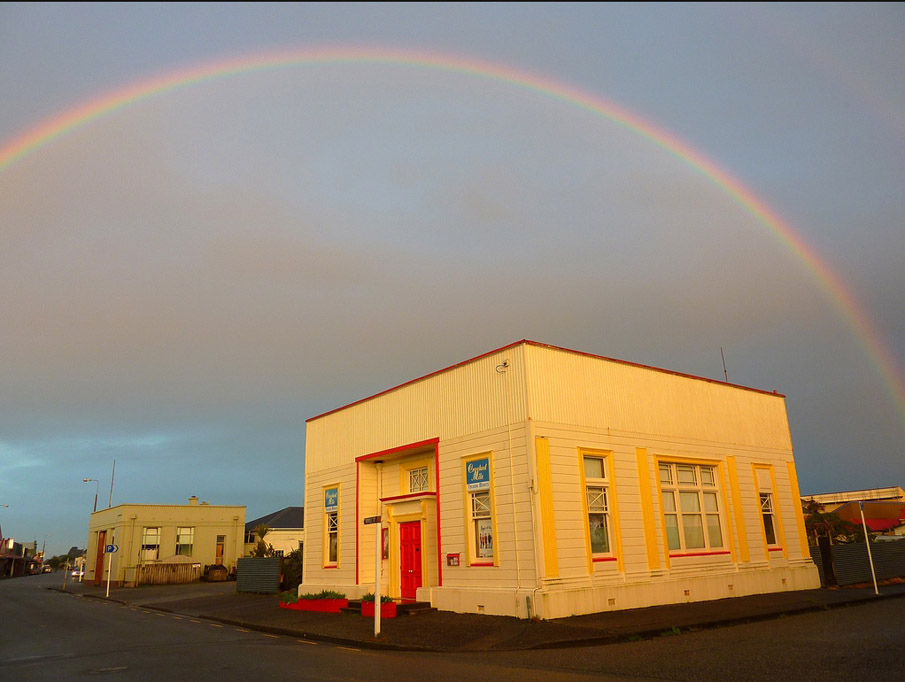
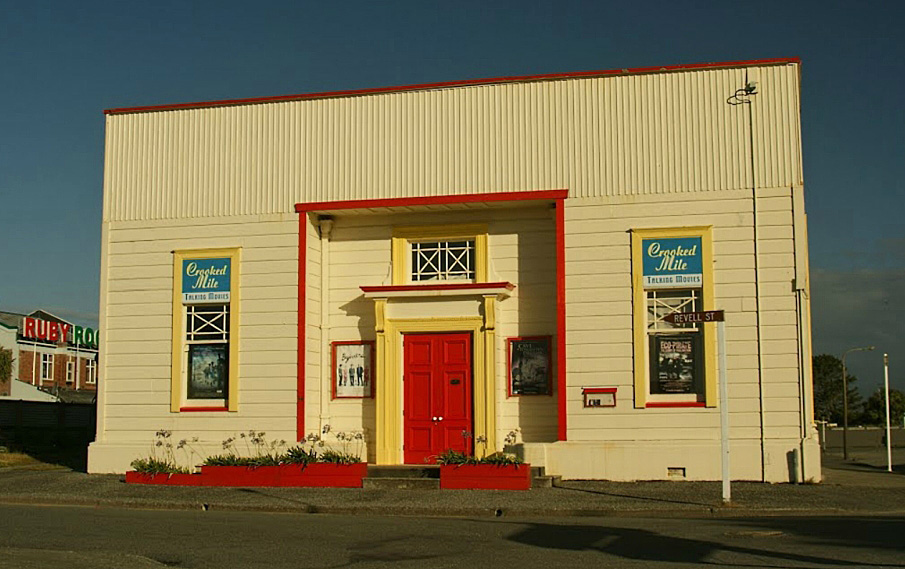
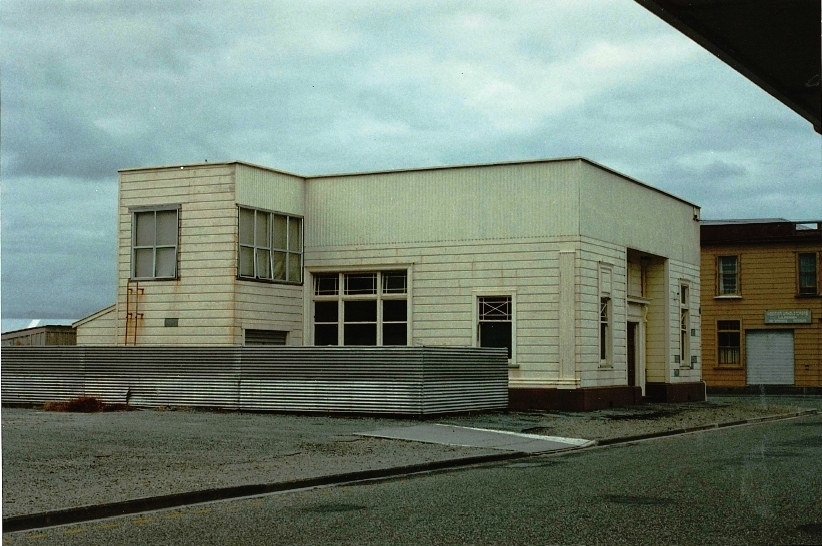
The timber weatherboard building incorporates classical elements and has a tall plain metal parapet concealing the corrugated steel roof beyond. The main, front, part of the building is single storeyed while towards the rear it is two storeys. The main entrance, flanked by windows, is on the west elevation fronting Revell Street, and contains a portico with a pair of timber doors. Windows are sash and casement, the upper portion of some containing the original criss-cross window decoration as shown in the architectural drawings of 1930. Glazing on much of the fenestration retains the wording ‘Bank of New Zealand’. At the rear (east) is a small cluster of low structures, constructed largely of weatherboard timber.
Alterations and additions were carried out in the 1950s. This included the removal of pilasters on the exterior of the building, some alteration of the interior layout and the addition of a bicycle shed at the north-east corner. The two storeyed wing at the north-west part of the building is also likely to date from this period. In 1966 the property changed to private ownership. Its accommodation function remained and part was later converted to an art house cinema, though rising insurance costs meant that the cinema closed in 2012. The building remains in use as a private house.
List Entry Information
Status
Listed
List Entry Status
Historic Place Category 2
Access
Private/No Public Access
List Number
5055
Date Entered
21st September 1989
Date of Effect
21st September 1989
City/District Council
Westland District
Region
West Coast Region
Extent of List Entry
Extent includes the land described as Sec 1705 Town of Hokitika (RT WS3A/1078), Westland Land District and the building known as Bank of New Zealand (Former) thereon.
Legal description
Sec 1705 Town of Hokitika (RT WS3A/1078), Westland Land District
Status
Listed
List Entry Status
Historic Place Category 2
Access
Private/No Public Access
List Number
5055
Date Entered
21st September 1989
Date of Effect
21st September 1989
City/District Council
Westland District
Region
West Coast Region
Extent of List Entry
Extent includes the land described as Sec 1705 Town of Hokitika (RT WS3A/1078), Westland Land District and the building known as Bank of New Zealand (Former) thereon.
Legal description
Sec 1705 Town of Hokitika (RT WS3A/1078), Westland Land District
Construction Details
Start Year
1931
Type
Original Construction
Construction Details
Start Year
1931
Type
Original Construction
Historical and Associated Iwi / Hapū / Whānau
Completion Date
30th January 2015
Report Written By
Robyn Burgess
Other Information
This place was identified as significant under previous legislation with different information requirements. It remains significant under the current legislation. There is opportunity under our legislation and policies to add to this information. Further information about this place may be available from the Southern Regional Office of Heritage New Zealand Pouhere Taonga. A fully referenced upgrade report is available on request from Southern Regional Office of Heritage New Zealand Please note that entry on the New Zealand Heritage List/Rarangi Korero identifies only the heritage values of the property concerned, and should not be construed as advice on the state of the property, or as a comment of its soundness or safety, including in regard to earthquake risk, safety in the event of fire, or insanitary conditions.
Historical and Associated Iwi / Hapū / Whānau
Completion Date
30th January 2015
Report Written By
Robyn Burgess
Other Information
This place was identified as significant under previous legislation with different information requirements. It remains significant under the current legislation. There is opportunity under our legislation and policies to add to this information. Further information about this place may be available from the Southern Regional Office of Heritage New Zealand Pouhere Taonga. A fully referenced upgrade report is available on request from Southern Regional Office of Heritage New Zealand Please note that entry on the New Zealand Heritage List/Rarangi Korero identifies only the heritage values of the property concerned, and should not be construed as advice on the state of the property, or as a comment of its soundness or safety, including in regard to earthquake risk, safety in the event of fire, or insanitary conditions.
Current Usages
Uses: Civic Facilities
Specific Usage: Residential Buildings - other
Former Usages
General Usage: Civic Facilities
Specific Usage: Cinema/movie theatre
General Usage: Finance
Specific Usage: Bank
Current Usages
Uses: Civic Facilities
Specific Usage: Residential Buildings - other
Former Usages
General Usage: Civic Facilities
Specific Usage: Cinema/movie theatre
General Usage: Finance
Specific Usage: Bank
Location
Sign up to hear more
Get the latest heritage news, features and events delivered
straight to your inbox.
