DonateSupporterVisit Heritage
  • Tūrangawaewae
    Places
  • Tira Māori
    Māori Heritage
  • Poutairangahia
    Archaeology
  • Rauemi
    Resources
  • Mō Tātou
    About Us
  • New Zealand Heritage List
  • Nominate and submit
  • Explore the List
  • National Historic Landmarks
  • Plaques
  • Rainbow List Project
  • Lost heritage
  • Visit Heritage
  • Our properties
  • Turnbull House Project
  • Collections
  • Shop
  • Tohu Whenua
  • Tira Māori
  • Conserving Māori heritage
  • Marae built heritage
  • Māori heritage on the List
  • Hinemihi—Te Hokinga Mai
  • What is archaeology?
  • Is there a site on my property?
  • What are my legal requirements?
  • Affecting an archaeological site
  • Declaring an archaeological site
  • Archaeology FAQs
  • Archaeology Digital Library
  • Archaeology guidelines and templates
  • Resources
  • Funding
  • Publications
  • Sustainable management guides
  • Disaster recovery
  • Podcasts & digital resources
  • Education Hub
  • Conservation plans
  • About
  • Board
  • Māori Heritage Council
  • Senior Staff
  • Offices
  • Contact us
  • Careers
  • Covenants
  • Fast-track
  • Corporate documents
  • Currently consulting on
  • Our submissions
  • News
Quick links
Rārangi Kōrero | The List
Explore the List
National Historic Landmarks
Ngā Manawhenua o Aotearoa me ōna Kōrero Tūturu
Quick links
Tapuwae
A Vision for Places of Māori Heritage
Funding for Māori Heritage
Resources
Quick links
Archaeological Authority Portal
Applying for an archaeological authority
Archaeology FAQs
Browse the most frequently asked questions about archaeological authorities and the archaeological process.
Quick links
Quick links
Contact us
Offices
DonateSupporterVisit Heritage
  • Tūrangawaewae
    Places
  • Tira Māori
    Māori Heritage
  • Poutairangahia
    Archaeology
  • Rauemi
    Resources
  • Mō Tātou
    About Us
  • New Zealand Heritage List
  • Nominate and submit
  • Explore the List
  • National Historic Landmarks
  • Plaques
  • Rainbow List Project
  • Lost heritage
  • Visit Heritage
  • Our properties
  • Turnbull House Project
  • Collections
  • Shop
  • Tohu Whenua
  • Tira Māori
  • Conserving Māori heritage
  • Marae built heritage
  • Māori heritage on the List
  • Hinemihi—Te Hokinga Mai
  • What is archaeology?
  • Is there a site on my property?
  • What are my legal requirements?
  • Affecting an archaeological site
  • Declaring an archaeological site
  • Archaeology FAQs
  • Archaeology Digital Library
  • Archaeology guidelines and templates
  • Resources
  • Funding
  • Publications
  • Sustainable management guides
  • Disaster recovery
  • Podcasts & digital resources
  • Education Hub
  • Conservation plans
  • About
  • Board
  • Māori Heritage Council
  • Senior Staff
  • Offices
  • Contact us
  • Careers
  • Covenants
  • Fast-track
  • Corporate documents
  • Currently consulting on
  • Our submissions
  • News
Quick links
Rārangi Kōrero | The List
Explore the List
National Historic Landmarks
Ngā Manawhenua o Aotearoa me ōna Kōrero Tūturu
Quick links
Tapuwae
A Vision for Places of Māori Heritage
Funding for Māori Heritage
Resources
Quick links
Archaeological Authority Portal
Applying for an archaeological authority
Archaeology FAQs
Browse the most frequently asked questions about archaeological authorities and the archaeological process.
Quick links
Quick links
Contact us
Offices
  • Places
  • Nominate and submit
  • National Historic Landmarks
  • Places
  • Nominate and submit
  • National Historic Landmarks
  • Tira Māori
  • Conserving Māori heritage
  • Marae built heritage
  • Tira Māori
  • Conserving Māori heritage
  • Marae built heritage
  • Archaeological authorities
  • Archaeology Digital Library
  • Archaeological authorities
  • Archaeology Digital Library
  • All resources
  • Publications
  • Funding
  • All resources
  • Publications
  • Funding
  • FAQs
  • FAQs
Follow us on:
Places
  • Places
  • Nominate and submit
  • National Historic Landmarks
Tira Māori
  • Tira Māori
  • Conserving Māori heritage
  • Marae built heritage
Archaeology
  • Archaeological authorities
  • Archaeology Digital Library
Resources
  • All resources
  • Publications
  • Funding
FAQs
  • FAQs
Follow us on
HomePrivacyTerms and conditionsAbout this site
© Heritage New Zealand Pouhere Taonga 2026.
 
Bank of New South Wales (Former)

32-34 Revell Street and Camp Street, HOKITIKA

Private

Historic Place Category 2

List No. 5056

Quick links:
List GalleryLocationDetails
The Bank of New South Wales (Former), constructed in 1905 in a prominent position on the corner of Revell and Camp Streets, is the oldest bank building still standing in Hokitika and tells the story of the integral role that banks played in the town. It represents a continuous stream of history back to when the agency set up their bank on this site in the 1860s to provide gold buying and assaying services.

Bank of New South Wales agent, George Preshaw, arrived in Hokitika in November 1864. Temporary quarters for the bank were opened in mid 1865, comprising a corrugated iron structure divided into a bank office and a sleeping compartment, where Preshaw and three others slept on the floor. As well as the Bank of New South Wales, two others were operating in Hokitika by the end of 1865 – the Union Bank and the Bank of New Zealand - all were three handling numerous transactions relating to the soaring gold production in the area. In early 1866, a more commodious bank chamber and manager’s residence was erected on the corner of Revell and Camp Streets for the Bank of New South Wales. Described at the time as being a most handsome and imposing structure, the building was designed by architect C G Smith and was the first of the permanent bank buildings to be completed in Hokitika. In 1904 architects Crichton and McKay designed a two-storeyed Bank of New South Wales building to replace the 1866 building on the same site.

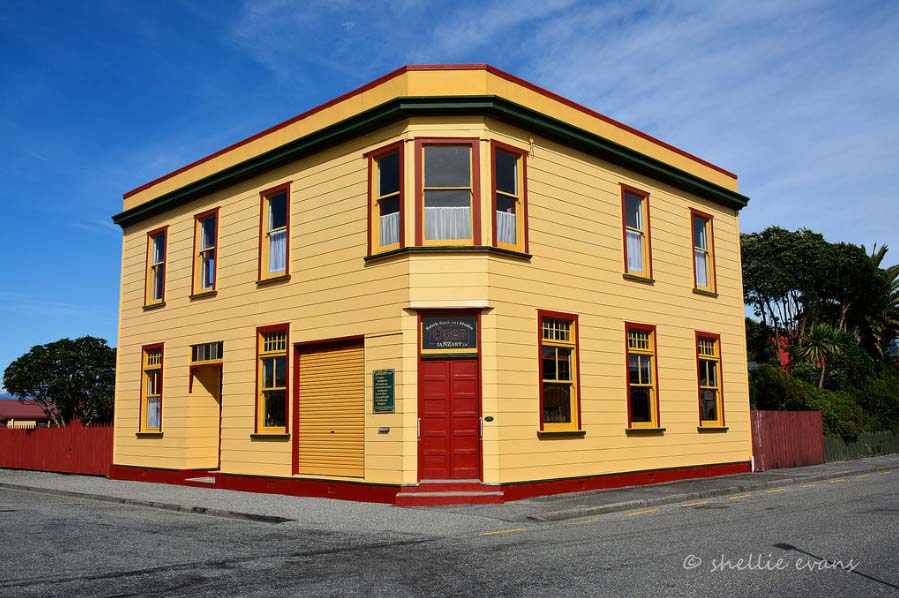
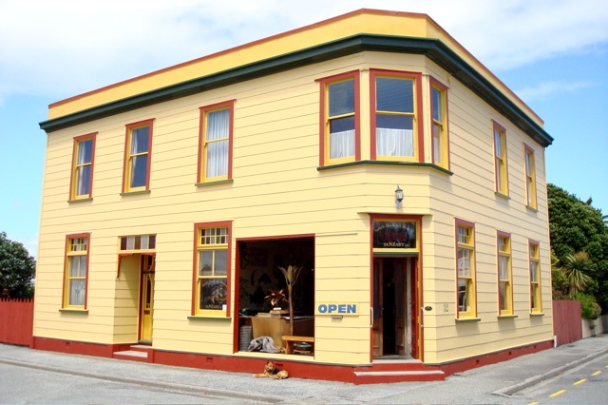
The building is two-storeyed and is largely constructed of timber, with a weatherboard exterior, metal parapet and corrugated iron roof. It has two main facades, one fronting Camp Street (north) with sash windows and, on the ground floor, a doorway leading to what would have been the manager’s residence. The north-west corner of the building contains what was the main entrance and on the Revell Street (west) front are further sash windows. Described at the time of construction in 1905 as representing progress in the town, the exterior of the building was considered to appear more like a handsome residence than a commercial institution. It contained a banking chamber, a manager’s office, strong room and a residence of eight rooms.

In 1959 the Bank of New South Wales (now Westpac) vacated the building when they moved to more modern premises at 97 Revell Street. Shortly afterwards, in 1961, Ivan Fern moved into the building and proceeded to operate his upholstery business from there for the next 41 years. South Bank Art Studios now operate from the building and its owners continue the tradition of living on site. Some changes have been made to the building over time, including simplification of the parapet and the removal of many of the features associated with the building’s banking days.
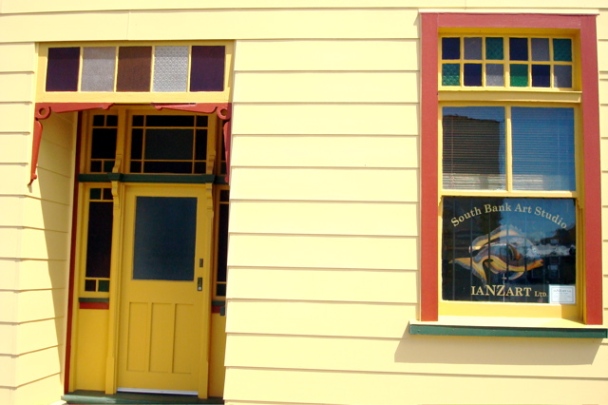
Bank of New South Wales (Former), Hokitika. Photo Competition Entrant 2025 | Tracy Griffith | 13/02/2025 | Tracy Griffith
Bank of New South Wales (Former), Hokitika. Image courtesy of www.flickr.com | Shellie Evans - flyingkiwigirl | 15/04/2015 | Shellie Evans
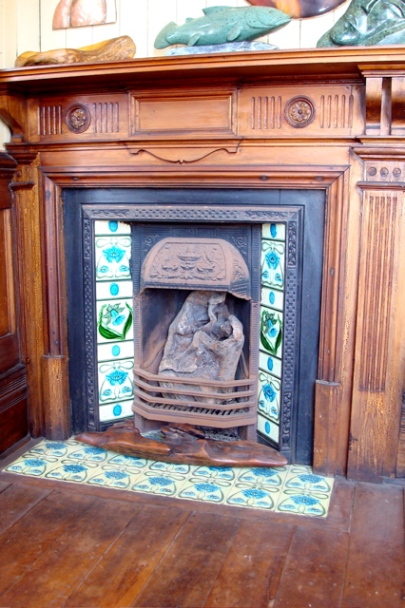
Bank of New South Wales (Former), Hokitika. Interior detail | Ian Phillips | 29/10/2008 | IANZART LTD
Bank of New South Wales (Former), Hokitika. c.1904 CC BY 4.0 Image courtesy of Museum of New Zealand Te Papa Tongarewa photography collection. Reg. No C.014055 | Muir & Moodie Photography Studio | No Known Copyright Restrictions
Bank of New South Wales (Former), Hokitika. Photo Competition Entrant 2025 | Tracy Griffith | 13/02/2025 | Tracy Griffith
Bank of New South Wales (Former), Hokitika. Image courtesy of www.flickr.com | Shellie Evans - flyingkiwigirl | 15/04/2015 | Shellie Evans
Bank of New South Wales (Former), Hokitika. Interior detail | Ian Phillips | 29/10/2008 | IANZART LTD
Bank of New South Wales (Former), Hokitika. c.1904 CC BY 4.0 Image courtesy of Museum of New Zealand Te Papa Tongarewa photography collection. Reg. No C.014055 | Muir & Moodie Photography Studio | No Known Copyright Restrictions

List Entry Information

Overview

Status
Listed

List Entry Status
Historic Place Category 2

Access
Private/No Public Access

List Number
5056

Date Entered
21st September 1989

Date of Effect
21st September 1989

City/District Council
Westland District

Region
West Coast Region

Extent of List Entry

Extent includes the land described as Secs 32, 34 Town of Hokitika (RT WS2C/679), Westland Land District and the building known as Bank of New South Wales (Former) thereon

Legal description

Secs 32, 34 Town of Hokitika (RT WS2C/679), Westland Land District

Detailed List Entry

Construction Details

Start Year

1906

Type

Original Construction

Reference

Completion Date

2nd February 2015

Report Written By

Robyn Burgess

Information Sources

Westpac Archives

Westpac Archives

Preshaw, 1888

G O Preshaw, 1888. Banking Under Difficulties or Life on the Goldfields of Victoria, New South Wales and New Zealand by a bank official. Edwards, Dunlop & Co. Reprint by Capper Press, 1971.

Report Written By

This place was identified as significant under previous legislation with different information requirements. It remains significant under the current legislation. There is opportunity under our legislation and policies to add to this information. Further information about this place may be available from the Southern Regional Office of Heritage New Zealand Pouhere Taonga. A fully referenced upgrade report is available on request from Southern Region Office of Heritage New Zealand Please note that entry on the New Zealand Heritage List/Rarangi Korero identifies only the heritage values of the property concerned, and should not be construed as advice on the state of the property, or as a comment of its soundness or safety, including in regard to earthquake risk, safety in the event of fire, or insanitary conditions.

Further Information

Current Usages

Uses: Civic Facilities

Specific Usage: Residential Buildings - other

Former Usages

General Usage:: Finance

Specific Usage: Bank

General Usage:: Trade

Specific Usage: Shop

Themes

Web Links

Overview

Status

Listed

List Entry Status

Historic Place Category 2

Access

Private/No Public Access

List Number

5056

Date Entered

21st September 1989

Date of Effect

21st September 1989

City/District Council

Westland District

Region

West Coast Region

Extent of List Entry

Extent includes the land described as Secs 32, 34 Town of Hokitika (RT WS2C/679), Westland Land District and the building known as Bank of New South Wales (Former) thereon

Legal description

Secs 32, 34 Town of Hokitika (RT WS2C/679), Westland Land District

Status

Listed

List Entry Status

Historic Place Category 2

Access

Private/No Public Access

List Number

5056

Date Entered

21st September 1989

Date of Effect

21st September 1989

City/District Council

Westland District

Region

West Coast Region

Extent of List Entry

Extent includes the land described as Secs 32, 34 Town of Hokitika (RT WS2C/679), Westland Land District and the building known as Bank of New South Wales (Former) thereon

Legal description

Secs 32, 34 Town of Hokitika (RT WS2C/679), Westland Land District

Construction Information

Construction Details

Start Year

1906

Type

Original Construction

Construction Details

Start Year

1906

Type

Original Construction

Reference

Historical and Associated Iwi / Hapū / Whānau

Completion Date

2nd February 2015

Report Written By

Robyn Burgess

Information Sources

Westpac Archives

Westpac Archives

Preshaw, 1888

G O Preshaw, 1888. Banking Under Difficulties or Life on the Goldfields of Victoria, New South Wales and New Zealand by a bank official. Edwards, Dunlop & Co. Reprint by Capper Press, 1971.

Other Information

This place was identified as significant under previous legislation with different information requirements. It remains significant under the current legislation. There is opportunity under our legislation and policies to add to this information. Further information about this place may be available from the Southern Regional Office of Heritage New Zealand Pouhere Taonga. A fully referenced upgrade report is available on request from Southern Region Office of Heritage New Zealand Please note that entry on the New Zealand Heritage List/Rarangi Korero identifies only the heritage values of the property concerned, and should not be construed as advice on the state of the property, or as a comment of its soundness or safety, including in regard to earthquake risk, safety in the event of fire, or insanitary conditions.

Historical and Associated Iwi / Hapū / Whānau

Completion Date

2nd February 2015

Report Written By

Robyn Burgess

Information Sources

Westpac Archives

Westpac Archives

Preshaw, 1888

G O Preshaw, 1888. Banking Under Difficulties or Life on the Goldfields of Victoria, New South Wales and New Zealand by a bank official. Edwards, Dunlop & Co. Reprint by Capper Press, 1971.

Other Information

This place was identified as significant under previous legislation with different information requirements. It remains significant under the current legislation. There is opportunity under our legislation and policies to add to this information. Further information about this place may be available from the Southern Regional Office of Heritage New Zealand Pouhere Taonga. A fully referenced upgrade report is available on request from Southern Region Office of Heritage New Zealand Please note that entry on the New Zealand Heritage List/Rarangi Korero identifies only the heritage values of the property concerned, and should not be construed as advice on the state of the property, or as a comment of its soundness or safety, including in regard to earthquake risk, safety in the event of fire, or insanitary conditions.

Further Information

Current Usages

Uses: Civic Facilities

Specific Usage: Residential Buildings - other

Former Usages

General Usage: Finance

Specific Usage: Bank

General Usage: Trade

Specific Usage: Shop

Current Usages

Uses: Civic Facilities

Specific Usage: Residential Buildings - other

Former Usages

General Usage: Finance

Specific Usage: Bank

General Usage: Trade

Specific Usage: Shop

Location

Loading
Sign up to hear more

Get the latest heritage news, features and events delivered
straight to your inbox.

Subscribe