

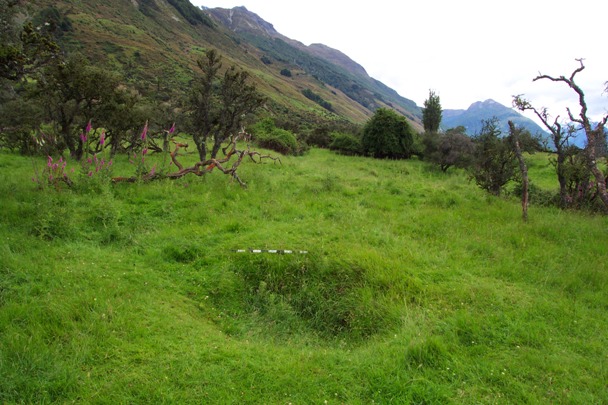
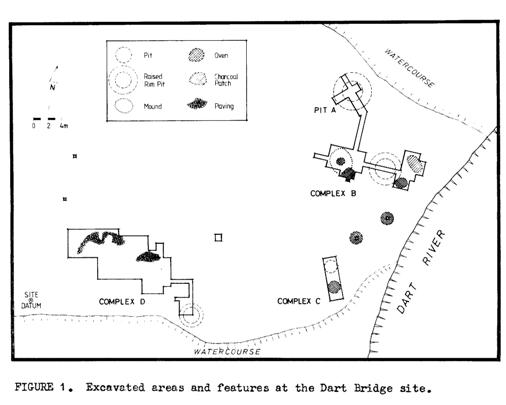
Archaeological Features: The following features were visible in January 1981: two large raised-rim pits, another large pit associated with a low mount and several slight depressions; some four to seven areas of barely perceptible mound and depression features, and alignments of cobbles showing through the soil.
Supporting Evidence: Artefacts from the site, including worked nephrite, were presented to the Otago Museum in 1919. In 1967, D.R. Simmons carried out a survey of sites in the Upper Wakatipu area and undertook a small test excavation within the Dart Bridge site. He interpreted it as a greenstone workers’ village. Prompted by Simmons’ broad interpretation, and the recent loss of site material through river bank erosion, Anderson and Ritchie undertook a major excavation of the site in 1981. They concluded that it was a temporary Archaic phase settlement at which ti [cabbage tree] and moa cooking occurred, and where there was greenstone working on a modest scale as well as the manufacture of flake and blade implements of porcellanite and silcrete. Two areas of stone paving are associated with lithic scatters from tool production. Radiocarbon dates suggest two periods of occupation c AD 1200 and c AD 1500.
Assessment: The site is a valuable source of information on interior Archaic subsistence economy. It has a proven association with the exploitation of the nearby Routeburn nephrite source. The stone paving is a rare but significant archaic feature. The site is believed to have considerable further excavation potential. The site is visually interesting to the casual visitor because of the numerous pit features. It. is in a picturesque situation easily accessible (50 metres) from the Kinloch road
List Entry Information
Status
Listed
List Entry Status
Historic Place Category 2
Access
Private/No Public Access
List Number
5600
Date Entered
4th April 1984
Date of Effect
4th April 1984
City/District Council
Queenstown-Lakes District
Region
Otago Region
Extent of List Entry
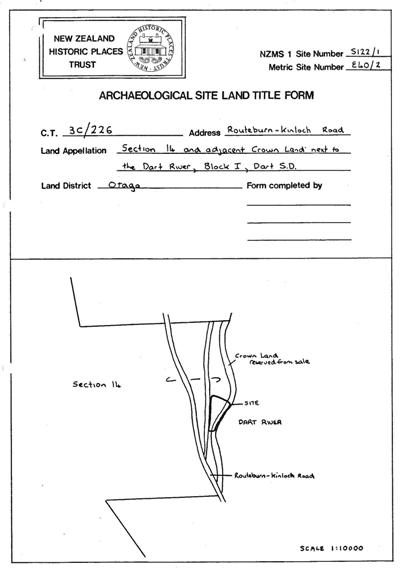
Extent includes part of the land comprised in Sec 3 SO 24940, Pt Sec 20 Blk I Dart SD (RT OT294144), Blk I Dart SD (Crown Land), Otago Land District and the archaeological site known as Te Kokora Occupation Site (refer to Archaeological Site Land Title Form for further information).
Legal description
Sec 3 SO 24940 (RT OT294144), Pt Sec 20 Blk I Dart SD, Blk I Dart SD (Crown Land), Otago Land District
Location Description
It is located between 350 and 400 metres downstream of the Dart Bridge, on the road to Kinloch on the western shore of Lake Wakatipu.
Status
Listed
List Entry Status
Historic Place Category 2
Access
Private/No Public Access
List Number
5600
Date Entered
4th April 1984
Date of Effect
4th April 1984
City/District Council
Queenstown-Lakes District
Region
Otago Region
Extent of List Entry
Extent includes part of the land comprised in Sec 3 SO 24940, Pt Sec 20 Blk I Dart SD (RT OT294144), Blk I Dart SD (Crown Land), Otago Land District and the archaeological site known as Te Kokora Occupation Site (refer to Archaeological Site Land Title Form for further information).
Legal description
Sec 3 SO 24940 (RT OT294144), Pt Sec 20 Blk I Dart SD, Blk I Dart SD (Crown Land), Otago Land District
Location Description
It is located between 350 and 400 metres downstream of the Dart Bridge, on the road to Kinloch on the western shore of Lake Wakatipu.
Historical and Associated Iwi / Hapū / Whānau
Public NZAA Number
E40/2
Completion Date
15th April 1982
Report Written By
N. A. Ritchie
Information Sources
Anderson, 1989
Atholl Anderson, Prodigious Birds: Moas and moa-hunting in prehistoric New Zealand, Cambridge, 1989.
New Zealand Historic Places Trust (NZHPT)
New Zealand Historic Places Trust
New Zealand Archaeological Association (NZAA)
New Zealand Archaeological Association
Otago Museum
Otago Museum
Other Information
This place was identified as significant under previous legislation with different information requirements. It remains significant under the current legislation. There is opportunity under our legislation and policies to add to this information. Further information about this place may be available from the Otago/Southland Office of Heritage New Zealand Pouhere Taonga. Information in this report is from the citation prepared for the NZHPT Archaeology Committee at the time of the registration. Please note that entry on the New Zealand Heritage List/Rarangi Korero identifies only the heritage values of the property concerned, and should not be construed as advice on the state of the property, or as a comment of its soundness or safety, including in regard to earthquake risk, safety in the event of fire, or insanitary conditions.
Historical and Associated Iwi / Hapū / Whānau
Public NZAA Number
E40/2
Completion Date
15th April 1982
Report Written By
N. A. Ritchie
Information Sources
Anderson, 1989
Atholl Anderson, Prodigious Birds: Moas and moa-hunting in prehistoric New Zealand, Cambridge, 1989.
New Zealand Historic Places Trust (NZHPT)
New Zealand Historic Places Trust
New Zealand Archaeological Association (NZAA)
New Zealand Archaeological Association
Otago Museum
Otago Museum
Other Information
This place was identified as significant under previous legislation with different information requirements. It remains significant under the current legislation. There is opportunity under our legislation and policies to add to this information. Further information about this place may be available from the Otago/Southland Office of Heritage New Zealand Pouhere Taonga. Information in this report is from the citation prepared for the NZHPT Archaeology Committee at the time of the registration. Please note that entry on the New Zealand Heritage List/Rarangi Korero identifies only the heritage values of the property concerned, and should not be construed as advice on the state of the property, or as a comment of its soundness or safety, including in regard to earthquake risk, safety in the event of fire, or insanitary conditions.
Former Usages
General Usage: Maori
Specific Usage: Flake area/ stone working area
General Usage: Maori
Specific Usage: Occupational site - temporary
General Usage: Maori
Specific Usage: Umu/ umu tī/ fireplace/ hearth/ hāngī stones
Themes
Of Significance to Maori
Archaeological Site (HPA 1980)
Former Usages
General Usage: Maori
Specific Usage: Flake area/ stone working area
General Usage: Maori
Specific Usage: Occupational site - temporary
General Usage: Maori
Specific Usage: Umu/ umu tī/ fireplace/ hearth/ hāngī stones
Themes
Of Significance to Maori
Archaeological Site (HPA 1980)
Location
Sign up to hear more
Get the latest heritage news, features and events delivered
straight to your inbox.
