

Archaeological knowledge of Māori habitation in Central Otago is relatively sparse. Stone tools appear to have been used to process moa carcasses. Moa-hunters used silcrete and porcellanites as cutting tools. Silcrete and porcellanite are found only in the south of the South Island, and most quarries are small (300m2 to 2000m2). The greatest concentration of silcrete and porcellanite in Otago is in a broad band from Nenthorn to the Manuherikia Valley. Archaeologist Atholl Anderson reports on records of 30 silcrete quarries and 15 porcellanite quarries for Otago, Southland, and South Canterbury. The main tools were flakes and blades, both struck from quarried cores. Most moa hunter’s flake tools are ‘primary flakes’ selected because they had an existing sharp edge. The Bremner quarry and those at Rough Block and Oturehua are among the largest. Anderson writes that the size of the quarries may reflect ‘frequency of repeated use.’
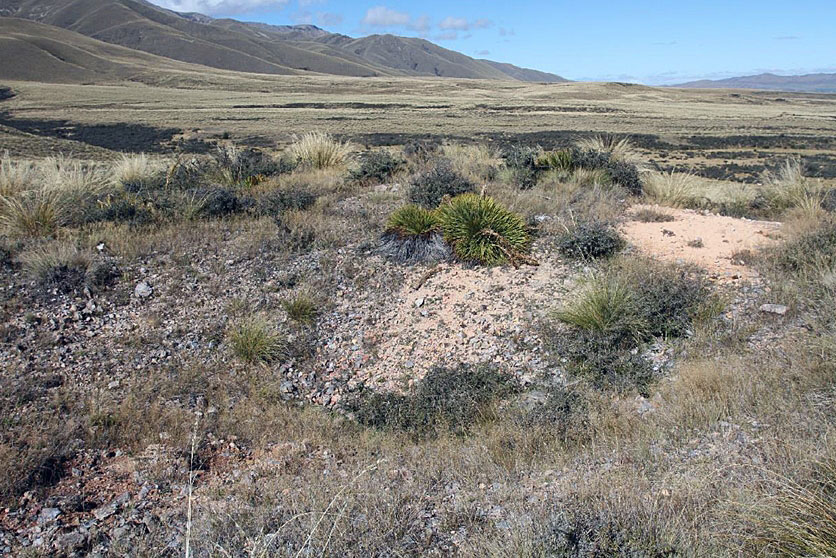
Alexander Mutch of the New Zealand Geological Survey recorded the site in March 1960. He described what appeared to be a ‘working floor of “burnt mudstone”’ with ovens nearby. Graeme Mason of the Anthropology Department of the University of Otago revisited the site in March 1974. The quarry has two patches of rock about 700 metres apart, each covering 0.6 hectares. Archaeologist Jill Hamel describes them as ‘bare pink areas’ in the tussocks at the edge of a terrace at the head of the Manuherikia Valley. The site covers about 1 ½ acres and shows evidence of quarry pits and a working floor on a south west facing terrace covered in tussock and herbfields. The site is largely undisturbed except for a bulldozer cut made in the late 1960s or early 1970s. The site looks to have been ‘heavily used over a long period of time.’
Archaeologist Tim Thomas relocated the site in March 2016. He described the face of the terrace as having several small outcrops of exposed porcellanite, the debris from which had tumbled downslope. Much of the seam of porcellanite is buried however, and the ground surface is covered in tussock, Spaniard and matagouri. Most of the stone working occurred on the uppermost edge of the terrace with surrounding pits dug down on top of the seam. The location where this is most visible is marked by several orange erosion scars exposing dissolving porcellanite formations just to the west of the track. A large circular quarry pit (approx. 5m diameter, 1m deep) is the most obvious feature, however flakes can be found over much of the flat/gently sloping area to the north of the terrace face. Vegetation covers most of the flaking floor, but the pit feature is relatively exposed. This pit is surrounded by heaped dumps of waste material, and is filled with flaked stone. Large greywacke hammerstones were noted, as were blade fragments and other debitage. Where water flows on site the porcellanite is dissolving to a light orange mud and flakes are found sitting atop this material suggesting some artefact transport in these areas. The porcellanite exhibits a wide range of colours but is mostly a light greyish purple, weathering or oxidising to orange; some yellow ochre coloured pieces occur. In 2018, the site is included within a pastoral lease.
List Entry Information
Status
Listed
List Entry Status
Historic Place Category 2
Access
Private/No Public Access
List Number
5632
Date Entered
16th April 1985
Date of Effect
16th April 1985
City/District Council
Central Otago District
Region
Otago Region
Extent of List Entry
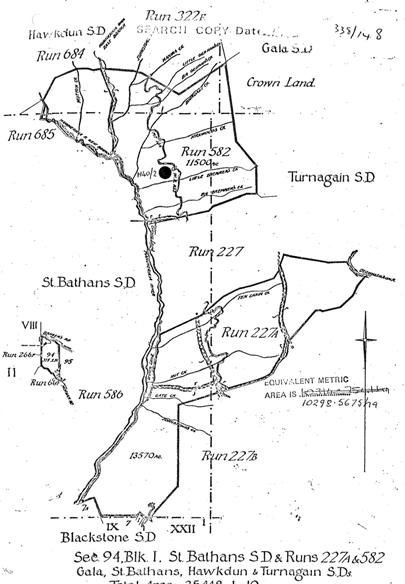
Extent includes part of the land described as Pt Run 582 (RT OT15C/20) and part of the land described as Mt Ida Water Race, Otago Land District, and the archaeological site known as the Bremner Porcellanite Quarry and Working Floor thereon. Please refer to the extent map tabled at the Rārangi Kōrero Committee meeting on 8 March 2018.
Legal description
Pt Run 582 (RT OT15C/20), Mt Ida Water Race, Otago Land District
Status
Listed
List Entry Status
Historic Place Category 2
Access
Private/No Public Access
List Number
5632
Date Entered
16th April 1985
Date of Effect
16th April 1985
City/District Council
Central Otago District
Region
Otago Region
Extent of List Entry
Extent includes part of the land described as Pt Run 582 (RT OT15C/20) and part of the land described as Mt Ida Water Race, Otago Land District, and the archaeological site known as the Bremner Porcellanite Quarry and Working Floor thereon. Please refer to the extent map tabled at the Rārangi Kōrero Committee meeting on 8 March 2018.
Legal description
Pt Run 582 (RT OT15C/20), Mt Ida Water Race, Otago Land District
Historical and Associated Iwi / Hapū / Whānau
Public NZAA Number
H40/2
Completion Date
29th January 2018
Report Written By
Heather Bauchop
Information Sources
Prodigious Birds: Moas and moa-hunting in prehistoric New Zealand
Atholl Anderson, Prodigious Birds: Moas and moa-hunting in prehistoric New Zealand, Cambridge University Press, Cambridge, 1989
The Archaeology of Otago
Jill Hamel, The Archaeology of Otago, Department of Conservation, Wellington, 2001
H40/2 Little Bremner Creek Porcellanite Source, Site visit 30 March 2016
Tim Thomas, H40/2 Little Bremner Creek Porcellanite Source, Site visit 30 March 2016, Copy of notes held Heritage New Zealand, Otago/Southland Area Office
Other Information
This place was identified as significant under previous legislation with different information requirements. It remains significant under the current legislation. There is opportunity under our legislation and policies to add to this information. Further information about this place may be available from the Otago/Southland Office of Heritage New Zealand Pouhere Taonga. Please note that entry on the New Zealand Heritage List/Rarangi Korero identifies only the heritage values of the property concerned, and should not be construed as advice on the state of the property, or as a comment of its soundness or safety, including in regard to earthquake risk, safety in the event of fire, or insanitary conditions. A fully referenced upgrade report is available on request from the Otago/Southland Area Office of Heritage New Zealand
Historical and Associated Iwi / Hapū / Whānau
Public NZAA Number
H40/2
Completion Date
29th January 2018
Report Written By
Heather Bauchop
Information Sources
Prodigious Birds: Moas and moa-hunting in prehistoric New Zealand
Atholl Anderson, Prodigious Birds: Moas and moa-hunting in prehistoric New Zealand, Cambridge University Press, Cambridge, 1989
The Archaeology of Otago
Jill Hamel, The Archaeology of Otago, Department of Conservation, Wellington, 2001
H40/2 Little Bremner Creek Porcellanite Source, Site visit 30 March 2016
Tim Thomas, H40/2 Little Bremner Creek Porcellanite Source, Site visit 30 March 2016, Copy of notes held Heritage New Zealand, Otago/Southland Area Office
Other Information
This place was identified as significant under previous legislation with different information requirements. It remains significant under the current legislation. There is opportunity under our legislation and policies to add to this information. Further information about this place may be available from the Otago/Southland Office of Heritage New Zealand Pouhere Taonga. Please note that entry on the New Zealand Heritage List/Rarangi Korero identifies only the heritage values of the property concerned, and should not be construed as advice on the state of the property, or as a comment of its soundness or safety, including in regard to earthquake risk, safety in the event of fire, or insanitary conditions. A fully referenced upgrade report is available on request from the Otago/Southland Area Office of Heritage New Zealand
Former Usages
General Usage: Maori
Specific Usage: Quarry
General Usage: Ruin
Specific Usage: Misc Archaeological
Themes
Of Significance to Maori
Former Usages
General Usage: Maori
Specific Usage: Quarry
General Usage: Ruin
Specific Usage: Misc Archaeological
Themes
Of Significance to Maori
Location
Sign up to hear more
Get the latest heritage news, features and events delivered
straight to your inbox.
