

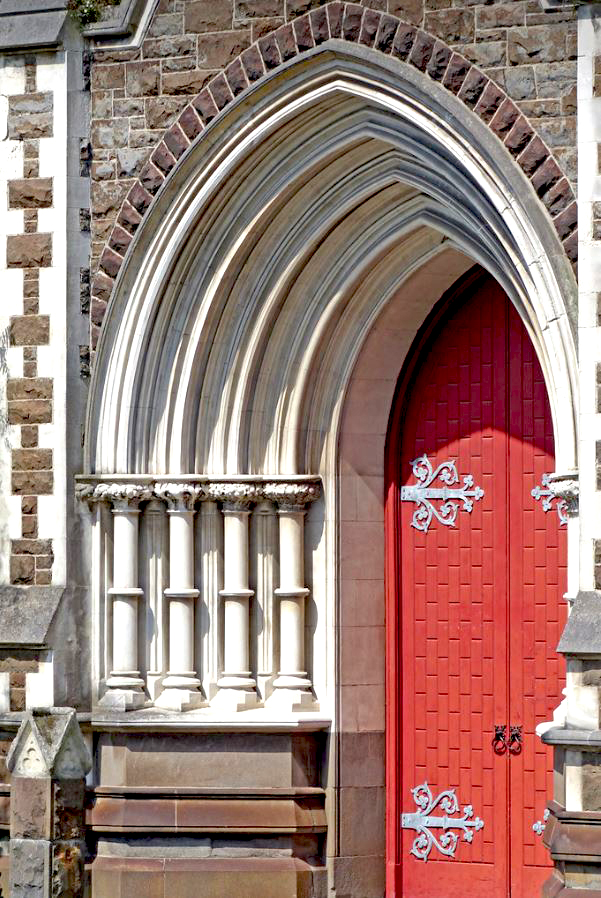
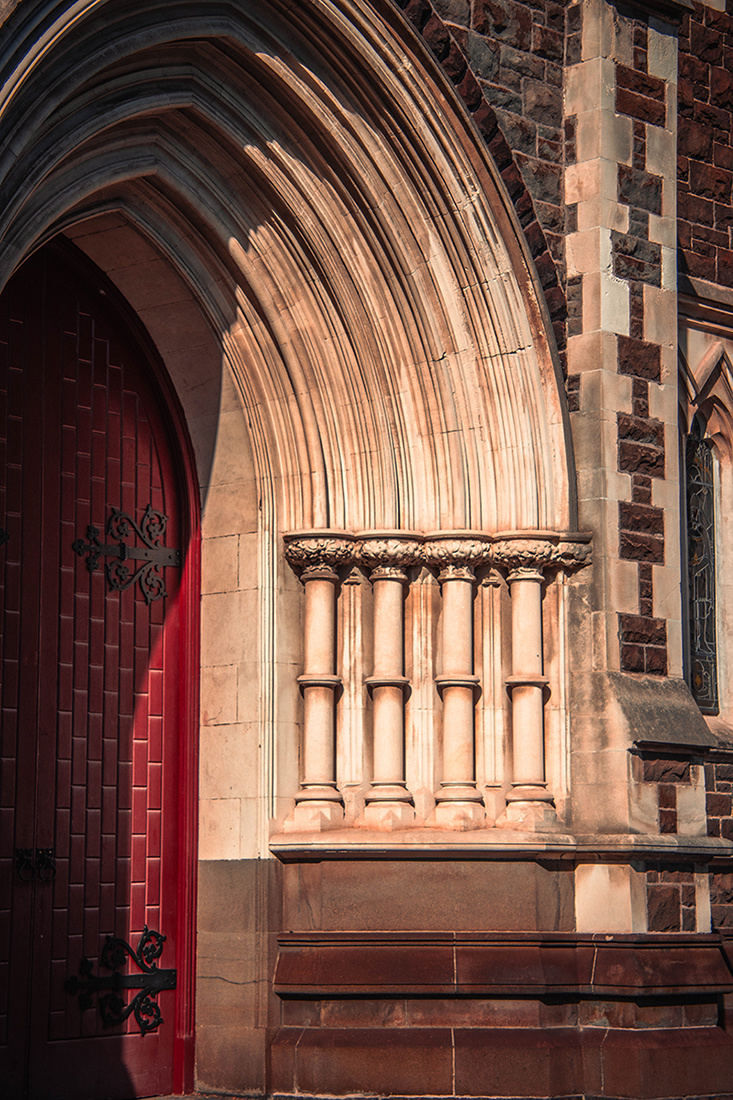
The foundation stone, from the first St Paul's, was relaid for the new church on 11 June 1894 and the building was consecrated the following year. The fine carving of the capitals and label stops was completed by William Feldon in 1910-11.
The foundation stone for the permanent chancel was laid on 11 April 1915 but the addition did not proceed until 1936. It was dedicated on 29 October that year. In 1945 the vestry briefly considered completing the church tower and spire as a war memorial.
The church features some interesting internal decoration and fittings including Bishop Selwyn's throne, communion patten and chalice presented to him by Queen Victoria. Set into the walls in the south west corner are carved stones from Westminster Abbey, Canterbury Cathedral, Yorkminster and St Paul's Cathedral.
List Entry Information
Status
Listed
List Entry Status
Historic Place Category 1
Access
Private/No Public Access
List Number
650
Date Entered
16th November 1989
Date of Effect
16th November 1989
City/District Council
Auckland Council
Region
Auckland Council
Extent of List Entry
Extent includes the land described as Pt Allot 8 Sec 15 Suburbs of Auckland (RT NA65/223), North Auckland Land District, and the building and structures known as St Paul's Church (Anglican) thereon.
Legal description
Pt Allot 8 Sec 15 Suburbs of Auckland (RT NA65/223), North Auckland Land District
Status
Listed
List Entry Status
Historic Place Category 1
Access
Private/No Public Access
List Number
650
Date Entered
16th November 1989
Date of Effect
16th November 1989
City/District Council
Auckland Council
Region
Auckland Council
Extent of List Entry
Extent includes the land described as Pt Allot 8 Sec 15 Suburbs of Auckland (RT NA65/223), North Auckland Land District, and the building and structures known as St Paul's Church (Anglican) thereon.
Legal description
Pt Allot 8 Sec 15 Suburbs of Auckland (RT NA65/223), North Auckland Land District
Why is this place significant?
Historic Significance
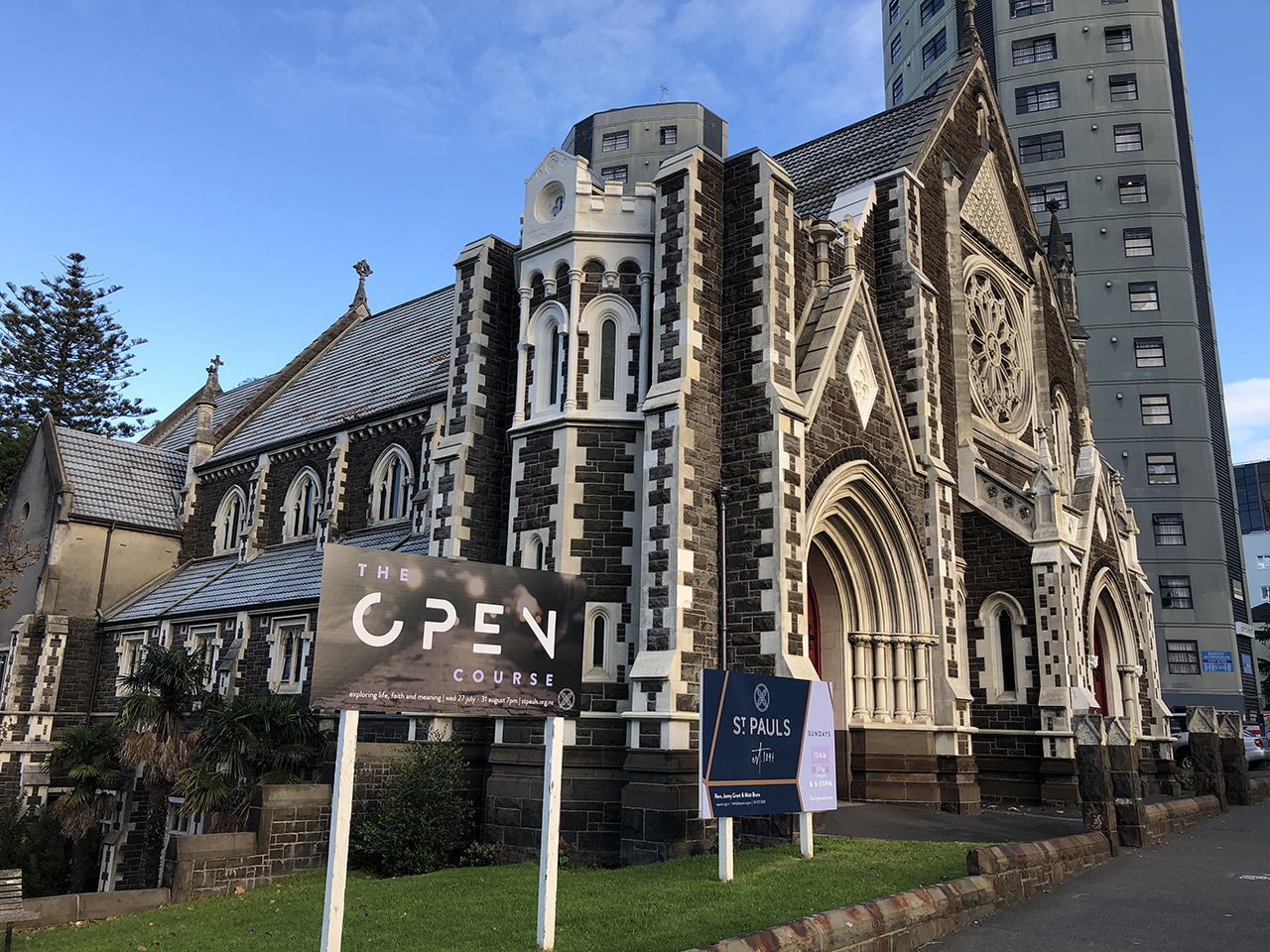
Historical Significance or Value As the church of Auckland city's oldest parish St Paul's is of considerable historic importance. With its central location and historic connections with the first St Paul's and the developing city this church and its predecessors have been a prominent feature of Auckland life since 1841. The present, curious, unfinished structure has in its own right been a prominent landmark in Auckland for nearly 100 years.
Physical Significance
ARCHITECTURAL QUALITY: Although it has never been completed St Paul's is nevertheless a particularly fine example of Gothic Revival architecture. The architects handling of the proportions and detailing was both skilful and elegant. St Paul's invites comparison with Sir Gilbert Scott's only New Zealand work, Christchurch Cathedral, c.1863. St Paul's makes a valuable contribution to the townscape in this area of Auckland. TOWNSCAPE/LANDMARK VALUE: Now unencumbered by surrounding contemporary buildings, St Paul's, with the polychromatic treatment of its stonework, visually dominates the Symonds Street, Wellesley Street intersection.
Why is this place significant?
Historic Significance
Historical Significance or Value As the church of Auckland city's oldest parish St Paul's is of considerable historic importance. With its central location and historic connections with the first St Paul's and the developing city this church and its predecessors have been a prominent feature of Auckland life since 1841. The present, curious, unfinished structure has in its own right been a prominent landmark in Auckland for nearly 100 years.
Physical Significance
ARCHITECTURAL QUALITY: Although it has never been completed St Paul's is nevertheless a particularly fine example of Gothic Revival architecture. The architects handling of the proportions and detailing was both skilful and elegant. St Paul's invites comparison with Sir Gilbert Scott's only New Zealand work, Christchurch Cathedral, c.1863. St Paul's makes a valuable contribution to the townscape in this area of Auckland. TOWNSCAPE/LANDMARK VALUE: Now unencumbered by surrounding contemporary buildings, St Paul's, with the polychromatic treatment of its stonework, visually dominates the Symonds Street, Wellesley Street intersection.
Construction Professional
Name
Feldon, William Henry
Type
Sculptor
Biography
Feldon (1871-1945) Feldon was born in Oxford where he served a five-year apprenticeship in sculpting with J. H. Arnett. He then worked for Farmer and Brindley in London. He was a visiting Master to the College at Eastbourne where he taught carving and modelling, while also teaching many apprentices at Oxford. He immigrated to New Zealand with his wife and children in 1910 where he first undertook a series of panels for Government House in Wellington. He served during the First World War. Following the war he won competitions for the design of war memorials at Bombay, Pōkeno and Rotorua. By 1920 he had achieved a level of recognition as a sculptor of public art. Feldon was responsible for many statues during his life including the Arawa Memorial (Rotorua Government Gardens Historic Area, New Zealand Heritage List No. 7015) and the Matakana War Memorial statue of George V (List No.9816). Feldon was also responsible for the carving of the Auckland Town Hall, the Auckland Ferry Buildings, St Paul’s Church, a statue of Earl Jellicoe, Auckland Children’s Hospital and Helensville District memorials.
Name
Skinner, William Henry
Type
Architect
Biography
Skinner (1838-1915) grew up in England, the son of a builder. A student in the Department of Science and Art at South Kensington, he was awarded a bronze medal for success in art in 1859. He came to New Zealand that same year, working as a contractor and builder in Auckland. He remained in Auckland and practised as an architect from 1880 until his death in 1915. His buildings include the "Star" Printing Office; the Onehunga Woollen Mills, the Freemason's Hall and the Grand Hotel, Princes Street. His ecclesiastical buildings include St Paul's Anglican Church, Symonds Street (1894-95), St James Presbyterian Church, Thames, and the Holy Sepulchre Church Hall, Khyber Pass. The latter was built as a temporary church for St Paul's parish and was later relocated. William Skinner William Henry Skinner (1838-1915), the son of a builder, was born in Newport, Wales. He studied in the Department of Science and Art at South Kensington, and was awarded a bronze medal for 'success in art' in 1859. Skinner came to New Zealand that same year, subsequently working as a contractor and builder in Auckland. In this capacity he erected a parsonage associated with the earlier Church of the Holy Sepulchre in Symonds Street in 1869. After enlisting in the Royal Rifle Volunteers during the New Zealand Wars, he rose to the rank of major. He remained in Auckland and practised as an architect from 1880 until his death in 1915. Skinner's designs as an architect included the 'Star' printing office (demolished); the Onehunga Woollen Works; and the Freemasons' Hall (now a façade) on Princes Street, Auckland. His ecclesiastical buildings included the St James Presbyterian Church, Thames; St Paul's Anglican Church, Symonds Street, Auckland (1894-1895); and the temporary St Paul's Church, Eden Crescent, Auckland (1885) which is now part of the Church of the Holy Sepulchre complex on Khyber Pass Road.
Construction Details
Start Year
1895
Type
Original Construction
Start Year
1915
Type
Modification
Description
Foundations for the permanent chancel laid
Start Year
1919
Type
Addition
Description
War Memorial tram shelter constructed at the northwest corner of the site
Start Year
1936
Type
Modification
Description
Chancel constructed and the position of the organ altered
Start Year
1961
Type
Other
Description
External stonework cleaned and badly damaged sections of Oamaru limestone replaced
Start Year
1965
Type
Modification
Description
Stained glass window by the English artist Lawrence Lee added, east wall
Start Year
1967
Type
Modification
Description
Slate roof replaced with tiles
Start Year
1970
Type
Other
Description
New pews, resulting in a reduction in seating from 650 to 250
Start Year
1971
Type
Demolished - Other
Description
Memorial tram shelter demolished
Start Year
1974
Type
Modification
Description
Alteration to sanctuary - removal of wing walls, new freestanding altar, new choir platform
Start Year
1975
Type
Modification
Description
Alteration to clergy vestry - raising floor, provision of new fittings. Construction of new mezzanine floor with servers' vestry, choir room and warden's office. Construction of new kitchen and toilets, basement.
Start Year
1977
startYearCirca
Type
Modification
Description
New parish office basement
Start Year
1983
startYearCirca
Type
Modification
Description
New ceiling to hall
Construction Materials
Auckland basalt; Oamaru limestone dressings; walls, buttressed; roof, hammerbeam trusses; tiled roof originally Welsh slate. 1936 addition, reinforced concrete and brickwork, plastered internally (painted) and externally (unpainted). Pressed metal roofing tiles.
Notable Features
Bishop Selwyn's throne, communion patten and chalice The stones from English cathedrals The foundation stone of the original church
Construction Professional
Name
Feldon, William Henry
Type
Sculptor
Biography
Feldon (1871-1945) Feldon was born in Oxford where he served a five-year apprenticeship in sculpting with J. H. Arnett. He then worked for Farmer and Brindley in London. He was a visiting Master to the College at Eastbourne where he taught carving and modelling, while also teaching many apprentices at Oxford. He immigrated to New Zealand with his wife and children in 1910 where he first undertook a series of panels for Government House in Wellington. He served during the First World War. Following the war he won competitions for the design of war memorials at Bombay, Pōkeno and Rotorua. By 1920 he had achieved a level of recognition as a sculptor of public art. Feldon was responsible for many statues during his life including the Arawa Memorial (Rotorua Government Gardens Historic Area, New Zealand Heritage List No. 7015) and the Matakana War Memorial statue of George V (List No.9816). Feldon was also responsible for the carving of the Auckland Town Hall, the Auckland Ferry Buildings, St Paul’s Church, a statue of Earl Jellicoe, Auckland Children’s Hospital and Helensville District memorials.
Name
Skinner, William Henry
Type
Architect
Biography
Skinner (1838-1915) grew up in England, the son of a builder. A student in the Department of Science and Art at South Kensington, he was awarded a bronze medal for success in art in 1859. He came to New Zealand that same year, working as a contractor and builder in Auckland. He remained in Auckland and practised as an architect from 1880 until his death in 1915. His buildings include the "Star" Printing Office; the Onehunga Woollen Mills, the Freemason's Hall and the Grand Hotel, Princes Street. His ecclesiastical buildings include St Paul's Anglican Church, Symonds Street (1894-95), St James Presbyterian Church, Thames, and the Holy Sepulchre Church Hall, Khyber Pass. The latter was built as a temporary church for St Paul's parish and was later relocated. William Skinner William Henry Skinner (1838-1915), the son of a builder, was born in Newport, Wales. He studied in the Department of Science and Art at South Kensington, and was awarded a bronze medal for 'success in art' in 1859. Skinner came to New Zealand that same year, subsequently working as a contractor and builder in Auckland. In this capacity he erected a parsonage associated with the earlier Church of the Holy Sepulchre in Symonds Street in 1869. After enlisting in the Royal Rifle Volunteers during the New Zealand Wars, he rose to the rank of major. He remained in Auckland and practised as an architect from 1880 until his death in 1915. Skinner's designs as an architect included the 'Star' printing office (demolished); the Onehunga Woollen Works; and the Freemasons' Hall (now a façade) on Princes Street, Auckland. His ecclesiastical buildings included the St James Presbyterian Church, Thames; St Paul's Anglican Church, Symonds Street, Auckland (1894-1895); and the temporary St Paul's Church, Eden Crescent, Auckland (1885) which is now part of the Church of the Holy Sepulchre complex on Khyber Pass Road.
Construction Details
Start Year
1895
Type
Original Construction
Start Year
1915
Type
Modification
Description
Foundations for the permanent chancel laid
Start Year
1919
Type
Addition
Description
War Memorial tram shelter constructed at the northwest corner of the site
Start Year
1936
Type
Modification
Description
Chancel constructed and the position of the organ altered
Start Year
1961
Type
Other
Description
External stonework cleaned and badly damaged sections of Oamaru limestone replaced
Start Year
1965
Type
Modification
Description
Stained glass window by the English artist Lawrence Lee added, east wall
Start Year
1967
Type
Modification
Description
Slate roof replaced with tiles
Start Year
1970
Type
Other
Description
New pews, resulting in a reduction in seating from 650 to 250
Start Year
1971
Type
Demolished - Other
Description
Memorial tram shelter demolished
Start Year
1974
Type
Modification
Description
Alteration to sanctuary - removal of wing walls, new freestanding altar, new choir platform
Start Year
1975
Type
Modification
Description
Alteration to clergy vestry - raising floor, provision of new fittings. Construction of new mezzanine floor with servers' vestry, choir room and warden's office. Construction of new kitchen and toilets, basement.
Start Year
1977
startYearCirca
Type
Modification
Description
New parish office basement
Start Year
1983
startYearCirca
Type
Modification
Description
New ceiling to hall
Construction Materials
Auckland basalt; Oamaru limestone dressings; walls, buttressed; roof, hammerbeam trusses; tiled roof originally Welsh slate. 1936 addition, reinforced concrete and brickwork, plastered internally (painted) and externally (unpainted). Pressed metal roofing tiles.
Notable Features
Bishop Selwyn's throne, communion patten and chalice The stones from English cathedrals The foundation stone of the original church
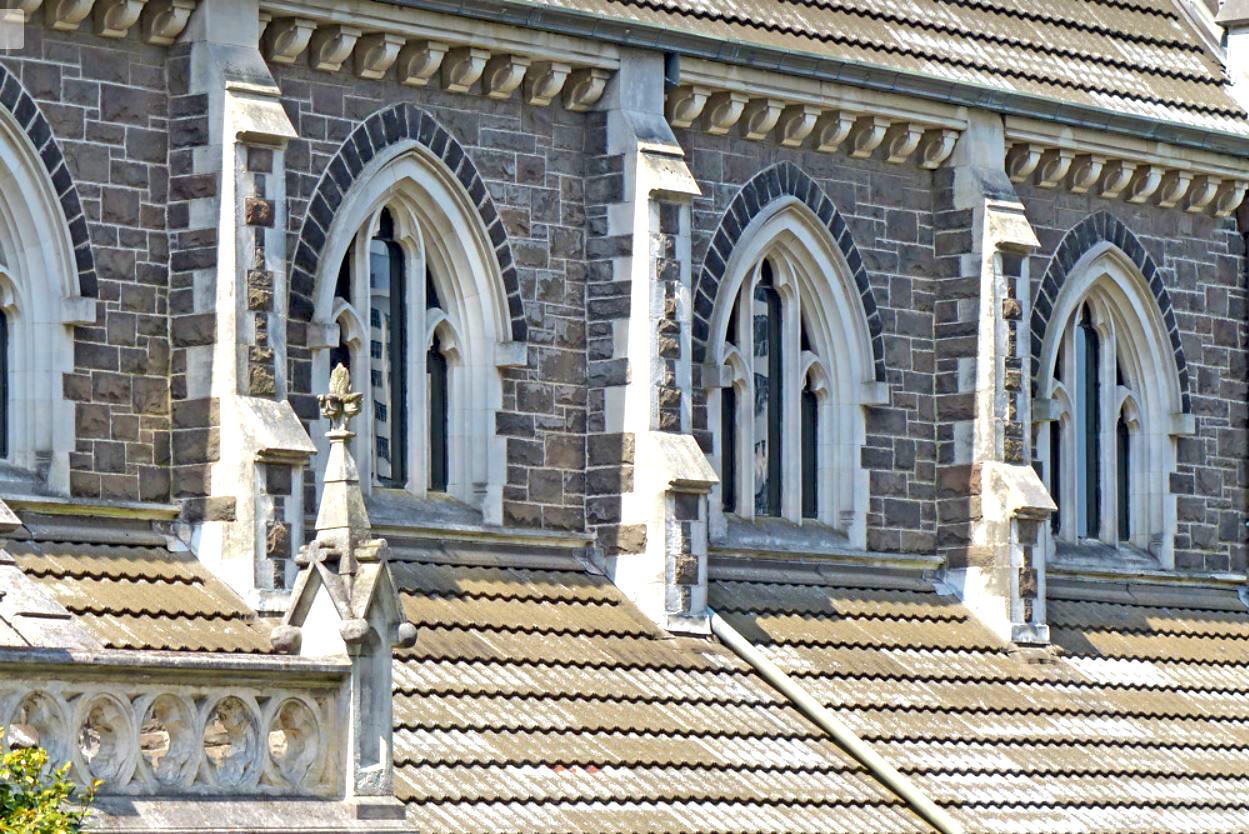
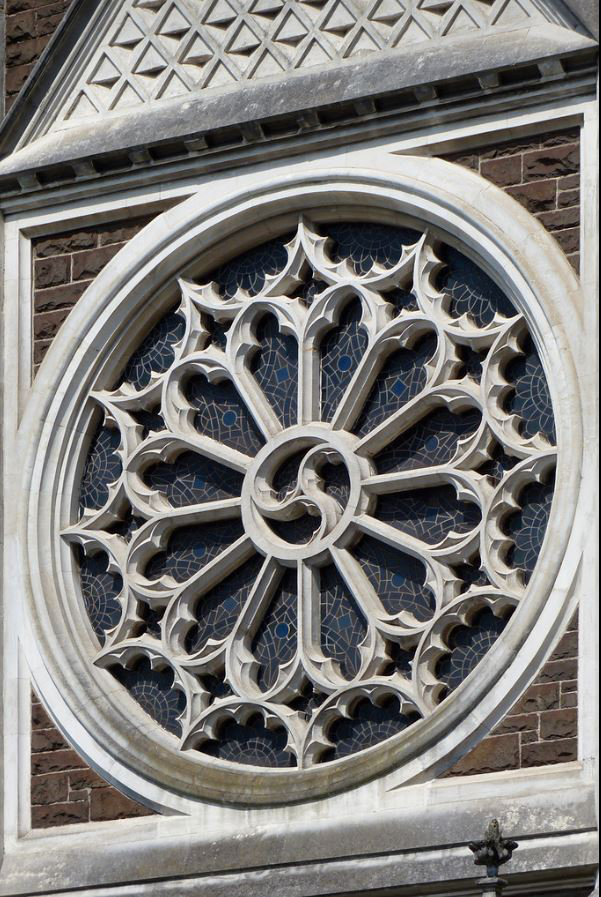
ARCHITECTURAL DESCRIPTION: The building is predominantly in the Early English Gothic style characteristic of the late Victorian period of the revival. The church is reminiscent of the work of the famous Gothic Revival architect Sir Gilbert Scott (senior). The plan is simple with side aisles and the nave leading to the sanctuary. The exterior is notable for the well proportioned west elevation, with gabled porches, rose window and pinnacled buttresses. These elements are highlighted by the use of white limestone. The side elevations incorporate lancet windows above square headed windows. Internally there are hammer beam roof trusses with alternating diagonally boarded panels. The aisle wall dadoes are random basalt. The painted brickwork above the dados feature the fourteen stations of the cross. The main walls are supported on stone arches and columns, having foliated capitals. The church has never been completed and still lacks a tower in the north western corner and its south transept.
ARCHITECTURAL DESCRIPTION: The building is predominantly in the Early English Gothic style characteristic of the late Victorian period of the revival. The church is reminiscent of the work of the famous Gothic Revival architect Sir Gilbert Scott (senior). The plan is simple with side aisles and the nave leading to the sanctuary. The exterior is notable for the well proportioned west elevation, with gabled porches, rose window and pinnacled buttresses. These elements are highlighted by the use of white limestone. The side elevations incorporate lancet windows above square headed windows. Internally there are hammer beam roof trusses with alternating diagonally boarded panels. The aisle wall dadoes are random basalt. The painted brickwork above the dados feature the fourteen stations of the cross. The main walls are supported on stone arches and columns, having foliated capitals. The church has never been completed and still lacks a tower in the north western corner and its south transept.
Historical and Associated Iwi / Hapū / Whānau
Information Sources
Cyclopedia of New Zealand, 1902
Cyclopedia Company, Industrial, descriptive, historical, biographical facts, figures, illustrations, Wellington, N.Z, 1897-1908, Vol.2, Christchurch, 1902
Dixon, 1978
Roger Dixon & Stefan Muthesius, 'Victorian Architecture', London, 1978
Hayward, 1987
Bruce W. Hayward, 'Granite and Marble: a guide to building stones in New Zealand', Geological Society of New Zealand Guidebook, No.8
Porter, 1979
Frances Porter (ed.), Historic Buildings of New Zealand: North Island, Auckland, 1979
Fleming, 1980
John Fleming, Hugh Honour and N. Pevsner, Dictionary of Architecture, London, 1980 The Penguin Dictionary of Architecture, Third Edition, Harmondsworth 1980
Clark, 1962
K. Clark, The Gothic Revival, Great Britain, 1962
Fletcher, 1948
B. Fletcher, A History of Architecture on the Comparative Method, London 1948
Stamp, 1980
G Stamp & C Amery, Victorian Buildings of London 1837 - 1887; An illustrated Guide, London 1980.
Other Information
This historic place was registered under the Historic Places Act 1980. This report includes the text from the original Building Classification Committee report considered by the NZHPT Board at the time of registration. Please note that entry on the New Zealand Heritage List/Rarangi Korero identifies only the heritage values of the property concerned, and should not be construed as advice on the state of the property, or as a comment of its soundness or safety, including in regard to earthquake risk, safety in the event of fire, or insanitary conditions.
Historical and Associated Iwi / Hapū / Whānau
Information Sources
Cyclopedia of New Zealand, 1902
Cyclopedia Company, Industrial, descriptive, historical, biographical facts, figures, illustrations, Wellington, N.Z, 1897-1908, Vol.2, Christchurch, 1902
Dixon, 1978
Roger Dixon & Stefan Muthesius, 'Victorian Architecture', London, 1978
Hayward, 1987
Bruce W. Hayward, 'Granite and Marble: a guide to building stones in New Zealand', Geological Society of New Zealand Guidebook, No.8
Porter, 1979
Frances Porter (ed.), Historic Buildings of New Zealand: North Island, Auckland, 1979
Fleming, 1980
John Fleming, Hugh Honour and N. Pevsner, Dictionary of Architecture, London, 1980 The Penguin Dictionary of Architecture, Third Edition, Harmondsworth 1980
Clark, 1962
K. Clark, The Gothic Revival, Great Britain, 1962
Fletcher, 1948
B. Fletcher, A History of Architecture on the Comparative Method, London 1948
Stamp, 1980
G Stamp & C Amery, Victorian Buildings of London 1837 - 1887; An illustrated Guide, London 1980.
Other Information
This historic place was registered under the Historic Places Act 1980. This report includes the text from the original Building Classification Committee report considered by the NZHPT Board at the time of registration. Please note that entry on the New Zealand Heritage List/Rarangi Korero identifies only the heritage values of the property concerned, and should not be construed as advice on the state of the property, or as a comment of its soundness or safety, including in regard to earthquake risk, safety in the event of fire, or insanitary conditions.
Current Usages
Uses: Religion
Specific Usage: Church
Former Usages
General Usage: Religion
Specific Usage: Church
Current Usages
Uses: Religion
Specific Usage: Church
Former Usages
General Usage: Religion
Specific Usage: Church
Location
Sign up to hear more
Get the latest heritage news, features and events delivered
straight to your inbox.
