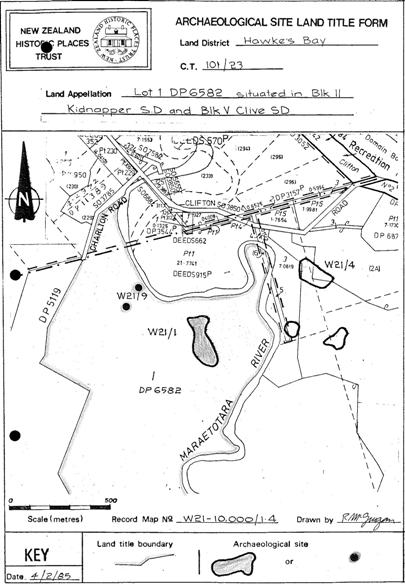
New Zealand Heritage List no. 6506 (NZAA site W21/1) is known as Tiromoana Pa, and has considerable cultural, traditional, archaeological and historical significance. The pa is on farmland at the end of a spur overlooking the Maraetotara River, which flows into the southern part of Hawke’s Bay at Te Awanga. Located at the edge of part of an uplifted marine terrace the pa has excellent elevated views of the surrounding landscape and has effectively utilised the natural defences of the topography.
Tiromoana Pa had spectacular surface evidence when it was excavated in 1974-75 under the direction of Lady Aileen Fox. This pa and the excavation carried out on the site provided, and can still provide, valuable archaeological information regarding the Maori occupation and settlement of the Hawke’s Bay and the Maraetotara River area.
Archaeological evidence and Maori oral history point to the initial settlement of Hawke’s Bay around 1250–1300 AD. Different hapu gradually settled the area from Mahia to Porangahau in a variety of diverse landscapes. The excavation and radiocarbon dates for Tiromoana Pa indicate that the development of the initial fortification of the site, when it was a small work of 450m² at the tip of the spur, was done in c. 1500AD. The construction of these fortifications coincides with the arrival of Ngati Kahungunu iwi into the Hawke’s Bay. Archaeological evidence from this site and others suggests that between 1550 to 1700 there was a period of widespread pa building and occupation that was undertaken in the Hawke’s Bay.
Tiromoana pa was a strongly defended site with a rampart fronted with a palisade and ditch, with a five metres long fighting stage built in two tiers on the highest point. A strong palisade with 22 large uprights covered the weaker eastern side. A second ditch 40 metres up the spur was dug to cover that line of approach. In the later period a third rampart was built 150 metres up the spur, and the pa was enlarged to take up 1.5 hectares. In the late 18th or early 19th century the second palisade was taken down and replaced with a long house (12 x 4 metres), rendering some of the internal defences ineffectual. Occupation of the site extended to the lower terraces. In one case a storage pit was modified into a hangi, and a new large raised rim was constructed. When the pa was abandoned the massive posts of the lateral palisade were dug out, presumably for use elsewhere.
In its present condition the three lines of defence across the spur are visible as are the two banks and three ditches at intervals of 150 and 50 metres. The interior contains fourteen raised rim storage pits, house platforms and terraces. The plateau within the outer defences is level and has no visible features besides the ditch and bank defining it. The outer plateau is grazed, while the section within the second defensive ditch is under scrub. The site is in good condition.
Tiromoana Pa had spectacular surface evidence when it was excavated in 1974-75 under the direction of Lady Aileen Fox. This pa and the excavation carried out on the site provided, and can still provide, valuable archaeological information regarding the Maori occupation and settlement of the Hawke’s Bay and the Maraetotara River area.
Archaeological evidence and Maori oral history point to the initial settlement of Hawke’s Bay around 1250–1300 AD. Different hapu gradually settled the area from Mahia to Porangahau in a variety of diverse landscapes. The excavation and radiocarbon dates for Tiromoana Pa indicate that the development of the initial fortification of the site, when it was a small work of 450m² at the tip of the spur, was done in c. 1500AD. The construction of these fortifications coincides with the arrival of Ngati Kahungunu iwi into the Hawke’s Bay. Archaeological evidence from this site and others suggests that between 1550 to 1700 there was a period of widespread pa building and occupation that was undertaken in the Hawke’s Bay.
Tiromoana pa was a strongly defended site with a rampart fronted with a palisade and ditch, with a five metres long fighting stage built in two tiers on the highest point. A strong palisade with 22 large uprights covered the weaker eastern side. A second ditch 40 metres up the spur was dug to cover that line of approach. In the later period a third rampart was built 150 metres up the spur, and the pa was enlarged to take up 1.5 hectares. In the late 18th or early 19th century the second palisade was taken down and replaced with a long house (12 x 4 metres), rendering some of the internal defences ineffectual. Occupation of the site extended to the lower terraces. In one case a storage pit was modified into a hangi, and a new large raised rim was constructed. When the pa was abandoned the massive posts of the lateral palisade were dug out, presumably for use elsewhere.
In its present condition the three lines of defence across the spur are visible as are the two banks and three ditches at intervals of 150 and 50 metres. The interior contains fourteen raised rim storage pits, house platforms and terraces. The plateau within the outer defences is level and has no visible features besides the ditch and bank defining it. The outer plateau is grazed, while the section within the second defensive ditch is under scrub. The site is in good condition.