Early History of the Site
Onehunga Primary School (Former) is located in the Auckland suburb of Onehunga on the lower slopes of Maungakiekie on the north side of Manukau Harbour. Forming part of a volcanic landscape associated with Mataaho, the god of earthquakes and volcanoes, Onehunga was an important place of Māori settlement over many centuries. In one local tradition the lagoon Te Hōpua was said to have been created by Mahuika, the goddess of fire, to warm Mataaho. The Tainui waka passed Onehunga and named one of the springs Te Puna a Taihaua. In Tainui waka traditions Onehunga is associated with a particular death rite. Local Māori took advantage of the alluvial soils undertaking horticultural enterprise on an very large scale. In the eighteenth century Waiohua had extensive kūmara gardens in the area. Under the mana of Āpihai Te Kawau, Ngāti Whātua established coastal kainga in the vicinity from later in that century. A concentration of shell midden (R11/513) located on a property adjacent to Onehunga Primary School (Former) is surviving evidence of Māori occupation in close proximity to the school site. Onehunga was an important link between Tāmaki, Manukau and Waikato for Māori and formed part of a significant Māori trade network.
After early contact between Māori and Church Missionary Society missionaries in 1820, a small number of European settlers established themselves in the area from 1840. In 1847 Governor Grey founded Onehunga as the first of four fencible settlements in south Auckland comprised of veteran former soldiers charged with defending the capital in Auckland in exchange for land grants. Linking the isthmus to Waikato, Onehunga continued to be an important trading centre from the earliest years of European settlement in Tāmaki where Māori traders would bring in canoe loads of produce to Onehunga to sell to settlers in Auckland, and was developed as an important west coast port. The population of Onehunga grew quickly over the next decades and the settlement became the second largest on the isthmus after Auckland City.
Education in Onehunga
Education was prioritised in the growing Onehunga community with the first school being established by the Anglican Church in 1847, followed quickly by the Catholic Church by 1848. Education remained under church control, excepting a few small private schools, until the Auckland Provincial Council passed the Education Act 1872. This legislation funded public schooling in the province through an education rate levied on households. The Auckland Education Board opened a number of schools in the next years including Onehunga District School in 1873. Due to the high population of Onehunga the new school was well-funded and initially operated from the stone Anglican Church schoolhouse. Education was subsequently standardised across the country in the 1877 Education Act which guaranteed access to free secular state primary education.
The Board built a schoolhouse on Selwyn Street and Onehunga District School moved to the new site in 1876. The expanding population of the settlement ensured the school was well attended and, with the increased focus on wider access to education following the election of the first Liberal Government in 1890, the Board acquired additional land adjoining the new school from local residents in 1898. This included Allotment 6 Section 19, which was purchased from Bradley and had been originally granted in 1854 to H.C. Lawlor, a resident magistrate. A small infant block was erected in the widened grounds the following year and, after the Board decided against relocating the original school building, plans were initiated for a new senior block to be built on the highest ground of the site, Allotment 6.
Creation of Onehunga Primary School (Former) Main Building
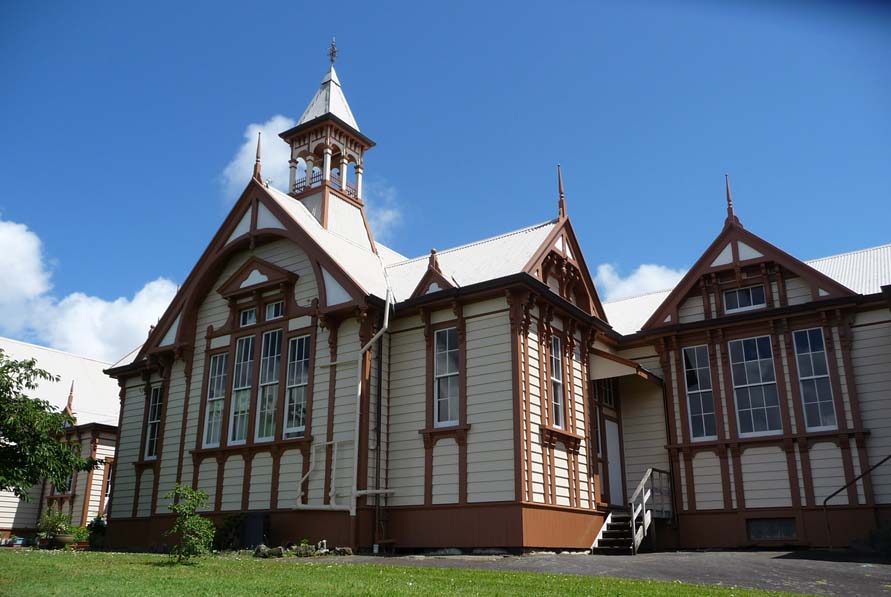
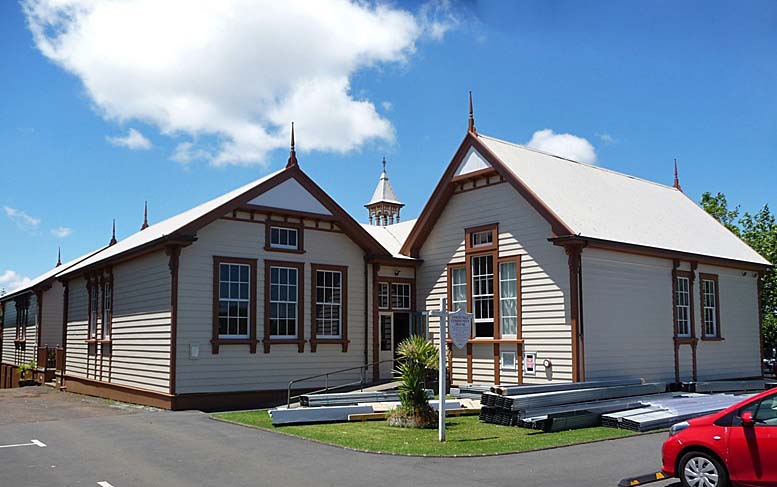
The Onehunga Primary School (Former) main building was designed by the architectural partnership of John Mitchell (c.1859-1947) and Robert Watt (1860-1907), the architects for the Auckland Education Board. They were responsible for designing all new schools and additions between 1892 and 1907 and their designs “are held to represent an important phase in the architectural development of school buildings in New Zealand”. Taking advantage of the prominent position of the site, they designed a large Queen Anne style-influenced timber building. This created a dramatic landmark from its commanding position visible from the township, port and harbour. Queen Anne architecture was closely associated with progressive, secular ideas and was used widely in New Zealand state architecture during the first decade of the Liberal Government as well as in Britain from the 1870s, particularly in Board schools. The striking applied timbering and detailed bracket ornamentation on the main façade and belfry evoked civic pride in the institution and demonstrated the importance given to education by both the government and the local community. The classrooms were symmetrically arranged with two wings either side of the large central room and wide u-shaped corridors. The building had a total of seven classrooms, five large and two smaller rooms, as well as a headmaster’s room, a teachers’ room, and two basement equipment rooms on the eastern side. One of the classrooms was also the school hall and contained a small museum collection, the cadet rifles and the roll of honour of students who had received scholarships. Reflecting the importance given to the learning environment for a good education, features of the modern design also included dedicated science facilities fitted with gas and water that could be used for a laboratory and the rooms were arranged to be well positioned for light and air flow. Mitchell and Watt continued using an innovative ventilation and heating system pioneered in their earlier school designs, with large windows in the gable ends to maximise light, ventilation holes in the eves as well as patent stoves and roof ventilators in each classroom. The rooms thought to be warmer or cooler were painted appropriate colours. Other features of the design included separate entrances for every classroom and washbasins at the ends of the main corridors.
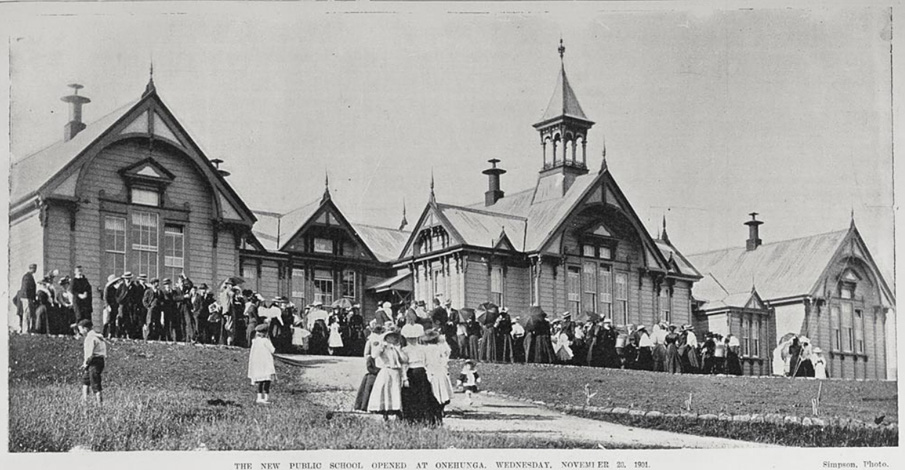
Construction was initially deferred for a short time as the Board was low on funds, however a tender of £2,374 plus £60 for the belfry was then accepted from G.M. Handcock and the building was completed in 1901. The building was officially opened with a public ceremony on November 20th 1901. The Education Board had spent a substantial portion of its £10,000 budget on the improvements at the school totalling £4,000 for the land, new buildings and other improvements since 1898. The Board hoped this would reduce future expenditure requirements and reflected the growth and importance of Onehunga, particularly as other smaller schools in the wider isthmus were experiencing decreasing rolls. The opening was described at the time as ‘one of the most important events that ever occurred in Onehunga’.
Onehunga District High School
Shortly after the main building was opened, the local community pushed for it to be used as a District High School. Onehunga District School provided classes up to standard seven, however the community found the expense required for older students to attend secondary schools in Auckland City to be too high. The Liberal Government reforms to education in 1900 widened access to secondary education, previously the preserve of the elite, and the Onehunga community pushed to take advantage of the new opportunities presented. After the Education Board provided their support for the proposal, Onehunga District High School opened in July 1903. The school ended the year with the highest number of enrolled students at a high school in Auckland Province with many students travelling from as far away as Pukekohe and Point Chevalier. By August 1904 the school had more students applying than there was space available. Requests for more classrooms were refused however, as Auckland Grammar School only had half the roll it was able to accommodate. The high school education offered at Onehunga focused on science and technical education with a view towards agriculture. In 1912 the Education Board determined that it would be more efficient and economical to close the high school department at Onehunga and the students could instead attend other secondary schools in Auckland.
Changes to Onehunga Primary School Main building
The next decades saw a number of changes to the organisation and functioning of Onehunga District School, later known as Onehunga Primary School, in response to roll growth as well as changing teaching methods and ideas. The main building was primarily used for teaching the senior classes, standards one to seven, but the rooms were also used for other school purposes. In 1929 one of the classrooms temporarily housed a dental clinic until a permanent two-chair clinic was built elsewhere on the school grounds; after a special education class was established in 1930, it was reportedly taught in one of the basement rooms which had been converted into a classroom, and a school library was created in one of the classroom spaces.
Onehunga School was the principal school in the area during these years and was one of the largest in Auckland. The school roll was under constant pressure from the growing population and the infant block was rebuilt with more classrooms after it burnt down in 1922. While the main building wasn’t initially expanded, the need for more classes is reflected in the changing internal layout of the block. From 1919 the largest classrooms were progressively partitioned into separate smaller spaces so by 1952 the building was noted as containing 10 classrooms, the Headmaster’s study, a staffroom, library and cloakrooms in the corridors.
The alterations to the classroom layout affected the heating and ventilation arrangements of the rooms many of which were noted to receive little to no sunlight after the changes. In 1939 the patent stoves had been removed and Airflow gas heating had been installed, however the building was still considered cold and the system was replaced again in 1955 with a boiler located in the infant block. The lighting in the classrooms was deemed inadequate for health and safety standards and electric lighting was installed in 1960. At the same time as the lighting changes, the centre front classroom was converted into staff toilets and an administration office.
The school was periodically subject to vandalism and in 1942 a party on the porch of the main building had caused a small amount of fire damage requiring minor repairs. The belfry was removed from the building in 1947 due to a leak that couldn’t be located and the finials were also removed before 1967. Routine maintenance at the school continued over these years including a roof replacement in 1957. The largest change to the external structure came in 1968 when it was noted that many of the classrooms were smaller than the minimum regulated size. Three of the classrooms on the north and west sides were enlarged with fibrolite extensions and louvre windows and verandahs were also enclosed. Other changes to the classrooms included the installation of orange and grey carpets and Pinex wall boarding.
School Grounds and Swimming Pool
When the building was constructed the surrounding grounds were landscaped with terraces and paths, and a flagpole was erected at the front of the building. Further terracing with rock retaining walls was completed in 1930 as designed by John Park, a former and future mayor of Onehunga. The improvements were partly paid for through local fundraising and a special grant from the Ministry of Education. In 1966 the damage to the walls was fixed along with fencing of the wider school grounds. In the early twentieth century the flat area west of the building was used as a general assembly space and playground as well as for fairs and bazaars. From the 1950s this space was evidently paved and used for car parking as well as remaining a play area.
Following the creation of the first learner pool at Cornwall Park School in 1938, the Onehunga School Committee began planning for a similar pool at Onehunga Primary School. These long shallow pools were being rapidly introduced into many schools during the next decades as swimming and water safety were important skills for New Zealand children given the high rate of drowning deaths on the extensive coastline. In 1945 a learner pool was constructed immediately east of the senior block on a lower terrace for a total of £265, much of which had been fundraised by the students. The pool was large enough for multiple classes to use it at the same time. The fundraising efforts were noted in Parliament as an example of school/community co-operation that could be used by other schools to build public facilities. In 1958 an experimental filter was installed at the Onehunga pool which, after proving to be successful in maintaining clean water, was subsided by the government and installed at a number of other learner pools over the next decades. In 2019 the pool is still in regular use by Onehunga Primary School.
Onehunga Primary School Community
From the earliest days of the Onehunga District School the local community were heavily involved in its organisation and running. The Onehunga School Committee was comprised of local residents and had responsibility for school functions and sometimes raised loans as part of their role. Community contributions were also monetary through the fundraising efforts of the school. From 1922 Mrs R. Buchanan, a local resident, invested in a scholarship for Onehunga student success known as the Buchanan prize. In 1941 community participation opportunities were enhanced with the formation of one of the earliest active Parent-Teacher Associations (PTA) in the country. As well as connecting parents and teachers through adult education opportunities, the PTA supported the school with events and fundraising for items such as a new piano, as well as supplying sports uniforms and other school equipment.
The 1950s and 1960s saw a significant demographic shift in the Onehunga community with an influx of Polynesians and other immigrants who came to work in the numerous factories that were established at Onehunga during the post-war years. By 1973 the school curriculum had expanded with cultural clubs and teaching “songs, dances and traditions of Maori, Samoan, and Niuean cultures as well as those that stem from […] British traditions”.
A number of students who attended Onehunga Primary School went on to have national and international success in later years. These careers included politics—Alfred E Allen, John Rae, George Laking and Aileen Henderson; sports—Peter Wolfenden, Ramesh Patel, Peter Gurnick, Kevin Curtin and Jonah Lomu; medicine —Dr Murray Brennan; Music—Ricky May; and fine arts—Olive Emily Jones and Kevin Davies.
From 1973 the future of the buildings at the school was in question as the main building was identified as needing replacement and the infant block was condemned due to it being an earthquake hazard. The Board decided to build a new school on the lower part of the site and retain the swimming pool as part of the new complex. The main building continued to be used during the period of construction (1979–1982) with a plan to demolish it after the new school opened. In 1980 the Principal of Onehunga Primary School, Lee Drummond, called a public meeting to discuss turning the building into a community house once it was no longer needed for classes as an alternative to demolition. The plan received local support and the building became known as Onehunga Community House in 1982 under the management of the Friends of Onehunga Community House Committee.
Onehunga Community House
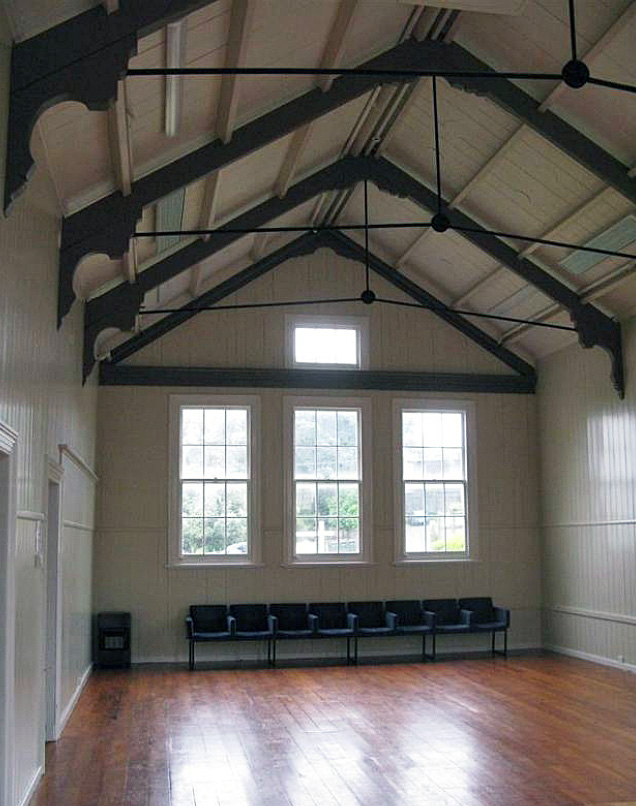
The committee expressed interest in restoring the building in the early 1980s however no physical changes were made. The Friends of Onehunga Community House Committee formed and took over management of the building from 1992 and in 2002 the committee began organising and fundraising for the restoration which was completed in stages under the direction of conservation architect Antony Matthews. In 2005 a replacement belfry, designed to closely replicate the original, was built and added on the earthquake strengthened roof in the same position as at construction in 1901. The original school bell was reinstalled in the new structure. The enclosed south porch was opened and the finials were also remade and replaced. A new sprinkler system was installed in 2006. From 2007 to 2014, the internal rooms were restored to their original design with most partitions, wall coverings and carpets removed and a ramp was built to the new main entrance door on the west side of the building. The louvre windows were replaced with multi-pane windows designed to match the remaining original ones and the removed walls were rebuilt. All lean-tos were removed and French doors opening onto a new central deck were added between the rear classrooms. The carpark west of the building was resurfaced in 2016. The total amount fundraised for the restoration totalled over $950,000 in early 2018. The Friends of Onehunga Community House created a museum in the small classroom in the west wing. The museum contains artefacts associated with New Zealand education such as early flashcards and books, items specific to Onehunga Primary school such as old school books and committee minute books, and general Onehunga history. The building is used by a wide range of community groups daily including classes, craft groups, family and past pupil gatherings, and public meetings.