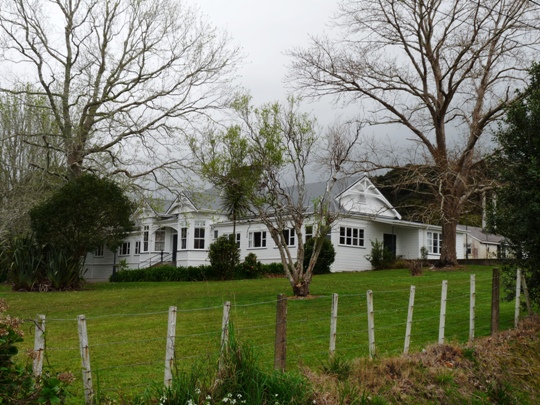
This historic area was registered under the Historic Places Act 1993. This report includes text from the original Recommendation for Registration considered by the NZHPT Board at the time of registration.
GENERAL DESCRIPTION:
Coromandel Hospital has heritage significance as a good example of a nineteenth century cottage hospital.
Gold was discovered in Coromandel in 1852 and the first gold boom began in 1869, following which the first permanent settlement was established in Coromandel. A temporary hospital, known as the "tin hospital", was established in 1871, as a response to the medical needs of the mining community. In the early 1870s the community and town of Coromandel was expanding. In early 1873 the Coromandel government offices were moved to a new building in the town, and the Coromandel Hospital took over the government offices' original buildings in Rings Rd, including 3 acres of land. This formed the basis of the present day hospital.
The hospital was severely underfunded, and was closed in 1879. It was reopened after a mining accident in 1881, which prompted the manager of that mine to guarantee the expense of re-opening. Through the early 1880s however the hospital was still underfunded, and decreased its number of beds. Conditions in this time were also less than adequate or sanitary. This appears to have improved in the later 1880s.
Discovery of a new gold seam in 1895 lead to another boom in Coromandel which lasted to the turn of the century. This was the last major goldrush in the country. An immediate effect of this rush was an increase in population, and in hospital admissions. However, this increase in numbers exposed the inadequacies of care and facilities. This was improved by the arrival of the Sisters of Mercy in 1896 who took over caregiving at the hospital. The Sisters had been in Coromandel since the early 1870s. The role of the Sisters improved the standard of care at the hospital, and they were given complete charge of the new hospital building when it opened in 1898.
The hospital has remained in use serving the local community until its closure in 1995. The hospital complex is set in a large park-like setting which contributes to its landscape qualities. The complex is comprised of a large number of buildings and structures, some of which are recently constructed and have little or no heritage significance, but which contribute to the development and functioning of the hospital complex. The main hospital block is the largest building on the site, constructed in 1898.
GENERAL DESCRIPTION:
Coromandel Hospital has heritage significance as a good example of a nineteenth century cottage hospital.
Gold was discovered in Coromandel in 1852 and the first gold boom began in 1869, following which the first permanent settlement was established in Coromandel. A temporary hospital, known as the "tin hospital", was established in 1871, as a response to the medical needs of the mining community. In the early 1870s the community and town of Coromandel was expanding. In early 1873 the Coromandel government offices were moved to a new building in the town, and the Coromandel Hospital took over the government offices' original buildings in Rings Rd, including 3 acres of land. This formed the basis of the present day hospital.
The hospital was severely underfunded, and was closed in 1879. It was reopened after a mining accident in 1881, which prompted the manager of that mine to guarantee the expense of re-opening. Through the early 1880s however the hospital was still underfunded, and decreased its number of beds. Conditions in this time were also less than adequate or sanitary. This appears to have improved in the later 1880s.
Discovery of a new gold seam in 1895 lead to another boom in Coromandel which lasted to the turn of the century. This was the last major goldrush in the country. An immediate effect of this rush was an increase in population, and in hospital admissions. However, this increase in numbers exposed the inadequacies of care and facilities. This was improved by the arrival of the Sisters of Mercy in 1896 who took over caregiving at the hospital. The Sisters had been in Coromandel since the early 1870s. The role of the Sisters improved the standard of care at the hospital, and they were given complete charge of the new hospital building when it opened in 1898.
The hospital has remained in use serving the local community until its closure in 1995. The hospital complex is set in a large park-like setting which contributes to its landscape qualities. The complex is comprised of a large number of buildings and structures, some of which are recently constructed and have little or no heritage significance, but which contribute to the development and functioning of the hospital complex. The main hospital block is the largest building on the site, constructed in 1898.
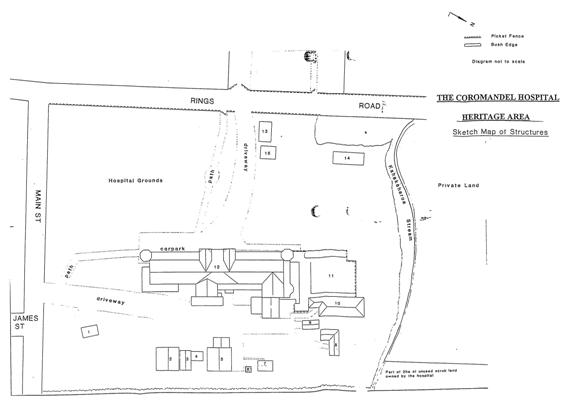
Coromandel Hospital Historic Area. Plan of Historic Area from registration report. | 27/10/1995 | Heritage New Zealand Pouhere Taonga
Coromandel Hospital Historic Area. Plan of Historic Area from registration report. | 27/10/1995 | Heritage New Zealand Pouhere Taonga