

List Entry Information
Status
Listed
List Entry Status
Historic Place Category 2
Access
Private/No Public Access
List Number
7341
Date Entered
25th October 1996
Date of Effect
25th October 1996
City/District Council
Dunedin City
Region
Otago Region
Legal description
Lot 6 DP 251 Blk VIII, South Dunedin
Status
Listed
List Entry Status
Historic Place Category 2
Access
Private/No Public Access
List Number
7341
Date Entered
25th October 1996
Date of Effect
25th October 1996
City/District Council
Dunedin City
Region
Otago Region
Legal description
Lot 6 DP 251 Blk VIII, South Dunedin
Why is this place significant?
Cultural Significance
This historic place was registered under the Historic Places Act 1993. The following text is from the original Recommendation for Registration considered by the NZHPT Board at the time of registration. Cultural: The interior of St Michael's Church represents in a very distinctive way the age-old continuity of the forms of the Orthodox faith as practiced in New Zealand by immigrant national communities from Eastern Europe and Russia. Spiritual: As an Eastern Orthodox Church, St Michael's has an obvious religious and cultural significance for the Orthodox families of the parish who originally appear to have been Greek, Syrian and Lebanese. The parish is believed to have special value and significance for its parishioners as the first place of worship for the Greek Orthodox Church in New Zealand.
Historic Significance
Historical Significance or Value This historic place was registered under the Historic Places Act 1993. The following text is from the original Recommendation for Registration considered by the NZHPT Board at the time of registration. St Michael's was built in 1911 to serve the needs of the small Dunedin Orthodox community and was the first purpose-built Orthodox church in the country. It has played a part in the affairs of Dunedin's distinctive Lebanese community.
Physical Significance
This historic place was registered under the Historic Places Act 1993. The following text is from the original Recommendation for Registration considered by the NZHPT Board at the time of registration. Aesthetic: The interior of St Michael's Church is arranged in conformity with the universal liturgy of the Orthodox church and as such contains an iconostasis, votive candles, candelabra and various other icons. Two icons are distinguished from the rest - a large icon of Our Lady with the Christ child positioned in a central and commanding position at the top of the iconostasis, and an icon of St John the Baptist located at the bottom right of the iconostasis and painted in the manner of traditional schools of the fifteenth century. The combination of these liturgical elements produces a beautiful visual effect integral with the religious significance of the icons. Architectural: Although the exterior design of St Michael's is in simple Gothic Revival style, this simplicity belies the comparatively rich interior which is designed in Byzantine Eastern Orthodox style.
Why is this place Category 1 / Category 2?
Detail Of Assessed Criteria
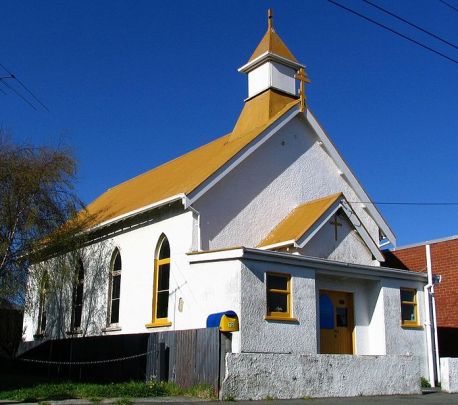
This historic place was registered under the Historic Places Act 1993. The following text is from the original Recommendation for Registration considered by the NZHPT Board at the time of registration. The following comments are made in relation to the criteria identified under S.23(2) of the Historic Places Act 1993. a) The extent to which the place reflects important or representative aspects of New Zealand history: Physically, this is modest even as a suburban church. Its true significance is its importance as a centre for worship for members of the small Orthodox community in Dunedin. b) The association of the place with events, persons or ideas of importance in New Zealand history: St Michael's symbolises the religious history of the small Orthodox faith in New Zealand. e) The community association with, or public esteem for, the place: The Dunedin Orthodox community, originally consisting of Greek, Syrian and Lebanese have a close association with St Michael's. g) The technical accomplishment or value, or design of the place: St Michael's Orthodox Church is a simple, Gothic Revival style building on the outside exhibiting conventional Gothic features in the form of eight lancet head windows along the nave, and a belfry atop the main gable. A lean-to porch at the front has an ecclesiastical gable placed over the top of it and two rectangular windows flank the main door. The building is probably made of timber which has been plastered over and painted white at some time. The plain exterior of St Michael's' belies the Eastern Orthodox interior which has a comparatively rich and exotic aspect to it which is quite distinctive. There are several features of note which are significant to the Orthodox faith and which form items of significant architectural design. The primary feature of note is the iconostasis or icon stand, which extends along the full width of the apse and stands as high as the walls of the nave. In Orthodox liturgy the iconostasis conceals the Eucharist from the congregation and the priest walks through it during the service, returning to administer communion. Next in significance is the icon of the day which stands on a table in front of the iconostasis. Third is the significance of the votive candles which are found on individual stands and, most spectacularly, hanging from the ceiling in the form of candelabra. These are all technically instruments of the Orthodox liturgy but they attain a design significance when it is appreciated that with the exception of the majority of icons they were made by the parish and clergy for this particular church in conformity with traditional Byzantine forms of artwork. Conclusion: St Michael's Antiochian Orthodox Church, 72 Fingall St, Dunedin, is recommended for registration as a Category II as a place of historical and cultural heritage significance and value. St Michael's was the first purpose-built Orthodox church in the country. Although the exterior design of St Michael's is in simple Gothic Revival style, this simplicity belies the comparatively rich interior which is designed in Byzantine Eastern Orthodox style.
Why is this place significant?
Cultural Significance
This historic place was registered under the Historic Places Act 1993. The following text is from the original Recommendation for Registration considered by the NZHPT Board at the time of registration. Cultural: The interior of St Michael's Church represents in a very distinctive way the age-old continuity of the forms of the Orthodox faith as practiced in New Zealand by immigrant national communities from Eastern Europe and Russia. Spiritual: As an Eastern Orthodox Church, St Michael's has an obvious religious and cultural significance for the Orthodox families of the parish who originally appear to have been Greek, Syrian and Lebanese. The parish is believed to have special value and significance for its parishioners as the first place of worship for the Greek Orthodox Church in New Zealand.
Historic Significance
Historical Significance or Value This historic place was registered under the Historic Places Act 1993. The following text is from the original Recommendation for Registration considered by the NZHPT Board at the time of registration. St Michael's was built in 1911 to serve the needs of the small Dunedin Orthodox community and was the first purpose-built Orthodox church in the country. It has played a part in the affairs of Dunedin's distinctive Lebanese community.
Physical Significance
This historic place was registered under the Historic Places Act 1993. The following text is from the original Recommendation for Registration considered by the NZHPT Board at the time of registration. Aesthetic: The interior of St Michael's Church is arranged in conformity with the universal liturgy of the Orthodox church and as such contains an iconostasis, votive candles, candelabra and various other icons. Two icons are distinguished from the rest - a large icon of Our Lady with the Christ child positioned in a central and commanding position at the top of the iconostasis, and an icon of St John the Baptist located at the bottom right of the iconostasis and painted in the manner of traditional schools of the fifteenth century. The combination of these liturgical elements produces a beautiful visual effect integral with the religious significance of the icons. Architectural: Although the exterior design of St Michael's is in simple Gothic Revival style, this simplicity belies the comparatively rich interior which is designed in Byzantine Eastern Orthodox style.
Why is this place Category 1 / Category 2?
Detail Of Assessed Criteria
This historic place was registered under the Historic Places Act 1993. The following text is from the original Recommendation for Registration considered by the NZHPT Board at the time of registration. The following comments are made in relation to the criteria identified under S.23(2) of the Historic Places Act 1993. a) The extent to which the place reflects important or representative aspects of New Zealand history: Physically, this is modest even as a suburban church. Its true significance is its importance as a centre for worship for members of the small Orthodox community in Dunedin. b) The association of the place with events, persons or ideas of importance in New Zealand history: St Michael's symbolises the religious history of the small Orthodox faith in New Zealand. e) The community association with, or public esteem for, the place: The Dunedin Orthodox community, originally consisting of Greek, Syrian and Lebanese have a close association with St Michael's. g) The technical accomplishment or value, or design of the place: St Michael's Orthodox Church is a simple, Gothic Revival style building on the outside exhibiting conventional Gothic features in the form of eight lancet head windows along the nave, and a belfry atop the main gable. A lean-to porch at the front has an ecclesiastical gable placed over the top of it and two rectangular windows flank the main door. The building is probably made of timber which has been plastered over and painted white at some time. The plain exterior of St Michael's' belies the Eastern Orthodox interior which has a comparatively rich and exotic aspect to it which is quite distinctive. There are several features of note which are significant to the Orthodox faith and which form items of significant architectural design. The primary feature of note is the iconostasis or icon stand, which extends along the full width of the apse and stands as high as the walls of the nave. In Orthodox liturgy the iconostasis conceals the Eucharist from the congregation and the priest walks through it during the service, returning to administer communion. Next in significance is the icon of the day which stands on a table in front of the iconostasis. Third is the significance of the votive candles which are found on individual stands and, most spectacularly, hanging from the ceiling in the form of candelabra. These are all technically instruments of the Orthodox liturgy but they attain a design significance when it is appreciated that with the exception of the majority of icons they were made by the parish and clergy for this particular church in conformity with traditional Byzantine forms of artwork. Conclusion: St Michael's Antiochian Orthodox Church, 72 Fingall St, Dunedin, is recommended for registration as a Category II as a place of historical and cultural heritage significance and value. St Michael's was the first purpose-built Orthodox church in the country. Although the exterior design of St Michael's is in simple Gothic Revival style, this simplicity belies the comparatively rich interior which is designed in Byzantine Eastern Orthodox style.
Construction Details
Start Year
1911
Type
Original Construction
Construction Details
Start Year
1911
Type
Original Construction
Historical and Associated Iwi / Hapū / Whānau
Information Sources
Olssen, 1984
Erik Olssen, A History of Otago, John McIndoe, Dunedin, 1984
Other Information
A copy of the original report is available from the NZHPT Southern region office Please note that entry on the New Zealand Heritage List/Rarangi Korero identifies only the heritage values of the property concerned, and should not be construed as advice on the state of the property, or as a comment of its soundness or safety, including in regard to earthquake risk, safety in the event of fire, or insanitary conditions.
Historical and Associated Iwi / Hapū / Whānau
Information Sources
Olssen, 1984
Erik Olssen, A History of Otago, John McIndoe, Dunedin, 1984
Other Information
A copy of the original report is available from the NZHPT Southern region office Please note that entry on the New Zealand Heritage List/Rarangi Korero identifies only the heritage values of the property concerned, and should not be construed as advice on the state of the property, or as a comment of its soundness or safety, including in regard to earthquake risk, safety in the event of fire, or insanitary conditions.
Current Usages
Uses: Religion
Specific Usage: Church
Former Usages
General Usage: Religion
Specific Usage: Church
Current Usages
Uses: Religion
Specific Usage: Church
Former Usages
General Usage: Religion
Specific Usage: Church
