

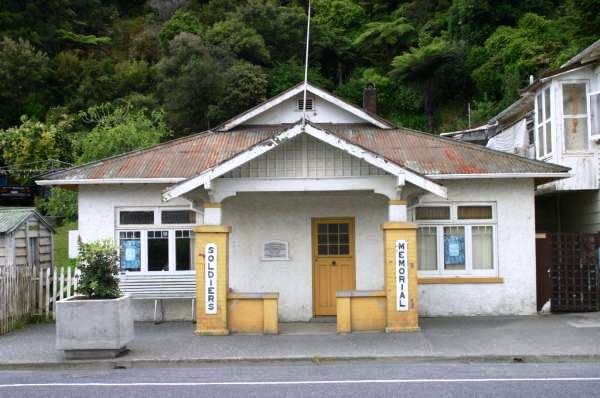
After the Kaeo War Memorial Library ceased to function as a library, much of this significance was removed from the interior, even to extent of the removal of the rolls of honour from the building. However, externally, the building retains most of its original heritage significance.
List Entry Information
Status
Listed
List Entry Status
Historic Place Category 2
Access
Private/No Public Access
List Number
7393
Date Entered
27th June 1997
Date of Effect
27th June 1997
City/District Council
Far North District
Region
Northland Region
Extent of List Entry
Extent includes the land described as Lot 5 DP 33253 (RT NA119D/333), North Auckland Land District, and the building known as War Memorial Library thereon.
Legal description
Lot 5 DP 33253 (RT NA119D/333), North Auckland Land District
Status
Listed
List Entry Status
Historic Place Category 2
Access
Private/No Public Access
List Number
7393
Date Entered
27th June 1997
Date of Effect
27th June 1997
City/District Council
Far North District
Region
Northland Region
Extent of List Entry
Extent includes the land described as Lot 5 DP 33253 (RT NA119D/333), North Auckland Land District, and the building known as War Memorial Library thereon.
Legal description
Lot 5 DP 33253 (RT NA119D/333), North Auckland Land District
Why is this place significant?
Cultural Significance
This historic place was registered under the Historic Places Act 1993. The following text is from the original Historic Place Assessment Under Section 23 Criteria report considered by the NZHPT Board at the time of registration. Social: The building is a focal point for the community, serving as a meeting place and information centre as well as accommodating the library. Spiritual: As a war memorial the Kaeo library commemorates the community's war dead from two world wars. It serves as an important emotional tie for many old families in the area who lost relatives in both wars. In addition to the two rolls of honour, the building contains RSA flags and insignia and a plaque commemorating World War I.
Historic Significance
Historical Significance or Value This historic place was registered under the Historic Places Act 1993. The following text is from the original Historic Place Assessment Under Section 23 Criteria report considered by the NZHPT Board at the time of registration. Historical: The site for the library was purchased by the former Whangaroa County Council in 1917. The building was constructed three years later as a memorial to local war dead. Funds were raised by donation and represented a tremendous effort by a small and wide-spread population. A loan obtained to finance the project was paid back within 18 months. Following World War II, a second roll of honour was added. Additions were made to the rear of the building. c.1950 and the floor was raised in 1984.
Physical Significance
This historic place was registered under the Historic Places Act 1993. The following text is from the original Historic Place Assessment Under Section 23 Criteria report considered by the NZHPT Board at the time of registration. Architectural: The Kaeo War Memorial Library was designed in the Inter War California Bungalow style of the period 1915-1940. Style indicators are: - Visually prominent low-pitch roof. - Wide eaves overhang. - Street-facing gable. - Gable ventilator. - Roughcast rendering. - Pylon with slab capping (supporting roof over the main entrance). - Geometric pattern lead-light glazing.
Why is this place Category 1 / Category 2?
Detail Of Assessed Criteria
This historic place was registered under the Historic Places Act 1993. The following text is from the original Historic Place Assessment Under Section 23 Criteria report considered by the NZHPT Board at the time of registration. (b) The association of the place with events, persons, or ideas of importance in New Zealand history: Persons: World War I affected every New Zealand community. Of the 100,000 New Zealanders who served outside the country, 16,000 died and another 45,000 were injured. The Kaeo War Memorial Library is of significance to the local community as a tangible link with those who lost their lives in World Wars I and II. As the names of those commemorated have not been provided as part of the nomination for registration, it is not known what their individual experiences and backgrounds were. This does not reduce their significance in terms of New Zealand's history however, as most of those who lost their lives in both World Wars were "ordinary" New Zealanders, a great many from small rural communities such as Kaeo. (g) The technical accomplishment or value, or design of the place: DATE: 1920 ARCIDTECT: Not known STYLE CODE: 44. Inter War California Bungalow, 1915-1940 DESIGN: The Kaeo War Memorial Library was designed in the popular California Bungalow style. Deriving from the English Arts and Crafts movement, the bungalow became popular in the United States at the turn of the century, especially in the temperate climate of California. The Bungalow was essentially a domestic form of architecture planned for casual living. Similarities between the West Coast of America and Australia and New Zealand led to the style becoming very popular in new Zealand where the preferred building material was timber, as in America, Australian examples were invariably designed in brick. The choice of this style for Kaeo War Memorial library was therefore not unusual, and the homely aspects associated with it may have been considered to be an appropriate way in which to commemorate the soldiers of Kaeo. (m) Such additional criteria not inconsistent with those in paragraphs (a) to (k): There are one hundred and thirteen registered places which are war memorials in one form or another. At the time the Kaeo War Memorial Library was built the dominant view, reinforced by Sir James Allen, Minister of Defence, was that war memorials should be non-utilitarian artistic structures representing the view that the Great War was fought to preserve idealistic and spiritual values. War memorials in the form of libraries or, to give examples of other types of "utilitarian" memorials, halls, clock towers, and bridges, were discredited on the grounds that they were appropriate only for "ordinary needs" but not for the commemoration of a World War. Because of this only a tiny percentage of World War One Memorials were actually built as war memorial libraries. Jock Phillips could only find seven altogether out of a total sample of 452 recorded memorials. The national register has only one listed, the Peace Memorial Library, Le Bons Bay, Banks Peninsular, built in 1919, and registered Category II. This latter place is a very small building consisting of a single room with an entry porch and two rolls of honour inside. It was registered as an example of the "utilitarian" type of structure favoured by small communities - which Kaeo, like Le Bons Bay would be - but opposed by community leaders like Sir James Allen. The library at Kaeo is obviously a more substantial building by comparison, and indeed it has stylistic pretensions as noted above. This lends added interest value to its primary significance, which is that it is another rare example of the utilitarian war memorial type designed after the First World War as a community library, and justified by the community on the grounds that the purpose of a library was to inculcate "higher values".
Why is this place significant?
Cultural Significance
This historic place was registered under the Historic Places Act 1993. The following text is from the original Historic Place Assessment Under Section 23 Criteria report considered by the NZHPT Board at the time of registration. Social: The building is a focal point for the community, serving as a meeting place and information centre as well as accommodating the library. Spiritual: As a war memorial the Kaeo library commemorates the community's war dead from two world wars. It serves as an important emotional tie for many old families in the area who lost relatives in both wars. In addition to the two rolls of honour, the building contains RSA flags and insignia and a plaque commemorating World War I.
Historic Significance
Historical Significance or Value This historic place was registered under the Historic Places Act 1993. The following text is from the original Historic Place Assessment Under Section 23 Criteria report considered by the NZHPT Board at the time of registration. Historical: The site for the library was purchased by the former Whangaroa County Council in 1917. The building was constructed three years later as a memorial to local war dead. Funds were raised by donation and represented a tremendous effort by a small and wide-spread population. A loan obtained to finance the project was paid back within 18 months. Following World War II, a second roll of honour was added. Additions were made to the rear of the building. c.1950 and the floor was raised in 1984.
Physical Significance
This historic place was registered under the Historic Places Act 1993. The following text is from the original Historic Place Assessment Under Section 23 Criteria report considered by the NZHPT Board at the time of registration. Architectural: The Kaeo War Memorial Library was designed in the Inter War California Bungalow style of the period 1915-1940. Style indicators are: - Visually prominent low-pitch roof. - Wide eaves overhang. - Street-facing gable. - Gable ventilator. - Roughcast rendering. - Pylon with slab capping (supporting roof over the main entrance). - Geometric pattern lead-light glazing.
Why is this place Category 1 / Category 2?
Detail Of Assessed Criteria
This historic place was registered under the Historic Places Act 1993. The following text is from the original Historic Place Assessment Under Section 23 Criteria report considered by the NZHPT Board at the time of registration. (b) The association of the place with events, persons, or ideas of importance in New Zealand history: Persons: World War I affected every New Zealand community. Of the 100,000 New Zealanders who served outside the country, 16,000 died and another 45,000 were injured. The Kaeo War Memorial Library is of significance to the local community as a tangible link with those who lost their lives in World Wars I and II. As the names of those commemorated have not been provided as part of the nomination for registration, it is not known what their individual experiences and backgrounds were. This does not reduce their significance in terms of New Zealand's history however, as most of those who lost their lives in both World Wars were "ordinary" New Zealanders, a great many from small rural communities such as Kaeo. (g) The technical accomplishment or value, or design of the place: DATE: 1920 ARCIDTECT: Not known STYLE CODE: 44. Inter War California Bungalow, 1915-1940 DESIGN: The Kaeo War Memorial Library was designed in the popular California Bungalow style. Deriving from the English Arts and Crafts movement, the bungalow became popular in the United States at the turn of the century, especially in the temperate climate of California. The Bungalow was essentially a domestic form of architecture planned for casual living. Similarities between the West Coast of America and Australia and New Zealand led to the style becoming very popular in new Zealand where the preferred building material was timber, as in America, Australian examples were invariably designed in brick. The choice of this style for Kaeo War Memorial library was therefore not unusual, and the homely aspects associated with it may have been considered to be an appropriate way in which to commemorate the soldiers of Kaeo. (m) Such additional criteria not inconsistent with those in paragraphs (a) to (k): There are one hundred and thirteen registered places which are war memorials in one form or another. At the time the Kaeo War Memorial Library was built the dominant view, reinforced by Sir James Allen, Minister of Defence, was that war memorials should be non-utilitarian artistic structures representing the view that the Great War was fought to preserve idealistic and spiritual values. War memorials in the form of libraries or, to give examples of other types of "utilitarian" memorials, halls, clock towers, and bridges, were discredited on the grounds that they were appropriate only for "ordinary needs" but not for the commemoration of a World War. Because of this only a tiny percentage of World War One Memorials were actually built as war memorial libraries. Jock Phillips could only find seven altogether out of a total sample of 452 recorded memorials. The national register has only one listed, the Peace Memorial Library, Le Bons Bay, Banks Peninsular, built in 1919, and registered Category II. This latter place is a very small building consisting of a single room with an entry porch and two rolls of honour inside. It was registered as an example of the "utilitarian" type of structure favoured by small communities - which Kaeo, like Le Bons Bay would be - but opposed by community leaders like Sir James Allen. The library at Kaeo is obviously a more substantial building by comparison, and indeed it has stylistic pretensions as noted above. This lends added interest value to its primary significance, which is that it is another rare example of the utilitarian war memorial type designed after the First World War as a community library, and justified by the community on the grounds that the purpose of a library was to inculcate "higher values".
Construction Details
Start Year
1920
Type
Original Construction
Construction Details
Start Year
1920
Type
Original Construction
Historical and Associated Iwi / Hapū / Whānau
Completion Date
1st January 1997
Report Written By
Joan McKenzie, Wayne Nelson
Other Information
A copy of the original report is available from the NZHPT Northern region office Please note that entry on the New Zealand Heritage List/Rarangi Korero identifies only the heritage values of the property concerned, and should not be construed as advice on the state of the property, or as a comment of its soundness or safety, including in regard to earthquake risk, safety in the event of fire, or insanitary conditions.
Historical and Associated Iwi / Hapū / Whānau
Completion Date
1st January 1997
Report Written By
Joan McKenzie, Wayne Nelson
Other Information
A copy of the original report is available from the NZHPT Northern region office Please note that entry on the New Zealand Heritage List/Rarangi Korero identifies only the heritage values of the property concerned, and should not be construed as advice on the state of the property, or as a comment of its soundness or safety, including in regard to earthquake risk, safety in the event of fire, or insanitary conditions.
Current Usages
Uses: Commemoration
Specific Usage: Memorial - World War One
Former Usages
General Usage: Civic Facilities
Specific Usage: Library
General Usage: Commemoration
Specific Usage: Memorial - World War One
Themes
War Memorial
Web Links
description: The Memorials Register, New Zealand History Online, Ministry for Culture and Heritage.
Current Usages
Uses: Commemoration
Specific Usage: Memorial - World War One
Former Usages
General Usage: Civic Facilities
Specific Usage: Library
General Usage: Commemoration
Specific Usage: Memorial - World War One
Themes
War Memorial
Web Links
description: The Memorials Register, New Zealand History Online, Ministry for Culture and Heritage.
Location
Sign up to hear more
Get the latest heritage news, features and events delivered
straight to your inbox.
