

The town of Feilding was established in 1874 as part of a special settlement scheme created in 1867 and presided over by the Duke of Manchester, for whom the land purchased for the scheme was named after. The first English immigrants arrived in 1874 and, following extensive bush clearance, established dairy and sheep farms.
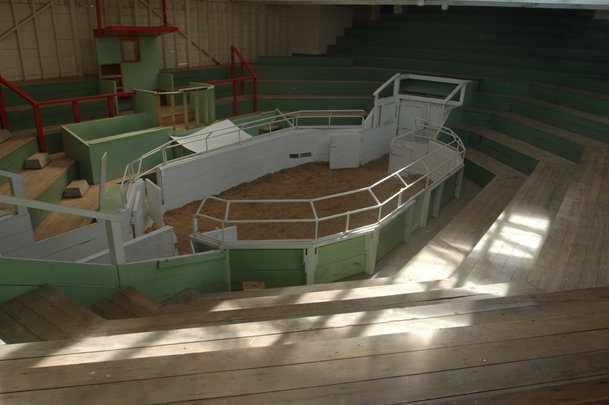
In 1902 the Feilding Industrial, Agricultural and Pastoral Association (I, A& P Association) was established and from 1906 held its first ram fairs in the days following the annual show. In the early 1920s it was decided to build a permanent pavilion and rostrum for sheep displays. The Pavilion was built by local builder Jack Edwards of Wilkinson Construction, and was completed in 1923. In the following year permanent sheep pens were added to the rostrum for ease of penning and showing sheep. These were eventually covered. The completed pavilion was named the Manchester Jubilee Pavilion to mark the 50 years since the founding of the town. Since then, the only alteration has been the addition of two skylights in 1937.
For the past eighty years, stud and commercial sheep of all breeds and from all parts of New Zealand have been sold from the pavilion. Today ram fairs at the Feilding Sales Rostrum are a major calendar event for farmers in the Manawatu and elsewhere. The facility continues to be used not only for its original purpose of selling sheep, but the association also uses the Pavilion for sheep and fleece displays, Young Farmer of the Year contests, judging seminars and stock breeding meetings.
List Entry Information
Status
Listed
List Entry Status
Historic Place Category 2
Access
Private/No Public Access
List Number
7515
Date Entered
13th June 2003
Date of Effect
13th June 2003
City/District Council
Manawatū District
Region
Horizons (Manawatū-Whanganui) Region
Legal description
Pt Lot 14 DP 1076
Status
Listed
List Entry Status
Historic Place Category 2
Access
Private/No Public Access
List Number
7515
Date Entered
13th June 2003
Date of Effect
13th June 2003
City/District Council
Manawatū District
Region
Horizons (Manawatū-Whanganui) Region
Legal description
Pt Lot 14 DP 1076
Why is this place significant?
Cultural Significance
Cultural Significance The Sheep Rostrum at Feilding has been a meeting place for hundreds of stud breeders and stock buyers from throughout New Zealand and overseas for 80 years. It is a major venue for sheep sales and A & P show displays of stock breeds in this country. An attempt was made in the early 1980s to shift the sales venue to Palmerston North. There was a public outcry, and the sheep rostrum sales were quickly returned to Feilding.
Historic Significance
Historical Significance or Value The Manawatu District is a significant North Island Farming area and the Feilding town saleyards some distance away from the A & P showgrounds are the biggest sale yards in New Zealand. Unlike selling a flock of sheep, in particular high value rams at the Feilding sheep rostrum have become a very special event for stud vendors, stock buyers and the auctioneers promoting the sheep sales. Since sales began there in the 1920s, stud and commercial sheep of all breeds from all parts of New Zealand have been sold. Stud stock have dominated the sheep industry, be it the fat lamb of yesteryear to the lean meat used in the chilled added value market of today. Buyers come from throughout New Zealand to the annual ram fairs in Feilding. It is also a significant display for stock breeds and a conference in the stock breeding industry.
Physical Significance
Physical Significance The sheep rostrum building has been designed to maximise the participation of stock sellers and buyers in the same way as Wool Exchange buildings in New Zealand were designed for wool agents to bid for their clients on tiered seating and everyone could see the auctioneer on the auditorium floor. In this instance, the sheep rostrum, the selling structure has a simple but effective viewing platform for the auctioneer to see his/her audience with the stock immediately below. The sheep pens, simple timber channels feed the stock direct to an enclosed arena. The stock cannot escape until they are let out. These structures are similar to those in operation at sale yards in other parts of the country, built specifically for sales operations and display areas for stock.
Why is this place significant?
Cultural Significance
Cultural Significance The Sheep Rostrum at Feilding has been a meeting place for hundreds of stud breeders and stock buyers from throughout New Zealand and overseas for 80 years. It is a major venue for sheep sales and A & P show displays of stock breeds in this country. An attempt was made in the early 1980s to shift the sales venue to Palmerston North. There was a public outcry, and the sheep rostrum sales were quickly returned to Feilding.
Historic Significance
Historical Significance or Value The Manawatu District is a significant North Island Farming area and the Feilding town saleyards some distance away from the A & P showgrounds are the biggest sale yards in New Zealand. Unlike selling a flock of sheep, in particular high value rams at the Feilding sheep rostrum have become a very special event for stud vendors, stock buyers and the auctioneers promoting the sheep sales. Since sales began there in the 1920s, stud and commercial sheep of all breeds from all parts of New Zealand have been sold. Stud stock have dominated the sheep industry, be it the fat lamb of yesteryear to the lean meat used in the chilled added value market of today. Buyers come from throughout New Zealand to the annual ram fairs in Feilding. It is also a significant display for stock breeds and a conference in the stock breeding industry.
Physical Significance
Physical Significance The sheep rostrum building has been designed to maximise the participation of stock sellers and buyers in the same way as Wool Exchange buildings in New Zealand were designed for wool agents to bid for their clients on tiered seating and everyone could see the auctioneer on the auditorium floor. In this instance, the sheep rostrum, the selling structure has a simple but effective viewing platform for the auctioneer to see his/her audience with the stock immediately below. The sheep pens, simple timber channels feed the stock direct to an enclosed arena. The stock cannot escape until they are let out. These structures are similar to those in operation at sale yards in other parts of the country, built specifically for sales operations and display areas for stock.
Construction Professional
Name
Jack Edwards
Type
Builder
Biography
No biography is currently available for this construction professional
Construction Details
Start Year
1920
Finish Year
1923
Type
Original Construction
Start Year
1923
Type
Addition
Description
Two skylights added to the rostrum building
Construction Materials
Timber construction throughout with corrugated iron roof.
Construction Professional
Name
Jack Edwards
Type
Builder
Biography
No biography is currently available for this construction professional
Construction Details
Start Year
1920
Finish Year
1923
Type
Original Construction
Start Year
1923
Type
Addition
Description
Two skylights added to the rostrum building
Construction Materials
Timber construction throughout with corrugated iron roof.
The building is of timber construction both exterior and interior. The rostrum measures 284.24m and the display area 514.18 and the sheep pens 113.1.15m. The rostrum as defined by the Oxford Dictionary is a platform for public speaking; in this case a sheep auctioneer's rsotrum and place for stock agents and clerks to see stock buyers. There is a timber bench seating on all four sides of the building for stock buyers and sellers with the sales rostrum above the sheep display pen. The special features of the rostrum are the acute angles used in it construction to enable stock vendors, buyers and auctioneers to have clear views of the sales ring and the auctioneers can see where the buyers are sitting. No matter where one sits or stands, there is an unobstructed view of animals on display or for sale. The only alteration to the building since 1920 has been the addition of two skylights in 1937. The sheep rostrum facility can hold up to 500 people.
The building is of timber construction both exterior and interior. The rostrum measures 284.24m and the display area 514.18 and the sheep pens 113.1.15m. The rostrum as defined by the Oxford Dictionary is a platform for public speaking; in this case a sheep auctioneer's rsotrum and place for stock agents and clerks to see stock buyers. There is a timber bench seating on all four sides of the building for stock buyers and sellers with the sales rostrum above the sheep display pen. The special features of the rostrum are the acute angles used in it construction to enable stock vendors, buyers and auctioneers to have clear views of the sales ring and the auctioneers can see where the buyers are sitting. No matter where one sits or stands, there is an unobstructed view of animals on display or for sale. The only alteration to the building since 1920 has been the addition of two skylights in 1937. The sheep rostrum facility can hold up to 500 people.
Historical and Associated Iwi / Hapū / Whānau
Completion Date
25th June 2003
Report Written By
Helen McCracken
Information Sources
Feilding IA&P Association
Minutes of the Feilding IA&P Association.
Feilding Star
Feilding Star
Other Information
Please note that entry on the New Zealand Heritage List/Rarangi Korero identifies only the heritage values of the property concerned, and should not be construed as advice on the state of the property, or as a comment of its soundness or safety, including in regard to earthquake risk, safety in the event of fire, or insanitary conditions.
Historical and Associated Iwi / Hapū / Whānau
Completion Date
25th June 2003
Report Written By
Helen McCracken
Information Sources
Feilding IA&P Association
Minutes of the Feilding IA&P Association.
Feilding Star
Feilding Star
Other Information
Please note that entry on the New Zealand Heritage List/Rarangi Korero identifies only the heritage values of the property concerned, and should not be construed as advice on the state of the property, or as a comment of its soundness or safety, including in regard to earthquake risk, safety in the event of fire, or insanitary conditions.
Current Usages
Uses: Civic Facilities
Specific Usage: Conference centre
Uses: Civic Facilities
Specific Usage: Showground
Current Usages
Uses: Civic Facilities
Specific Usage: Conference centre
Uses: Civic Facilities
Specific Usage: Showground
Location
Sign up to hear more
Get the latest heritage news, features and events delivered
straight to your inbox.
