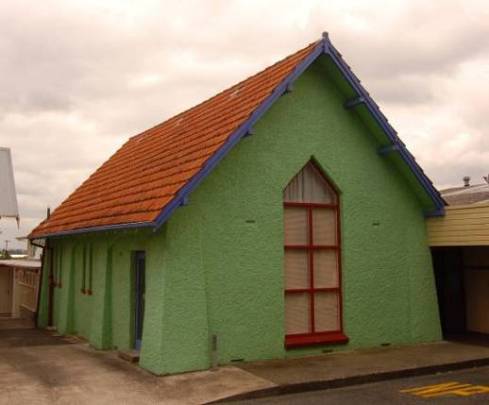
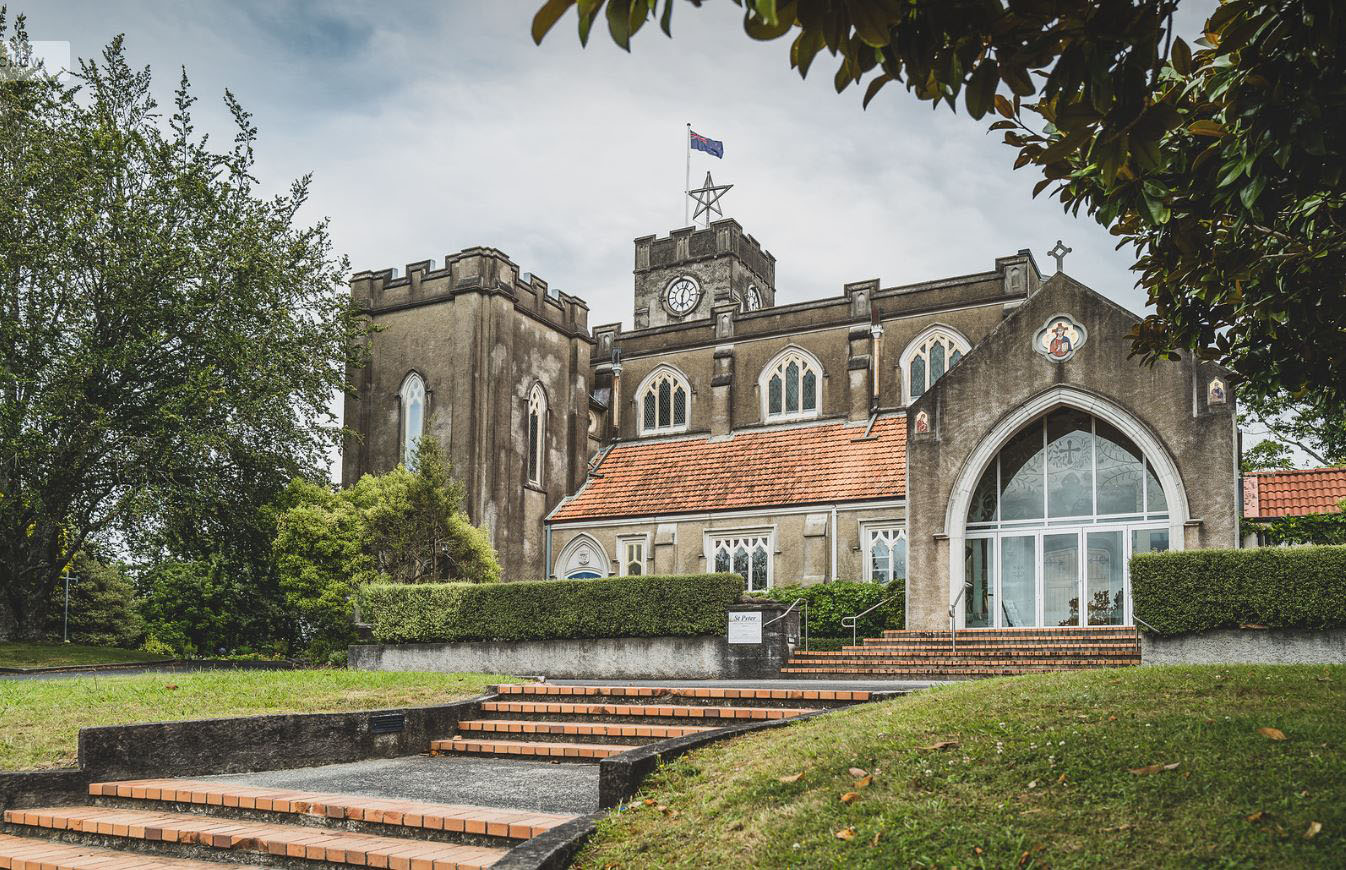
Bishopscourt in Hamilton was originally a substantial concrete residence designed by noted architect Frederick C. Daniell by 1912. It served as the home of the first Bishop of Waikato and as a theological school, before becoming the Hamilton base for the Young Women's Christian Association (YWCA) from 1954 to present day.
Daniell was an early twentieth century Hamilton architect and Bishopscourt bears many of the hallmarks of his style. In particular, Daniell is notable for his comparatively early use of the reinforced 'Camerated Concrete' construction system along with aerated concrete. His house designs typically followed the fashion of the day for villas and bungalows and Bishopscourt is an interesting hybrid of the two.
After a period as a family home, the property was bought by the Anglican Church in 1926 as the residence of the first Bishop of Waikato. Within months the Episcopal Chapel was commissioned and built from plans thought to be by the Waikato Architect H. I. Foster, in memory of the Bishop's mother and his first wife. St Anselm's Theological School was also set up early on, operating out of Bishopscourt to reduce costs. The School enabled men intending to go into the ministry, to gain matriculation, so that they would be eligible for a scholarship from St John's College enabling further study at the University of New Zealand. The large public rooms of the house could accommodate up to twenty people each, so during the Bishopscourt period the buildings were used to host visiting dignitaries such as the Archbishop of Canterbury, and to provide a venue for meetings, such as the AGM of the Council of the Mothers Union. The house was bitterly cold so a new Bishopscourt residence was purchased, and the chapel deconsecrated in 1953.
The property briefly became a boarding house called 'Bank View' before being purchased by the Young Women's Christian Association (YWCA) Hamilton branch in 1954. The Episcopal Chapel was used as a club room and dance studio, and the house as accommodation and office space. In 1957 White, Leigh, De Lisle and Fraser, architects of Hamilton, were commissioned to design upgraded facilities that included closing in the spacious verandah to create more office and bedroom spaces which were completed in 1963. The YWCA programs were expanding along with Hamilton's population, causing space problems, but the membership were outraged at the suggestion of the Building Advisory Committee that Bishopscourt should be demolished, believing that the building should be preserved at all costs. Thus the YWCA complex has grown around the two original buildings. A wide variety of services to women and young children were run out of the two buildings, including a crèche for about thirty years and accommodation for other not for profit groups.
In 1997 a joint project unique to Hamilton, between the YWCA and Whakahou Services began, that saw the chapel transformed into Te Whare Wahine, a Maori women's space, decorated by Maori women who had experienced family violence and their supporters. The National Women's carving group helped with designing and making carved panels featuring atua/goddesses which tell stories of courage, survival and hope. The renewed space was opened in 1999 and the project won Hamilton City's Civic Trust premier project award. This initiative has very rapidly become recognised as part of the cultural history of the place.
Bishopscourt has architectural and technological significance with the residence being a representative example of an early domestic building using the reinforced 'Camerated Concrete' construction system, by noted Waikato architect Frederick C. Daniell. Architect H.I. Foster's design for the Chapel created a sympathetic and affordable ecclesiastical building to accompany it. In addition to architects Daniell and Foster, the site is also associated with the significant Waikato architectural firm, White, Leigh, De Lisle and Fraser. There is substantial material available on some of these firms, providing an opportunity for research and education using the buildings. The place also provides a window on the transformation of a substantial residential building on the edge of a small rural centre, to the first Bishop's residence of the newly created Waikato Diocese, then becoming the home of an organisation committed to the provision of affordable accommodation, training and social services for young women and their children in the central business district of New Zealand's fourth largest city. The site has a history of ownership and management by Waikato women, Maori women, and the not-for-profit sector that serves them.
Bishopscourt and the Chapel's, now Te Whare Wahine's, survival has been despite many past attempts to have it demolished and replaced with more modern facilities. However, present day management of the YWCA of Hamilton have proactively sought to retain the buildings and have community support in this, as shown by a number of positive letters and articles in local media.