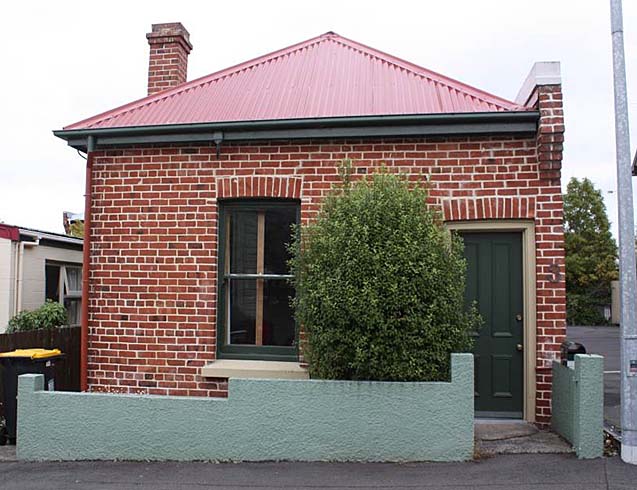
North Dunedin
The history of coastal Otago relates to the tradition of the waka Arai Te Uru and provides the basis of tribal identity, recalled in place names and tribal histories. Muaūpoko (Otago Peninsula) provided shelter for settlements, and Waitaha, Ngāti Māmoe and Ngāi Tahu, who all visited and lived in the vicinity. At one time up to 12 kāinga existed in the lower Otago harbour. Local resources were important to iwi, and with the Pākehā settlement in the late 1840s there was a significant loss of access to land-based food sources. When Dunedin was established in 1848, the traditional use of the harbour changed forever.
A Worker’s Cottage
From the 1860s North Dunedin developed into a densely populated suburb spotted with tiny worker’s houses. The scale is in contrast to the generous residences overlooking the tight streets. In 1862, the land along the single lane Titan Street was subdivided into 52 allotments. John Roberts owned the section on which the cottage stands, part of his two section holding running from Titan Street through to Dundas Street. The neighbouring sections were owned by Mary Heads, Elizabeth Girvan and Richard Tilbury. Roberts sold section 10 to Elizabeth Girvan in 1897 and his remaining land to Thomas and Edward Hitchcock in 1903. In 1907 Edward transferred his share to Thomas who sold the property to Tilbury.
The house was built for ‘Express proprietor’ Tilbury in 1909, probably by A. Mitchell, and was most likely rented out. In the twentieth century the house has remained a modest residence: cook Edwin Girvan bought the house in 1920, fireman Thomas Souness bought the house in 1924, and civil servant William Fogarty owned the house from 1949. Through the 1970s, it was owned by a series of Chinese families – including fruiterer Peter Ming Wong and wife Mary, fruiterer George Wong and Hing Man, a Dunedin Woollen worker. In the 1980s, the house changed hands several times before Robert Lord bought it in 1988.
Playwright Robert Lord and New Zealand Theatre
Robert Lord was born in Rotorua, studied for an Arts Degree at Victoria University and in 1969 was awarded the Katherine Mansfield Young Writers Award. His first full length play It Isn't Cricket premiered at Downstage Theatre in 1971. From 1970-74, he was on ACT magazine’s editorial board and he cofounded the pioneering and successful writers’ agency Playmarket. Lord was a larger than life, energetic and engaging man – irreverent and subversive - he christened Downstage’s show-stopping centre of attention theatre cat ‘Fucky’, who specialised in walk on roles, and provided another item to pre-show list of things to do for the stage manager: lock Fucky in the box office. His plays are even more irreverent.
Scholar Susan Williams writes that drama was ‘the slowest of the arts to develop an authentic New Zealand “voice.”’ Considering the work of five playwrights (Bruce Mason, James K. Baxter, Mervyn Thompson, Renee and Robert Lord) she describes their significance in enlivening New Zealand culture while at the same time extending the margin the voices of women, Māori and gay people. She writes that in ‘less than forty years, they have helped facilitate the transition of New Zealand theatre from amateur to professional status and have been instrumental in providing the practical framework whereby future New Zealand playwrights may find an outlet in their work.’ Before the 1950s New Zealand theatre ‘mimicked the theatre of the perceived ‘centre’’, often feeling it necessary to set their plays in the British Isles in order to ‘make them acceptable to theatre-going audiences.’ Exploring the ‘margin’ enabled New Zealand dramatists to discover a ‘representative national ‘voice’ and so ‘develop a new individual’ dramatic tradition.
The importance of drama as a form of literature in New Zealand is under-represented. In the introduction to their interviews with contemporary playwrights, Michelanne Forster and Vivienne Plumb write that a recent anthology of New Zealand literature includes just 20 pages out of 1,048 on dramatic writing, but is outdone by The Penguin History of New Zealand Literature, which fails to mention dramatic writing. They consider that playwrights ‘have a vital voice in defining who we are as a people and as a nation.’ Academic Hilary Halba writes that Lord’s work was miniaturist, quoting Lord’s friend, American director Jack Hofsiss who describes Lord’s particular brilliance as his ability to ‘honour the little and understand it as a gateway to the larger’ –studying large scale social issues by investigating small-scale social situations. Halba writes that these ‘microcosmic “small” universes were made “big” through the vitality of Lord’s language, which features repetitions, lurid and baroque descriptions, complex minutiae of plot points, language patterning, and an exuberant specificity in adjectives and adverbs.’
John Thomson’s history of New Zealand drama records that Lord was one of New Zealand’s successful playwrights. He was, Thomson says, the least ‘obviously concerned with “society”’, and exploited the new interest in New Zealand. He wrote during the ‘Professional Years’ (1970-1980) where professional theatre was being established, and where theatres were interested in performing New Zealand plays.
Playmarket
In the 40 years since Playmarket was founded, ‘the art of New Zealand playwriting has changed beyond recognition. Once it was a rarity for a locally written play to be performed by a professional theatre company, now it is the norm.’ Co-founder Nonnita Rees writes that the ‘premise for establishing Playmarket was to do what needed to be done to get New Zealand plays into theatres where they could be experienced by New Zealand audiences.’
Robert Lord worked at Wellington’s Downstage Theatre in the early 1970s (as part-time publicity officer for Downstage and ‘defacto playwright-in-residence’). Lord, whose play It Isn’t Cricket (1971) was selected at one of the first Australian National Playwrights’ Conferences, came back inspired to get New Zealand writing into theatres. He gathered together Judy Russell, Nonnita Rees and Ian Fraser – and came up with the idea of a writer’s agency called Playmarket. Playmarket worked first to encourage script writers, assess new scripts, and later to represent writers’ interests and to workshop new scripts. Playmarket established the play workshopping process in New Zealand, transforming the opportunities for the country’s playwrights.
Theatre historian Howard McNaughton writes that Lord began writing at a time when theatre was turning from the proscenium and raised stage towards more intimate productions where ‘confrontation between actor and audience was almost entirely on a personal basis, unqualified by any decorative element other than the nonrepresentational effects of light and music.’ Dramatists, like Lord, wrote to exploit these conditions (which were in part a reflection of low budgets and limited resources). McNaughton writes that Lord ‘remains an important transitional writer for his sustained attempt to reconcile the intimate reality of most New Zealand theatre with the generic and abstract possibilities of a severely economical dramaturgy.’
Making a home
In 1974 Lord travelled across the United States on his way to the O'Neil Playwrights Conference in Connecticut. He relocated to the States, but kept close personal and professional ties with New Zealand. In the 1980s Lord was based in New York, where his play Well Hung was well received at the Trinity Square Repertory. Lord became a leading figure in the New Dramatists group. His work was seen throughout New Zealand as well as in Australia, Canada and the United States. He was playwright in residence at Auckland's Mercury Theatre and Burns Fellow at Otago University in 1987, while also writing television programmes and screen plays. He was represented by Gilbert Parker of the William Morris agency – one of the few New Zealand dramatists to secure a major agent. He never lost his connection to New Zealand.
In 1988 Lord returned to home – finding audiences more receptive to New Zealand drama; writing a play was no longer seen as a perversion. He looked for a property in Dunedin– choosing finally this small, central, easy-to-maintain dwelling, with the potential for a tower and studio out the back. In November 1990, he returned to Dunedin, and in 1991 was appointed Fortune Theatre’s playwright in residence. Lord set about organizing the garden, planting trees, and altering the house to his requirements and aesthetic. He lived at Titan Street until his death in January 1992 – a month and thirteen days before his last play Joyful and Triumphant (an ‘epic and a miniaturist’ New Zealand drama) opened at Circa Theatre. His funeral at All Saints Church was followed by a wake at Titan Street – attended by family and friends – including figures such as John McDavitt from Playmarket, Sunny Amey (ex-Downstage), writer and journalist Mike Nicolaidi, actor Sam Neill and Michael Houstoun. Robert’s body was cremated and his ashes returned to his mother Bebe who buried half of them on her Auckland property, in 1993 burying the other half under the kowhai tree at Titan Street.
When Lord returned to Dunedin, he was aware he was dying of an AIDS-related illness, and with the future in mind set up the ‘Writers Cottage Trust’ to allow his cottage to be used in perpetuity writer-in-residence accommodation. The Trust’s aims were to ‘foster the growth and development of New Zealand literature and writers’, ‘to bring writers to Dunedin to enrich the city’s literary life’, to ‘support and assist established writers by providing accommodation in Dunedin free of rental as a retreat, to enable such writers to work on literary projects’. Writers also had the possibility of financial assistance in consultation with the Queen Elizabeth II Arts Council and its literary committee. Lord, who had had not always had the luxury of being able to write fulltime and lived on the smell of an oily rag, wanted to assist others.
On Lord’s death in 1992, the cottage was transferred to the Robert Lord Writer’s Trust, with the first resident being Elizabeth O’Connor. In 2003 Bebe Lord (who had a life interest in the property), marked the tenth anniversary of Robert’s death by making the cottage formally available as a writer’s residence. Lord’s commitment to the Arts and to drama in New Zealand is shown in his bequest. Playmarket records that Lord’s ‘commitment to New Zealand writing is reflected in his decision to make his Dunedin cottage available to writers after he died at the age of 46.’
Robert Lord Writer’s Residency
Writers’ residences and writer’s residencies have cultural special significance – both as places of commemoration, and as nurseries of cultural development. Cultural historian Harald Hendrix writes:
‘[w]riters’ houses have meaning, even beyond their obvious documentary value as elements in the author’s biography. There are a medium of expression and of remembrance. Planning, building and decorating a house provides a writer the opportunity not only to materialize his architectural fantasies and fictions, but also to experiment with a mode of expression fundamentally different from his own. To some authors a place to live, whether or not purposely created, means nothing more than a frame for his art, a tool that contributes to the making of literature. To others, a house is an object of prestige. It can express social or cultural status or the hope for it, and be a means to immortalize and remember such success. But expression and remembrance fuse most in houses created by authors as a work of art, as a parallel or alternative to their poetry or narrative. Such places not only are thought to be statements on art, on what is expressed and how it can be best expressed. They, moreover, perpetuate these artistic assertions, being turned into monuments by the builders themselves, their heirs, or by later generations of admirers.’
Transforming a writer’s house into a residency or a museum is a ‘second process of memory-making.’ Visiting writers participate in a kind of ‘material contact’ with Lord – contributing to the making of ‘cultural memory.’ The cottage is not a museum but an experience of sharing Lord’s space, and experiencing his vision for promoting New Zealand writing, and continuing the value that he placed in literature. Hendrix writes that building or decorating a house (as Lord decorated his house) ‘can be a tool to express and demonstrate his opinions on what literature may or may not be able to accomplish, or which direction it should take.’
Hendrix writes of the importance of place for a writer: ‘Our unconscious is ‘located.’ Our soul is a dwelling. And while remembering ‘houses’ and ‘rooms’ we learn how to dwell in ourselves.’ Writer’s houses are ‘instruments of self-fashioning’, with houses shaping the writers dwelling in them. Writers’ houses change meaning once they become a place of remembrance, sliding ‘from the sphere of personal and individual into that of collective and cultural memory.’ Meanings are projected onto the house, the writer’s own views often being appropriated by others, and ‘who in their turn may project their meaning and memories onto the house.’ ‘Hendrix considers that as a ‘medium of remembrance’, writers’ houses not only recall the poets and novelists who dwelt in them, but also the ideologies of those who turned them into memorial sites. In its use as a writer’s residence, the house may ‘condition the way in which an author thinks and works, by association or through memory, willingly and consciously or not. Besides being shaped by writers, houses shape the writers dwelling in them.’
Robert Lord’s cottage reflects both the author himself and the authors that live in his space, and who contribute something of themselves – whether by gifting chattels to the house, or contributing to the narrative of the house by writing in the visitor’s book. Writer’s residencies have played a significant role in fostering literary or artist endeavours. The Robert Lord Writers’ Cottage compares with Dunedin’s Caselberg Trust residency based at John and Anna Caselberg’s house at Broad Bay on Otago Peninsula, and to the Hone Tuwhare Crib at Kaka Point in the Clutha district. The Robert Lord Writers’ Cottage writer’s residency also contributes to Dunedin’s literary identity as recognised by its declaration as a UNESCO Creative City of Literature in 2014. By 2017 fifty writers will have benefited from the residency.
Residency programmes have an important role in fostering writing. Nancy Earle, writing about Canadian programmes, argues that such programmes are ‘materially significant in supporting writers.’ Speaking of residencies, many of which were associated with academic institutions, Earle writes that a ‘writer-in-residence is not an author with a day-job as a creative writing instructor. Nor is he or she simply an author with a patron. A writer-in-residence is an author who is provided with time and space to write in exchange for the adoption of a public role’, positioned as a ‘professional freelancer’, with duties ranging from the ‘specialised to the symbolic.’ The author acts as a mentor to aspiring writers, as guest speakers, editors, a presence at functions and the like, that is performing a function that is ‘culturally and socially significant.’ A writer-in-residence acts as a ‘touchstone of the national culture, firmly ensconced within national boundaries, not languishing in a foreign garret or living it up as a expat in Paris, London, New York, or Los Angeles.’
Earle writes that writers themselves have expressed opinions about the role of the resident writer: ‘a travelling mountebank, a tamed poetic cat, a token artistic nigger, a cheap teacher, a showpiece, a placeman, an artist in performance of his art, a Court Jester, and Interesting Person, a real live author.’ The visitors’ book at Robert Lord Writers’ Cottage reflects a positive view of their experience and the privilege of being able to devote themselves to their craft. The feelings expressed by authors ‘call attention to the social and economic positions of authors.’ This kind of support is an economic necessity for writers struggling to make a living and to make connections in the literary world. Residency programmes do overcome isolation ‘between writers, between literary communities and those potential writers who have few exemplars in their everyday worlds….’ In return, the writer contributes to a developing culture – Searle writes that a writer-in residence ‘is a valuable contributor to the national culture in both the widest and the more narrow sense of the word.’
Residency programmes associated with universities tended to develop first – the Robert Burns Fellowship at the University of Otago, established in 1958, aimed ‘to encourage and promote imaginative New Zealand literature and to associate writers with the University.’ As in other places, later residencies included those provided by authors themselves, focusing on ‘strengthening an association between writer and place, and encouraging others to follow in the writers’ footsteps.’ These residencies ‘imbue cities and smaller communities with a sense of a distinct literary identity’, and can construct a ‘literary past and cultural present.’
The writers who have worked under Lord’s gaze report a dialogue with the absent playwright and their environment, including the surrounding rambunctious student community. They speak of the privilege of being given time and space to devote to writing, and the importance of the house itself. When editing Lord’s plays while sitting in Lord’s front room, academic and director Phillip Mann wrote ‘a retreat is a good way to go forward,’ emphasising the pause of time and space that such a residency allows. Mann writes that someone one day will write a dissertation on the ‘influence of small rooms on the creative process…A small room becomes ones castle. It soon comes to reflect and support one’s habits, be they to scatter papers on the floor or keep them ordered in a pile.’ The house and the garden provided memory of Robert, solace, inspiration, challenge and a home – and a sense of responsibility to living up to Robert’s vision. One writer commented ‘Dear Robert Lord, dear, dear Robert Lord. I never knew him but I feel now that I do. He watched over me & my novel cheekily enough, as other writers have found, sometimes encouraging me & sometimes telling me to lighten up, and occasionally openly (when I was being dramatic) scoffing! Seriously though, my time here has been so crucial and so advantageous to the unfolding of my book, which before now was trying to fit itself into little gaps & spurts of time.’ In 2016, the Robert Lord Writers’ Cottage remains home to visiting writers.