Quick links


Quick links
Quick links
Quick links
Quick links
Quick links
23 Story Place, Taupo Domain, TAUPO
Public
Historic Place Category 2
List No. 942


List Entry Information
Status
Listed
List Entry Status
Historic Place Category 2
Access
Able to Visit
List Number
942
Date Entered
2nd April 2004
Date of Effect
2nd April 2004
City/District Council
Taupo District
Region
Waikato Region
Extent of List Entry
Registration includes the building, its fixtures and fittings and land beneath its footprint on part Historic Reserve Gazette 1983 p.17.
Legal description
Secs 5 and 8 Blk XXXVI Town of Taupo (Historic Reserve NZ Gazette 1983, p.19)
Why is this place significant?
Historic Significance
Historical Significance or Value It is historically important for its close association with the role and deployment of the Armed Constabulary, the extension of government authority over the central North Island, and the origins of Taupo as a colonial township.
Physical Significance
The former Magazine has high architectural significance as one of very few nineteenth-century Armed Constabulary magazines believed to survive in New Zealand. It has technological value as an early example of local pumice stone construction in the Taupo area.
Why is this place Category 1 / Category 2?
Detail Of Assessed Criteria
The former Magazine can be assigned Category II status. It reflects important and representative aspects of New Zealand history, including the role of the Armed Constabulary in the extension of government authority, and the contribution of munitions in this regard. The place has considerable potential for public education, being a distinctive and well-preserved structure located in a public reserve. The building is the earliest known European building in Taupo, and is one of the earliest in the region. It also has rarity value as one of only very few Armed Constabulary magazines believed to survive in New Zealand. The building forms an integral part of an important historical and cultural landscape. This includes the archaeological remains of Tapuaeharuru redoubt and an adjacent courthouse.
Construction Professional
Name
Armed Constabulary
Type
Architect
Biography
No biography is currently available for this construction professional
Name
Armed Constabulary
Type
Builder
Biography
No biography is currently available for this construction professional
Construction Details
Start Year
1873
Finish Year
1874
Type
Original Construction
Description
Original construction of Magazine
Type
Other
Description
Major restoration of interior
Period
1960s
Start Year
1972
Type
Modification
Description
Shallow trench around footings filled with concrete
Start Year
1983
Type
Modification
Description
Upper part of southern wall rebuilt
Construction Materials
Pumice walls with timber lining, floor and roof structure. The roof is clad with corrugated iron.
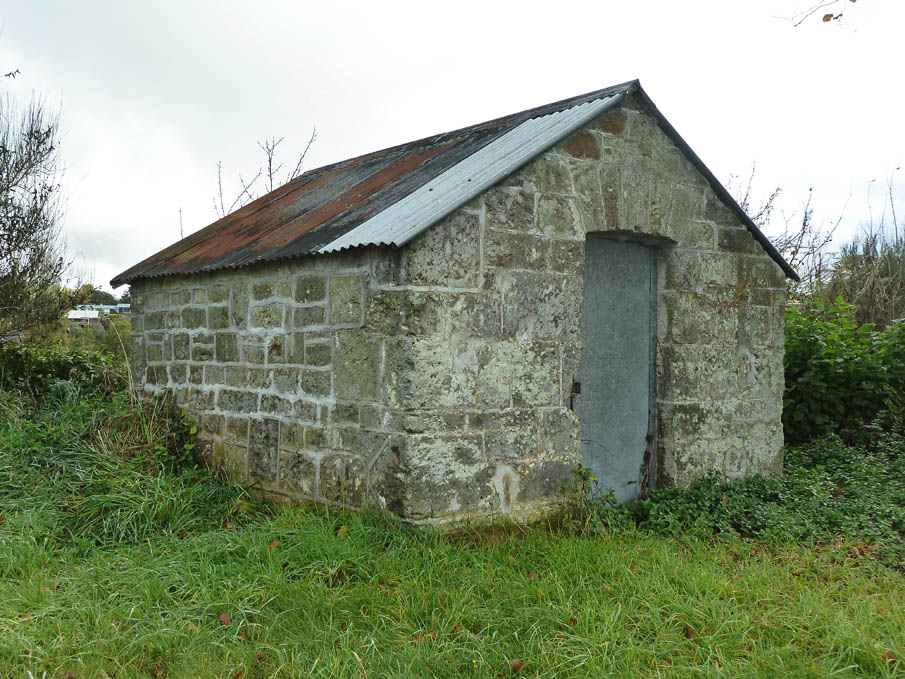
The former Magazine lies within the well-preserved earthwork remains of the Armed Constabulary redoubt in Taupo Domain, Taupo (NZAA archaeological site U18/2). It is the only structure within the fortification to have survived, although other historic remnants are preserved in the form of banks and ditches, archaeological deposits and exotic trees. The building lies on flat ground, close to the top of a steep scarp which runs down to the Waikato River. Both the building and the redoubt lie in a historic reserve that was administered by Heritage New Zealand (formerly New Zealand Historic Places Trust) until its transfer to Tuwharetoa in 2019 as part of a Treaty settlement. The former Magazine is a small stone structure, almost square in plan. It measures 3.35m. x 2.95 m., and is approximately 2.3. m high. The shorter western and eastern ends of the structure are gabled, supporting a shallow-angled roof. The building has a doorway in its eastern side, giving access to a single internal room. There are no windows or other apertures. The walls of the building are made up of pumice stone fragments, most of which are carefully dressed and rectangular in shape. The largest of these measures approximately 0.57m. x 0.32m. The stonework incorporates at least one string course and appears to have been originally bonded with lime mortar, although cement has been used to re-point much of the structure. Cement has also been employed in the 1980s rebuilding of the upper part of the southern wall. The building's timber-lined interior consists mostly of material inserted during restoration work in the 1960s, which replicated an earlier arrangement. The walls are made up of circular-sawn horizontal planks attached to vertical studs, while the floor has been renewed using totara boards. Some of the roof timbers pre-date the restoration work, as does much of the roof covering. The latter comprises tinned corrugated iron stamped 'Gospel Oak', with ridges that are centred 85mm. apart.
The former Magazine lies within the well-preserved earthwork remains of the Armed Constabulary redoubt in Taupo Domain, Taupo (NZAA archaeological site U18/2). It is the only structure within the fortification to have survived, although other historic remnants are preserved in the form of banks and ditches, archaeological deposits and exotic trees. The building lies on flat ground, close to the top of a steep scarp which runs down to the Waikato River. Both the building and the redoubt lie in a historic reserve that was administered by Heritage New Zealand (formerly New Zealand Historic Places Trust) until its transfer to Tuwharetoa in 2019 as part of a Treaty settlement. The former Magazine is a small stone structure, almost square in plan. It measures 3.35m. x 2.95 m., and is approximately 2.3. m high. The shorter western and eastern ends of the structure are gabled, supporting a shallow-angled roof. The building has a doorway in its eastern side, giving access to a single internal room. There are no windows or other apertures. The walls of the building are made up of pumice stone fragments, most of which are carefully dressed and rectangular in shape. The largest of these measures approximately 0.57m. x 0.32m. The stonework incorporates at least one string course and appears to have been originally bonded with lime mortar, although cement has been used to re-point much of the structure. Cement has also been employed in the 1980s rebuilding of the upper part of the southern wall. The building's timber-lined interior consists mostly of material inserted during restoration work in the 1960s, which replicated an earlier arrangement. The walls are made up of circular-sawn horizontal planks attached to vertical studs, while the floor has been renewed using totara boards. Some of the roof timbers pre-date the restoration work, as does much of the roof covering. The latter comprises tinned corrugated iron stamped 'Gospel Oak', with ridges that are centred 85mm. apart.
Historical and Associated Iwi / Hapū / Whānau
Completion Date
8th September 2004
Report Written By
Martin Jones
Information Sources
Cooper, 1989
B. Cooper, The Remotest Interior: A history of Taupo' Moana Press, Tauranga, New Zealand, 1989.
Mitchell, 1983
John Mitchell, 'The History and Archaeology of the Armed Constabulary Archaeological Sites along the Napier-Taupo Road, 1869-1885', MA research essay, University of Auckland, 1983
Historic Places in New Zealand
Historic Places in New Zealand
Other Information
A fully referenced version of this report is available from the NZHPT Northern Region Office Please note that entry on the New Zealand Heritage List/Rarangi Korero identifies only the heritage values of the property concerned, and should not be construed as advice on the state of the property, or as a comment of its soundness or safety, including in regard to earthquake risk, safety in the event of fire, or insanitary conditions.
Current Usages
Uses: Civic Facilities
Specific Usage: Historic Property
Current Usages
Uses: Civic Facilities
Specific Usage: Historic Property
Get the latest heritage news, features and events delivered
straight to your inbox.