Maori tradition tells of Wellington harbour and its entrances being formed by two taniwha, Ngake and Whataitai, who lived in the harbour when it was an enclosed lake. The first Polynesian navigators to come to the area were Kupe and Ngahue. Sometime after Kupe, Tara and Tautoki, the sons of Whatonga from the Mahia Peninsula, visited the harbour and were so impressed with the place that Whatonga decided to establish a settlement there. He named the harbour Te Whanganui-a-Tara (the great harbour of Tara) after his son.
Iwi who then settled around Wellington’s inner harbour and wider area included Ngai Tara, Ngati Ira, Ngati Kahungunu, Ngai Tahu and Ngati Mamoe. By 1819 when a war party comprising Taranaki, Te Atiawa, Ngati Toa, Nga Puhi and Ngati Whatua attacked the Wellington area it was mainly occupied by Ngati Ira, who were then driven out to the eastern side of the harbour and the Wairarapa. The Waitangi Tribunal found that by 1840 those Maori having rights in Wellington Harbour and its foreshore were Te Atiawa, Ngati Tama, Taranaki, and Ngati Ruanui.
The first European name given to Te Whanganui-a-Tara was Port Nicholson, after Captain J. Nicholson the harbour master at Sydney in 1826. In 1839 the Tory sailed into Port Nicholson. Aboard the ship were Edward Jerningham Wakefield (1820-1879) and his uncle Colonel William Wakefield (1803-1848). William Wakefield was charged with selecting the spot ‘which he should deem most eligible as the site of a considerable colony to make preparations for the arrival and settlement of the emigrants.’ It was Wellington’s harbour that was a key factor in the New Zealand Company choosing it as the location for its first organised settlement, as well as the new colony’s capital city, although it did not to achieve this position until 1865.
Early swimming in Wellington
Being located around a harbour there were plenty of places for sea bathing in Wellington. Longstanding swimming clubs like the Hataitai Amateur Swimming Club Incorporated started when a group of local residents leased a section of beach from the Wellington Harbour Board in order to build changing facilities.
More formal swimming facilities also have a long history in Wellington. There has been a swimming pool in the vicinity of Clyde Quay and Oriental Parade since 1862. These privately run salt water baths were formed by enclosing part of the harbour in order to protect patrons from ‘visits of sea monsters.’ The baths were built by Henry Meech who immigrated to Wellington aboard the Oriental in 1840. In 1898 the Wellington City Reclamation and Public Baths Act passed. This allowed for the creation of the Clyde Quay boat harbour, but also the building of Te Aro Baths, including reclamations if necessary. A provision of the Act was that this be done within five years or else the City Council’s claim to the land would cease.
Te Aro Baths were eventually built by the Council in 1900, slightly north of the location of the earlier swimming pool. Until 1924, when the Thorndon Summer Pool was constructed, this was the only public pool facility in central Wellington. As Wellington’s suburbs developed more outdoor swimming facilities were built. For example, the Khandallah Pool was opened in the 1920s by the Khandallah Progressive Association, and the Karori Pool followed in 1936.
Aside from therapeutic bathing facilities such as the Bath House at Rotorua (1908, List no. 141), Auckland’s Tepid Baths (1914, List no. 7377) and the Otago Therapeutic Pool (1946, List no. 7581), swimming in New Zealand was generally a summer activity until the 1960s, when the first indoor public pools were created. For example, the swimming events at Auckland’s 1950 British Empire Games were in an outdoor pool. By the 1960s some Wellington swimmers were voicing displeasure at a perceived disadvantage, when compared with other main centres, because there were no heated indoor pools for winter training and competitions. However, it appears that while some cities were considering indoor swimming pools in the late 1950s, most did not get built until the 1960s and 1970s. For example, the Dunedin City Council had been pursuing its Moana Pool idea since 1956 (opened November 1964), and in 1959 planning of Palmerston North’s Lido complex was underway (opened 1966). Wellington Swimming clubs were crying out for similar facilities, with proposals being put forward to cover the Thorndon Pool, as well as a joint proposal by the Hataitai Amateur Swimming Club and the local Rotarians for an indoor pool in the eastern suburbs. Neither of these proposals eventuated.
Wellington City Council had periodically considered a project to build an indoor pool at various locations around the city since the 1920s. The project gathered momentum in the post war period. However, the municipal engineers and architects were busy and short staffed in the early 1960s. Therefore, when finances became available and the location was finally decided upon, the design and construction was completed by private companies. Construction of Freyberg Pool was undertaken by local company Lemmon and Slack Construction Company Limited. The work was estimated as costing £163,700, a sum which was the result of several cost-reducing revisions of the design by King and Dawson Architects. The engineering required in reclaiming the land for the pool was undertaken by Wellington consulting engineers, D Bruce-Smith and Associates, who had a history of collaborating with King and Dawson on projects.
Creating Freyberg Pool
King and Dawson, the Wellington-based architecture firm, began designing the tepid pool on Oriental Parade in 1961. Other King and Dawson buildings on the New Zealand Heritage List/Rārangi Kōrero (‘the List’) include: Cuba Street’s Commercial/Retail Building (List no. 5364, Category 2 historic place) and Commercial/Retail Building (Craft Village (List no. 3628), Category 2 historic place). Before 1957 the firm was known as King, Cooke and Dawson, and they designed the Lower Hutt Central Fire Station (Former) (List no. 9319, Category 1 historic place). In 1963, the year that Freyberg Pool was completed, one of the firm’s partners, Eric Vernon Dawson (1914 – 1998?), was elected President of the New Zealand Institute of Architects (NZIA). A few years later the firm won the national Silver Award for their New Zealand Apple and Pear Board Marketing Board Cool Store in Nelson.
However, it was another partner, Jason Lewis Smith (1917-1964), who took the lead on the Freyberg Pool project. Born in India, trained in Ireland, and beginning his career in England, Smith immigrated to New Zealand in 1951. Five years later he was made a partner in the firm that was then called King, Cook and Dawson. Smith was well-known for his churches, including St Matthew’s Anglican Church in Masterton (1955), and three Wellington Catholic churches: Island Bay’s St Francis de Sales (1958), St Teresa’s in Karori (1963), and the Church of Our Lady of Fatima, Tawa. Smith was said to have embraced innovation, and he was ‘the first architect in the office to come to terms with modern architecture.’ This was recognised in 1964 by the New Zealand Institute of Architects Wellington Branch with a merit award for Freyberg Pool. Freyberg Pool is said to have been the last project Smith work on before he died.
When writing about the ideal specifications for modern swimming pools in 1958, Dietrich Fabian conceded that unfortunately ‘the construction and operation of 50 metre, or 55 yard indoor pools can be financed only by large cities, government subsidies, and universities.’ This is why there were only about twenty 50 metre indoor pools in the world at the time. At the 1956 Melbourne Summer Olympic Games a 50 metre indoor pool was used, which was an innovation of that Olympics. Olympic events had previously been swum outdoors, and after 1957 this became the Olympic and competition standard length for indoor swimming pools as well. This meant that soon indoor pools all over the world were being enlarged to meet the new standard. Length was not the only consideration for pool designs, but width as well. Ideally a competition pool would have eight lanes and be at least 21 metres wide.
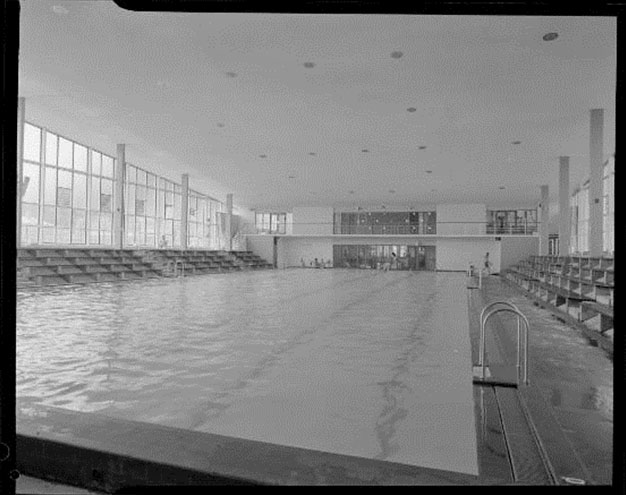
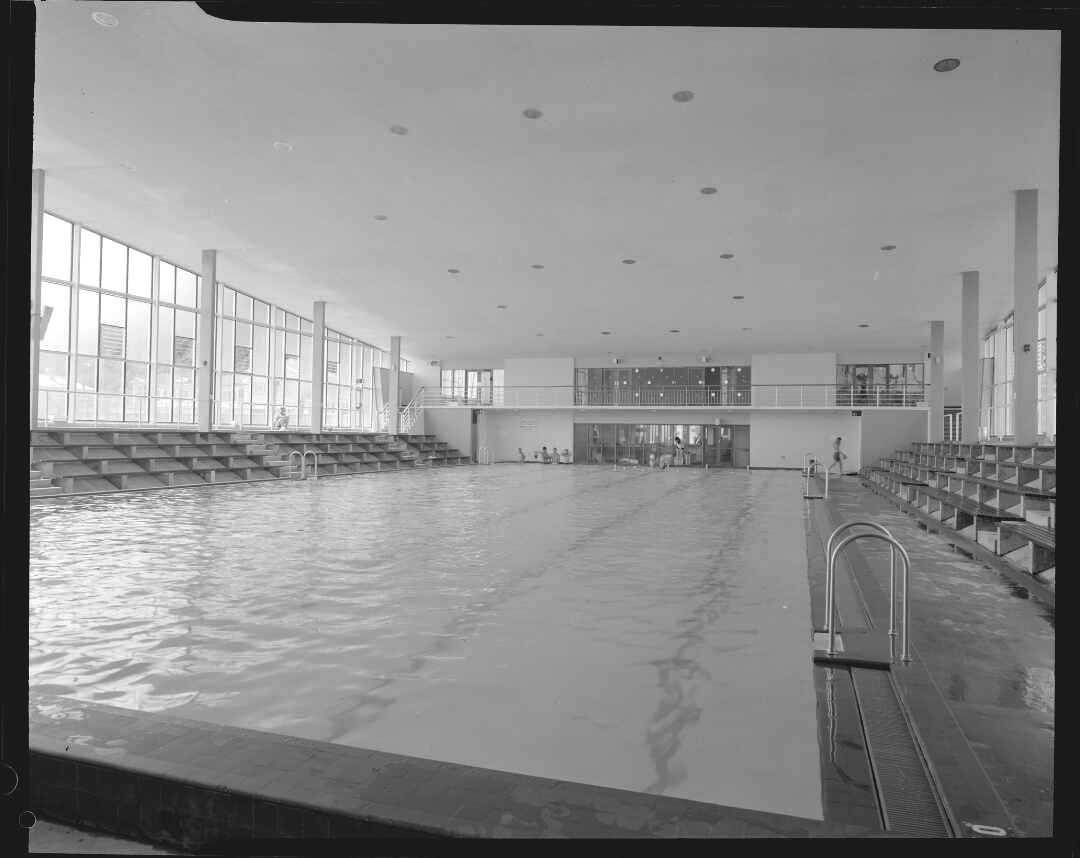
The pool design of Freyberg Pool fell short of all of these standards. Freyberg Pool was the next size down from the 50 metre pool at 33.3 metres. A more ideal length for Freyberg Pool at the time, and since, would have been either a 25 metre (short course), like Napier’s 1971 indoor pool, or a 50 metre (long course) pool, such as the Moana Pool in Dunedin (1964). Despite this, it seems that the pool was designed with competitive swimming in mind, and even had provision for radio and television broadcasting. There were critics of the chosen pool length during the construction who anticipated that this would limit the pool’s use. However, it appears that Freyberg Pool continued to be used as a competitive swimming location until the Wellington Regional Aquatic Centre (WRAC) in Kilbirnie was opened in late 1988.
The pool was nearing completion when ‘New Zealand’s greatest solider,’ Cyril Bernard Freyberg (1889-1963), died and it was named in his memory. The opening of the pool seems to have been greatly anticipated primarily because it promised to be a ‘big boon to competitive swimmers.’ On its opening day the Dominion featured three pages of information and advertising related to the building. The building was opened by Governor-General Sir Bernard Fergusson (1911-1980) on 14 December 1963. Fergusson had known Freyberg for 30 years and stated that he believed his friend ‘would certainly have been pleased that the pool bore his name.’ The opening carnival featured a water-sports showcase.
In his youth Freyberg was a frequent patron at Te Aro Baths, which were close to his home. Freyberg trained towards his 1906 and 1910 national 100 yards titles at Te Aro Baths. This prowess was useful during World War One and led to Freyberg being awarded the Distinguished Service Order at Gallipoli for swimming ashore and setting diversionary flares. Later Freyberg was also awarded the Victoria Cross. After the war he continued to serve in the British Army, only returning to New Zealand briefly. However, during World War Two, Freyberg offered his expertise to the New Zealand Government and became Commander of the second New Zealand Expeditionary Force. After the war Freyberg became New Zealand Governor General; he was the first person in this role to have been raised in New Zealand. His term as governor general finished in 1946 and he returned to England. However, Freyberg’s connection to Wellington was cemented in the title he took upon gaining his peerage, Baron Freyberg of Wellington New Zealand and of Munstead in the County Surrey.
Freyberg’s death coincided with the final phase of construction of what became his eponymous pool. This was the first substantial monument dedicated to him after his death in mid-1963. Given Freyberg’s early love for swimming, and direct personal connection with the Freyberg Pool’s antecedent, it is perhaps also the most fitting of the many places in New Zealand which now commemorate his life and achievements. Other examples include a New Zealand Defence Department Headquarters building in Wellington (1979), Freyberg High School (1955) and a swimming pool (both in Palmerston North), as well as a namesake park in Auckland and also one near Freyberg Pool. Many New Zealand towns and cities also have streets named after Freyberg. One of the major national swimming trophies is the Freyberg Shield. Created in 1954, this shield is awarded to the junior and senior teams combined points winners.
The Freyberg Pool’s public
Swimming skills have long been recognised as an essential ability for New Zealanders considering our close proximity to the sea, lakes, and rivers. Death by drowning was so prevalent in the late nineteenth century that it was referred to as ‘the New Zealand death.’ This is why nearly every town has a public or school swimming pool where most New Zealand children are taught to swim. Swimming has been part of school programmes since they were begun by the New Zealand Amateur Swimming Association in the late nineteenth century.
When Freyberg Pool was completed in 1963 there were 197 swimming clubs around the country. For Wellington swimming clubs, Freyberg Pool meant that they finally had a winter, or inclement weather, venue for teaching, training and competitions. For example, the Hataitai Amateur Swimming Club was offered use of the pool on Friday evenings from 7 to 9 pm, which it gratefully accepted in 1969. This club’s learn to swim programmes are said to have ‘filled the Freyberg Pool with families from all over Wellington. One family came from as far away as Paekakariki.’ The Hataitai club have continued to base their activities out of the Freyberg Pool, teaching young Wellingtonians to swim there despite the availability of the WRAC. These lessons were free of charge up until 1997 when the Wellington City Council began to charge pool hire fees.
Currently, Maranui Swimming Club also uses the Freyberg Pool for training sessions and learn to swim programmes, as does Capital Swim Club in conjunction with those they offer at the WRAC. Other clubs who use the facilities are the Kupe and Victoria University of Wellington Canoe Clubs, and life-savers, scuba divers and aqua-joggers, and waterpolo and underwater hockey teams have also used the pool. Lane and casual swimming for the general public is available from 6 am until 9 pm daily, with a few exceptions.
There are now gym facilities, a sauna, spa pools, and a steam room available too. These were incorporated into the complex as part of a redevelopment project that began in the wake of the completion of the WRAC in the late 1980s. There was a shift in focus, styling Freyberg Pool towards being a purely recreational, rather than competition, facility. An initial concept by architects Burwell Hunt was to expand the pool complex through the addition of three more pools that encompassed much of the current carparking area. However, the cost of this seems to have been prohibitive.
Freyberg Pool continues to be a valued community asset. In 2009-2010 Freyberg Pool had 228,124 visits, which meant it was the second most popular of the seven public pools in Wellington, behind the WRAC. Freyberg Pool has consistently had annual attendance figures of around 200,000 since at least the early 1980s.
The pool has been associated with many leading figures in New Zealand swimming over the years. For example at Freyberg Pool’s opening carnival Vivien Haddon, a silver and bronze medallist at the British Empire Games in Perth the previous year, partook in a breaststroke demonstration. Some others include Clive Lewis, who was a former British swimming champion and Empire Games representative, who began coaching for the Hataitai club in 1975. He trained Meda McKenzie for swimming across Cook Strait. Meda made her first crossing at 15 years old, and she later became the only woman to complete a successful double crossing on 26 March 1984. Meda later also became a coach for the Hataitai club at Freyberg Pool. Jonathon Winter, national record holder and Olympic swimmer, also coached at the pool in 1996.
A key modern building
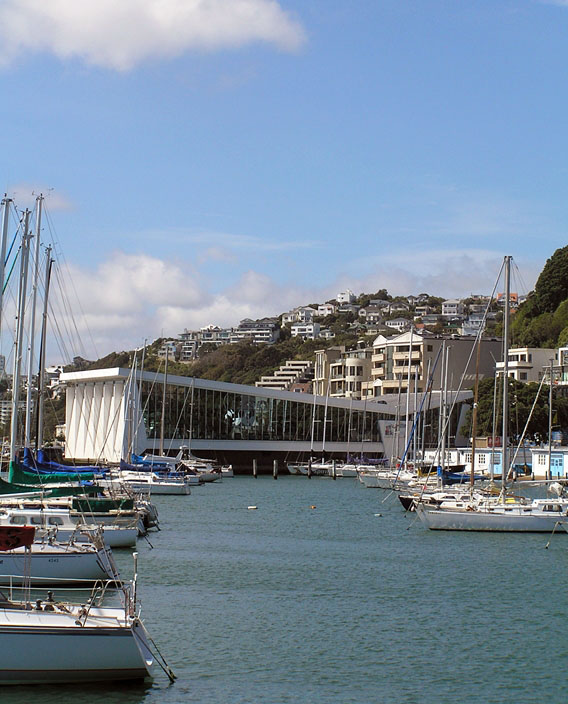
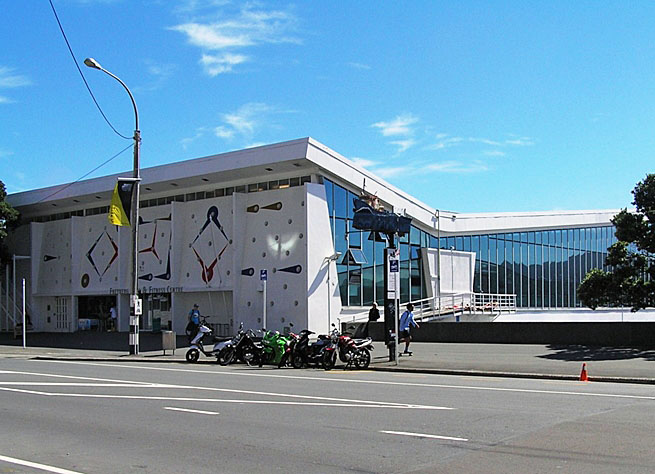
In recent years the lasting architectural qualities of Freyberg Pool have been recognised. In 2007 Freyberg Pool was ranked by multi-disciplinary interest group The Architectural Centre as one of Wellington’s top ten buildings. Furthermore, DOCOMOMO New Zealand members identified the building as one of New Zealand’s key modern buildings and it was showcased in Dr Julia Gatley’s 2008 book Long Live the Modern: New Zealand’s new architecture . The architectural merit of the Freyberg Pool was also recognised by the New Zealand Institute of Architects in 2011 with its Enduring Architecture Award. The award citation for the Freyberg Pool is glowing in its praise of the building:
‘Prominently and significantly sited, possessing a gentle monumentality, and providing a valuable amenity, the Freyberg Pool has a secure place in the affections of Wellingtonians … Swimmers in Wellington will often be grateful for the building around them, and always be thankful for the modest wonder that is the Freyberg Pool.’