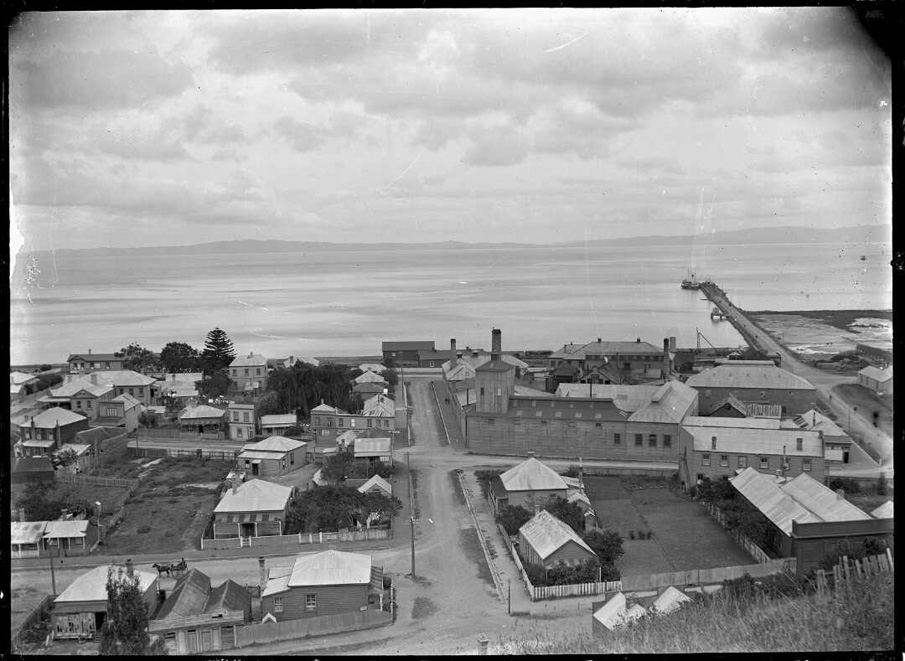
The Thames works grew in a piecemeal fashion. Mainly concerned with the production of machinery and plant for the Thames goldfield, Price also produced equipment for the timber milling industry, and boilers and engines for coastal boats and mine pumps. They later developed into the manufacture of railway engines.
List Entry Information
Status
Listed
List Entry Status
Historic Place Category 1
Access
Private/No Public Access
List Number
128
Date Entered
28th June 1990
Date of Effect
28th June 1990
City/District Council
Thames-Coromandel District
Region
Waikato Region
Legal description
Lot 1 DP 36203 Lot 1 DP 37116 Pts Kauaeranga 14 17 19 20 & Pt Parareka Blk
Status
Listed
List Entry Status
Historic Place Category 1
Access
Private/No Public Access
List Number
128
Date Entered
28th June 1990
Date of Effect
28th June 1990
City/District Council
Thames-Coromandel District
Region
Waikato Region
Legal description
Lot 1 DP 36203 Lot 1 DP 37116 Pts Kauaeranga 14 17 19 20 & Pt Parareka Blk
Why is this place significant?
Historic Significance
Historical Significance or Value The establishment of A. & G. Price's foundry in Thames in 1871 was directly associated with the Thames gold rush of 1867. In addition to the manufacture of machinery for gold mining the firm played an important role in the development of other resources in the Thames-Coromandel region through the design and manufacture of equipment for timber milling and engines for coastal steamers. The company also played a part in the growth of New Zealand industry generally, initially through the development of their flax fibre stripping machines, introduction of the pelton wheel and manufacture of locomotives and rolling stock for the New Zealand Railways. The buildings form part of a heavy engineering works which has operated continuously on the site for almost 120 years.
Physical Significance
ARCHITECTURAL QUALITY: These buildings are simply executed industrial buildings. The weatherboard exteriors and detailed fenestration of the Beach Road frontage give a unity to the site, and an architectural sophistication that reflects the prosperity and continuity of the engineering enterprise. The timber construction of the boiler shop tower, although clad in corrugated iron, is reminiscent of the mine poppet heads that were formerly a striking feature of Thames. TOWNSCAPE/LANDMARK VALUE: The Beach Road facade of the pattern shop and office and store buildings is a pleasing contrast to the more utilitarian buildings elsewhere in the complex. The boiler shop tower is dominant.
Why is this place significant?
Historic Significance
Historical Significance or Value The establishment of A. & G. Price's foundry in Thames in 1871 was directly associated with the Thames gold rush of 1867. In addition to the manufacture of machinery for gold mining the firm played an important role in the development of other resources in the Thames-Coromandel region through the design and manufacture of equipment for timber milling and engines for coastal steamers. The company also played a part in the growth of New Zealand industry generally, initially through the development of their flax fibre stripping machines, introduction of the pelton wheel and manufacture of locomotives and rolling stock for the New Zealand Railways. The buildings form part of a heavy engineering works which has operated continuously on the site for almost 120 years.
Physical Significance
ARCHITECTURAL QUALITY: These buildings are simply executed industrial buildings. The weatherboard exteriors and detailed fenestration of the Beach Road frontage give a unity to the site, and an architectural sophistication that reflects the prosperity and continuity of the engineering enterprise. The timber construction of the boiler shop tower, although clad in corrugated iron, is reminiscent of the mine poppet heads that were formerly a striking feature of Thames. TOWNSCAPE/LANDMARK VALUE: The Beach Road facade of the pattern shop and office and store buildings is a pleasing contrast to the more utilitarian buildings elsewhere in the complex. The boiler shop tower is dominant.
Construction Professional
Name
Price, Alfred & George
Type
Engineer
Biography
Brothers Alfred (1835-1907) and George (1843-1917) Price were born in Stroud, England, and served apprenticeships as patternmakers at the Dudbridge Works in Rodborough. Alfred emigrated to Auckland in 1863, and George in 1867. Early in 1868 they set up business as engineers at Onehunga. Their first well-known design was for a machine to strip fibre from flax leaves. This machine was employed in most parts of the country. Increased demand for the Prices' products resulted in the establishment of a large new foundry, erected under their personal direction by their own carpenters, on an acre of land near the wharf at the port of Queen Street, Onehunga, in 1870. In 1872 they secured a contract from the Public Works Department to build rolling stock for the North Island Railway. In later years the company became well-known as the producers of locomotive engines for New Zealand Railways and other industries. Realising the potential of the Thames goldfield where crushers, boilers and other machinery were in demand, the firm moved to Grahamstown (Thames) in 1871. It is likely that the Thames foundry was erected once again by the firm's carpenters under the personal direction of the Price brothers. In Thames the firm was also well placed to serve the local sawmilling industry. Prices' achievements as engineers were diverse. In 1884 they acquired the New Zealand manufacturing rights to the Pelton wheel, and built the first triple expansion engine in New Zealand from their own design and specifications. They also built engines and boilers for several coastal steamers and even ventured into shipbuilding themselves. In 1883 A. & G. Price bought the Prince Imperial Mine. However, the company's biggest contribution to gold mining was the building of stamper batteries, pumps and mining machinery for various goldmining companies. The 100 head battery erected for the Waihi Goldmining Company at Waikino in 1896 was probably the largest. Prices also manufactured 10 Lancashire boilers for the Big Pump at the Queen of Beauty Shaft (Thames-Hauraki Goldfields Company) in 1897, considered at that time to be the largest pump in the southern hemisphere. Both Alfred and George Price were active in local body and community affairs, being members of the Harbour Board and the Thames Scottish Volunteers. Both men served as Thames Borough Councillors and were respectively, fire inspector and superintendent of the Thames Fire Brigade.
Construction Details
Start Year
1871
Type
Original Construction
Description
Pattern Shop
Start Year
1880
startYearCirca
Finish Year
1889
finishYearCirca
Type
Original Construction
Description
Office & Store
Start Year
1880
startYearCirca
Finish Year
1889
finishYearCirca
Type
Original Construction
Description
Old Boiler House
Start Year
1924
Type
Modification
Description
Original iron foundry building converted to carpenters shop; and north end of building converted to offices; lean-to added to south side.
Start Year
1926
Type
Modification
Description
Part of original pattern-shop and store converted to tool room; office extension becomes drawing offices; extension to verandah on east side.
Start Year
1960
startYearCirca
Finish Year
1970
finishYearCirca
Type
Modification
Description
1960s - Hydraulic riveter and steam winch removed from boiler shop.
Construction Materials
Pattern Shop: - Concrete slab flooring - Timber frame construction, timber floor, timber clad - Pitched roof clad in longrun galvanised steel Office & Stores: - Concrete slab flooring - Timber frame construction, timber clad - Pitched roof clad in longrun galvanised steel Old Boiler House: - Concrete slab flooring - Timber frame construction, clad in longrun galvanised steel - Pitched roof clad in longrun galvanised steel
Notable Features
Boiler shop tower. Beach Road frontage.
Construction Professional
Name
Price, Alfred & George
Type
Engineer
Biography
Brothers Alfred (1835-1907) and George (1843-1917) Price were born in Stroud, England, and served apprenticeships as patternmakers at the Dudbridge Works in Rodborough. Alfred emigrated to Auckland in 1863, and George in 1867. Early in 1868 they set up business as engineers at Onehunga. Their first well-known design was for a machine to strip fibre from flax leaves. This machine was employed in most parts of the country. Increased demand for the Prices' products resulted in the establishment of a large new foundry, erected under their personal direction by their own carpenters, on an acre of land near the wharf at the port of Queen Street, Onehunga, in 1870. In 1872 they secured a contract from the Public Works Department to build rolling stock for the North Island Railway. In later years the company became well-known as the producers of locomotive engines for New Zealand Railways and other industries. Realising the potential of the Thames goldfield where crushers, boilers and other machinery were in demand, the firm moved to Grahamstown (Thames) in 1871. It is likely that the Thames foundry was erected once again by the firm's carpenters under the personal direction of the Price brothers. In Thames the firm was also well placed to serve the local sawmilling industry. Prices' achievements as engineers were diverse. In 1884 they acquired the New Zealand manufacturing rights to the Pelton wheel, and built the first triple expansion engine in New Zealand from their own design and specifications. They also built engines and boilers for several coastal steamers and even ventured into shipbuilding themselves. In 1883 A. & G. Price bought the Prince Imperial Mine. However, the company's biggest contribution to gold mining was the building of stamper batteries, pumps and mining machinery for various goldmining companies. The 100 head battery erected for the Waihi Goldmining Company at Waikino in 1896 was probably the largest. Prices also manufactured 10 Lancashire boilers for the Big Pump at the Queen of Beauty Shaft (Thames-Hauraki Goldfields Company) in 1897, considered at that time to be the largest pump in the southern hemisphere. Both Alfred and George Price were active in local body and community affairs, being members of the Harbour Board and the Thames Scottish Volunteers. Both men served as Thames Borough Councillors and were respectively, fire inspector and superintendent of the Thames Fire Brigade.
Construction Details
Start Year
1871
Type
Original Construction
Description
Pattern Shop
Start Year
1880
startYearCirca
Finish Year
1889
finishYearCirca
Type
Original Construction
Description
Office & Store
Start Year
1880
startYearCirca
Finish Year
1889
finishYearCirca
Type
Original Construction
Description
Old Boiler House
Start Year
1924
Type
Modification
Description
Original iron foundry building converted to carpenters shop; and north end of building converted to offices; lean-to added to south side.
Start Year
1926
Type
Modification
Description
Part of original pattern-shop and store converted to tool room; office extension becomes drawing offices; extension to verandah on east side.
Start Year
1960
startYearCirca
Finish Year
1970
finishYearCirca
Type
Modification
Description
1960s - Hydraulic riveter and steam winch removed from boiler shop.
Construction Materials
Pattern Shop: - Concrete slab flooring - Timber frame construction, timber floor, timber clad - Pitched roof clad in longrun galvanised steel Office & Stores: - Concrete slab flooring - Timber frame construction, timber clad - Pitched roof clad in longrun galvanised steel Old Boiler House: - Concrete slab flooring - Timber frame construction, clad in longrun galvanised steel - Pitched roof clad in longrun galvanised steel
Notable Features
Boiler shop tower. Beach Road frontage.
ARCHITECTURAL DESCRIPTION: The A. & G. Price Foundry site at Thames comprises a large number of buildings of various ages and architecture on the one site. Only three of these buildings are proposed for classification: (1) The present pattern shop (2) The present office and stores building (3) The former boiler fabricating building (1) The present pattern shop (former iron foundry building): The section of the present building fronting Beach Road, is all that remains of the original 1871 iron foundry building, forming the northern wing of the present building which has been substantially modified and added to over the years. In this process Abraham Street has been incorporated into the foundry complex and built over. The former iron foundry building section is a wooden hipped roof building clad with rusticated weather boarding, with corrugated galvanised iron roofing. A rectangular ventilator with slatted sides and peaked roof of corrugated iron is located on the ridge. The Beach Road facade has a large machine shop or vehicle sliding door on the line of the later Abraham Street addition. The Beach Road facade also has eight fixed nine-pane windows with inwardly opening three-pane fanlights, hinged at the bottom. These windows are segmental headed, with elegant window frames giving an architectural sophistication to an otherwise plain weatherboard surface. A further similar window is located on the end facade facing the gate, next to a six-panelled door. Six of the windows and the Beach Road facade have curved corrugated iron shades. The style of the Beach Road facade of the former iron foundry has been continued around on to the former Abraham Street wing which also has an identical ridge ventilator. The style is also maintained on the adjoining former pattern and machine shop on Beach Road. (2) The present office and store (formerly pattern and machine shop): This is a two-storeyed building with rusticated weatherboard cladding. It originally housed the machine shop in the lower floor with the original pattern shop above. The lower floor has nine evenly spaced windows, of the same design as those in the present pattern shop building. On the top floor these windows are echoed by nine smaller two light windows. Seven other windows, generally matching the original ones have been added later on this floor. As with the previous building, the windows on both floors are segmental headed and their simple decoration contributes an architectural elegance to the weatherboard facade. There is a doorway with a suspended canopy of a plain functional design over a doorway at the end of the Beach Road frontage, farthest from the present pattern shop. Two ventilators are placed on the ridge of the building. Internally the Beach Road wall is lined with rebated timber. Elsewhere exposed framing and substantial timber posts with chamfered corners highlight the open plan of the building. Early office space still survives in the end bay of this floor of the building. Originally serving as a drawing office this area has a stair balustrade with simplified trefoil motifs, timber flooring and rebated timber panelled walls. (3) The former boiler fabricating shop: This is a hipped roof building of barn-like proportions, with a large centrally-placed rectangular tower surmounted by substantial ventilator which echoes the general architectural style of the building. The building is of simple truss beam construction of heavy kauri timbers. Cross bracing timber in the tower also supported the winding mechanism, the steel wheels of which are still in place. A lean-to building has been added to one side. The building, roof, tower and ventilator are clad in corrugated galvanised iron. The street front fenestration consists of a central bank of eight nine-pane windows, with a separate cluster of three similar windows in one side of it and a single window on the other. A row of five smaller windows are evenly spaced high up above the main windows. The open end of the building has a very large sliding shop door. MODIFICATIONS: Over the years from the establishment of the foundry the functions of the buildings have been changed, with consequent modification to the buildings. These include: 1924: Original iron foundry building converted to carpenters shop; and north end of building converted to offices; lean-to added to south side. 1926: Part of original pattern-shop and store converted to tool room; office extension becomes drawing offices; extension to verandah on east side. 1960s: Hydraulic riveter and steam winch removed from boiler shop.
ARCHITECTURAL DESCRIPTION: The A. & G. Price Foundry site at Thames comprises a large number of buildings of various ages and architecture on the one site. Only three of these buildings are proposed for classification: (1) The present pattern shop (2) The present office and stores building (3) The former boiler fabricating building (1) The present pattern shop (former iron foundry building): The section of the present building fronting Beach Road, is all that remains of the original 1871 iron foundry building, forming the northern wing of the present building which has been substantially modified and added to over the years. In this process Abraham Street has been incorporated into the foundry complex and built over. The former iron foundry building section is a wooden hipped roof building clad with rusticated weather boarding, with corrugated galvanised iron roofing. A rectangular ventilator with slatted sides and peaked roof of corrugated iron is located on the ridge. The Beach Road facade has a large machine shop or vehicle sliding door on the line of the later Abraham Street addition. The Beach Road facade also has eight fixed nine-pane windows with inwardly opening three-pane fanlights, hinged at the bottom. These windows are segmental headed, with elegant window frames giving an architectural sophistication to an otherwise plain weatherboard surface. A further similar window is located on the end facade facing the gate, next to a six-panelled door. Six of the windows and the Beach Road facade have curved corrugated iron shades. The style of the Beach Road facade of the former iron foundry has been continued around on to the former Abraham Street wing which also has an identical ridge ventilator. The style is also maintained on the adjoining former pattern and machine shop on Beach Road. (2) The present office and store (formerly pattern and machine shop): This is a two-storeyed building with rusticated weatherboard cladding. It originally housed the machine shop in the lower floor with the original pattern shop above. The lower floor has nine evenly spaced windows, of the same design as those in the present pattern shop building. On the top floor these windows are echoed by nine smaller two light windows. Seven other windows, generally matching the original ones have been added later on this floor. As with the previous building, the windows on both floors are segmental headed and their simple decoration contributes an architectural elegance to the weatherboard facade. There is a doorway with a suspended canopy of a plain functional design over a doorway at the end of the Beach Road frontage, farthest from the present pattern shop. Two ventilators are placed on the ridge of the building. Internally the Beach Road wall is lined with rebated timber. Elsewhere exposed framing and substantial timber posts with chamfered corners highlight the open plan of the building. Early office space still survives in the end bay of this floor of the building. Originally serving as a drawing office this area has a stair balustrade with simplified trefoil motifs, timber flooring and rebated timber panelled walls. (3) The former boiler fabricating shop: This is a hipped roof building of barn-like proportions, with a large centrally-placed rectangular tower surmounted by substantial ventilator which echoes the general architectural style of the building. The building is of simple truss beam construction of heavy kauri timbers. Cross bracing timber in the tower also supported the winding mechanism, the steel wheels of which are still in place. A lean-to building has been added to one side. The building, roof, tower and ventilator are clad in corrugated galvanised iron. The street front fenestration consists of a central bank of eight nine-pane windows, with a separate cluster of three similar windows in one side of it and a single window on the other. A row of five smaller windows are evenly spaced high up above the main windows. The open end of the building has a very large sliding shop door. MODIFICATIONS: Over the years from the establishment of the foundry the functions of the buildings have been changed, with consequent modification to the buildings. These include: 1924: Original iron foundry building converted to carpenters shop; and north end of building converted to offices; lean-to added to south side. 1926: Part of original pattern-shop and store converted to tool room; office extension becomes drawing offices; extension to verandah on east side. 1960s: Hydraulic riveter and steam winch removed from boiler shop.
Historical and Associated Iwi / Hapū / Whānau
Information Sources
Auckland Public Libraries
Auckland Public Libraries
Daily Southern Cross
Daily Southern Cross
Furkert, 1953
Frederick William Furkert, Early New Zealand Engineers, Wellington, 1953
Salmond, 1986
Jeremy Salmond, Old New Zealand Houses 1800-1940, Auckland, 1986, Reed Methuen
Thornton, 1982
Geoffrey G. Thornton, New Zealand's Industrial Heritage, A.H. & A.W. Reed, Wellington, 1982
Weekly News
Weekly News
Stott, 1983
R Stott, Prices of Thames, Wellington, 1983
Vennell, 1968
C W Vennell, Men of Metal: The Story of A. & G. Price Ltd, Auckland & Thames, Auckland, 1968
New Zealand Scrapbook
New Zealand Scrapbook
Other Information
This historic place was registered under the Historic Places Act 1980. This report includes the text from the original Building Classification Committee report considered by the NZHPT Board at the time of registration. Please note that entry on the New Zealand Heritage List/Rarangi Korero identifies only the heritage values of the property concerned, and should not be construed as advice on the state of the property, or as a comment of its soundness or safety, including in regard to earthquake risk, safety in the event of fire, or insanitary conditions.
Historical and Associated Iwi / Hapū / Whānau
Information Sources
Auckland Public Libraries
Auckland Public Libraries
Daily Southern Cross
Daily Southern Cross
Furkert, 1953
Frederick William Furkert, Early New Zealand Engineers, Wellington, 1953
Salmond, 1986
Jeremy Salmond, Old New Zealand Houses 1800-1940, Auckland, 1986, Reed Methuen
Thornton, 1982
Geoffrey G. Thornton, New Zealand's Industrial Heritage, A.H. & A.W. Reed, Wellington, 1982
Weekly News
Weekly News
Stott, 1983
R Stott, Prices of Thames, Wellington, 1983
Vennell, 1968
C W Vennell, Men of Metal: The Story of A. & G. Price Ltd, Auckland & Thames, Auckland, 1968
New Zealand Scrapbook
New Zealand Scrapbook
Other Information
This historic place was registered under the Historic Places Act 1980. This report includes the text from the original Building Classification Committee report considered by the NZHPT Board at the time of registration. Please note that entry on the New Zealand Heritage List/Rarangi Korero identifies only the heritage values of the property concerned, and should not be construed as advice on the state of the property, or as a comment of its soundness or safety, including in regard to earthquake risk, safety in the event of fire, or insanitary conditions.
Former Usages
General Usage: Manufacturing
Specific Usage: Foundry Iron/Brass
Web Links
description: Engineering NZ Heritage
url: https://www.engineeringnz.org/our-work/heritage/heritage-records/and-g-price-limited/
Former Usages
General Usage: Manufacturing
Specific Usage: Foundry Iron/Brass
Web Links
description: Engineering NZ Heritage
url: https://www.engineeringnz.org/our-work/heritage/heritage-records/and-g-price-limited/