DonateMembershipVisit Heritage
  • Tūrangawaewae
    Places
  • Tira Māori
    Māori Heritage
  • Poutairangahia
    Archaeology
  • Rauemi
    Resources
  • Mō Tātou
    About Us
  • New Zealand Heritage List
  • Nominate and submit
  • Explore the List
  • National Historic Landmarks
  • Plaques
  • Rainbow List Project
  • Lost heritage
  • Visit Heritage
  • Our properties
  • Turnbull House Project
  • Collections
  • Shop
  • Tohu Whenua
  • Tira Māori
  • Conserving Māori heritage
  • Marae built heritage
  • Māori heritage on the List
  • Hinemihi—Te Hokinga Mai
  • What is archaeology?
  • Is there a site on my property?
  • What are my legal requirements?
  • Affecting an archaeological site
  • Declaring an archaeological site
  • Archaeology FAQs
  • Archaeology Digital Library
  • Archaeology guidelines and templates
  • Resources
  • Funding
  • Publications
  • Sustainable management guides
  • Disaster recovery
  • Podcasts & digital resources
  • Education Hub
  • Conservation plans
  • About
  • Board
  • Māori Heritage Council
  • Senior Staff
  • Offices
  • Contact us
  • Careers
  • Covenants
  • Fast-track
  • Corporate documents
  • Currently consulting on
  • Our submissions
  • News
  • Covid-19 response
Quick links
Rārangi Kōrero | The List
Explore the List
National Historic Landmarks
Ngā Manawhenua o Aotearoa me ōna Kōrero Tūturu
Quick links
Tapuwae
A Vision for Places of Māori Heritage
Funding for Māori Heritage
Resources
Quick links
Archaeological Authority Portal
Applying for an archaeological authority
Archaeology FAQs
Browse the most frequently asked questions about archaeological authorities and the archaeological process.
Quick links
Quick links
News
News Keep up to date with Heritage New Zealand Pouhere Taonga
Membership
Membership Find out more and sign up today
DonateMembershipVisit Heritage
  • Tūrangawaewae
    Places
  • Tira Māori
    Māori Heritage
  • Poutairangahia
    Archaeology
  • Rauemi
    Resources
  • Mō Tātou
    About Us
  • New Zealand Heritage List
  • Nominate and submit
  • Explore the List
  • National Historic Landmarks
  • Plaques
  • Rainbow List Project
  • Lost heritage
  • Visit Heritage
  • Our properties
  • Turnbull House Project
  • Collections
  • Shop
  • Tohu Whenua
  • Tira Māori
  • Conserving Māori heritage
  • Marae built heritage
  • Māori heritage on the List
  • Hinemihi—Te Hokinga Mai
  • What is archaeology?
  • Is there a site on my property?
  • What are my legal requirements?
  • Affecting an archaeological site
  • Declaring an archaeological site
  • Archaeology FAQs
  • Archaeology Digital Library
  • Archaeology guidelines and templates
  • Resources
  • Funding
  • Publications
  • Sustainable management guides
  • Disaster recovery
  • Podcasts & digital resources
  • Education Hub
  • Conservation plans
  • About
  • Board
  • Māori Heritage Council
  • Senior Staff
  • Offices
  • Contact us
  • Careers
  • Covenants
  • Fast-track
  • Corporate documents
  • Currently consulting on
  • Our submissions
  • News
  • Covid-19 response
Quick links
Rārangi Kōrero | The List
Explore the List
National Historic Landmarks
Ngā Manawhenua o Aotearoa me ōna Kōrero Tūturu
Quick links
Tapuwae
A Vision for Places of Māori Heritage
Funding for Māori Heritage
Resources
Quick links
Archaeological Authority Portal
Applying for an archaeological authority
Archaeology FAQs
Browse the most frequently asked questions about archaeological authorities and the archaeological process.
Quick links
Quick links
News
News Keep up to date with Heritage New Zealand Pouhere Taonga
Membership
Membership Find out more and sign up today
  • Places
  • Nominate and submit
  • National Historic Landmarks
  • Places
  • Nominate and submit
  • National Historic Landmarks
  • Tira Māori
  • Conserving Māori heritage
  • Marae built heritage
  • Tira Māori
  • Conserving Māori heritage
  • Marae built heritage
  • Archaeological authorities
  • Archaeology Digital Library
  • Archaeological authorities
  • Archaeology Digital Library
  • All resources
  • Publications
  • Funding
  • All resources
  • Publications
  • Funding
  • FAQs
  • FAQs
Follow us on:
Places
  • Places
  • Nominate and submit
  • National Historic Landmarks
Tira Māori
  • Tira Māori
  • Conserving Māori heritage
  • Marae built heritage
Archaeology
  • Archaeological authorities
  • Archaeology Digital Library
Resources
  • All resources
  • Publications
  • Funding
FAQs
  • FAQs
Follow us on
HomePrivacyTerms and conditionsAbout this site
© Heritage New Zealand Pouhere Taonga 2026.
 
Somerled House

192 The Terrace, WELLINGTON

Private

Historic Place Category 2

List No. 1404

Quick links:
List GalleryLocationDetails
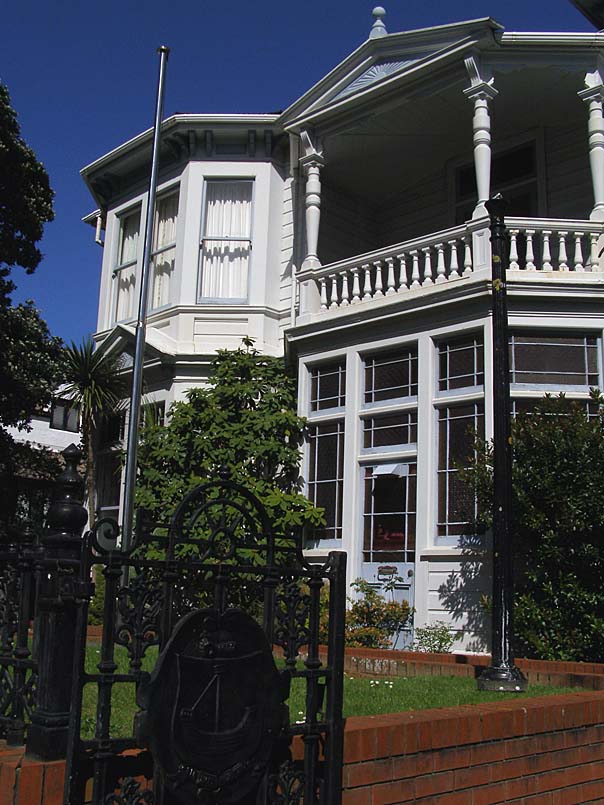
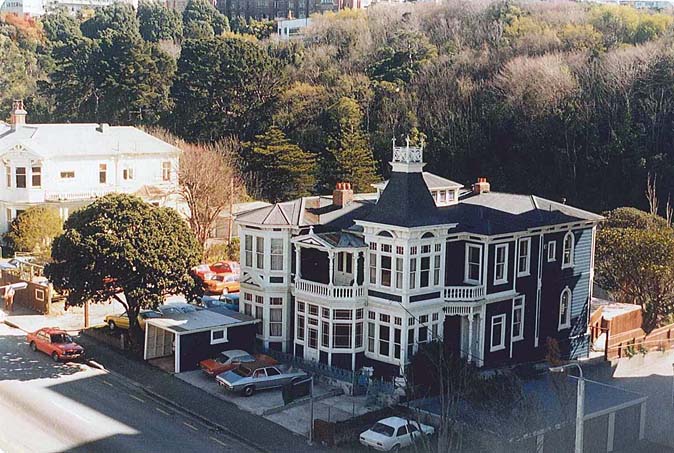
The current appearance of Somerled House dates from 1902 when additions, designed by William Turnbull, were made to an existing house owned by well-known businessman and politician Thomas Kennedy MacDonald (1847–1914) and his wife. MacDonald purchased the house from Frances Pharazyn in 1892. Other former owners of the property include Alfred Domett, former premier of New Zealand and a poet (owner from 1868 to 1874) and John Blackett, Engineer-in-Chief of the Public Works Department (1874 to 1889). It was MacDonald who gave the house its name of Somerled – a 12th century Scottish King of Argyll. MacDonald owned the house until 1900 when it was conveyed to his wife, Frances Rossiter MacDonald. The 1902 additions were designed by William Turnbull of Thomas Turnbull and Son and built by a Mr Humphries. William Turnbull later designed the grander Antrim House (Register No. 208, Category 1) (1905), and both houses include a distinctive turret.

T K MacDonald had many business and political interests. As well as an auction business, he was chairman of the Wellington Harbour Board, a Member of Parliament and Legislative councillor. His daughter Vera had her wedding reception at Somerled in 1907. Somerled’s household furnishings were advertised for sale in 1911 and in 1912 ‘superior board and residence’ at Somerled was advertised. T K MacDonald died in 1914 and his wife sold the house in 1920, after which it had a succession of owners. Files at Wellington City Council Archives include one from March 1932 relating to ‘reinstate dwelling damaged by fire’; repiling (1976); and additions and alterations (2006).

Somerled House is an Edwardian addition to a smaller Victorian residence. The construction is timber, with rusticated weatherboards, a corrugated iron roof, and kauri window joinery. The facade has projecting bays, porch, balconies and a square turret that give it a distinctive appearance in the streetscape. According to the Wellington City Council Heritage Inventory, the present entrance porch was originally a conservatory, and the most distinctive element on the facade is the square turret, ‘with its elongated windows, string courses, half-timbered frieze and hipped roof capped by iron fretwork’.

Although the building has been converted to apartments, the Wellington City Council Heritage Inventory notes that some of the original elements remain, especially on the first floor of the house: ‘One of the main features is a domed ceiling with a stained-glass lantern illuminating the central hall. A fine kauri staircase survives, along with kauri doors, arches, fire surrounds, and other features.’

Somerled House, with its distinctive porch, balcony and turret, is an important part of The Terrace streetscape, and one of a diminishing number of substantial wooden houses that once lined both sides of The Terrace that were built for middle-class Victorian and Edwardian Wellington residents. This building has been associated with a number of historically important owners. It is enhanced by a setting of trees and cast iron fence and gates.
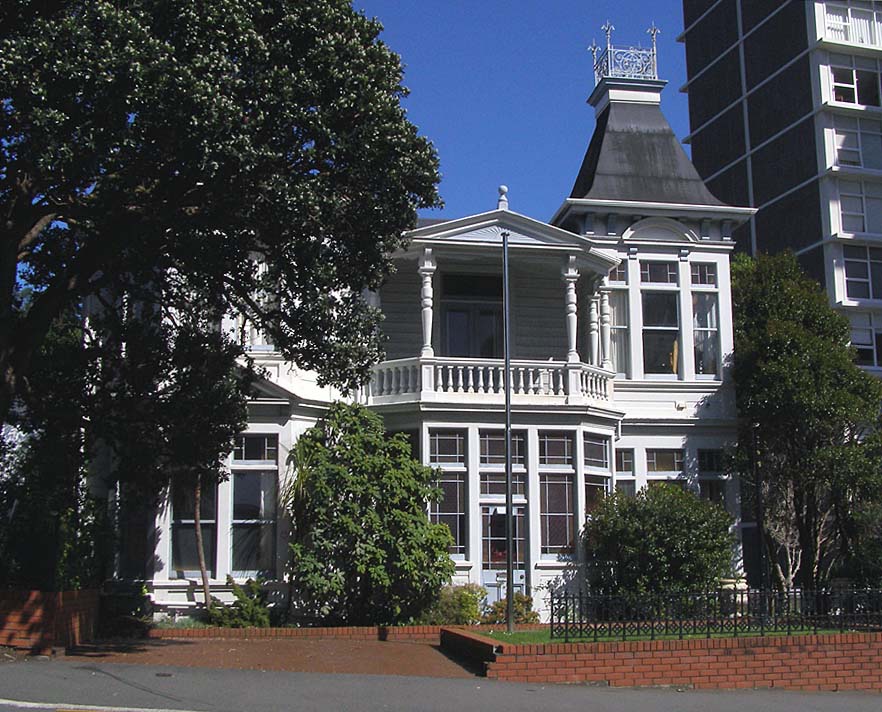
Somerled House | Vivienne Morrell | 11/11/2011 | NZ Historic Places Trust
Somerled House c.1980s. Original image submitted at time of registration | Unknown | Image included in NZHPT file
Somerled House | Vivienne Morrell | 11/11/2011 | NZ Historic Places Trust
Somerled House c.1980s. Original image submitted at time of registration | Unknown | Image included in NZHPT file

List Entry Information

Overview

Status
Listed

List Entry Status
Historic Place Category 2

Access
Private/No Public Access

List Number
1404

Date Entered
25th November 1982

Date of Effect
25th November 1982

City/District Council
Wellington City

Region
Wellington Region

Legal description

Pt Sec 454 Town of Wellington (RT WN351/79), Wellington Land District

Detailed List Entry

Construction Professional

Name

Turnbull, William (1868-1941)

Type

Architect

Biography

William Turnbull (1868-1941) entered the architectural office of his father Thomas (1825-1907) in 1882, and received a professional education from him. In 1890, William visited Melbourne and Sydney and was engaged in the office of J A Gordon, a Melbourne architect who at that time was engaged in the design of several major commercial buildings including the Melbourne (now Victoria) Markets. In 1891 William returned to Wellington and was admitted into partnership in the firm of Thomas Turnbull and Son. This was one of the foremost architectural practices in the city at the turn of the century and it continued after Thomas Turnbull's death in 1907. William became a Fellow of the Royal Institute of British Architects in 1906, designing many important early twentieth century buildings in Wellington such as 12 Boulcott Street (1902), Turnbull House (1918), and the Wellington Free Ambulance Building (1932). The range and variety of his adaptation of architectural styles show him to be fully versed in virtually every contemporary architectural style and to have special skills and flair for masonry design.

Construction Details

Start Year

1902

Type

Original Construction

Start Year

1932

Type

Modification

Description

Some fire damage

Start Year

1976

Type

Modification

Description

Repiled

Start Year

2006

Type

Modification

Description

Alterations

Reference

Completion Date

7th November 2012

Report Written By

Vivienne Morrell

Information Sources

Evening Post

Evening Post, 27 Jun 1919, p.7.

Report Written By

This place was identified as significant under previous legislation with different information requirements. It remains significant under the current legislation. There is opportunity under our legislation and policies to add to this information. Further information about this place may be available from the Central Regional Office of Heritage New Zealand Pouhere Taonga. A fully referenced proposal summary report is available from the Central Region office of NZHPT. Please note that entry on the New Zealand Heritage List/Rarangi Korero identifies only the heritage values of the property concerned, and should not be construed as advice on the state of the property, or as a comment of its soundness or safety, including in regard to earthquake risk, safety in the event of fire, or insanitary conditions.

Further Information

Current Usages

Uses: Accommodation

Specific Usage: Complex of flats

Former Usages

General Usage:: Accommodation

Specific Usage: Complex of flats

General Usage:: Accommodation

Specific Usage: House

General Usage:: Trade

Specific Usage: Office building/Offices

Themes

Web Links

Overview

Status

Listed

List Entry Status

Historic Place Category 2

Access

Private/No Public Access

List Number

1404

Date Entered

25th November 1982

Date of Effect

25th November 1982

City/District Council

Wellington City

Region

Wellington Region

Legal description

Pt Sec 454 Town of Wellington (RT WN351/79), Wellington Land District

Status

Listed

List Entry Status

Historic Place Category 2

Access

Private/No Public Access

List Number

1404

Date Entered

25th November 1982

Date of Effect

25th November 1982

City/District Council

Wellington City

Region

Wellington Region

Legal description

Pt Sec 454 Town of Wellington (RT WN351/79), Wellington Land District

Construction Information

Construction Professional

Name

Turnbull, William (1868-1941)

Type

Architect

Biography

William Turnbull (1868-1941) entered the architectural office of his father Thomas (1825-1907) in 1882, and received a professional education from him. In 1890, William visited Melbourne and Sydney and was engaged in the office of J A Gordon, a Melbourne architect who at that time was engaged in the design of several major commercial buildings including the Melbourne (now Victoria) Markets. In 1891 William returned to Wellington and was admitted into partnership in the firm of Thomas Turnbull and Son. This was one of the foremost architectural practices in the city at the turn of the century and it continued after Thomas Turnbull's death in 1907. William became a Fellow of the Royal Institute of British Architects in 1906, designing many important early twentieth century buildings in Wellington such as 12 Boulcott Street (1902), Turnbull House (1918), and the Wellington Free Ambulance Building (1932). The range and variety of his adaptation of architectural styles show him to be fully versed in virtually every contemporary architectural style and to have special skills and flair for masonry design.

Construction Details

Start Year

1902

Type

Original Construction

Start Year

1932

Type

Modification

Description

Some fire damage

Start Year

1976

Type

Modification

Description

Repiled

Start Year

2006

Type

Modification

Description

Alterations

Construction Professional

Name

Turnbull, William (1868-1941)

Type

Architect

Biography

William Turnbull (1868-1941) entered the architectural office of his father Thomas (1825-1907) in 1882, and received a professional education from him. In 1890, William visited Melbourne and Sydney and was engaged in the office of J A Gordon, a Melbourne architect who at that time was engaged in the design of several major commercial buildings including the Melbourne (now Victoria) Markets. In 1891 William returned to Wellington and was admitted into partnership in the firm of Thomas Turnbull and Son. This was one of the foremost architectural practices in the city at the turn of the century and it continued after Thomas Turnbull's death in 1907. William became a Fellow of the Royal Institute of British Architects in 1906, designing many important early twentieth century buildings in Wellington such as 12 Boulcott Street (1902), Turnbull House (1918), and the Wellington Free Ambulance Building (1932). The range and variety of his adaptation of architectural styles show him to be fully versed in virtually every contemporary architectural style and to have special skills and flair for masonry design.

Construction Details

Start Year

1902

Type

Original Construction

Start Year

1932

Type

Modification

Description

Some fire damage

Start Year

1976

Type

Modification

Description

Repiled

Start Year

2006

Type

Modification

Description

Alterations

Reference

Historical and Associated Iwi / Hapū / Whānau

Completion Date

7th November 2012

Report Written By

Vivienne Morrell

Information Sources

Evening Post

Evening Post, 27 Jun 1919, p.7.

Other Information

This place was identified as significant under previous legislation with different information requirements. It remains significant under the current legislation. There is opportunity under our legislation and policies to add to this information. Further information about this place may be available from the Central Regional Office of Heritage New Zealand Pouhere Taonga. A fully referenced proposal summary report is available from the Central Region office of NZHPT. Please note that entry on the New Zealand Heritage List/Rarangi Korero identifies only the heritage values of the property concerned, and should not be construed as advice on the state of the property, or as a comment of its soundness or safety, including in regard to earthquake risk, safety in the event of fire, or insanitary conditions.

Historical and Associated Iwi / Hapū / Whānau

Completion Date

7th November 2012

Report Written By

Vivienne Morrell

Information Sources

Evening Post

Evening Post, 27 Jun 1919, p.7.

Other Information

This place was identified as significant under previous legislation with different information requirements. It remains significant under the current legislation. There is opportunity under our legislation and policies to add to this information. Further information about this place may be available from the Central Regional Office of Heritage New Zealand Pouhere Taonga. A fully referenced proposal summary report is available from the Central Region office of NZHPT. Please note that entry on the New Zealand Heritage List/Rarangi Korero identifies only the heritage values of the property concerned, and should not be construed as advice on the state of the property, or as a comment of its soundness or safety, including in regard to earthquake risk, safety in the event of fire, or insanitary conditions.

Further Information

Current Usages

Uses: Accommodation

Specific Usage: Complex of flats

Former Usages

General Usage: Accommodation

Specific Usage: Complex of flats

General Usage: Accommodation

Specific Usage: House

General Usage: Trade

Specific Usage: Office building/Offices

Current Usages

Uses: Accommodation

Specific Usage: Complex of flats

Former Usages

General Usage: Accommodation

Specific Usage: Complex of flats

General Usage: Accommodation

Specific Usage: House

General Usage: Trade

Specific Usage: Office building/Offices

Location

Loading
Related listings
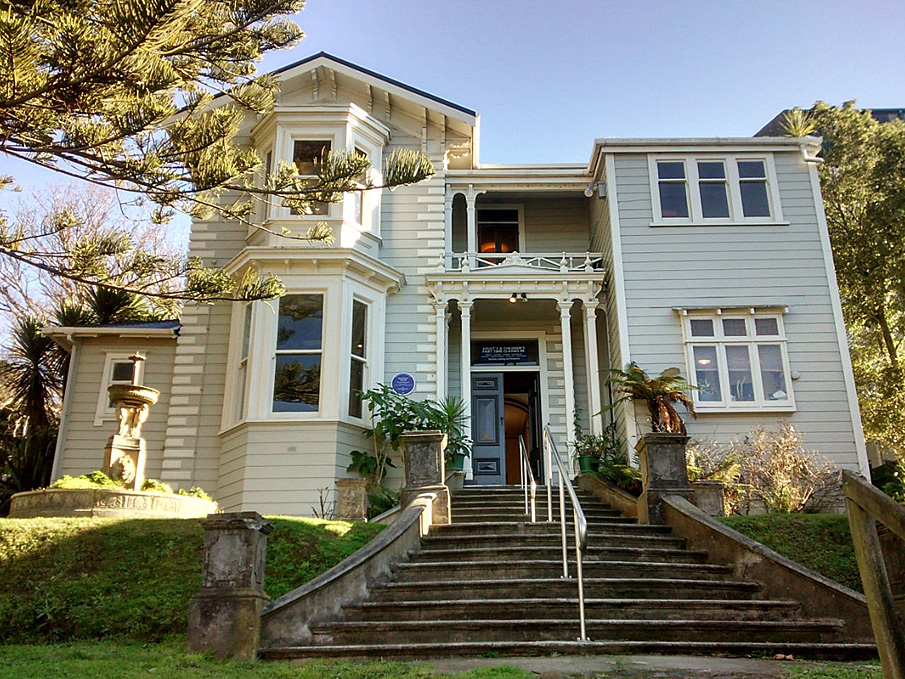
Inverlochy House, Wellington. CC Licence 3.0 Image courtesy of commons.wikimedia.org
Inverlochy House
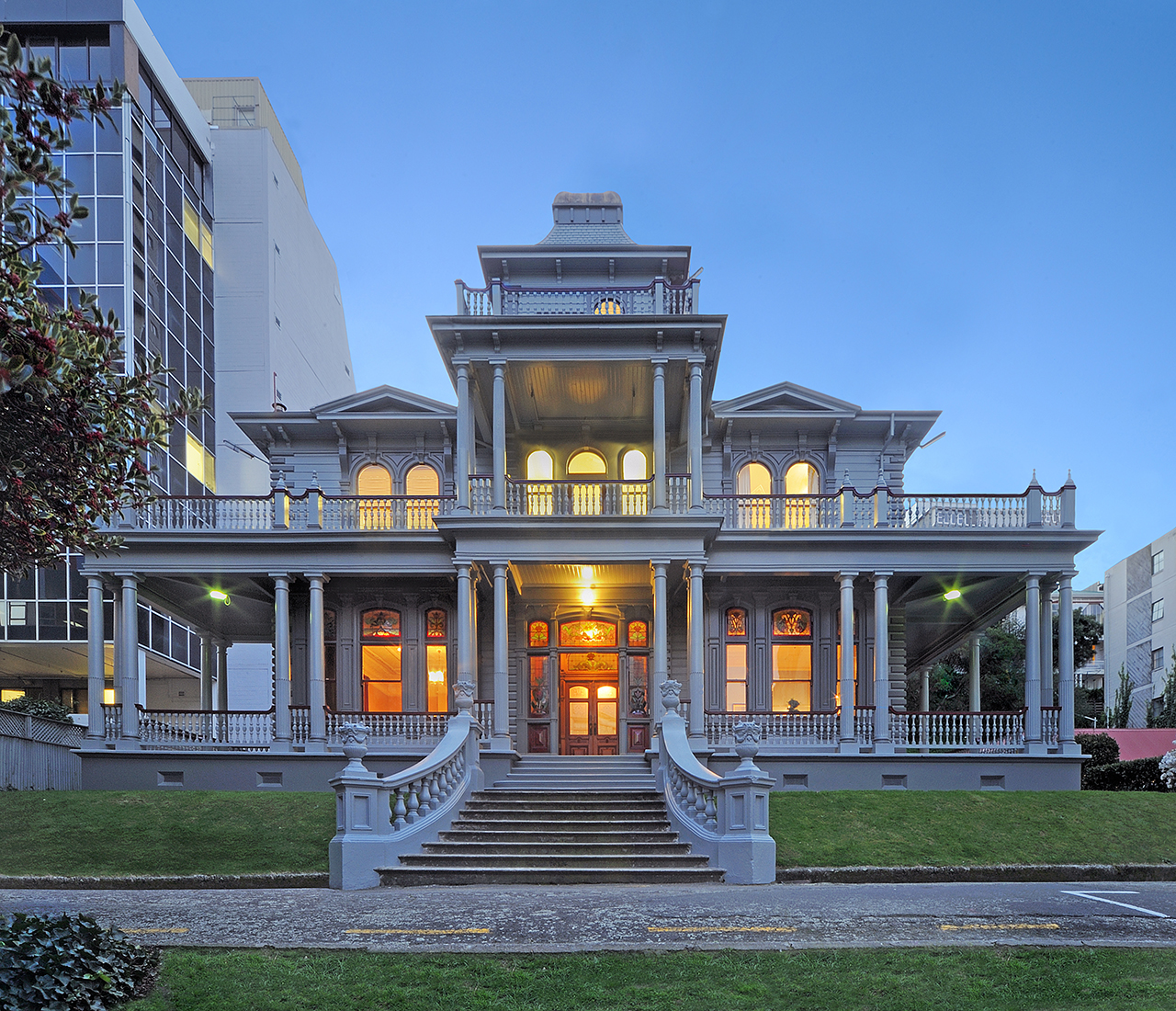
Antrim House, Wellington
Antrim House
Antrim House, Wellington
Antrim House
Inverlochy House, Wellington. CC Licence 3.0 Image courtesy of commons.wikimedia.org
Inverlochy House
Stay up to date with Heritage this month