DonateMembershipVisit Heritage
  • Tūrangawaewae
    Places
  • Tira Māori
    Māori Heritage
  • Poutairangahia
    Archaeology
  • Rauemi
    Resources
  • Mō Tātou
    About Us
  • New Zealand Heritage List
  • Nominate and submit
  • Explore the List
  • National Historic Landmarks
  • Plaques
  • Rainbow List Project
  • Lost heritage
  • Visit Heritage
  • Our properties
  • Turnbull House Project
  • Collections
  • Shop
  • Tohu Whenua
  • Tira Māori
  • Conserving Māori heritage
  • Marae built heritage
  • Māori heritage on the List
  • Hinemihi—Te Hokinga Mai
  • What is archaeology?
  • Is there a site on my property?
  • What are my legal requirements?
  • Affecting an archaeological site
  • Declaring an archaeological site
  • Archaeology FAQs
  • Archaeology Digital Library
  • Archaeology guidelines and templates
  • Resources
  • Funding
  • Publications
  • Sustainable management guides
  • Disaster recovery
  • Podcasts & digital resources
  • Education Hub
  • Conservation plans
  • About
  • Board
  • Māori Heritage Council
  • Senior Staff
  • Offices
  • Contact us
  • Careers
  • Covenants
  • Fast-track
  • Corporate documents
  • Currently consulting on
  • Our submissions
  • News
  • Covid-19 response
Quick links
Rārangi Kōrero | The List
Explore the List
National Historic Landmarks
Ngā Manawhenua o Aotearoa me ōna Kōrero Tūturu
Quick links
Tapuwae
A Vision for Places of Māori Heritage
Funding for Māori Heritage
Resources
Quick links
Archaeological Authority Portal
Applying for an archaeological authority
Archaeology FAQs
Browse the most frequently asked questions about archaeological authorities and the archaeological process.
Quick links
Quick links
News
News Keep up to date with Heritage New Zealand Pouhere Taonga
Membership
Membership Find out more and sign up today
DonateMembershipVisit Heritage
  • Tūrangawaewae
    Places
  • Tira Māori
    Māori Heritage
  • Poutairangahia
    Archaeology
  • Rauemi
    Resources
  • Mō Tātou
    About Us
  • New Zealand Heritage List
  • Nominate and submit
  • Explore the List
  • National Historic Landmarks
  • Plaques
  • Rainbow List Project
  • Lost heritage
  • Visit Heritage
  • Our properties
  • Turnbull House Project
  • Collections
  • Shop
  • Tohu Whenua
  • Tira Māori
  • Conserving Māori heritage
  • Marae built heritage
  • Māori heritage on the List
  • Hinemihi—Te Hokinga Mai
  • What is archaeology?
  • Is there a site on my property?
  • What are my legal requirements?
  • Affecting an archaeological site
  • Declaring an archaeological site
  • Archaeology FAQs
  • Archaeology Digital Library
  • Archaeology guidelines and templates
  • Resources
  • Funding
  • Publications
  • Sustainable management guides
  • Disaster recovery
  • Podcasts & digital resources
  • Education Hub
  • Conservation plans
  • About
  • Board
  • Māori Heritage Council
  • Senior Staff
  • Offices
  • Contact us
  • Careers
  • Covenants
  • Fast-track
  • Corporate documents
  • Currently consulting on
  • Our submissions
  • News
  • Covid-19 response
Quick links
Rārangi Kōrero | The List
Explore the List
National Historic Landmarks
Ngā Manawhenua o Aotearoa me ōna Kōrero Tūturu
Quick links
Tapuwae
A Vision for Places of Māori Heritage
Funding for Māori Heritage
Resources
Quick links
Archaeological Authority Portal
Applying for an archaeological authority
Archaeology FAQs
Browse the most frequently asked questions about archaeological authorities and the archaeological process.
Quick links
Quick links
News
News Keep up to date with Heritage New Zealand Pouhere Taonga
Membership
Membership Find out more and sign up today
  • Places
  • Nominate and submit
  • National Historic Landmarks
  • Places
  • Nominate and submit
  • National Historic Landmarks
  • Tira Māori
  • Conserving Māori heritage
  • Marae built heritage
  • Tira Māori
  • Conserving Māori heritage
  • Marae built heritage
  • Archaeological authorities
  • Archaeology Digital Library
  • Archaeological authorities
  • Archaeology Digital Library
  • All resources
  • Publications
  • Funding
  • All resources
  • Publications
  • Funding
  • FAQs
  • FAQs
Follow us on:
Places
  • Places
  • Nominate and submit
  • National Historic Landmarks
Tira Māori
  • Tira Māori
  • Conserving Māori heritage
  • Marae built heritage
Archaeology
  • Archaeological authorities
  • Archaeology Digital Library
Resources
  • All resources
  • Publications
  • Funding
FAQs
  • FAQs
Follow us on
HomePrivacyTerms and conditionsAbout this site
© Heritage New Zealand Pouhere Taonga 2026.
 
Opera House

109-117 Manners Street, WELLINGTON

Private

Historic Place Category 1

List No. 1432
Quick links:
List GalleryLocationDetails
The State Opera House, Manners Street, Wellington

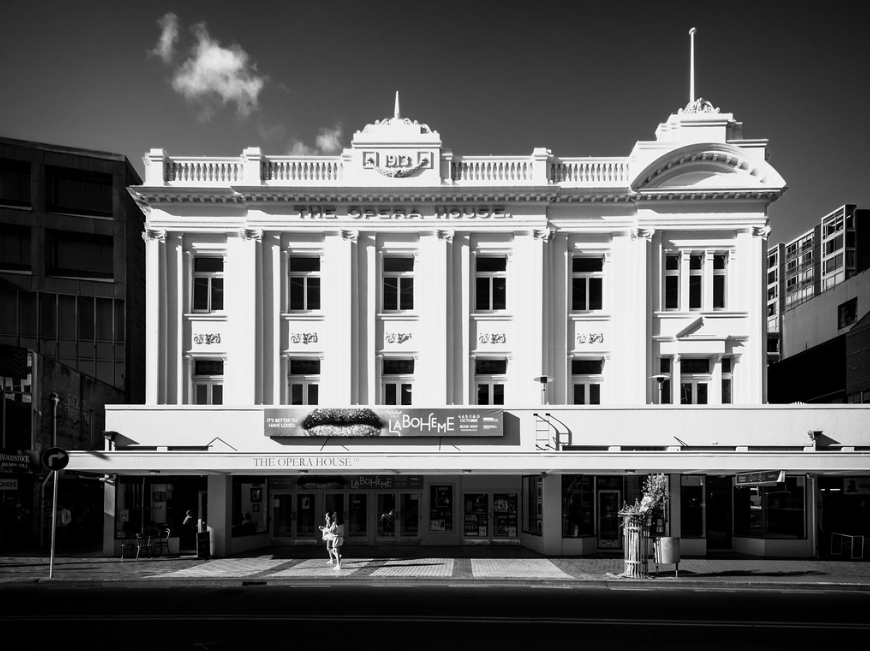
The Grand Opera House, as it was then known, was designed and built between 1911-1914, opening in April 1914.

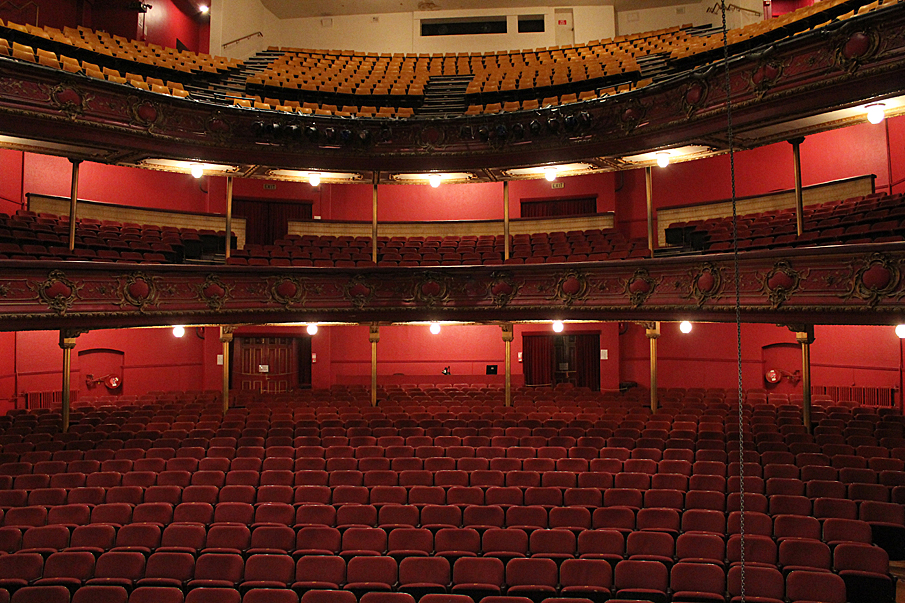
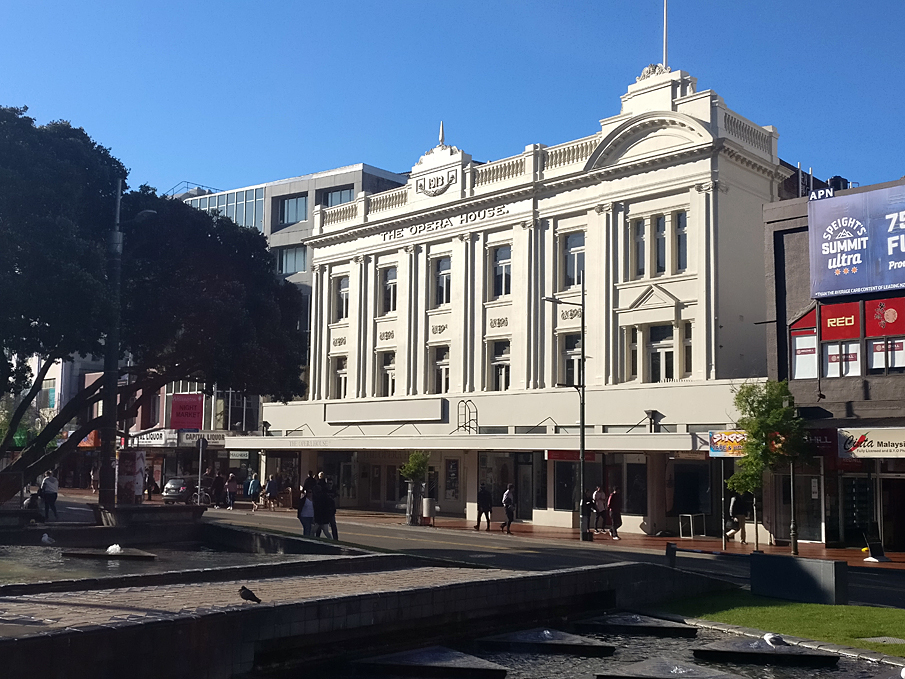
The building, providing some 16,500 square metres of floor space is a large brick rectangle with only one façade of any significance, that faces Manners Street. This is of plain style in a classical mode with an over-the-footpath verandah and ground floor shop windows and entrance doors. The remaining three walls are brick with very few openings. A balustraded parapet tops the building, and the roof of the verandah doubles as a balcony. The real significance of the building is its interior, which has 22m walls and a domed ceiling, with stalls, circle, and grand circle or 'gods' together with two tiers of boxes flanking the proscenium arch. Stage and backstage provides a space almost as large as the ground floor of the auditorium, and there are large ground and first floor foyers.

The architect was the Hon William Pitt of Melbourne, the site architect was Mr Albert Liddy. The scenic artist for the interior was Harold Bevan, the decorative artist was G Goulter of Sydney. Fibrous plaster decoration was by Mr O Wasohatz of Melbourne, and the builders were Messrs Sanders Bros of Wellington. The building was strengthened in 1977-82.

Apart form the now strengthened fabric, which is of tapering thicknesses of cement-mortared brick (six bricks deep at the bottom level) the architectural significance of the building is its interior. The stage facilities are unique in Wellington and may be unique in New Zealand. Behind a generous proscenium arch is a large stage and fly tower some 22 metres in height. Equipment for operating the theatre remains in place. The auditorium is lavishly decorated with fibrous plaster flowers, fruits, wreaths, corbels, brackets, cupids, bas-relief panels, columns and the large central dome. A grand white marble staircase leads from the black and white marble tiled ground floor foyer to the magnificent foyer on the first floor. This foyer, with an ornate ceiling, has four sets of double glass panelled doors leading to a balcony across the width of the street frontage. There are four ornamented boxes in two tiers on either side of the proscenium arch, dressing rooms on three floors, separate stairs to the 'gods' and adequate booking and administration offices and toilets.

The State Opera House has become an accepted and valued part of the Manners Street scene, a fact accepted by both the City and Government when the decision was made by State Insurance, the present owners, to strengthen, restore and preserve it in 1977. Built on an erst-while waterfront section, site of Kebbell's flour mill and since 1885 the Poneke Rugby Club Gymnasium, both the site and the building are part of Wellington's mercantile, social and musical history. Since the Grand Opera House was opened on Easter Saturday 1914, four generations of New Zealanders have shared the delights of opera, ballet, comedy and tragedy, drama - in fact the whole range of the musical, dramatic and performing arts. Under modern economic conditions it could truly be said that the building is as irreplaceable as its link with cultural development of the city and nation.
Opera House, Wellington. CC BY-SA 4.0 Image courtesy of commons.wikimedia.org | Jonathanischoice | 19/10/2018 | Jonathanischoice - Wikimedia Commons
Opera House, Wellington. Image courtesy of www.flickr.com | Andrew Caldwell | 29/09/2018 | Andrew Caldwell
Opera House, Wellington. Interior CC BY-SA 2.0 Image courtesy of www.flickr.com | Kristina D.C. Hoeppner | 05/11/2011 | Kristina D.C. Hoeppner
Opera House, Wellington. CC BY-SA 4.0 Image courtesy of commons.wikimedia.org | Jonathanischoice | 19/10/2018 | Jonathanischoice - Wikimedia Commons
Opera House, Wellington. Image courtesy of www.flickr.com | Andrew Caldwell | 29/09/2018 | Andrew Caldwell
Opera House, Wellington. Interior CC BY-SA 2.0 Image courtesy of www.flickr.com | Kristina D.C. Hoeppner | 05/11/2011 | Kristina D.C. Hoeppner

List Entry Information

Overview

Status
Listed

List Entry Status
Historic Place Category 1

Access
Private/No Public Access

List Number
1432

Date Entered
27th June 1985

Date of Effect
27th June 1985

City/District Council
Wellington City

Region
Wellington Region

Legal description

Lot 2 DP 2987 (RT WN226/172), Wellington Land District

Detailed List Entry

Construction Professional

Name

Pitt, William

Type

Architect

Biography

Australian architect

Construction Details

Start Year

1911

Finish Year

1914

Type

Original Construction

Start Year

1977

Type

Modification

Description

Restoration by the State Insurance Company

Reference

Report Written By

This place was identified as significant under previous legislation with different information requirements. It remains significant under the current legislation. There is opportunity under our legislation and policies to add to this information. Further information about this place may be available from the Central Regional Office of Heritage New Zealand Pouhere Taonga. Please note that entry on the New Zealand Heritage List/Rarangi Korero identifies only the heritage values of the property concerned, and should not be construed as advice on the state of the property, or as a comment of its soundness or safety, including in regard to earthquake risk, safety in the event of fire, or insanitary conditions. This historic place was registered under the Historic Places Act 1980. The following text is the original citation considered by the NZHPT Board at the time of registration. Information in square brackets indicate modifications made after the paper was considered by the NZHPT Board.

Further Information

Current Usages

Former Usages

General Usage:: Civic Facilities

Specific Usage: Opera House

General Usage:: Civic Facilities

Specific Usage: Theatre

Themes

Web Links

Overview

Status

Listed

List Entry Status

Historic Place Category 1

Access

Private/No Public Access

List Number

1432

Date Entered

27th June 1985

Date of Effect

27th June 1985

City/District Council

Wellington City

Region

Wellington Region

Legal description

Lot 2 DP 2987 (RT WN226/172), Wellington Land District

Status

Listed

List Entry Status

Historic Place Category 1

Access

Private/No Public Access

List Number

1432

Date Entered

27th June 1985

Date of Effect

27th June 1985

City/District Council

Wellington City

Region

Wellington Region

Legal description

Lot 2 DP 2987 (RT WN226/172), Wellington Land District

Construction Information

Construction Professional

Name

Pitt, William

Type

Architect

Biography

Australian architect

Construction Details

Start Year

1911

Finish Year

1914

Type

Original Construction

Start Year

1977

Type

Modification

Description

Restoration by the State Insurance Company

Construction Professional

Name

Pitt, William

Type

Architect

Biography

Australian architect

Construction Details

Start Year

1911

Finish Year

1914

Type

Original Construction

Start Year

1977

Type

Modification

Description

Restoration by the State Insurance Company

Reference

Historical and Associated Iwi / Hapū / Whānau

Other Information

This place was identified as significant under previous legislation with different information requirements. It remains significant under the current legislation. There is opportunity under our legislation and policies to add to this information. Further information about this place may be available from the Central Regional Office of Heritage New Zealand Pouhere Taonga. Please note that entry on the New Zealand Heritage List/Rarangi Korero identifies only the heritage values of the property concerned, and should not be construed as advice on the state of the property, or as a comment of its soundness or safety, including in regard to earthquake risk, safety in the event of fire, or insanitary conditions. This historic place was registered under the Historic Places Act 1980. The following text is the original citation considered by the NZHPT Board at the time of registration. Information in square brackets indicate modifications made after the paper was considered by the NZHPT Board.

Historical and Associated Iwi / Hapū / Whānau

Other Information

This place was identified as significant under previous legislation with different information requirements. It remains significant under the current legislation. There is opportunity under our legislation and policies to add to this information. Further information about this place may be available from the Central Regional Office of Heritage New Zealand Pouhere Taonga. Please note that entry on the New Zealand Heritage List/Rarangi Korero identifies only the heritage values of the property concerned, and should not be construed as advice on the state of the property, or as a comment of its soundness or safety, including in regard to earthquake risk, safety in the event of fire, or insanitary conditions. This historic place was registered under the Historic Places Act 1980. The following text is the original citation considered by the NZHPT Board at the time of registration. Information in square brackets indicate modifications made after the paper was considered by the NZHPT Board.

Further Information

Former Usages

General Usage: Civic Facilities

Specific Usage: Opera House

General Usage: Civic Facilities

Specific Usage: Theatre

Former Usages

General Usage: Civic Facilities

Specific Usage: Opera House

General Usage: Civic Facilities

Specific Usage: Theatre

Location

Loading
Stay up to date with Heritage this month