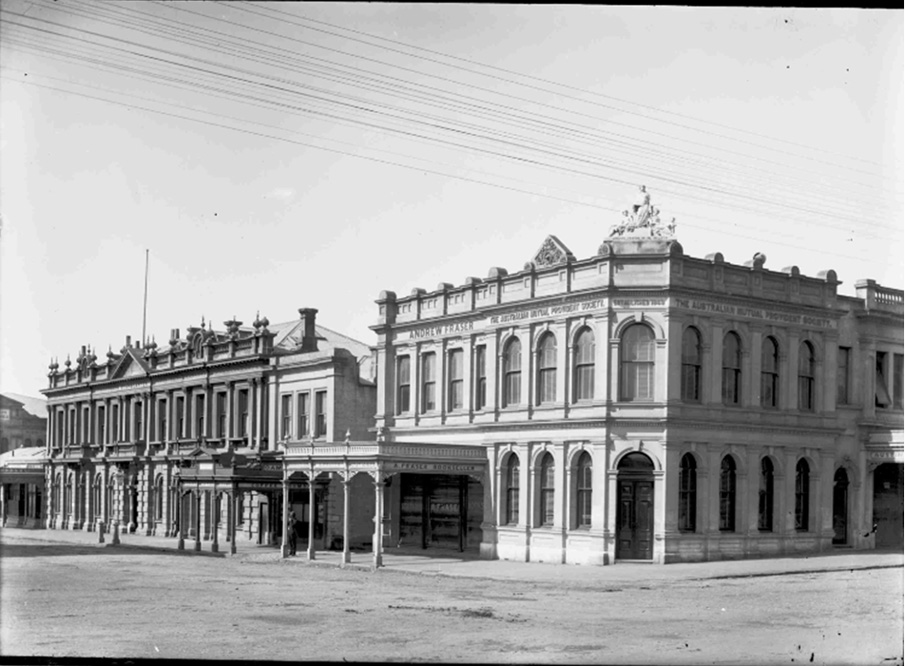
John Hood (1835-1907) and John Shennan (c.1843-1887) established the first drapers shop in Oamaru in 1863 at the foot of Wansbeck Street. Their business was a success and in 1871 they acquired a prominent site on the corner of Itchen and Tees Streets and built new premises, a ‘fine showy structure’ constructed from stone in Italianate style ‘plain in character, but exhibiting in a marked degree fitness for the business for which it is intended.’ The main entrance was on Itchen Street, with deep windows either side of the door. The drapery department was on Tees Street. A showroom was located upstairs, with a furnishing and clothing department, tailors’ workshop and offices on the ground floor. The contractor was Thomas King and the building was erected under Thomas Forrester’s superintendence. A photograph taken prior to 1874 shows a plainly detailed building of two storeys, with the main entrance on Itchen Street, and building work in progress, extending the Itchen Street façade; ornamentation (balustrades and cartouches on the parapet) evident in later photographs has yet to be added, and there is an empty section on Tees Street.
The building was extended in late 1874, with tenders advertised in August. In January 1875 the North Otago Times reported that ‘a new two-storey building’ designed by Forrester was ‘in course of erection’ by Messrs Barclay and Co. The frontage was 32 ft [10m] to Tees street, with a depth of 56 ft [17m]. ‘The front is very handsome, and the building, with those previously erected, and to which it is an addition forms a very handsome block.’ The whole building was described as 66 ft by 50 ft [20 by 15m] in a September 1875 description. A photograph dated 1876 shows a new building on the previously empty section on Tees Street, matching the style of the first building.
Hood and Shennan’s partnership ended in September 1882. They sold the property to the Australian Mutual Provident (‘AMP’) Society. John Hood carried on business for a time on his own account.
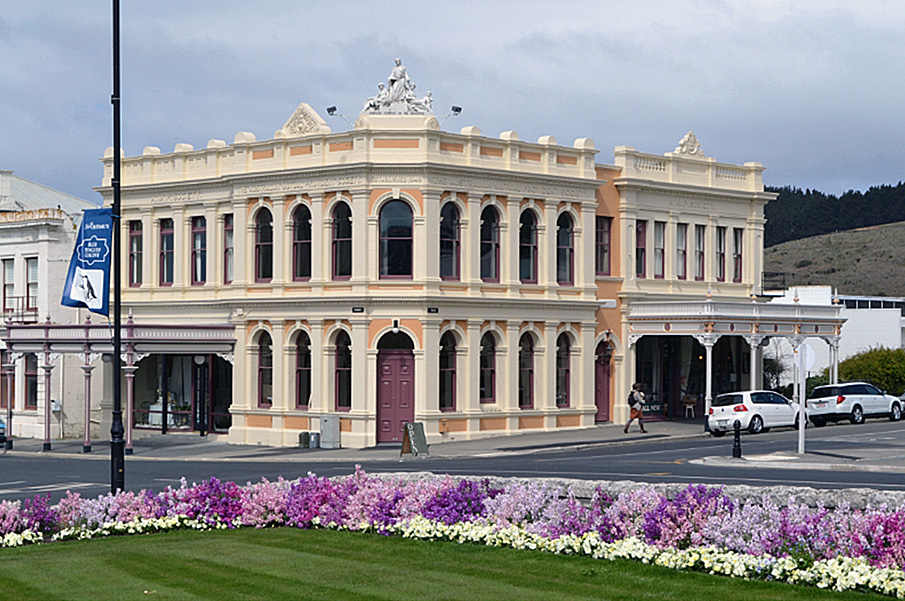
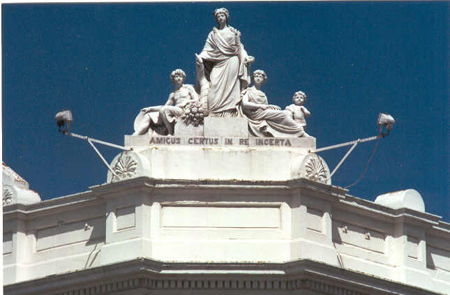
The façade was remodelled by Forrester and Lemon in 1885 for the Australian Mutual Provident Society’s offices. The design included what architectural historian Conal McCarthy describes as ‘the magnificent marble statue group’ ‘Amicus’ which was placed on the corner parapet. Verandahs were added to the shop fronts on Itchen Street and Tees Street. AMP owned the building until 1958 when it was bought by stock and station agents Stringer and Co. Ltd.
The North Otago Club took over the building in 1975. In 2010 the building was restored, including the reinstatement and restoration of the verandahs to Itchen and Tees Streets. The restoration was awarded a New Zealand Institute of Architects Local Architecture Award (Southern) Citation and a second citation for the paint colour scheme.
In 2013 the AMP Society Building (Former) remains a landmark in Oamaru’s Harbour/Tyne Street Historic Area (Register No. 7064).
List Entry Information
Status
Listed
List Entry Status
Historic Place Category 1
Access
Private/No Public Access
List Number
2278
Date Entered
2nd July 1987
Date of Effect
2nd July 1987
City/District Council
Waitaki District
Region
Otago Region
Extent of List Entry
Extent includes the land described as Pt Sec 12 Blk III Town of Oamaru (RT OT75/298), Otago Land District, and the building known as AMP Society Building (Former) thereon.
Legal description
Pt Sec 12 Blk III Town of Oamaru (RT OT75/298), Otago Land District
Status
Listed
List Entry Status
Historic Place Category 1
Access
Private/No Public Access
List Number
2278
Date Entered
2nd July 1987
Date of Effect
2nd July 1987
City/District Council
Waitaki District
Region
Otago Region
Extent of List Entry
Extent includes the land described as Pt Sec 12 Blk III Town of Oamaru (RT OT75/298), Otago Land District, and the building known as AMP Society Building (Former) thereon.
Legal description
Pt Sec 12 Blk III Town of Oamaru (RT OT75/298), Otago Land District
Why is this place significant?
Historic Significance
Historical Significance or Value This information below is from the original Building Classification Committee report considered by the NZHPT Board at the time of registration. The building was originally constructed by [Forrester] on the corner of Itchen and Tees Streets as Hood and Shennan's Drapery in [1871]. The building was extended along Tees Street in 1875 and then completely remodelled by the practice for the AMP Society in [1885]. It is one of the oldest buildings constructed for the society in New Zealand. Its prominent corner site and bold façade typify the way in which insurance companies and banks advertise their services in the late nineteenth century.
Physical Significance
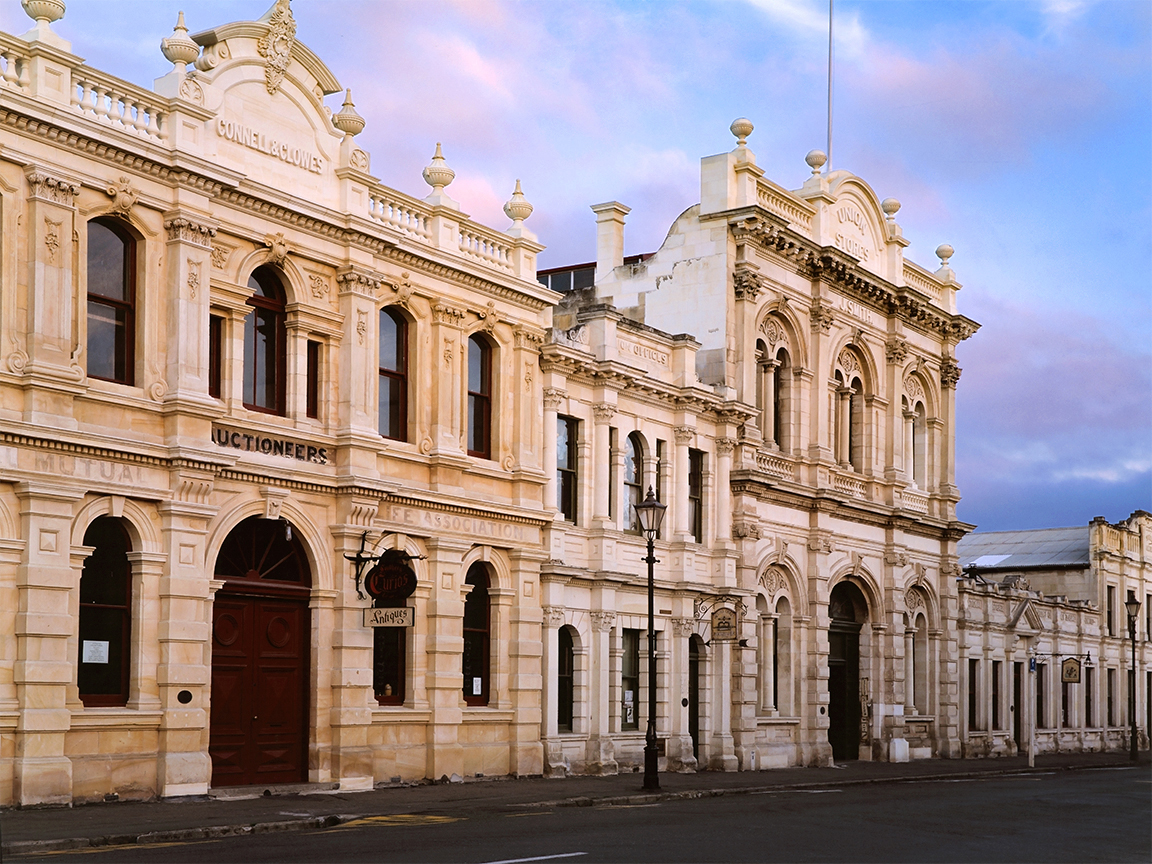
This information below is from the original Building Classification Committee report considered by the NZHPT Board at the time of registration. ARCHITECTURAL SIGNIFICANCE An important corner building of simplified classical style. The building was deliberately designed by Forrester and Lemon to match their Colonial Bank on the opposite corner so as to give Itchen Street a unified character. TOWNSCAPE/LANDMARK SIGNIFCANCE The building occupies a pivotal position in the townscape acting as a visual stop the view south down Thames Street and defining the beginning of the nationally significant Harbour/Tyne Street conservation area.
Why is this place significant?
Historic Significance
Historical Significance or Value This information below is from the original Building Classification Committee report considered by the NZHPT Board at the time of registration. The building was originally constructed by [Forrester] on the corner of Itchen and Tees Streets as Hood and Shennan's Drapery in [1871]. The building was extended along Tees Street in 1875 and then completely remodelled by the practice for the AMP Society in [1885]. It is one of the oldest buildings constructed for the society in New Zealand. Its prominent corner site and bold façade typify the way in which insurance companies and banks advertise their services in the late nineteenth century.
Physical Significance
This information below is from the original Building Classification Committee report considered by the NZHPT Board at the time of registration. ARCHITECTURAL SIGNIFICANCE An important corner building of simplified classical style. The building was deliberately designed by Forrester and Lemon to match their Colonial Bank on the opposite corner so as to give Itchen Street a unified character. TOWNSCAPE/LANDMARK SIGNIFCANCE The building occupies a pivotal position in the townscape acting as a visual stop the view south down Thames Street and defining the beginning of the nationally significant Harbour/Tyne Street conservation area.
Construction Professional
Name
Forrester, Thomas
Type
Architect
Biography
Born in Glasgow and educated at the Glasgow School of Art, Thomas Forrester (1838-1907) emigrated to New Zealand in 1861 with some experience in building construction, particularly plasterwork. Settling in Dunedin he worked under William Mason (1810-97) and William Henry Clayton (1823-77) and later Robert Arthur Lawson (1833-1902). In 1865 he superintended the Dunedin Exhibition and in 1870 was employed by the Otago Provincial Government to supervise borings for the Waitaki road and rail bridge. In 1872 Forrester entered partnership with John Lemon (1828-90) in Oamaru. Forrester was responsible for most of the design work while Lemon administered the practice. Among their many designs were St Paul's Church (1875-76), the Harbour Board Offices (1876), Queen's (later Brydone) Hotel (1881), Waitaki Boys' High School (1883), The Courthouse (1883) and the Post Office (1883-84). They contributed greatly to Oamaru's nineteenth century character. On Lemon's death in 1890 the practice was taken over by Forrester's son, John Megget Forrester (1865-1965). From 1870 Forrester became involved with the supervision of harbour works and some time after 1885 he became Engineer to the Oamaru Harbour Board. In this capacity he designed the repairs to the breakwater following storm damage in 1886 and later the Holmes Wharf. On his death in 1907 he was still in the employ of the Harbour Board. Forrester is also believed to have prepared the first geological maps of New Zealand under the direction of Sir James Hector (1834-1907).
Name
King, Thomas
Type
Builder
Biography
No biography is currently available for this construction professional
Name
Barclay and Co.
Type
Builder
Biography
No biography is currently available for this construction professional
Name
Butcher, Ian
Type
Architect
Biography
No biography is currently available for this construction professional
Construction Details
Start Year
1871
Type
Original Construction
Start Year
1874
Type
Addition
Description
New extension on Tees Street
Start Year
1885
Type
Modification
Description
Facade re-faced for AMP
Finish Year
2010
Type
Restoration
Description
Reinstatement and restoration of verandahs on Tees and Itchen Streets, new paint scheme.
Construction Materials
Oamaru stone
Notable Features
The building incorporates the only surviving wooden verandah in Oamaru (Tees Street side of building). The marble 'Amicus' statue group which surmounts the parapet at the corner of the building is one of the few pieces of statuary in Oamaru.
Construction Professional
Name
Forrester, Thomas
Type
Architect
Biography
Born in Glasgow and educated at the Glasgow School of Art, Thomas Forrester (1838-1907) emigrated to New Zealand in 1861 with some experience in building construction, particularly plasterwork. Settling in Dunedin he worked under William Mason (1810-97) and William Henry Clayton (1823-77) and later Robert Arthur Lawson (1833-1902). In 1865 he superintended the Dunedin Exhibition and in 1870 was employed by the Otago Provincial Government to supervise borings for the Waitaki road and rail bridge. In 1872 Forrester entered partnership with John Lemon (1828-90) in Oamaru. Forrester was responsible for most of the design work while Lemon administered the practice. Among their many designs were St Paul's Church (1875-76), the Harbour Board Offices (1876), Queen's (later Brydone) Hotel (1881), Waitaki Boys' High School (1883), The Courthouse (1883) and the Post Office (1883-84). They contributed greatly to Oamaru's nineteenth century character. On Lemon's death in 1890 the practice was taken over by Forrester's son, John Megget Forrester (1865-1965). From 1870 Forrester became involved with the supervision of harbour works and some time after 1885 he became Engineer to the Oamaru Harbour Board. In this capacity he designed the repairs to the breakwater following storm damage in 1886 and later the Holmes Wharf. On his death in 1907 he was still in the employ of the Harbour Board. Forrester is also believed to have prepared the first geological maps of New Zealand under the direction of Sir James Hector (1834-1907).
Name
King, Thomas
Type
Builder
Biography
No biography is currently available for this construction professional
Name
Barclay and Co.
Type
Builder
Biography
No biography is currently available for this construction professional
Name
Butcher, Ian
Type
Architect
Biography
No biography is currently available for this construction professional
Construction Details
Start Year
1871
Type
Original Construction
Start Year
1874
Type
Addition
Description
New extension on Tees Street
Start Year
1885
Type
Modification
Description
Facade re-faced for AMP
Finish Year
2010
Type
Restoration
Description
Reinstatement and restoration of verandahs on Tees and Itchen Streets, new paint scheme.
Construction Materials
Oamaru stone
Notable Features
The building incorporates the only surviving wooden verandah in Oamaru (Tees Street side of building). The marble 'Amicus' statue group which surmounts the parapet at the corner of the building is one of the few pieces of statuary in Oamaru.
ARCHITECTURAL DESCRIPTION (Style) Two storey, simplified Victorian Italianate building with splayed corner and continuous bands of round-headed windows set between Tuscan pilasters. The façade is relatively flat and devoid of sculptural decoration. MODIFICATIONS Verandah over ground floor on the Itchen Street side of the building has been removed.
Historical and Associated Iwi / Hapū / Whānau
Completion Date
13th August 2013
Report Written By
Heather Bauchop
Information Sources
McCarthy, 2002
Conal McCarthy, Forrester and Lemon of Oamaru, architects, Oamaru, 2002
North Otago Times
North Otago Times
Oamaru Borough Council
Historic Building Catalogue
Other Information
A fully referenced upgrade report is available on request from Otago/Southland Area Office of the NZHPT. This historic place was registered under the Historic Places Act 1980. This report includes the text from the original Building Classification Committee report considered by the NZHPT Board at the time of registration. This registration is also included in the Harbour/Tyne Street Historic Area (Record no. 7064). Please note that entry on the New Zealand Heritage List/Rarangi Korero identifies only the heritage values of the property concerned, and should not be construed as advice on the state of the property, or as a comment of its soundness or safety, including in regard to earthquake risk, safety in the event of fire, or insanitary conditions.
Historical and Associated Iwi / Hapū / Whānau
Completion Date
13th August 2013
Report Written By
Heather Bauchop
Information Sources
McCarthy, 2002
Conal McCarthy, Forrester and Lemon of Oamaru, architects, Oamaru, 2002
North Otago Times
North Otago Times
Oamaru Borough Council
Historic Building Catalogue
Other Information
A fully referenced upgrade report is available on request from Otago/Southland Area Office of the NZHPT. This historic place was registered under the Historic Places Act 1980. This report includes the text from the original Building Classification Committee report considered by the NZHPT Board at the time of registration. This registration is also included in the Harbour/Tyne Street Historic Area (Record no. 7064). Please note that entry on the New Zealand Heritage List/Rarangi Korero identifies only the heritage values of the property concerned, and should not be construed as advice on the state of the property, or as a comment of its soundness or safety, including in regard to earthquake risk, safety in the event of fire, or insanitary conditions.
Current Usages
Uses: Trade
Specific Usage: Shop
Former Usages
General Usage: Civic Facilities
Specific Usage: Club rooms/building
General Usage: Trade
Specific Usage: Office building/Offices
General Usage: Trade
Specific Usage: Restaurant/cafe/tearoom
General Usage: Trade
Specific Usage: Shop
General Usage: Trade
Specific Usage: Showrooms
Current Usages
Uses: Trade
Specific Usage: Shop
Former Usages
General Usage: Civic Facilities
Specific Usage: Club rooms/building
General Usage: Trade
Specific Usage: Office building/Offices
General Usage: Trade
Specific Usage: Restaurant/cafe/tearoom
General Usage: Trade
Specific Usage: Shop
General Usage: Trade
Specific Usage: Showrooms
Stay up to date with Heritage this month


