DonateMembershipVisit Heritage
  • Tūrangawaewae
    Places
  • Tira Māori
    Māori Heritage
  • Poutairangahia
    Archaeology
  • Rauemi
    Resources
  • Mō Tātou
    About Us
  • New Zealand Heritage List
  • Nominate and submit
  • Explore the List
  • National Historic Landmarks
  • Plaques
  • Rainbow List Project
  • Lost heritage
  • Visit Heritage
  • Our properties
  • Turnbull House Project
  • Collections
  • Shop
  • Tohu Whenua
  • Tira Māori
  • Conserving Māori heritage
  • Marae built heritage
  • Māori heritage on the List
  • Hinemihi—Te Hokinga Mai
  • What is archaeology?
  • Is there a site on my property?
  • What are my legal requirements?
  • Affecting an archaeological site
  • Declaring an archaeological site
  • Archaeology FAQs
  • Archaeology Digital Library
  • Archaeology guidelines and templates
  • Resources
  • Funding
  • Publications
  • Sustainable management guides
  • Disaster recovery
  • Podcasts & digital resources
  • Education Hub
  • Conservation plans
  • About
  • Board
  • Māori Heritage Council
  • Senior Staff
  • Offices
  • Contact us
  • Careers
  • Covenants
  • Fast-track
  • Corporate documents
  • Currently consulting on
  • Our submissions
  • News
  • Covid-19 response
Quick links
Rārangi Kōrero | The List
Explore the List
National Historic Landmarks
Ngā Manawhenua o Aotearoa me ōna Kōrero Tūturu
Quick links
Tapuwae
A Vision for Places of Māori Heritage
Funding for Māori Heritage
Resources
Quick links
Archaeological Authority Portal
Applying for an archaeological authority
Archaeology FAQs
Browse the most frequently asked questions about archaeological authorities and the archaeological process.
Quick links
Quick links
News
News Keep up to date with Heritage New Zealand Pouhere Taonga
Membership
Membership Find out more and sign up today
DonateMembershipVisit Heritage
  • Tūrangawaewae
    Places
  • Tira Māori
    Māori Heritage
  • Poutairangahia
    Archaeology
  • Rauemi
    Resources
  • Mō Tātou
    About Us
  • New Zealand Heritage List
  • Nominate and submit
  • Explore the List
  • National Historic Landmarks
  • Plaques
  • Rainbow List Project
  • Lost heritage
  • Visit Heritage
  • Our properties
  • Turnbull House Project
  • Collections
  • Shop
  • Tohu Whenua
  • Tira Māori
  • Conserving Māori heritage
  • Marae built heritage
  • Māori heritage on the List
  • Hinemihi—Te Hokinga Mai
  • What is archaeology?
  • Is there a site on my property?
  • What are my legal requirements?
  • Affecting an archaeological site
  • Declaring an archaeological site
  • Archaeology FAQs
  • Archaeology Digital Library
  • Archaeology guidelines and templates
  • Resources
  • Funding
  • Publications
  • Sustainable management guides
  • Disaster recovery
  • Podcasts & digital resources
  • Education Hub
  • Conservation plans
  • About
  • Board
  • Māori Heritage Council
  • Senior Staff
  • Offices
  • Contact us
  • Careers
  • Covenants
  • Fast-track
  • Corporate documents
  • Currently consulting on
  • Our submissions
  • News
  • Covid-19 response
Quick links
Rārangi Kōrero | The List
Explore the List
National Historic Landmarks
Ngā Manawhenua o Aotearoa me ōna Kōrero Tūturu
Quick links
Tapuwae
A Vision for Places of Māori Heritage
Funding for Māori Heritage
Resources
Quick links
Archaeological Authority Portal
Applying for an archaeological authority
Archaeology FAQs
Browse the most frequently asked questions about archaeological authorities and the archaeological process.
Quick links
Quick links
News
News Keep up to date with Heritage New Zealand Pouhere Taonga
Membership
Membership Find out more and sign up today
  • Places
  • Nominate and submit
  • National Historic Landmarks
  • Places
  • Nominate and submit
  • National Historic Landmarks
  • Tira Māori
  • Conserving Māori heritage
  • Marae built heritage
  • Tira Māori
  • Conserving Māori heritage
  • Marae built heritage
  • Archaeological authorities
  • Archaeology Digital Library
  • Archaeological authorities
  • Archaeology Digital Library
  • All resources
  • Publications
  • Funding
  • All resources
  • Publications
  • Funding
  • FAQs
  • FAQs
Follow us on:
Places
  • Places
  • Nominate and submit
  • National Historic Landmarks
Tira Māori
  • Tira Māori
  • Conserving Māori heritage
  • Marae built heritage
Archaeology
  • Archaeological authorities
  • Archaeology Digital Library
Resources
  • All resources
  • Publications
  • Funding
FAQs
  • FAQs
Follow us on
HomePrivacyTerms and conditionsAbout this site
© Heritage New Zealand Pouhere Taonga 2026.
 
Union Bank of Australia (Former)

12 Tyne Street, OAMARU

Private

Historic Place Category 1

List No. 2306

Quick links:
List GalleryLocationDetails
The former Union Bank of Australia was designed by Oamaru architectural partnership Forrester and Lemon and opened in 1879. It has historical, architectural and townscape significance as ‘an early example of the Venetian palazzo style’ and one of the partnership’s finest bank buildings. It is a symbol of Oamaru’s growing prosperity.

The Union Bank was one of the earliest banks to open in New Zealand, its first branch established in Petone, shifting to Wellington when the city was surveyed. Its Dunedin branch opened in 1857, one of many throughout the country. The Union Bank of Australia opened in Oamaru in 1873, with its first premises on Tyne Street. By 1877, there were plans for ‘new and handsome premises.’ Forrester designed the new premises in Venetian style, a style, art historian Conal McCarthy writes, was ‘entirely appropriate for a building of that function because of the role Venice had played as a financial centre.’

The Union Bank of Australia has two storeys and is built of Oamaru stone. McCarthy writes that it is one of the earliest examples of the Venetian Palazzo style. The ornate detailing includes balustrades and flanking colonettes added to the first floor windows, and a balustrade and scroll on the parapet (now removed). The decorative detailing results in a strong play of light and shade, and the elaborate façade reflects the prosperity of Oamaru in the 1870s. The building was in strong contrast to its then neighbour, the Bank of New Zealand built in 1865 (and since demolished), illustrating the commercial rivalry and the town’s wealth. The Union Bank was to influence subsequent bank designs.

The bank looks to have closed in the 1920s. John Moore of Oamaru bought the land in 1927. In the 1930s, after Moore’s death the building was owned by Raymond Gibb and Robert Milligan. They sold the land to the Oamaru Squash and Badminton Club in 1957. The Union Bank of Australia merged with the Bank of Australasia to form the ANZ Bank in 1951. In 2015, the building remains home to the Oamaru Squash and Badminton Club.
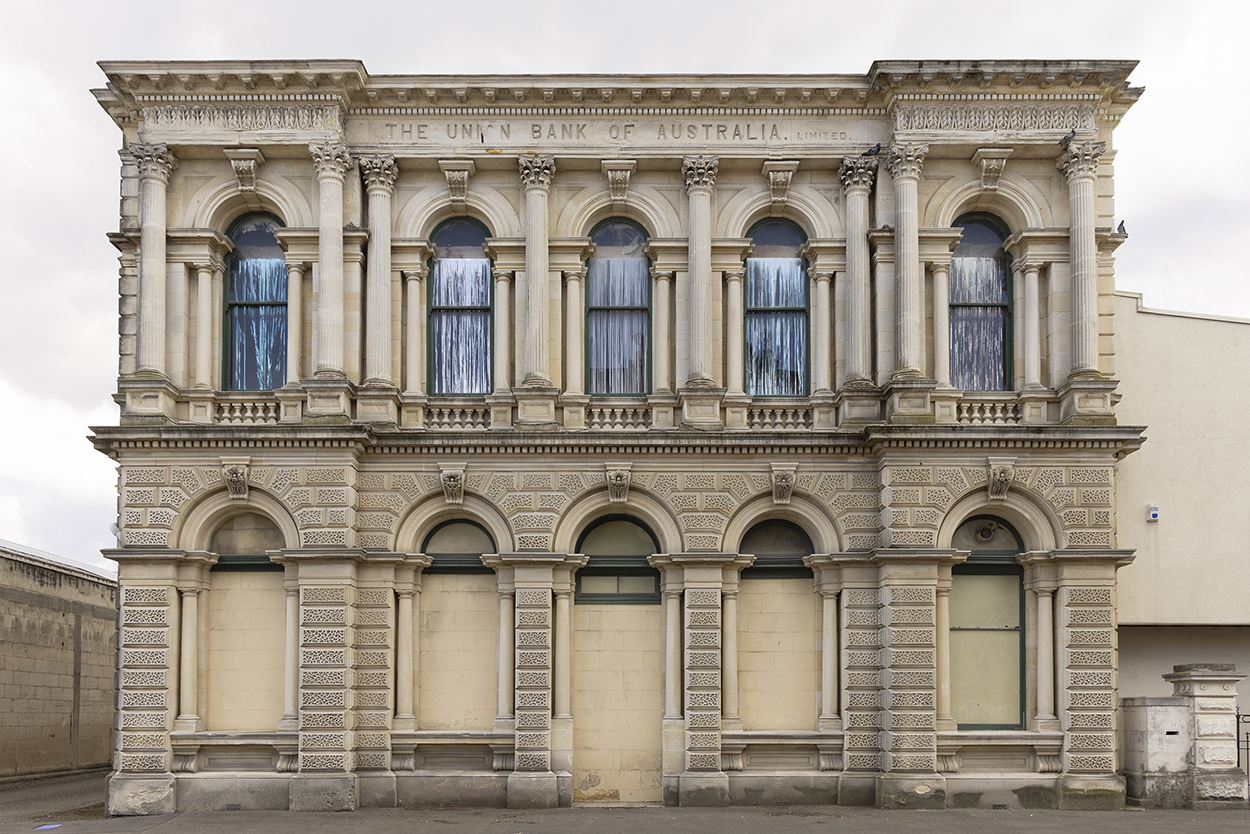
Union Bank of Australia (Former), Oamaru. CC BY Licence | Tracy Griffith | 28/09/2023 | Tracy Griffith
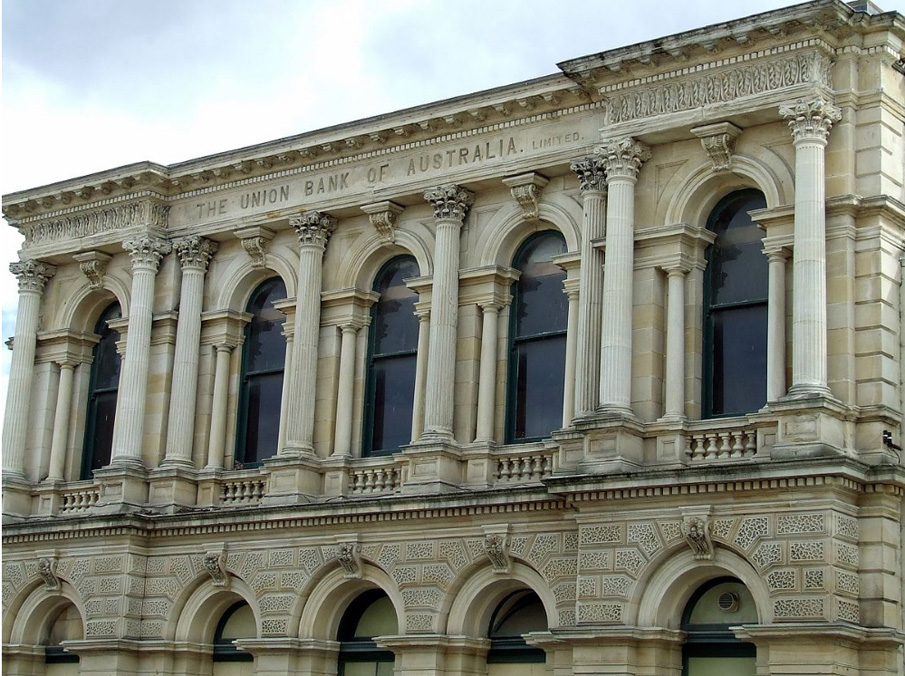
Union Bank of Australia (Former), Oamaru. CC BY 2.0 Image courtesy of commons.wikimedia.org | Tim Parkinson | 19/09/2006 | Tim Parkinson - Wikimedia Commons
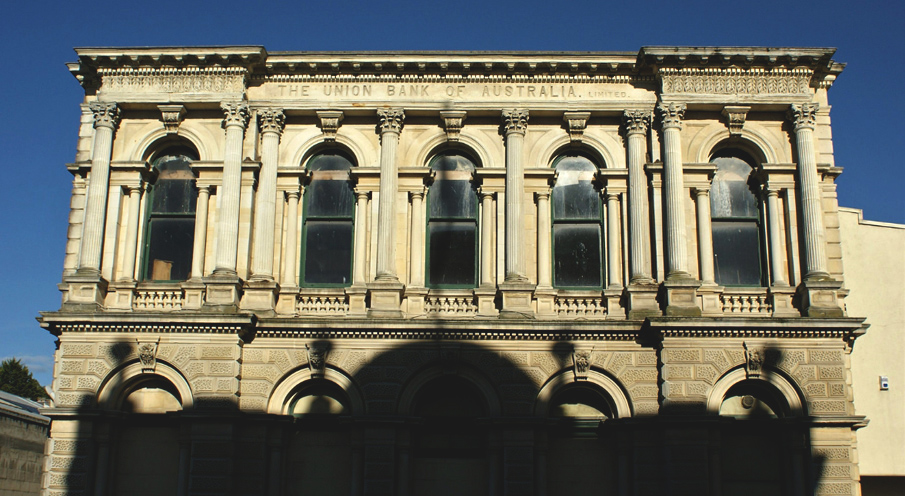
Union Bank of Australia (Former), Oamaru. Image courtesy of www.flickr.com | PhilBee NZ - Phil Braithwaite | 24/01/2017 | Phil Braithwaite
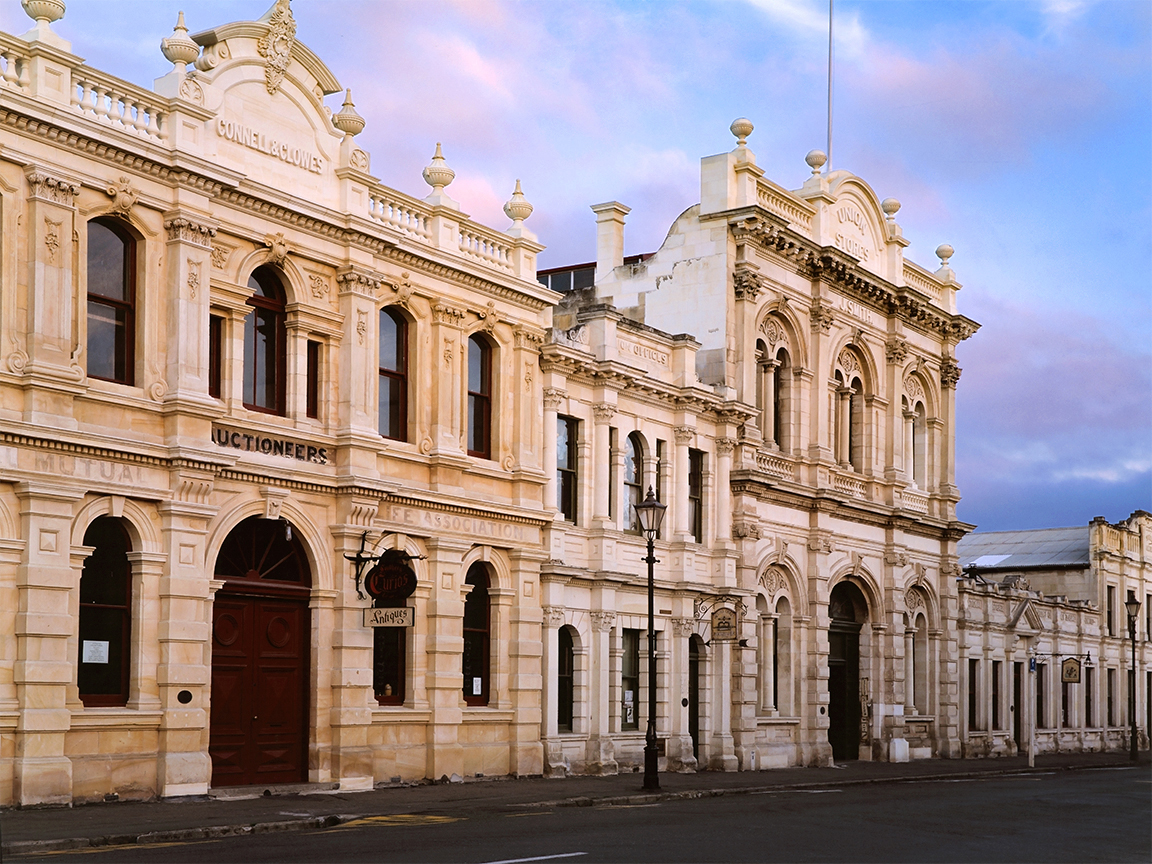
Union Bank of Australia (Former), Oamaru. CC BY Licence | Tracy Griffith | 28/09/2023 | Tracy Griffith
Union Bank of Australia (Former), Oamaru. CC BY 2.0 Image courtesy of commons.wikimedia.org | Tim Parkinson | 19/09/2006 | Tim Parkinson - Wikimedia Commons
Union Bank of Australia (Former), Oamaru. Image courtesy of www.flickr.com | PhilBee NZ - Phil Braithwaite | 24/01/2017 | Phil Braithwaite


List Entry Information

Overview

Status
Listed

List Entry Status
Historic Place Category 1

Access
Private/No Public Access

List Number
2306

Date Entered
2nd July 1987

Date of Effect
2nd July 1987

City/District Council
Waitaki District

Region
Otago Region

Extent of List Entry

Extent includes the land described as Secs 7-8 Blk III Town of Oamaru (RT OT5A/805), Otago Land District, and the building associated with the Union Bank of Australia (Former) thereon.

Legal description

Secs 7-8 Blk III Town of Oamaru (RT OT5A/805), Otago Land District

Location Description

CT 5A/805 as per Heritage Covenant 1999.

Detailed List Entry
Significance

Historic Significance

Historical Significance or Value The Union Bank (the forerunner of the ANZ Bank) was established in Tyne Street in 1873. The opulent appearance of the building was a symbol of Oamaru's growing prosperity and an example of commercial rivalry existing between the banks in the town.

Physical Significance

ARCHITECTURAL SIGNIFICANCE Despite its alterations and additions, this building is notable for its superb façade. It is a major work by Forrester and one of the first examples of the Venetian palazzo style of commercial architecture in New Zealand. Mason and Clayton's Bank of New Zealand (1865) now demolished, was sited immediately adjacent to the Union Bank in Tyne Street which at that time formed the commercial heart of the town. TOWNSCAPE/LANDMARK SIGNIFICANCE The building is included in the Harbour/Tyne Street Conservation Area but its immediate environment has been marred somewhat by unsympathetic additions.

Construction Professional

Name

Forrester & Lemon

Type

Architectural Partnership

Biography

The architectural partnership of Forrester and Lemon was established in Oamaru in 1872. Thomas Forrester (1838-1907) was born in Glasgow and educated at the Glasgow School of Art. Emigrating to New Zealand in 1861 he settled in Dunedin and worked under William Mason (1810-97) and William Henry Clayton (1823-77) and later Robert Arthur Lawson (1833-1902). In 1865 he superintended the Dunedin Exhibition and from 1870 he became involved with the supervision of harbour works. Some time after 1885 he became Engineer to the Oamaru Harbour Board and in this capacity designed the repairs to the breakwater following storm damage in 1886 and later the Holmes Wharf. On his death in 1907 he was still in the employ of the Harbour Board. John Lemon (1828-1890) was born in Jamaica and travelled to England before emigrating to New Zealand in 1849. He settled in Oamaru in 1860 and with his brother Charles established a timber merchant's business. By 1869 he was in partnership with his father-in-law, George Sumpter calling themselves "Timber and General Merchants, Land and Commission Agents". This partnership was dissolved in 1872 and Lemon entered into partnership with Forrester. Lemon had no architectural experience at all, but had a wide circle of business contacts and was an efficient administrator. Buildings designed by the partnership of Forrester and Lemon include St Paul's Church (1875-76), the Harbour Board Offices (1876), Queen's (later Brydone) Hotel (1881), Waitaki Boys' High School (1883), The Courthouse (1883) and the Post Office (1883-84), all in Oamaru. Forrester and Lemon contributed greatly to Oamaru's nineteenth century character. On Lemon's death in 1890 the practice was taken over by Forrester's son, John Megget Forrester (1865-1965).

Construction Details

Start Year

1878

Type

Original Construction

Start Year

1879

Type

Other

Description

6 February – Union Bank opened

Type

Addition

Description

Concrete Block addition

Period

1970s

Construction Materials

Oamaru stone

Notable Features

High quality exterior ornamentation carved in Oamaru stone.

Physical Description

ARCHITECTURAL DESCRIPTION (Style) A lavish Victorian Italianate building with Venetian features. First floor has a detached Corinthian colonnade flanking round-headed windows. The windows have balustrades and flanking colonettes. The ground floor is heavily rusticated creating a monumental effect. MODIFICATIONS The original parapet and other top hamper has been removed. Three ground floor windows and the doorway have been blocked in. An unsympathetic addition has been made to the building's left side.

Reference

Completion Date

9th September 2015

Report Written By

Heather Bauchop

Information Sources

McCarthy, 2002

Conal McCarthy, Forrester and Lemon of Oamaru, architects, Oamaru, 2002

Oamaru Borough Council

Historic Building Catalogue

Report Written By

Please note that entry on the New Zealand Heritage List/Rarangi Korero identifies only the heritage values of the property concerned, and should not be construed as advice on the state of the property, or as a comment of its soundness or safety, including in regard to earthquake risk, safety in the event of fire, or insanitary conditions. A fully referenced upgrade report is available on request from the Otago/Southland Office of Heritage New Zealand

Further Information

Current Usages

Uses: Civic Facilities

Specific Usage: Club rooms/building

Former Usages

General Usage:: Finance

Specific Usage: Bank

Themes

Web Links

Overview

Status

Listed

List Entry Status

Historic Place Category 1

Access

Private/No Public Access

List Number

2306

Date Entered

2nd July 1987

Date of Effect

2nd July 1987

City/District Council

Waitaki District

Region

Otago Region

Extent of List Entry

Extent includes the land described as Secs 7-8 Blk III Town of Oamaru (RT OT5A/805), Otago Land District, and the building associated with the Union Bank of Australia (Former) thereon.

Legal description

Secs 7-8 Blk III Town of Oamaru (RT OT5A/805), Otago Land District

Location Description

CT 5A/805 as per Heritage Covenant 1999.

Status

Listed

List Entry Status

Historic Place Category 1

Access

Private/No Public Access

List Number

2306

Date Entered

2nd July 1987

Date of Effect

2nd July 1987

City/District Council

Waitaki District

Region

Otago Region

Extent of List Entry

Extent includes the land described as Secs 7-8 Blk III Town of Oamaru (RT OT5A/805), Otago Land District, and the building associated with the Union Bank of Australia (Former) thereon.

Legal description

Secs 7-8 Blk III Town of Oamaru (RT OT5A/805), Otago Land District

Location Description

CT 5A/805 as per Heritage Covenant 1999.

Significance

Why is this place significant?

Historic Significance

Historical Significance or Value The Union Bank (the forerunner of the ANZ Bank) was established in Tyne Street in 1873. The opulent appearance of the building was a symbol of Oamaru's growing prosperity and an example of commercial rivalry existing between the banks in the town.

Physical Significance

ARCHITECTURAL SIGNIFICANCE Despite its alterations and additions, this building is notable for its superb façade. It is a major work by Forrester and one of the first examples of the Venetian palazzo style of commercial architecture in New Zealand. Mason and Clayton's Bank of New Zealand (1865) now demolished, was sited immediately adjacent to the Union Bank in Tyne Street which at that time formed the commercial heart of the town. TOWNSCAPE/LANDMARK SIGNIFICANCE The building is included in the Harbour/Tyne Street Conservation Area but its immediate environment has been marred somewhat by unsympathetic additions.

Why is this place significant?

Historic Significance

Historical Significance or Value The Union Bank (the forerunner of the ANZ Bank) was established in Tyne Street in 1873. The opulent appearance of the building was a symbol of Oamaru's growing prosperity and an example of commercial rivalry existing between the banks in the town.

Physical Significance

ARCHITECTURAL SIGNIFICANCE Despite its alterations and additions, this building is notable for its superb façade. It is a major work by Forrester and one of the first examples of the Venetian palazzo style of commercial architecture in New Zealand. Mason and Clayton's Bank of New Zealand (1865) now demolished, was sited immediately adjacent to the Union Bank in Tyne Street which at that time formed the commercial heart of the town. TOWNSCAPE/LANDMARK SIGNIFICANCE The building is included in the Harbour/Tyne Street Conservation Area but its immediate environment has been marred somewhat by unsympathetic additions.

Construction Information

Construction Professional

Name

Forrester & Lemon

Type

Architectural Partnership

Biography

The architectural partnership of Forrester and Lemon was established in Oamaru in 1872. Thomas Forrester (1838-1907) was born in Glasgow and educated at the Glasgow School of Art. Emigrating to New Zealand in 1861 he settled in Dunedin and worked under William Mason (1810-97) and William Henry Clayton (1823-77) and later Robert Arthur Lawson (1833-1902). In 1865 he superintended the Dunedin Exhibition and from 1870 he became involved with the supervision of harbour works. Some time after 1885 he became Engineer to the Oamaru Harbour Board and in this capacity designed the repairs to the breakwater following storm damage in 1886 and later the Holmes Wharf. On his death in 1907 he was still in the employ of the Harbour Board. John Lemon (1828-1890) was born in Jamaica and travelled to England before emigrating to New Zealand in 1849. He settled in Oamaru in 1860 and with his brother Charles established a timber merchant's business. By 1869 he was in partnership with his father-in-law, George Sumpter calling themselves "Timber and General Merchants, Land and Commission Agents". This partnership was dissolved in 1872 and Lemon entered into partnership with Forrester. Lemon had no architectural experience at all, but had a wide circle of business contacts and was an efficient administrator. Buildings designed by the partnership of Forrester and Lemon include St Paul's Church (1875-76), the Harbour Board Offices (1876), Queen's (later Brydone) Hotel (1881), Waitaki Boys' High School (1883), The Courthouse (1883) and the Post Office (1883-84), all in Oamaru. Forrester and Lemon contributed greatly to Oamaru's nineteenth century character. On Lemon's death in 1890 the practice was taken over by Forrester's son, John Megget Forrester (1865-1965).

Construction Details

Start Year

1878

Type

Original Construction

Start Year

1879

Type

Other

Description

6 February – Union Bank opened

Type

Addition

Description

Concrete Block addition

Period

1970s

Construction Materials

Oamaru stone

Notable Features

High quality exterior ornamentation carved in Oamaru stone.

Construction Professional

Name

Forrester & Lemon

Type

Architectural Partnership

Biography

The architectural partnership of Forrester and Lemon was established in Oamaru in 1872. Thomas Forrester (1838-1907) was born in Glasgow and educated at the Glasgow School of Art. Emigrating to New Zealand in 1861 he settled in Dunedin and worked under William Mason (1810-97) and William Henry Clayton (1823-77) and later Robert Arthur Lawson (1833-1902). In 1865 he superintended the Dunedin Exhibition and from 1870 he became involved with the supervision of harbour works. Some time after 1885 he became Engineer to the Oamaru Harbour Board and in this capacity designed the repairs to the breakwater following storm damage in 1886 and later the Holmes Wharf. On his death in 1907 he was still in the employ of the Harbour Board. John Lemon (1828-1890) was born in Jamaica and travelled to England before emigrating to New Zealand in 1849. He settled in Oamaru in 1860 and with his brother Charles established a timber merchant's business. By 1869 he was in partnership with his father-in-law, George Sumpter calling themselves "Timber and General Merchants, Land and Commission Agents". This partnership was dissolved in 1872 and Lemon entered into partnership with Forrester. Lemon had no architectural experience at all, but had a wide circle of business contacts and was an efficient administrator. Buildings designed by the partnership of Forrester and Lemon include St Paul's Church (1875-76), the Harbour Board Offices (1876), Queen's (later Brydone) Hotel (1881), Waitaki Boys' High School (1883), The Courthouse (1883) and the Post Office (1883-84), all in Oamaru. Forrester and Lemon contributed greatly to Oamaru's nineteenth century character. On Lemon's death in 1890 the practice was taken over by Forrester's son, John Megget Forrester (1865-1965).

Construction Details

Start Year

1878

Type

Original Construction

Start Year

1879

Type

Other

Description

6 February – Union Bank opened

Type

Addition

Description

Concrete Block addition

Period

1970s

Construction Materials

Oamaru stone

Notable Features

High quality exterior ornamentation carved in Oamaru stone.

Physical Description

ARCHITECTURAL DESCRIPTION (Style) A lavish Victorian Italianate building with Venetian features. First floor has a detached Corinthian colonnade flanking round-headed windows. The windows have balustrades and flanking colonettes. The ground floor is heavily rusticated creating a monumental effect. MODIFICATIONS The original parapet and other top hamper has been removed. Three ground floor windows and the doorway have been blocked in. An unsympathetic addition has been made to the building's left side.

ARCHITECTURAL DESCRIPTION (Style) A lavish Victorian Italianate building with Venetian features. First floor has a detached Corinthian colonnade flanking round-headed windows. The windows have balustrades and flanking colonettes. The ground floor is heavily rusticated creating a monumental effect. MODIFICATIONS The original parapet and other top hamper has been removed. Three ground floor windows and the doorway have been blocked in. An unsympathetic addition has been made to the building's left side.

Reference

Historical and Associated Iwi / Hapū / Whānau

Completion Date

9th September 2015

Report Written By

Heather Bauchop

Information Sources

McCarthy, 2002

Conal McCarthy, Forrester and Lemon of Oamaru, architects, Oamaru, 2002

Oamaru Borough Council

Historic Building Catalogue

Other Information

Please note that entry on the New Zealand Heritage List/Rarangi Korero identifies only the heritage values of the property concerned, and should not be construed as advice on the state of the property, or as a comment of its soundness or safety, including in regard to earthquake risk, safety in the event of fire, or insanitary conditions. A fully referenced upgrade report is available on request from the Otago/Southland Office of Heritage New Zealand

Historical and Associated Iwi / Hapū / Whānau

Completion Date

9th September 2015

Report Written By

Heather Bauchop

Information Sources

McCarthy, 2002

Conal McCarthy, Forrester and Lemon of Oamaru, architects, Oamaru, 2002

Oamaru Borough Council

Historic Building Catalogue

Other Information

Please note that entry on the New Zealand Heritage List/Rarangi Korero identifies only the heritage values of the property concerned, and should not be construed as advice on the state of the property, or as a comment of its soundness or safety, including in regard to earthquake risk, safety in the event of fire, or insanitary conditions. A fully referenced upgrade report is available on request from the Otago/Southland Office of Heritage New Zealand

Further Information

Current Usages

Uses: Civic Facilities

Specific Usage: Club rooms/building

Former Usages

General Usage: Finance

Specific Usage: Bank

Current Usages

Uses: Civic Facilities

Specific Usage: Club rooms/building

Former Usages

General Usage: Finance

Specific Usage: Bank

Location

Loading
Related listings
Oamaru Historic Area. Image courtesy of www.jimwitkowski.com
Oamaru Historic Area
Oamaru Historic Area. Image courtesy of www.jimwitkowski.com
Oamaru Historic Area
Stay up to date with Heritage this month