DonateSupporterVisit Heritage
  • Tūrangawaewae
    Places
  • Tira Māori
    Māori Heritage
  • Poutairangahia
    Archaeology
  • Rauemi
    Resources
  • Mō Tātou
    About Us
  • New Zealand Heritage List
  • Nominate and submit
  • Explore the List
  • National Historic Landmarks
  • Plaques
  • Rainbow List Project
  • Lost heritage
  • Visit Heritage
  • Our properties
  • Turnbull House Project
  • Collections
  • Shop
  • Tohu Whenua
  • Tira Māori
  • Conserving Māori heritage
  • Marae built heritage
  • Māori heritage on the List
  • Hinemihi—Te Hokinga Mai
  • What is archaeology?
  • Is there a site on my property?
  • What are my legal requirements?
  • Affecting an archaeological site
  • Declaring an archaeological site
  • Archaeology FAQs
  • Archaeology Digital Library
  • Archaeology guidelines and templates
  • Resources
  • Funding
  • Publications
  • Sustainable management guides
  • Disaster recovery
  • Podcasts & digital resources
  • Education Hub
  • Conservation plans
  • About
  • Board
  • Māori Heritage Council
  • Senior Staff
  • Offices
  • Contact us
  • Careers
  • Covenants
  • Fast-track
  • Corporate documents
  • Currently consulting on
  • Our submissions
  • News
Quick links
Rārangi Kōrero | The List
Explore the List
National Historic Landmarks
Ngā Manawhenua o Aotearoa me ōna Kōrero Tūturu
Quick links
Tapuwae
A Vision for Places of Māori Heritage
Funding for Māori Heritage
Resources
Quick links
Archaeological Authority Portal
Applying for an archaeological authority
Archaeology FAQs
Browse the most frequently asked questions about archaeological authorities and the archaeological process.
Quick links
Quick links
Contact us
Offices
DonateSupporterVisit Heritage
  • Tūrangawaewae
    Places
  • Tira Māori
    Māori Heritage
  • Poutairangahia
    Archaeology
  • Rauemi
    Resources
  • Mō Tātou
    About Us
  • New Zealand Heritage List
  • Nominate and submit
  • Explore the List
  • National Historic Landmarks
  • Plaques
  • Rainbow List Project
  • Lost heritage
  • Visit Heritage
  • Our properties
  • Turnbull House Project
  • Collections
  • Shop
  • Tohu Whenua
  • Tira Māori
  • Conserving Māori heritage
  • Marae built heritage
  • Māori heritage on the List
  • Hinemihi—Te Hokinga Mai
  • What is archaeology?
  • Is there a site on my property?
  • What are my legal requirements?
  • Affecting an archaeological site
  • Declaring an archaeological site
  • Archaeology FAQs
  • Archaeology Digital Library
  • Archaeology guidelines and templates
  • Resources
  • Funding
  • Publications
  • Sustainable management guides
  • Disaster recovery
  • Podcasts & digital resources
  • Education Hub
  • Conservation plans
  • About
  • Board
  • Māori Heritage Council
  • Senior Staff
  • Offices
  • Contact us
  • Careers
  • Covenants
  • Fast-track
  • Corporate documents
  • Currently consulting on
  • Our submissions
  • News
Quick links
Rārangi Kōrero | The List
Explore the List
National Historic Landmarks
Ngā Manawhenua o Aotearoa me ōna Kōrero Tūturu
Quick links
Tapuwae
A Vision for Places of Māori Heritage
Funding for Māori Heritage
Resources
Quick links
Archaeological Authority Portal
Applying for an archaeological authority
Archaeology FAQs
Browse the most frequently asked questions about archaeological authorities and the archaeological process.
Quick links
Quick links
Contact us
Offices
  • Places
  • Nominate and submit
  • National Historic Landmarks
  • Places
  • Nominate and submit
  • National Historic Landmarks
  • Tira Māori
  • Conserving Māori heritage
  • Marae built heritage
  • Tira Māori
  • Conserving Māori heritage
  • Marae built heritage
  • Archaeological authorities
  • Archaeology Digital Library
  • Archaeological authorities
  • Archaeology Digital Library
  • All resources
  • Publications
  • Funding
  • All resources
  • Publications
  • Funding
  • FAQs
  • FAQs
Follow us on:
Places
  • Places
  • Nominate and submit
  • National Historic Landmarks
Tira Māori
  • Tira Māori
  • Conserving Māori heritage
  • Marae built heritage
Archaeology
  • Archaeological authorities
  • Archaeology Digital Library
Resources
  • All resources
  • Publications
  • Funding
FAQs
  • FAQs
Follow us on
HomePrivacyTerms and conditionsAbout this site
© Heritage New Zealand Pouhere Taonga 2026.
 
St Martin’s Anglican Church

3487 Kurow-Duntroon Road and Earthquake Road, DUNTROON

Private

Historic Place Category 2

List No. 2429

Quick links:
List GalleryLocationDetails
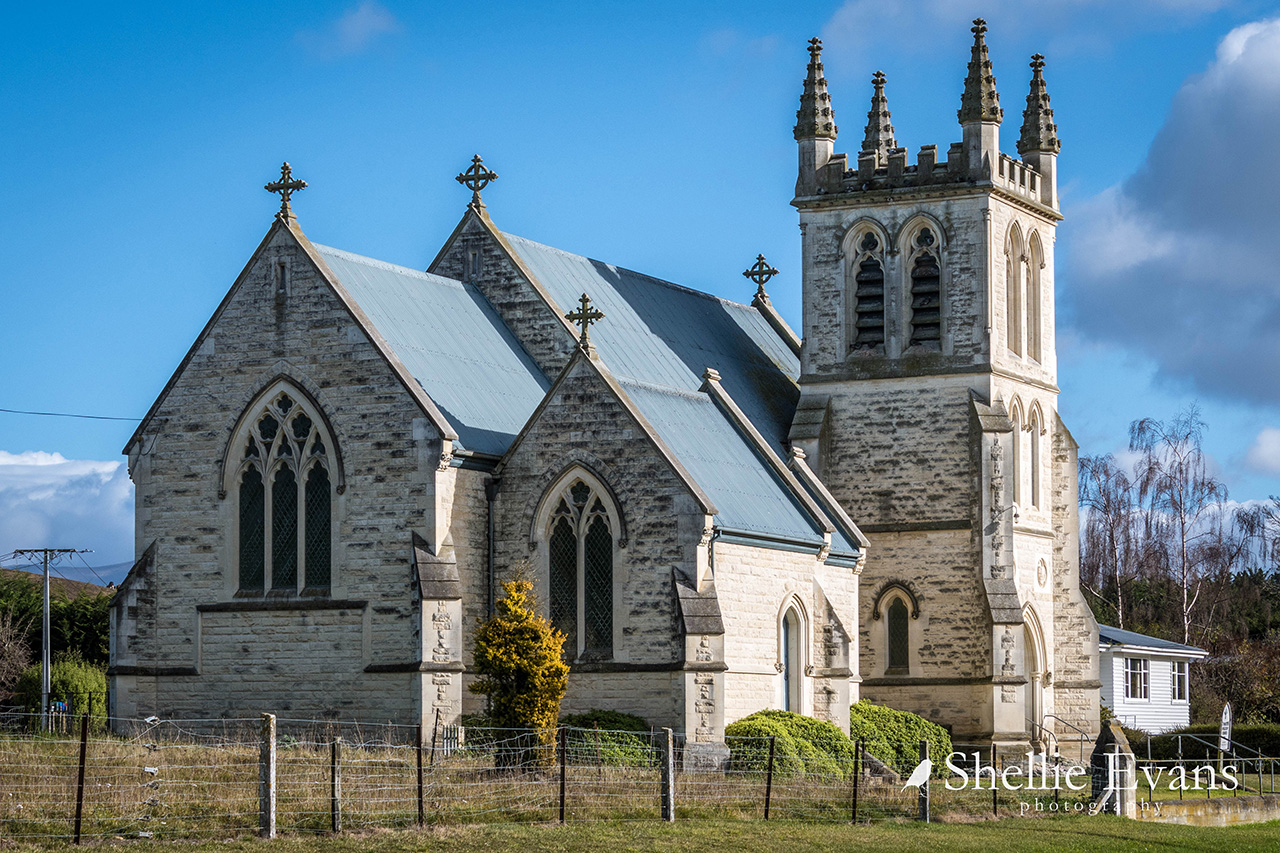
Funded by a bequest from Emily Campbell, wife of runholder Robert Campbell of Otekaieke Station, this handsome church designed by architect Thomas Cane and built 1901, tells a story of landed gentry in North Otago and of the significance of religion in nineteenth century New Zealand. St Martin’s Anglican Church has aesthetic, architectural, historic and spiritual significance.

Between 1881 and 1891 the Waitaki Valley Anglican community was served by curates who lived locally but who were appointed by the vicar of Oamaru. In 1891 the Waitaki Mission District was established and Hugh Corrie Frere was appointed first curate of the parish. Kurow was in the Waitaki Mission District of the Anglican Church that extended from the ‘sea coast to a point in the mountains beyond Kurow, about sixty miles from that township.’ The district included the settlements of Kurow, Ngapara, Livingstone, Maerewhenua, Duntroon and the Hakataramea Valley. Frere’s appointment coincided with the generous but troublesome bequest left by Emily Campbell, wife of the late Robert Campbell who had been a leading North Otago landholder.

The Campbell bequest caused some difficulties for the parish. In 1892 the Church News reported from Minister H.C. Frere, the Anglican priest for the parish, that a ‘terrible mistake’ had been made in the bequest restricting it to the building of one church and parsonage for the Kurow and Duntroon districts. The trustees could not buy land or allow two churches to be built nor provide for the clergyman’s stipend. There was considerable local controversy over where the church should be built: the Duntroon folk wished the church and parsonage erected side by side in their town. While Kurow people argued for the buildings to be there. Nor did the endowment provide for a stipend for a curate. The bishop stepped in to offer a compromise where the parsonage would be built at Kurow and the church at Duntroon.

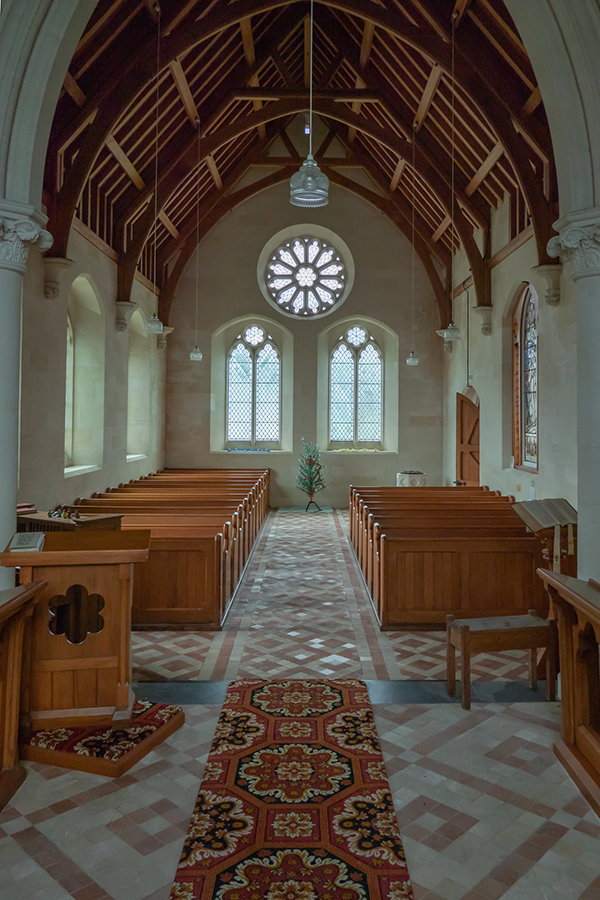
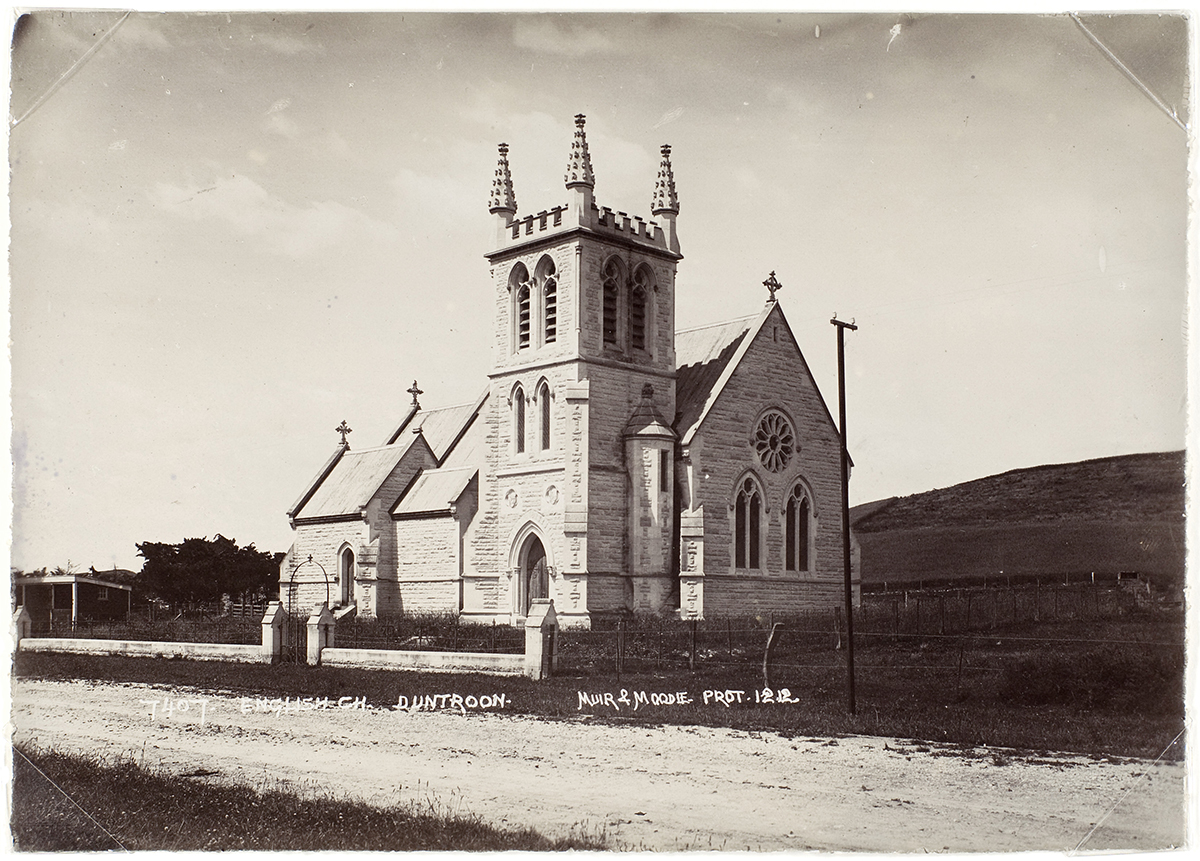
An 1892 newspaper article discussed the Kurow controversy. Mrs Campbell left £6,000 to the Anglican Church Property Trustees for the building of a church and parsonage between Kurow and Duntroon – the towns are 22 kilometres apart. After a lengthy period of debate a site in Duntroon was chosen and purchased from R. Orr. Plans were called for and the design of Christchurch architect Thomas Cane was chosen by the congregation and approved by the bishop. The Otago Daily Times described the design as fourteenth century Gothic and consisting of a nave, chancel, vestry, organ chamber and tower. All windows had traceried heads and were glazed with pale green cathedral glass with white margins in lead quarries. The floors were tiled, except under the seats where there were wood. The nave provided seating for 95 adults. The font, located just inside the door, stood on a base of wrought bluestone. The chancel was accessed down three bluestone steps through a ‘truly magnificent arch.’ The tower was finished with a battlemented parapet with a crocketted pinnacle at each corner. The tower from floor level to apex is fifty feet high. All corbels, capitals, summer stones and bosses were carved to Cane’s carefully conceived designs. The stone was from Perry’s Totara quarry. The contractor was John Menzies from Maheno, who also built the Kurow vicarage. The carver was Mr Baird of Hall Street in South Dunedin. Mr and Mrs Campbell presented a brass altar cross and desk, vases and candlesticks, and book markers.

St Martin’s Anglican Church was consecrated by the Bishop of Dunedin on 29 August 1901 and named for St Martin’s in the old town of Duntroon in Scotland. In his address the bishop recalled the kindness of the donors in giving the church and noted that it was built just outside Duntroon ‘on the nearest pieces of land’ to the Kurow vicarage and chapel. He recognised the effort that both the architect and the builder had put into the church.

In 2010 a stained glass window from Duntroon’s now-closed St Magnus Presbyterian Church in memory of parishioners Tom Mclean and Douglas Peterson found a new home in St Martin’s. In 2016, St Martin’s Anglican Church remains the centre for Anglican worship in the Waitaki Valley.
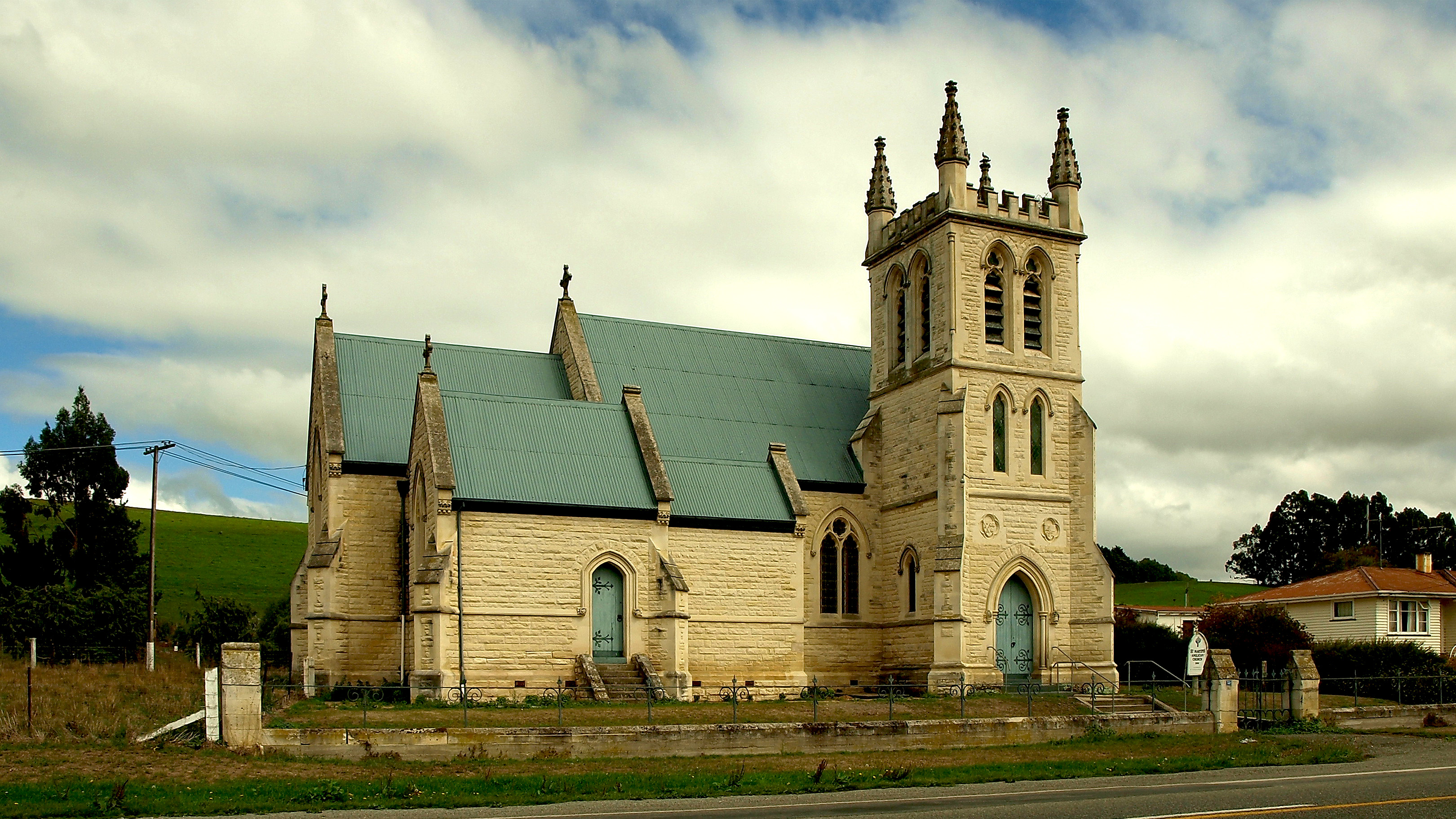
St Martin’s Anglican Church, Duntroon. Image courtesy of www.flickr.com | Joe Wallace | 04/03/2015 | Joe Wallace
St Martin’s Anglican Church, Duntroon. CC BY-NC-ND 2.0 Image courtesy of www.flickr.com | Shellie Evans – flyingkiwigirl | 03/06/2022 | Shellie Evans
St Martin’s Anglican Church, Duntroon. Interior CC BY-NC-SA 2.0 Image courtesy of www.flickr.com | Nick Thompson | 07/01/2018 | Nick Thompson
St Martin's Anglican Church, Duntroon. English Church, Duntroon, 1912, New Zealand, by Muir & Moodie. Te Papa (O.001845) | No Known Copyright Restrictions
St Martin’s Anglican Church, Duntroon. Image courtesy of www.flickr.com | Joe Wallace | 04/03/2015 | Joe Wallace
St Martin’s Anglican Church, Duntroon. CC BY-NC-ND 2.0 Image courtesy of www.flickr.com | Shellie Evans – flyingkiwigirl | 03/06/2022 | Shellie Evans
St Martin’s Anglican Church, Duntroon. Interior CC BY-NC-SA 2.0 Image courtesy of www.flickr.com | Nick Thompson | 07/01/2018 | Nick Thompson
St Martin's Anglican Church, Duntroon. English Church, Duntroon, 1912, New Zealand, by Muir & Moodie. Te Papa (O.001845) | No Known Copyright Restrictions

List Entry Information

Overview

Status
Listed

List Entry Status
Historic Place Category 2

Access
Private/No Public Access

List Number
2429

Date Entered
7th April 1983

Date of Effect
7th April 1983

City/District Council
Waitaki District

Region
Canterbury Region

Extent of List Entry

Extent includes the land described as Pt Lot 1 DP 294 (RT OT122/26), Otago Land District, and the building known as St Martin’s Anglican Church, thereon.

Legal description

Pt Lot 1 DP 294 (RT OT122/26), Otago Land District

Detailed List Entry

Construction Professional

Name

John Menzies

Type

Builder

Biography

No biography is currently available for this construction professional

Name

Cane, Thomas Walter

Type

Architect

Biography

Thomas Cane (1830-1905) was born in Brighton, Sussex. For many years he worked for Sir Gilbert Scott, the celebrated architect of London. Cane came to Lyttelton in 1874 and succeeded Benjamin Woolfield Mountfort (1825-1898) as Provincial Architect for Canterbury. He held this position until the abolition of the provinces in 1876, making his name as a Christchurch architect. Cane was responsible for Corfe House at Christ's College and for Christchurch Girls' High School which became the School of Art, and later an extension of the University of Canterbury Library. Cane also achieved recognition as a landscape artist.

Construction Details

Start Year

2010

Type

Modification

Description

Stained glass window from St Magnus Presbyterian Church installed

Start Year

1901

Type

Original Construction

Reference

Completion Date

19th December 2016

Report Written By

Heather Bauchop

Report Written By

This place was identified as significant under previous legislation with different information requirements. It remains significant under the current legislation. There is opportunity under our legislation and policies to add to this information. Further information about this place may be available from the Otago/Southland Office of Heritage New Zealand Pouhere Taonga. Please note that entry on the New Zealand Heritage List/Rarangi Korero identifies only the heritage values of the property concerned, and should not be construed as advice on the state of the property, or as a comment of its soundness or safety, including in regard to earthquake risk, safety in the event of fire, or insanitary conditions. A fully referenced upgrade report is available on request from the Otago/Southland Office of Heritage New Zealand.

Further Information

Current Usages

Uses: Religion

Specific Usage: Church

Former Usages

General Usage:: Religion

Specific Usage: Church

Themes

Web Links

Overview

Status

Listed

List Entry Status

Historic Place Category 2

Access

Private/No Public Access

List Number

2429

Date Entered

7th April 1983

Date of Effect

7th April 1983

City/District Council

Waitaki District

Region

Canterbury Region

Extent of List Entry

Extent includes the land described as Pt Lot 1 DP 294 (RT OT122/26), Otago Land District, and the building known as St Martin’s Anglican Church, thereon.

Legal description

Pt Lot 1 DP 294 (RT OT122/26), Otago Land District

Status

Listed

List Entry Status

Historic Place Category 2

Access

Private/No Public Access

List Number

2429

Date Entered

7th April 1983

Date of Effect

7th April 1983

City/District Council

Waitaki District

Region

Canterbury Region

Extent of List Entry

Extent includes the land described as Pt Lot 1 DP 294 (RT OT122/26), Otago Land District, and the building known as St Martin’s Anglican Church, thereon.

Legal description

Pt Lot 1 DP 294 (RT OT122/26), Otago Land District

Construction Information

Construction Professional

Name

John Menzies

Type

Builder

Biography

No biography is currently available for this construction professional

Name

Cane, Thomas Walter

Type

Architect

Biography

Thomas Cane (1830-1905) was born in Brighton, Sussex. For many years he worked for Sir Gilbert Scott, the celebrated architect of London. Cane came to Lyttelton in 1874 and succeeded Benjamin Woolfield Mountfort (1825-1898) as Provincial Architect for Canterbury. He held this position until the abolition of the provinces in 1876, making his name as a Christchurch architect. Cane was responsible for Corfe House at Christ's College and for Christchurch Girls' High School which became the School of Art, and later an extension of the University of Canterbury Library. Cane also achieved recognition as a landscape artist.

Construction Details

Start Year

2010

Type

Modification

Description

Stained glass window from St Magnus Presbyterian Church installed

Start Year

1901

Type

Original Construction

Construction Professional

Name

John Menzies

Type

Builder

Biography

No biography is currently available for this construction professional

Name

Cane, Thomas Walter

Type

Architect

Biography

Thomas Cane (1830-1905) was born in Brighton, Sussex. For many years he worked for Sir Gilbert Scott, the celebrated architect of London. Cane came to Lyttelton in 1874 and succeeded Benjamin Woolfield Mountfort (1825-1898) as Provincial Architect for Canterbury. He held this position until the abolition of the provinces in 1876, making his name as a Christchurch architect. Cane was responsible for Corfe House at Christ's College and for Christchurch Girls' High School which became the School of Art, and later an extension of the University of Canterbury Library. Cane also achieved recognition as a landscape artist.

Construction Details

Start Year

2010

Type

Modification

Description

Stained glass window from St Magnus Presbyterian Church installed

Start Year

1901

Type

Original Construction

Reference

Historical and Associated Iwi / Hapū / Whānau

Completion Date

19th December 2016

Report Written By

Heather Bauchop

Other Information

This place was identified as significant under previous legislation with different information requirements. It remains significant under the current legislation. There is opportunity under our legislation and policies to add to this information. Further information about this place may be available from the Otago/Southland Office of Heritage New Zealand Pouhere Taonga. Please note that entry on the New Zealand Heritage List/Rarangi Korero identifies only the heritage values of the property concerned, and should not be construed as advice on the state of the property, or as a comment of its soundness or safety, including in regard to earthquake risk, safety in the event of fire, or insanitary conditions. A fully referenced upgrade report is available on request from the Otago/Southland Office of Heritage New Zealand.

Historical and Associated Iwi / Hapū / Whānau

Completion Date

19th December 2016

Report Written By

Heather Bauchop

Other Information

This place was identified as significant under previous legislation with different information requirements. It remains significant under the current legislation. There is opportunity under our legislation and policies to add to this information. Further information about this place may be available from the Otago/Southland Office of Heritage New Zealand Pouhere Taonga. Please note that entry on the New Zealand Heritage List/Rarangi Korero identifies only the heritage values of the property concerned, and should not be construed as advice on the state of the property, or as a comment of its soundness or safety, including in regard to earthquake risk, safety in the event of fire, or insanitary conditions. A fully referenced upgrade report is available on request from the Otago/Southland Office of Heritage New Zealand.

Further Information

Current Usages

Uses: Religion

Specific Usage: Church

Former Usages

General Usage: Religion

Specific Usage: Church

Current Usages

Uses: Religion

Specific Usage: Church

Former Usages

General Usage: Religion

Specific Usage: Church

Location

Loading
Related listings
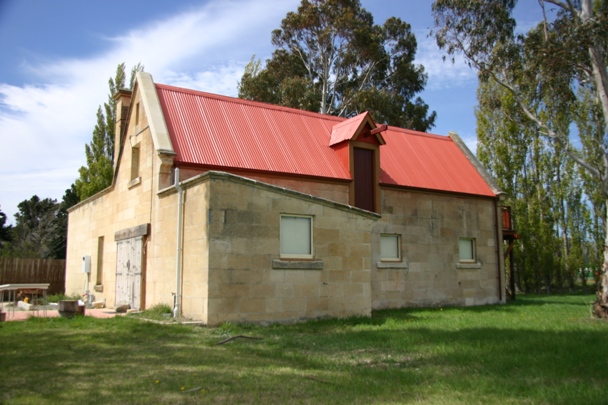
St Albans Stables
St Albans Stables
St Alban's Chapel and Vicarage. Image courtesy of www.flickr.com
St Alban's Chapel and Vicarage
St Alban's Chapel and Vicarage. Image courtesy of www.flickr.com
St Alban's Chapel and Vicarage
St Albans Stables
St Albans Stables
Sign up to hear more

Get the latest heritage news, features and events delivered
straight to your inbox.

Subscribe