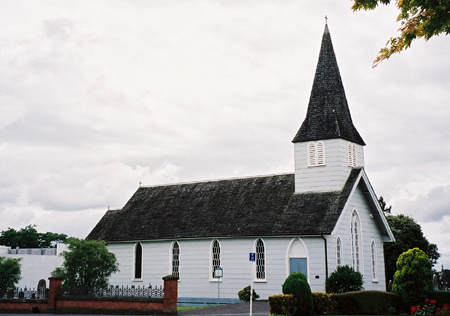
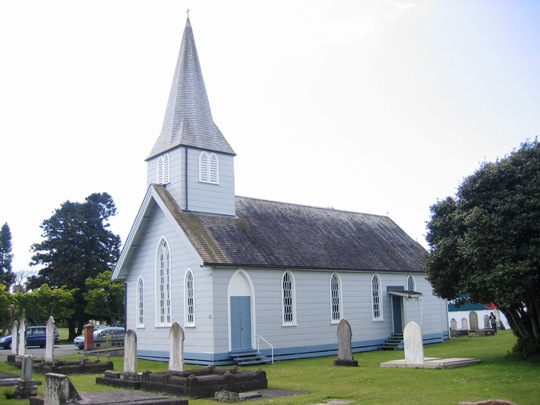
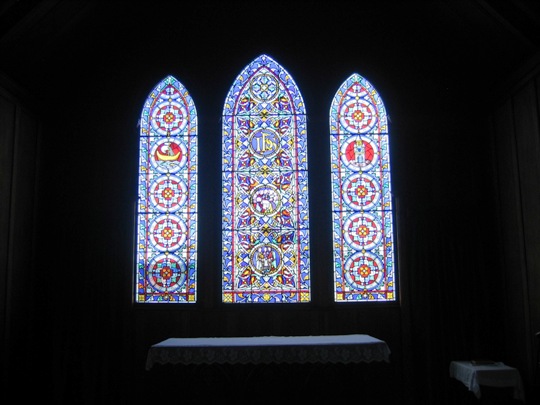
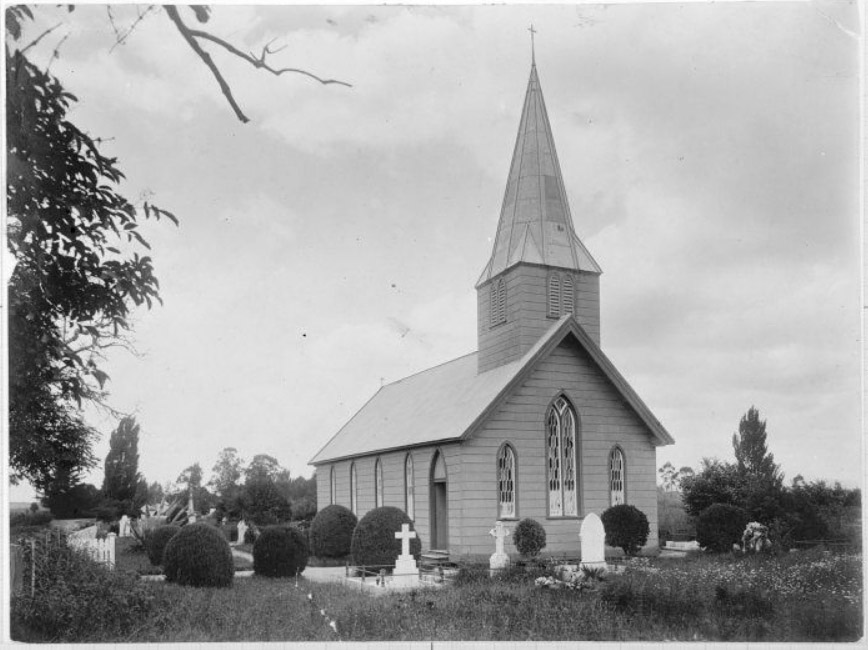
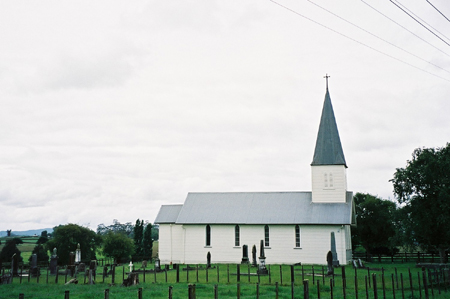
St John's is a timber church of Gothic Revival style and is the oldest surviving building in the Waikato. It reflects the colonial history of the region, having been successively used as a mission church, a military chapel and a place of worship for the parishioners of Te Awamutu. Constructed in 1853, the building was originally part of the Church Missionary Society (CMS) station at Otawhao, which had been established in 1841. The mission was located a short distance from Otawhao pa - the paramount pa in the southern Waikato at the time - becoming a model village for the education of Maori and the introduction of new crops and agricultural techniques. Construction of the church was overseen by the resident missionary and mission founder, John Morgan (1806/7?-1865), from timber that had been donated locally and prepared by Pakeha sawyers. Built for a largely Maori congregation, its Gothic form was considered by Morgan to be 'in the English style' and included a bell tower, prominent steeple and a small chancel containing elaborate stained glass windows. Its form reflected the English pastoral ideal on which the settlement was based and the notion that Maori would benefit from assimilating Anglo-Saxon culture. It also indicates a retreat from Georgian church architecture, which embodied more egalitarian ideas towards religion and social interaction.
The subsequent history of the church reflects Maori resistance to the spread of colonial settlement in the region, with the missionaries being obliged to leave the station in the early 1860s. Both Maori and Pakeha casualties from the third New Zealand - or Waikato - War (1863-1864) were buried in the churchyard, including those from nearby battles at Rangiaowhia (Hairini) and Orakau. A British military garrison of up to 4,000 troops was based at the mission during and after the war, using the church for interdenominational services. Additions included pews and a timber lining, making the interior more comfortable for its new congregation. The building was transferred to the Anglican Diocese of Auckland in 1870, when it became the parish church for the emerging town of Te Awamutu. Subsequently known as St John's, the structure stayed in continuous use until a new church was built alongside it in 1965. Minor modifications that occurred during this period were linked in part to changes in religious ideas during the late nineteenth and early twentieth century. These included the addition, then removal, of a rood screen across the chancel and the raising in height of the baptistry. The church still remains in use, mostly for marriages and other services.
St John's Church is of national significance for its association with the colonisation of the Waikato, and close connections with events in the third New Zealand War. It is particularly valuable for reflecting aspects of nineteenth-century Maori history, and the complexity of relations between Maori and Pakeha. It is important for its association with the arrival of Christianity in the Waikato, and the prominent role played by religion in early cross-cultural contact. Along with St Paul's, Hairini, it is one of a unique pair of churches in the region, illustrating the activities of the CMS and its early members, including those of John Morgan. The building is one of few CMS churches to survive in New Zealand, and reflects architectural and religious changes in the movement during the 1850s. Its fabric provides valuable information about colonial life - both Maori and Pakeha - from techniques of construction to social attitudes towards race. It contains fixtures of national importance, including memorials to Maori casualties of war - one in te reo Maori (the Maori language) - and some of the earliest and most unique surviving stained glass windows in the country. The building reflects the later development of the Anglican church in the region, and has made a significant contribution to the social and spiritual life of Te Awamutu. It is the only remnant of Otawhao mission and the large military garrison of the 1860s, which led to the town's foundation. The church is an integral part of its archaeological landscape, which includes graves, gravestones and memorials in its surrounding churchyard. It has high townscape value, being located on a main street, and enjoys considerable public esteem.
The subsequent history of the church reflects Maori resistance to the spread of colonial settlement in the region, with the missionaries being obliged to leave the station in the early 1860s. Both Maori and Pakeha casualties from the third New Zealand - or Waikato - War (1863-1864) were buried in the churchyard, including those from nearby battles at Rangiaowhia (Hairini) and Orakau. A British military garrison of up to 4,000 troops was based at the mission during and after the war, using the church for interdenominational services. Additions included pews and a timber lining, making the interior more comfortable for its new congregation. The building was transferred to the Anglican Diocese of Auckland in 1870, when it became the parish church for the emerging town of Te Awamutu. Subsequently known as St John's, the structure stayed in continuous use until a new church was built alongside it in 1965. Minor modifications that occurred during this period were linked in part to changes in religious ideas during the late nineteenth and early twentieth century. These included the addition, then removal, of a rood screen across the chancel and the raising in height of the baptistry. The church still remains in use, mostly for marriages and other services.
St John's Church is of national significance for its association with the colonisation of the Waikato, and close connections with events in the third New Zealand War. It is particularly valuable for reflecting aspects of nineteenth-century Maori history, and the complexity of relations between Maori and Pakeha. It is important for its association with the arrival of Christianity in the Waikato, and the prominent role played by religion in early cross-cultural contact. Along with St Paul's, Hairini, it is one of a unique pair of churches in the region, illustrating the activities of the CMS and its early members, including those of John Morgan. The building is one of few CMS churches to survive in New Zealand, and reflects architectural and religious changes in the movement during the 1850s. Its fabric provides valuable information about colonial life - both Maori and Pakeha - from techniques of construction to social attitudes towards race. It contains fixtures of national importance, including memorials to Maori casualties of war - one in te reo Maori (the Maori language) - and some of the earliest and most unique surviving stained glass windows in the country. The building reflects the later development of the Anglican church in the region, and has made a significant contribution to the social and spiritual life of Te Awamutu. It is the only remnant of Otawhao mission and the large military garrison of the 1860s, which led to the town's foundation. The church is an integral part of its archaeological landscape, which includes graves, gravestones and memorials in its surrounding churchyard. It has high townscape value, being located on a main street, and enjoys considerable public esteem.