Quick links


Quick links
Quick links
Quick links
Quick links
Quick links
Whare Ra
2 Tauroa Road, HAVELOCK NORTH
Private
Historic Place Category 1
List No. 4407
Quick links:
List GalleryLocationDetails
2 Tauroa Road, HAVELOCK NORTH
Private
Historic Place Category 1
List No. 4407
List Entry Information
Status
Listed
List Entry Status
Historic Place Category 1
Access
Private/No Public Access
List Number
4407
Date Entered
28th June 1990
Date of Effect
28th June 1990
City/District Council
Hastings District
Region
Hawke's Bay Region
Extent of List Entry
Extent includes the land described as Lot 1 DP 19613 (RT HBL3/849), Hawkes Bay Land District, and the building known as Whare Ra thereon.
Legal description
Lot 1 DP 19613 (RT HBL3/849), Hawkes Bay Land District
Status
Listed
List Entry Status
Historic Place Category 1
Access
Private/No Public Access
List Number
4407
Date Entered
28th June 1990
Date of Effect
28th June 1990
City/District Council
Hastings District
Region
Hawke's Bay Region
Extent of List Entry
Extent includes the land described as Lot 1 DP 19613 (RT HBL3/849), Hawkes Bay Land District, and the building known as Whare Ra thereon.
Legal description
Lot 1 DP 19613 (RT HBL3/849), Hawkes Bay Land District
Why is this place significant?
Historic Significance
Historical Significance or Value This historic place was registered under the Historic Places Act 1980. This report includes the text from the original Building Classification Committee report considered by the NZHPT Board at the time of registration. Whare Ra is most closely associated with the establishment in Havelock North of the secret Stella Matutina Hermetic Order and its remarkable leader Dr R N Felkin. Comparatively little known in his adopted country Felkin was an outstanding Victorian scholar and traveller and expert on tropical diseases who devoted the last ten years of his life to the spiritual and physical well-being of a small Hawkes Bay town.
Physical Significance
This historic place was registered under the Historic Places Act 1980. This report includes the text from the original Building Classification Committee report considered by the NZHPT Board at the time of registration. ARCHITECTURAL QUALITY: The house represents a significant departure from the style of the architect's other commissions both before and after the construction of Whare Ra. Chapman-Taylor generally used a pure Arts and Crafts style for his houses, following the ideas of English architects and designers such as Charles Voysey, William Morris and M H Baillie Scott. While Whare Ra is largely of Arts and Crafts design, it also reflects the influence and peculiar requirements of Dr Felkin. In addition to its function as a residence, Whare Ra was designed to serve as New Zealand Headquarters of the Stella Matutina Hermetic Order of which Felkin was the head. This dictated the construction of the basement temple. Certain features were required for mystical reasons, for example the building's orientation along an east-west axis because this was the same direction in which Moses cast his tent. Felkin's personal influence over his architect led to other unusual features including the linear nature of the plan, the large false roof and high arched ceiling of the main living space. None of these conform to Chapman-Taylor's ideals of rational and economic use of space and are a distinct variation from the other work by the most faithful of New Zealand's Arts and Crafts architects. TOWNSCAPE/ LANDMARK. VALUE: Whare Ra is hidden from the road and therefore has little townscape or landmark significance, particularly since the sub-division in 1979-80 of the formerly spacious and well planted grounds. .
Why is this place significant?
Historic Significance
Historical Significance or Value This historic place was registered under the Historic Places Act 1980. This report includes the text from the original Building Classification Committee report considered by the NZHPT Board at the time of registration. Whare Ra is most closely associated with the establishment in Havelock North of the secret Stella Matutina Hermetic Order and its remarkable leader Dr R N Felkin. Comparatively little known in his adopted country Felkin was an outstanding Victorian scholar and traveller and expert on tropical diseases who devoted the last ten years of his life to the spiritual and physical well-being of a small Hawkes Bay town.
Physical Significance
This historic place was registered under the Historic Places Act 1980. This report includes the text from the original Building Classification Committee report considered by the NZHPT Board at the time of registration. ARCHITECTURAL QUALITY: The house represents a significant departure from the style of the architect's other commissions both before and after the construction of Whare Ra. Chapman-Taylor generally used a pure Arts and Crafts style for his houses, following the ideas of English architects and designers such as Charles Voysey, William Morris and M H Baillie Scott. While Whare Ra is largely of Arts and Crafts design, it also reflects the influence and peculiar requirements of Dr Felkin. In addition to its function as a residence, Whare Ra was designed to serve as New Zealand Headquarters of the Stella Matutina Hermetic Order of which Felkin was the head. This dictated the construction of the basement temple. Certain features were required for mystical reasons, for example the building's orientation along an east-west axis because this was the same direction in which Moses cast his tent. Felkin's personal influence over his architect led to other unusual features including the linear nature of the plan, the large false roof and high arched ceiling of the main living space. None of these conform to Chapman-Taylor's ideals of rational and economic use of space and are a distinct variation from the other work by the most faithful of New Zealand's Arts and Crafts architects. TOWNSCAPE/ LANDMARK. VALUE: Whare Ra is hidden from the road and therefore has little townscape or landmark significance, particularly since the sub-division in 1979-80 of the formerly spacious and well planted grounds. .
Construction Professional
Name
Chapman-Taylor, James Walter
Type
Architect
Biography
Chapman-Taylor (1878-1958) was born in London and his family came to New Zealand in 1880. He was apprenticed to a builder in Stratford, and there he studied architecture by correspondence. In 1909 Chapman-Taylor went on a voyage to England where he acquainted himself with the English vernacular and the Arts and Crafts movement. This trip had a profound effect on Chapman-Taylor's future work as he followed the principles of the Arts and Crafts movement, a movement with origins in the English Gothic Revival. Chapman-Taylor adhered to the Arts and Crafts principles of permanence, honesty, simplicity and beauty as espoused by architects C.F.A. Voysey (1857-1941), Baillie Scott, Parker and Unwin whom he met on this trip to England. He adapted the English movement to local conditions. His is an honest architecture which remained popular despite changing fashions. Chapman-Taylor adhered to Arts and Crafts principles over the 50 years of his career and showed a keen awareness of local forms and materials. He designed the furniture and fittings for many of his houses, including details such as wrought iron door and window fittings. As an architect and a craftsman, Chapman-Taylor designed and then built his houses himself - approximately 80 of them dated between 1904 and 1953. While most of these houses are situated in Wellington and Heretaunga, there are others throughout the North Island and one in the South Island.
Construction Details
Start Year
1913
Type
Original Construction
Start Year
1916
Type
Addition
Description
Two storey addition made to west end of house as rooms for Dr Felkin's medical practice
Start Year
1980
Type
Modification
Description
Kitchen modernised. Fireplaces altered to have five stoves installed
Start Year
1989
Type
Modification
Description
Lounge fireplace stripped back to original state
Type
Relocation
Description
Additional rooms [cottage] was removed from site and relocated onto adjacent site. Sited in 2020.
Period
Circa 1980s
Construction Materials
Floors, [walls] and some ceilings, reinforced concrete. Walls with rough cast exterior finish and plaster interior. Roof of Marseilles tiles with French glass tiles inset to admit light to darker rooms.
Notable Features
Basement temple. Roof lighting and ventilation systems. Early use of reinforced concrete in residential work.
Construction Professional
Name
Chapman-Taylor, James Walter
Type
Architect
Biography
Chapman-Taylor (1878-1958) was born in London and his family came to New Zealand in 1880. He was apprenticed to a builder in Stratford, and there he studied architecture by correspondence. In 1909 Chapman-Taylor went on a voyage to England where he acquainted himself with the English vernacular and the Arts and Crafts movement. This trip had a profound effect on Chapman-Taylor's future work as he followed the principles of the Arts and Crafts movement, a movement with origins in the English Gothic Revival. Chapman-Taylor adhered to the Arts and Crafts principles of permanence, honesty, simplicity and beauty as espoused by architects C.F.A. Voysey (1857-1941), Baillie Scott, Parker and Unwin whom he met on this trip to England. He adapted the English movement to local conditions. His is an honest architecture which remained popular despite changing fashions. Chapman-Taylor adhered to Arts and Crafts principles over the 50 years of his career and showed a keen awareness of local forms and materials. He designed the furniture and fittings for many of his houses, including details such as wrought iron door and window fittings. As an architect and a craftsman, Chapman-Taylor designed and then built his houses himself - approximately 80 of them dated between 1904 and 1953. While most of these houses are situated in Wellington and Heretaunga, there are others throughout the North Island and one in the South Island.
Construction Details
Start Year
1913
Type
Original Construction
Start Year
1916
Type
Addition
Description
Two storey addition made to west end of house as rooms for Dr Felkin's medical practice
Start Year
1980
Type
Modification
Description
Kitchen modernised. Fireplaces altered to have five stoves installed
Start Year
1989
Type
Modification
Description
Lounge fireplace stripped back to original state
Type
Relocation
Description
Additional rooms [cottage] was removed from site and relocated onto adjacent site. Sited in 2020.
Period
Circa 1980s
Construction Materials
Floors, [walls] and some ceilings, reinforced concrete. Walls with rough cast exterior finish and plaster interior. Roof of Marseilles tiles with French glass tiles inset to admit light to darker rooms.
Notable Features
Basement temple. Roof lighting and ventilation systems. Early use of reinforced concrete in residential work.
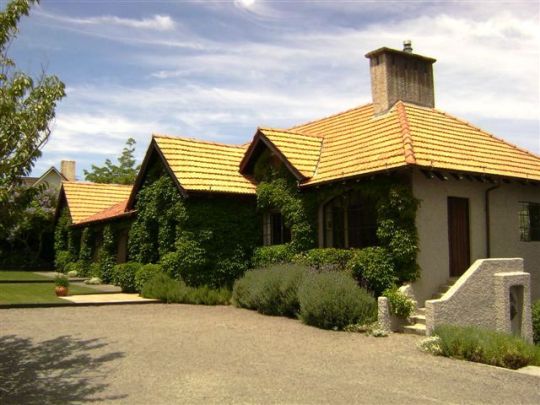
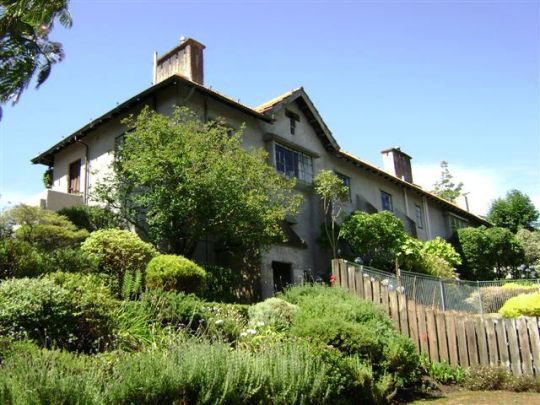
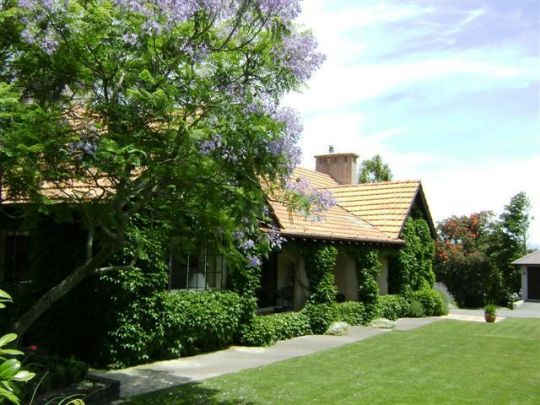
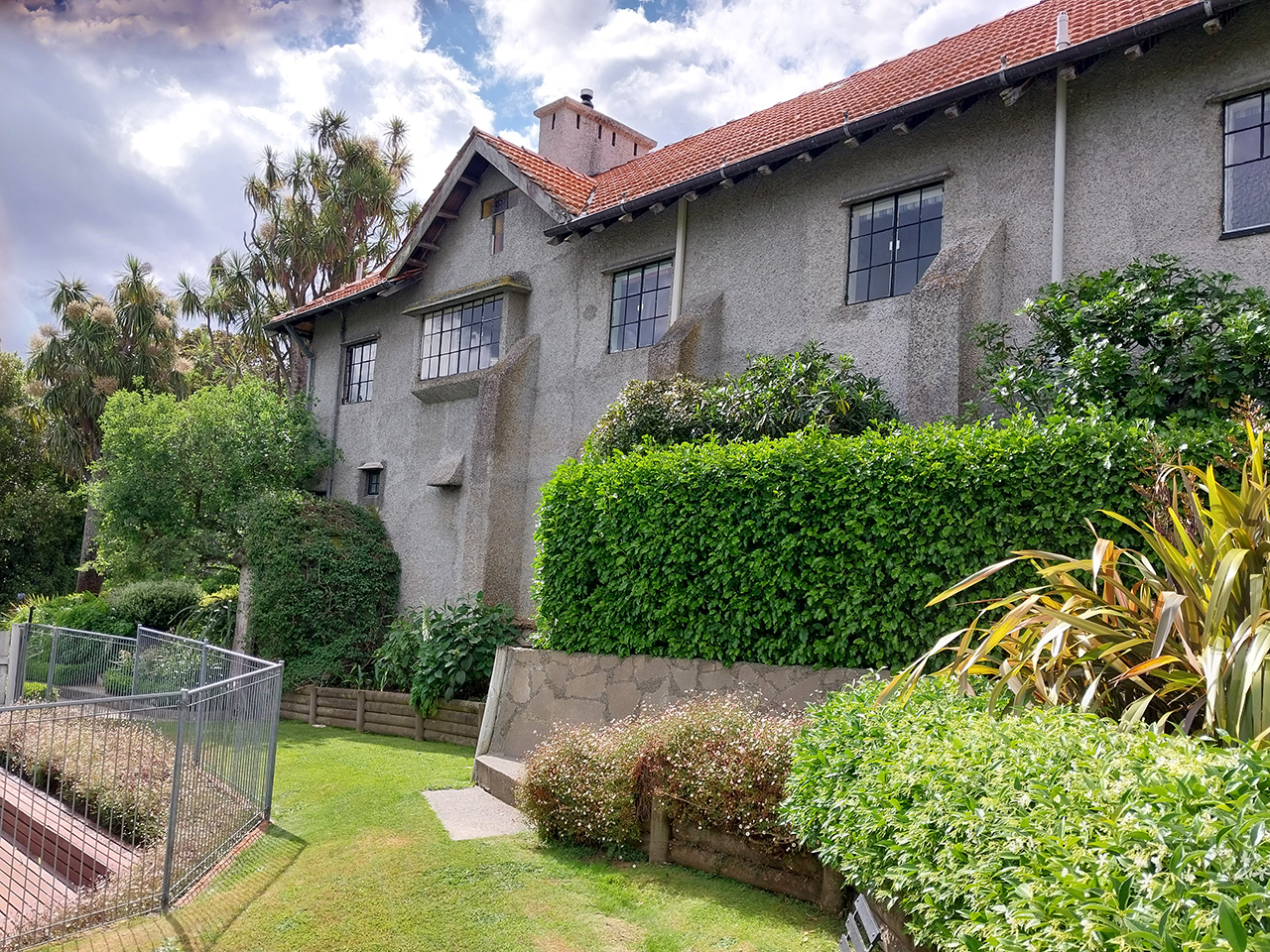
This historic place was registered under the Historic Places Act 1980. This report includes the text from the original Building Classification Committee report considered by the NZHPT Board at the time of registration. Information in square brackets indicates modifications made after the paper was considered by the NZHPT Board. ARCHITECTURAL DESCRIPTION: The style of Whare Ra broadly follows the Arts and Crafts movement favoured by Chapman-Taylor, but with adaptations to meet the requirements of his client. The house is aligned along an east-west axis and is long and low, with a large hipped roof. The front elevation is characterised by an irregular arrangement of gables. Between the two main gables is a deep, shady verandah. The interior has an extensive central hallway panelled with jarrah crafted by Chapman-Taylor himself, as were the adzed jarrah beams exposed in the ceilings. In plan there is an unusual separation of the family and formal living areas of the house, the living room being divided from the family room by two bedrooms and a passageway. The dark rooms behind the terrace are ingeniously lit by sliding panels in the roof which open onto glass tiles, allowing light from above to enter. Ventilation is provided by a portion of the casement hinged separately to open without having to open the whole window. An important feature of the house is the basement temple of reinforced concrete designed for Dr Felkin, the first owner. It was to be the New Zealand headquarters for the mystical order which he established in Havelock North. It contains a main temple, outer sanctuary and octagonal inner sanctuary. The walls are painted in a series of coloured squares, each containing a different symbol relating to the rituals of the order.
This historic place was registered under the Historic Places Act 1980. This report includes the text from the original Building Classification Committee report considered by the NZHPT Board at the time of registration. Information in square brackets indicates modifications made after the paper was considered by the NZHPT Board. ARCHITECTURAL DESCRIPTION: The style of Whare Ra broadly follows the Arts and Crafts movement favoured by Chapman-Taylor, but with adaptations to meet the requirements of his client. The house is aligned along an east-west axis and is long and low, with a large hipped roof. The front elevation is characterised by an irregular arrangement of gables. Between the two main gables is a deep, shady verandah. The interior has an extensive central hallway panelled with jarrah crafted by Chapman-Taylor himself, as were the adzed jarrah beams exposed in the ceilings. In plan there is an unusual separation of the family and formal living areas of the house, the living room being divided from the family room by two bedrooms and a passageway. The dark rooms behind the terrace are ingeniously lit by sliding panels in the roof which open onto glass tiles, allowing light from above to enter. Ventilation is provided by a portion of the casement hinged separately to open without having to open the whole window. An important feature of the house is the basement temple of reinforced concrete designed for Dr Felkin, the first owner. It was to be the New Zealand headquarters for the mystical order which he established in Havelock North. It contains a main temple, outer sanctuary and octagonal inner sanctuary. The walls are painted in a series of coloured squares, each containing a different symbol relating to the rituals of the order.
Historical and Associated Iwi / Hapū / Whānau
Completion Date
15th March 1990
Information Sources
Evening Post
Evening Post, 27 Jun 1919, p.7.
Niven, 1975
Stuart Niven, 'J. W. Chapman-Taylor; Architect and Craftsman', Bachelor of Architecture, University of Auckland, 1975
New Zealand Institute of Architects Journal
New Zealand Institute of Architects Journal (NZIA), No.8, Aug 1974
Salmond, 1986
Jeremy Salmond, Old New Zealand Houses 1800-1940, Auckland, 1986, Reed Methuen
Grant, 1978
SW Grant, Havelock North: From Village to Borough 1860-1952, Central Hawkes Bay Printers/Publishers 1978
Grant, 1980
SW Grant, In Other Days: A History of the Chambers Family of Te Mata, Havelock North, Hawkes Bay Newspapers Limited, 1980
Herald Tribune
Herald Tribune
New Zealand Obituaries
New Zealand Obituaries
Von Dadelszen, 1984
J. Von Dadelszen, The Havelock Work 1909-1939, Havelock North Artifacts, 1984/2, June 1984
White, 1978
M White, Chapman-Taylor Architect and Craftsman, Research Report, 1978
Other Information
NZIA Local Architecture Award Winners 2010, Category: Heritage A copy of this report is available from the NZHPT Central region office Please note that entry on the New Zealand Heritage List/Rarangi Korero identifies only the heritage values of the property concerned, and should not be construed as advice on the state of the property, or as a comment of its soundness or safety, including in regard to earthquake risk, safety in the event of fire, or insanitary conditions. his historic place was registered under the Historic Places Act 1980. This report includes the text from the original Building Classification Committee report considered by the NZHPT Board at the time of registration.
Historical and Associated Iwi / Hapū / Whānau
Completion Date
15th March 1990
Information Sources
Evening Post
Evening Post, 27 Jun 1919, p.7.
Niven, 1975
Stuart Niven, 'J. W. Chapman-Taylor; Architect and Craftsman', Bachelor of Architecture, University of Auckland, 1975
New Zealand Institute of Architects Journal
New Zealand Institute of Architects Journal (NZIA), No.8, Aug 1974
Salmond, 1986
Jeremy Salmond, Old New Zealand Houses 1800-1940, Auckland, 1986, Reed Methuen
Grant, 1978
SW Grant, Havelock North: From Village to Borough 1860-1952, Central Hawkes Bay Printers/Publishers 1978
Grant, 1980
SW Grant, In Other Days: A History of the Chambers Family of Te Mata, Havelock North, Hawkes Bay Newspapers Limited, 1980
Herald Tribune
Herald Tribune
New Zealand Obituaries
New Zealand Obituaries
Von Dadelszen, 1984
J. Von Dadelszen, The Havelock Work 1909-1939, Havelock North Artifacts, 1984/2, June 1984
White, 1978
M White, Chapman-Taylor Architect and Craftsman, Research Report, 1978
Other Information
NZIA Local Architecture Award Winners 2010, Category: Heritage A copy of this report is available from the NZHPT Central region office Please note that entry on the New Zealand Heritage List/Rarangi Korero identifies only the heritage values of the property concerned, and should not be construed as advice on the state of the property, or as a comment of its soundness or safety, including in regard to earthquake risk, safety in the event of fire, or insanitary conditions. his historic place was registered under the Historic Places Act 1980. This report includes the text from the original Building Classification Committee report considered by the NZHPT Board at the time of registration.
Current Usages
Uses: Accommodation
Specific Usage: House
Former Usages
General Usage: Accommodation
Specific Usage: House
General Usage: Health
Specific Usage: Doctor’s Surgery
General Usage: Religion
Specific Usage: Religion - other
Current Usages
Uses: Accommodation
Specific Usage: House
Former Usages
General Usage: Accommodation
Specific Usage: House
General Usage: Health
Specific Usage: Doctor’s Surgery
General Usage: Religion
Specific Usage: Religion - other
Location
Get the latest heritage news, features and events delivered
straight to your inbox.
