In 1862 it became compulsory to use stamps to prepay the cost of delivering letters within New Zealand. Before then, all letters were taken to the counter of the local post office to be marked by the clerk with the correct postage costs. The use of stamps meant it was no longer necessary to take letters to the post office and in 1863 the Colonial Secretary William Fox (1812-1893) campaigned for the provision of public letterboxes. By the end of the following year the Postmaster-General, Thomas Bannatyne Gillies (1828-1889), was able to report that iron pillar boxes were in use in New Zealand's principal towns. Two iron letterboxes were ordered from Sydney for the Nelson Province in January 1864. Arriving in April that year, one was installed at the port and the other, the Pillar Letterbox, was placed outside the Hardy Street Girls' School (321 Hardy Street) near the cottage used by the postmaster of Nelson, B. Walmsley.
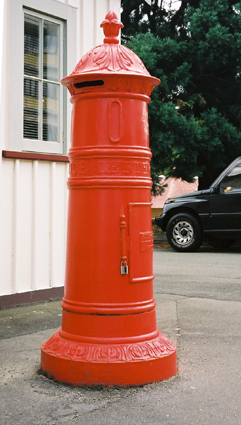
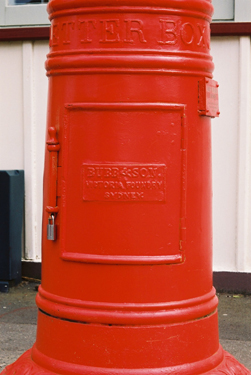
The Pillar Letterbox was made by Bubb & Son in their Victoria foundry in Sydney. The company had won the tender to manufacture iron letterboxes for the Postmaster General of New South Wales in 1855. Post office employee T. W. Levinge designed the cast-iron letterboxes made by the company. They were 1.8 metres (5.9 feet) high, circular in plan, and featured an ornate top decorated with acanthus leaf mouldings. Based on those in use in Belgium and Paris, the Australian letterboxes were considered to have a more elegant appearance than those in London. The letterboxes exported to New Zealand between 1864 and 1878 matched their Australian counterparts with just two exceptions. In Australia, each letterbox was bronzed and had three vertical slots near the top of the pillar to allow people on horseback to post their letters without dismounting. Those sent to New Zealand were painted red and, while they bore the vestiges of the three slots used in Australia, letters were posted through two horizontal openings on each side of the box in traditional British fashion.
From 1879 the Levinge style letterbox was replaced by a New Zealand-made, hexagonal version based on British letterboxes designed by architect J. W. Penfold. These cast-iron, British style letterboxes remained standard issue until the early 1950s, when the New Zealand Post Office Association began a campaign to replace them all with hutch-like wooden letter boxes mounted on posts. Considered unsanitary, leaky, and difficult to clear, most cast-iron letter boxes were sold to museums and private collectors or turned into scrap metal. The Hardy Street Pillar Letterbox in Nelson was one of just a handful to survive this campaign and the only one in New Zealand still located on its original site. Other than the addition of a padlock, it remains the same as it was in 1864 and continues to be used daily by the Nelson public.
The Pillar Letterbox in Nelson has great national significance as one of the first letterboxes used in New Zealand. As the only letterbox of its kind remaining in use on its original site, it is a unique symbol of important developments in the history of New Zealand's postal service, marking the transition to the modern, standardised prepaid mail system. The letterbox is architecturally interesting for its unique blend of British and Australian characteristics.
List Entry Information
Status
Listed
List Entry Status
Historic Place Category 1
Access
Able to Visit
List Number
5116
Date Entered
28th June 1990
Date of Effect
28th June 1990
City/District Council
Nelson City
Region
Nelson Region
Legal description
Legal Road.
Location Description
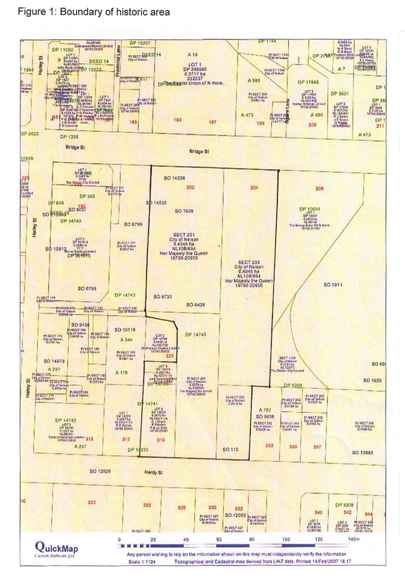
Located in front of the Hardy Street Girls' School (Former) at 319 Hardy Street, Nelson, and located within the Albion Square Historic Area which is bounded on the north and south side by Hardy Street and Bridge Street, Nelson.
Status
Listed
List Entry Status
Historic Place Category 1
Access
Able to Visit
List Number
5116
Date Entered
28th June 1990
Date of Effect
28th June 1990
City/District Council
Nelson City
Region
Nelson Region
Legal description
Legal Road.
Location Description
Located in front of the Hardy Street Girls' School (Former) at 319 Hardy Street, Nelson, and located within the Albion Square Historic Area which is bounded on the north and south side by Hardy Street and Bridge Street, Nelson.
Why is this place significant?
Historic Significance
Historical Significance or Value This historic place was registered under the Historic Places Act 1980. The following text is from the original Building Classification Committee report considered by the NZHPT Board at the time of registration. Hardy Street pillar letter box is New Zealand's oldest public letter box. It is still on its original site and still in daily use.
Physical Significance
This historic place was registered under the Historic Places Act 1980. The following text is from the original Building Classification Committee report considered by the NZHPT Board at the time of registration. ARCHITECTURAL QUALITY: The bright red colouring and bold Victorian styling, particularly the acanthus mouldings, give considerable visual appeal to the letter box. The circular design was earlier than the more common octagonal type of pillar letter box and the Hardy Street example is valuable in illustrating this variation in design. TOWNSCAPE/LANDMARK VALUE: The letter box is a well-known piece of street furniture but not a landmark.
Why is this place significant?
Historic Significance
Historical Significance or Value This historic place was registered under the Historic Places Act 1980. The following text is from the original Building Classification Committee report considered by the NZHPT Board at the time of registration. Hardy Street pillar letter box is New Zealand's oldest public letter box. It is still on its original site and still in daily use.
Physical Significance
This historic place was registered under the Historic Places Act 1980. The following text is from the original Building Classification Committee report considered by the NZHPT Board at the time of registration. ARCHITECTURAL QUALITY: The bright red colouring and bold Victorian styling, particularly the acanthus mouldings, give considerable visual appeal to the letter box. The circular design was earlier than the more common octagonal type of pillar letter box and the Hardy Street example is valuable in illustrating this variation in design. TOWNSCAPE/LANDMARK VALUE: The letter box is a well-known piece of street furniture but not a landmark.
Construction Professional
Name
Bubb & Son
Type
Engineer
Biography
Bubb and Son was established as a Sydney-based iron- and brass-founding business in 1856. Emerging from an enterprise created by Robert Watts Bubb (1805-91), it was run in partnership with his son, John Robert Bubb (1832-1900), until 1867, and by the latter under a variety of guises until 1889. Robert Watts Bubb was born in Avening, Gloucestershire, England. Evidently a French polisher by trade, he emigrated to Australia in 1839. By 1843-4, R. W. Bubb had become a Sydney-based agent and auctioneer, and also subsequently manufactured ‘colonial tweed’ in a short-lived venture at Bathurst. In 1852, he moved into the iron- and brass-founding industry with business partner Erasmus Temperley, taking over the Victoria Foundry in Sussex Street, Sydney. Following Temperley’s death in 1855, R. W. Bubb further acquired the Newtown Brass and Iron Foundry. John Robert Bubb joined his father as a partner in the firm in January 1856, after which the business was known as Bubb and Son. Early in the same year, the firm manufactured Australia’s first cast iron pillar boxes, which were erected in Sydney. Other early contracts included railings and columns for the Sydney Exchange (demolished 1964), and cast iron sewers for King and Hunter Streets, Sydney. From 1861, Bubb and Son also produced large-sized pillar boxes for posting newspapers, commissioned by the New South Wales government; and between 1864 and 1878 exported pillar letter receivers to New Zealand. By 1865, the firm’s premises are said to have expanded fourfold, carrying out orders for the engineering trade and producing ‘every description of ironwork used in house-building.’ R. W. Bubb retired in 1867, with J. R. Bubb continuing the Victoria Foundry business alone or with other partners until 1889. Commissions undertaken by J. R. Bubb included waiting rooms for the North Shore Ferry Company at Circular Quay, Sydney. In addition to his business activities, J. R. Bubb was a significant figure in the development of the Sydney suburb of Burwood, petitioning for its creation as a municipality in 1873 and briefly becoming its mayor six years later. He was also a secretary of the New South Wales Cremation Society. R. W. Bubb died at Forest Lodge in 1891, and J. R. Bubb in Sydney in 1900. Source: List Entry Report for Thames Pillar Boxes, List No. 9791, 16 May 2017
Construction Details
Start Year
1864
Type
Original Construction
Start Year
1990
Type
Modification
Description
Alteration to locking system on the door
Construction Materials
Constructed from cast iron
Notable Features
Vestiges of the three slots used in Australian post office boxes near the top of the structure, and the age of the letterbox.
Construction Professional
Name
Bubb & Son
Type
Engineer
Biography
Bubb and Son was established as a Sydney-based iron- and brass-founding business in 1856. Emerging from an enterprise created by Robert Watts Bubb (1805-91), it was run in partnership with his son, John Robert Bubb (1832-1900), until 1867, and by the latter under a variety of guises until 1889. Robert Watts Bubb was born in Avening, Gloucestershire, England. Evidently a French polisher by trade, he emigrated to Australia in 1839. By 1843-4, R. W. Bubb had become a Sydney-based agent and auctioneer, and also subsequently manufactured ‘colonial tweed’ in a short-lived venture at Bathurst. In 1852, he moved into the iron- and brass-founding industry with business partner Erasmus Temperley, taking over the Victoria Foundry in Sussex Street, Sydney. Following Temperley’s death in 1855, R. W. Bubb further acquired the Newtown Brass and Iron Foundry. John Robert Bubb joined his father as a partner in the firm in January 1856, after which the business was known as Bubb and Son. Early in the same year, the firm manufactured Australia’s first cast iron pillar boxes, which were erected in Sydney. Other early contracts included railings and columns for the Sydney Exchange (demolished 1964), and cast iron sewers for King and Hunter Streets, Sydney. From 1861, Bubb and Son also produced large-sized pillar boxes for posting newspapers, commissioned by the New South Wales government; and between 1864 and 1878 exported pillar letter receivers to New Zealand. By 1865, the firm’s premises are said to have expanded fourfold, carrying out orders for the engineering trade and producing ‘every description of ironwork used in house-building.’ R. W. Bubb retired in 1867, with J. R. Bubb continuing the Victoria Foundry business alone or with other partners until 1889. Commissions undertaken by J. R. Bubb included waiting rooms for the North Shore Ferry Company at Circular Quay, Sydney. In addition to his business activities, J. R. Bubb was a significant figure in the development of the Sydney suburb of Burwood, petitioning for its creation as a municipality in 1873 and briefly becoming its mayor six years later. He was also a secretary of the New South Wales Cremation Society. R. W. Bubb died at Forest Lodge in 1891, and J. R. Bubb in Sydney in 1900. Source: List Entry Report for Thames Pillar Boxes, List No. 9791, 16 May 2017
Construction Details
Start Year
1864
Type
Original Construction
Start Year
1990
Type
Modification
Description
Alteration to locking system on the door
Construction Materials
Constructed from cast iron
Notable Features
Vestiges of the three slots used in Australian post office boxes near the top of the structure, and the age of the letterbox.
This historic place was registered under the Historic Places Act 1980. The following text is from the original Building Classification Committee report considered by the NZHPT Board at the time of registration. DESCRIPTION: Late in 1863 the Colonial Secretary advocated the provision of Post Office letter boxes. Two arrived in Nelson in April 1864 on the steamer "Auckland" from Sydney. One was to be placed at the port and the other at the rear of the Provincial Council Chambers. This one, in Hardy Street, is in its original position and is still in daily use. The other seems to have been shifted several times and is now at the Provincial Museum at Isle Park, disused. There were fourteen pillar letter boxes of the circular design in use in 1868 and twenty-five by 1878, when the design was changed to the octagonal type. Only four of the circular design remain in use - the Hardy Street example and three in Thames. The Thames boxes were installed about 1871 and only one of these is on its original site. There were 98 octagonal boxes made between 1879 and 1909, in Christchurch, and only a few of these are still in use. During the 1950s the Post Office made an effort to replace all remaining iron pillar boxes with wooden ones. Many found their way to museums or private collectors but very few survive as working facilities, as opposed to historical curiosity pieces.
This historic place was registered under the Historic Places Act 1980. The following text is from the original Building Classification Committee report considered by the NZHPT Board at the time of registration. ARCHITECT/ENGINEER/DESIGNER: Unknown Manufactured at Bubb & Son, Victoria Foundry, Sydney ARCHITECTURAL DESCRIPTION: The Pillar Letter Box is circular in plan and stands 1.8 metres tall. It has a plinth 600mm in diameter with a simplified acanthus moulding on the upper surface. The body of the letter box is cylindrical, punctuated with cirque mouldings. On the lower body is the door to the mail receptacle with hinges on the vertical edge. It bares the name of the manufacturer. The words "POST OFFICE LETTER BOX" are boldly raised around the circumference at the mid height of the pillar, above the door. The two receiving slots are on opposite sides at the top of the shaft. The ornate top section has an ogee profile and bold acanthus mouldings repeated four times around the circumference with a bud moulding at the apex. This top section overhangs the receiving slots, providing weather protection. The letter box is painted the standard red colour used by the former New Zealand Post Office. This circular design used in Great Britain during the 1850s-1860s was known as the "Levinge" type pillar box. MODIFICATIONS: A modern padlock has been fitted to the door. Otherwise unmodified
Historical and Associated Iwi / Hapū / Whānau
Completion Date
28th February 2003
Report Written By
Rebecca O'Brien
Information Sources
Alexander Turnbull Library
Alexander Turnbull Library, Wellington
Farrugia, 1969
Farrugia, Jean Young, The Letter Box: A history of the post office pillar and wall boxes, Sussex, Centaur, 1969
Robinson, 1964
Howard Robinson, A History of the Post Office in New Zealand, RE Owen, Government Printer, Wellington, 1964
Startup, 1975
R. Startup, Through Gorge and Valley: A History of the Postal District of Nelson from 1842, Masterton, 1975
Colonist
The Colonist
Nelson Historical Society Journal
Other Information
A fully referenced version of this report is available from the NZHPT Central Region Office This historic place was registered under the Historic Places Act 1980. This report includes the text from the original Building Classification Committee report considered by the NZHPT Board at the time of registration. Please note that entry on the New Zealand Heritage List/Rarangi Korero identifies only the heritage values of the property concerned, and should not be construed as advice on the state of the property, or as a comment of its soundness or safety, including in regard to earthquake risk, safety in the event of fire, or insanitary conditions.
Historical and Associated Iwi / Hapū / Whānau
Completion Date
28th February 2003
Report Written By
Rebecca O'Brien
Information Sources
Alexander Turnbull Library
Alexander Turnbull Library, Wellington
Farrugia, 1969
Farrugia, Jean Young, The Letter Box: A history of the post office pillar and wall boxes, Sussex, Centaur, 1969
Robinson, 1964
Howard Robinson, A History of the Post Office in New Zealand, RE Owen, Government Printer, Wellington, 1964
Startup, 1975
R. Startup, Through Gorge and Valley: A History of the Postal District of Nelson from 1842, Masterton, 1975
Colonist
The Colonist
Nelson Historical Society Journal
Other Information
A fully referenced version of this report is available from the NZHPT Central Region Office This historic place was registered under the Historic Places Act 1980. This report includes the text from the original Building Classification Committee report considered by the NZHPT Board at the time of registration. Please note that entry on the New Zealand Heritage List/Rarangi Korero identifies only the heritage values of the property concerned, and should not be construed as advice on the state of the property, or as a comment of its soundness or safety, including in regard to earthquake risk, safety in the event of fire, or insanitary conditions.
Current Usages
Uses: Communication
Specific Usage: Post Box
Former Usages
General Usage: Communication
Specific Usage: Post Box
Current Usages
Uses: Communication
Specific Usage: Post Box
Former Usages
General Usage: Communication
Specific Usage: Post Box
Stay up to date with Heritage this month


