

Lying east of New Zealand’s South Island, the Chatham Islands include two inhabited islands – Rēkohu/Wharekauri (Chatham Island) and Rangihute/Rangiāuria (Pitt Island) – together with several uninhabited islands. From the 1400s the Chatham Islands were home to Moriori, descendants of East Polynesian settlers with a distinct language and culture. The islands were rich in birdlife, eels and seafood, and the kernels of the kopi (karaka tree), all of which supported the hunter-gatherer lifestyle of the nine Moriori imi (tribes). Their society was shaped by Nunuku’s law, a pacifist doctrine that forbade killing and warfare. European contact began in 1791 with the arrival of the brig Chatham, from which William Broughton claimed the islands for Britain. European sealers began arriving from 1800. In 1835 the trading ship Rodney brought migrating Ngāti Mutunga and Ngāti Tama to the Chatham Islands, seeking sanctuary from the upheavals following European settlement in Taranaki and Te Whanganui-a-Tara. The Waitangi Tribunal commenced investigation of historic Moriori and Māori grievances in the early 2000s, with the Moriori claim settled in 2020.
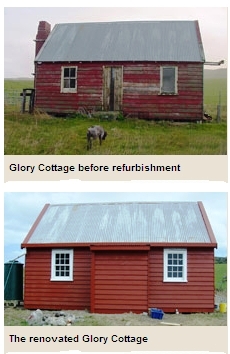
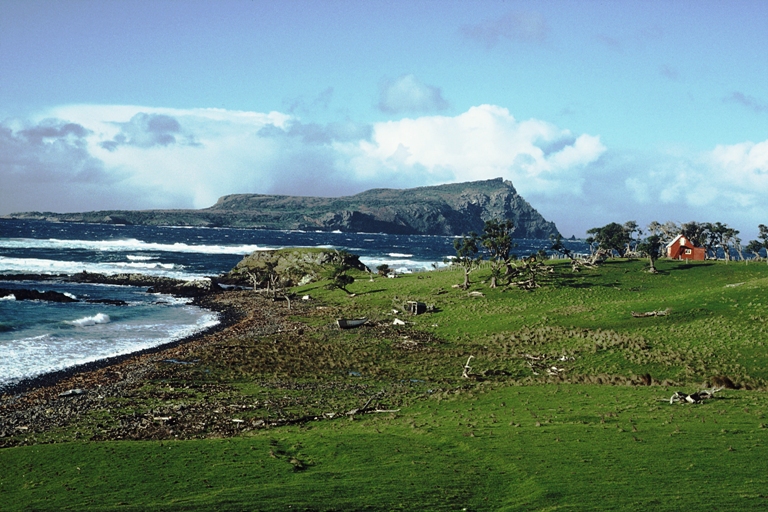
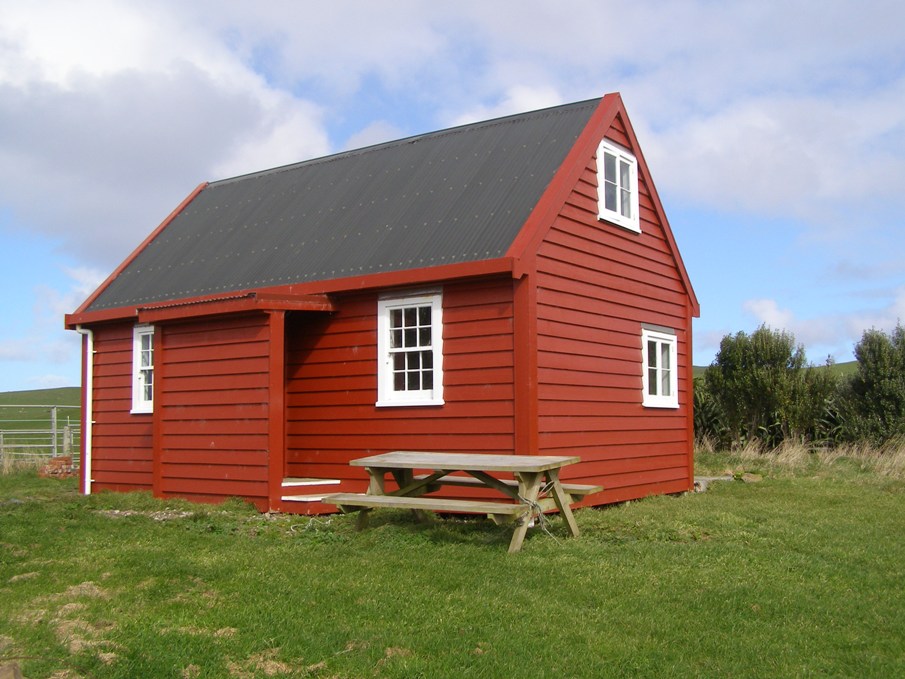
Rangihute/Rangiāuria (Pitt Island) is the smaller of the inhabited Chatham Islands. Glory Bay, in the southeast of the island, was named following the wreck of the ship Glory. Glory Cottage was constructed in the late 1860s by William Gordon Jacobs, a colourful character who had reputedly come to New Zealand as a ship’s carpenter and arrived in the Chathams on the Despatch in 1866. The simple rectangular form is built of sawn Kauri boards with split foundation blocks, likely of akeake. Its principal living area comprises paired entrance doors at the front and rear elevations and a central fireplace, with two compact bunk rooms arranged at the northern end. Externally, the walls are clad in lapped weatherboarding; internally, the walls are fully lined with horizontally fixed, beaded tongue and groove boarding. An attic space, reached by a steep ladder, further illustrates the building’s utilitarian design. The cottage’s technological significance lies in its high degree of preservation as an essentially unaltered example of 1860s New Zealand timber architecture.
Alternative theories exist concerning the original purpose of the cottage. One school of thought states that the cottage was built for Frederick Hunt (1817-1891), who wanted it as onshore accommodation for whaling crews; the second, that it was built and used as a shepherd’s cottage for much of its life. The truth is likely a combination of the two stories, given that Hunt farmed much of Pitt Island from the 1870s, trading potatoes and other vegetables with visiting ship crews. In the latter part of the twentieth century, the cottage provided temporary accommodation for farm workers, and occasionally, trampers. The cottage underwent restoration in 2007-2008 and is now a tourist attraction.
List Entry Information
Status
Listed
List Entry Status
Historic Place Category 2
Access
Able to Visit
List Number
5386
Date Entered
22nd August 1991
Date of Effect
22nd August 1991
City/District Council
Chatham Islands Territory
Region
Chatham Islands
Extent of List Entry
Extent includes part of the land described as Sec 5 SO 545003 being the land shown as Area 1A SO 545003 (RT 1113445; NZ Gazette 1993 p. 29), Wellington Land District, and the building known as Glory Cottage thereon. See map tabled at the Rārangi Kōrero Committee meeting on 25 September 2025.
Legal description
Area 1A SO 545003 of Sec 5 SO 545003 (RT 1113445; NZ Gazette 1993 p. 29), Wellington Land District.
Status
Listed
List Entry Status
Historic Place Category 2
Access
Able to Visit
List Number
5386
Date Entered
22nd August 1991
Date of Effect
22nd August 1991
City/District Council
Chatham Islands Territory
Region
Chatham Islands
Extent of List Entry
Extent includes part of the land described as Sec 5 SO 545003 being the land shown as Area 1A SO 545003 (RT 1113445; NZ Gazette 1993 p. 29), Wellington Land District, and the building known as Glory Cottage thereon. See map tabled at the Rārangi Kōrero Committee meeting on 25 September 2025.
Legal description
Area 1A SO 545003 of Sec 5 SO 545003 (RT 1113445; NZ Gazette 1993 p. 29), Wellington Land District.
Why is this place significant?
Physical Significance
Landscape Significance: Sits prominently on the point at the south end of Glory Bay. Technological Significance: A relatively unaltered timber building of the late 1860s.
Why is this place significant?
Physical Significance
Landscape Significance: Sits prominently on the point at the south end of Glory Bay. Technological Significance: A relatively unaltered timber building of the late 1860s.
Construction Professional
Name
William Gordon Jacobs
Type
Builder
Biography
Name
Ian Wilson
Type
Carpenter
Biography
Name
Murray Wilson
Type
Carpenter
Biography
Construction Details
Start Year
2007
Finish Year
2008
Type
Restoration
Description
Removal of lean-to; painting
Start Year
1866
startYearCirca
Type
Original Construction
Construction Professional
Name
William Gordon Jacobs
Type
Builder
Biography
Name
Ian Wilson
Type
Carpenter
Biography
Name
Murray Wilson
Type
Carpenter
Biography
Construction Details
Start Year
2007
Finish Year
2008
Type
Restoration
Description
Removal of lean-to; painting
Start Year
1866
startYearCirca
Type
Original Construction
Historical and Associated Iwi / Hapū / Whānau
Completion Date
17th July 2025
Report Written By
Anna Renton-Green
Information Sources
King, 1990
Michael King and Robin Morrison. A Land Apart: The Chatham Islands of New Zealand. Random Century, Auckland, 1990.
Ingram and Wheatley, 2007
Charles William Ingram and Percy Owen Wheatley, New Zealand Shipwrecks (8th edition), Hodder Moa, 2007
Holmes, 1984
Fiona Holmes, Chatham Islands ‘Rekohu’ 1791-1984, Reproduced by Raven Press Co. Ltd., Christchurch, 1984
Richards, 1982
Rhys Richards, Whaling and Sealing at the Chatham Islands, Roebuck Society Publication, Canberra, 1982
Thomson, 2023
J. Inches Thomson, with an introduction by Rosy Renwicke, Voyages and Wanderings in Far-Off Seas and Lands, Re-published 2023 by Wonderful World Ltd. (NZ) with additional material by Rosy Fenwicke
Other Information
A fully referenced copy of the Upgrade Report is available upon request from the Central Regional Office of Heritage New Zealand Pouhere Taonga. Disclaimer Please note that entry on the New Zealand Heritage List/Rārangi Kōrero identifies only the heritage values of the property concerned, and should not be construed as advice on the state of the property, or as a comment of its soundness or safety, including in regard to earthquake risk, safety in the event of fire, or insanitary conditions. Archaeological sites are protected by the Heritage New Zealand Pouhere Taonga Act 2014, regardless of whether they are entered on the New Zealand Heritage List/Rārangi Kōrero or not. Archaeological sites include ‘places associated with pre-1900 human activity, where there may be evidence relating to the history of New Zealand’. This List entry report should not be read as a statement on whether or not the archaeological provisions of the Act apply to the property(s) concerned. Please contact your local Heritage New Zealand office for archaeological advice.
Historical and Associated Iwi / Hapū / Whānau
Completion Date
17th July 2025
Report Written By
Anna Renton-Green
Information Sources
King, 1990
Michael King and Robin Morrison. A Land Apart: The Chatham Islands of New Zealand. Random Century, Auckland, 1990.
Ingram and Wheatley, 2007
Charles William Ingram and Percy Owen Wheatley, New Zealand Shipwrecks (8th edition), Hodder Moa, 2007
Holmes, 1984
Fiona Holmes, Chatham Islands ‘Rekohu’ 1791-1984, Reproduced by Raven Press Co. Ltd., Christchurch, 1984
Richards, 1982
Rhys Richards, Whaling and Sealing at the Chatham Islands, Roebuck Society Publication, Canberra, 1982
Thomson, 2023
J. Inches Thomson, with an introduction by Rosy Renwicke, Voyages and Wanderings in Far-Off Seas and Lands, Re-published 2023 by Wonderful World Ltd. (NZ) with additional material by Rosy Fenwicke
Other Information
A fully referenced copy of the Upgrade Report is available upon request from the Central Regional Office of Heritage New Zealand Pouhere Taonga. Disclaimer Please note that entry on the New Zealand Heritage List/Rārangi Kōrero identifies only the heritage values of the property concerned, and should not be construed as advice on the state of the property, or as a comment of its soundness or safety, including in regard to earthquake risk, safety in the event of fire, or insanitary conditions. Archaeological sites are protected by the Heritage New Zealand Pouhere Taonga Act 2014, regardless of whether they are entered on the New Zealand Heritage List/Rārangi Kōrero or not. Archaeological sites include ‘places associated with pre-1900 human activity, where there may be evidence relating to the history of New Zealand’. This List entry report should not be read as a statement on whether or not the archaeological provisions of the Act apply to the property(s) concerned. Please contact your local Heritage New Zealand office for archaeological advice.
Current Usages
Uses: Accommodation
Specific Usage: House
Former Usages
General Usage: Accommodation
Specific Usage: House
Current Usages
Uses: Accommodation
Specific Usage: House
Former Usages
General Usage: Accommodation
Specific Usage: House
Location
Sign up to hear more
Get the latest heritage news, features and events delivered
straight to your inbox.
