DonateMembershipVisit Heritage
  • Tūrangawaewae
    Places
  • Tira Māori
    Māori Heritage
  • Poutairangahia
    Archaeology
  • Rauemi
    Resources
  • Mō Tātou
    About Us
  • New Zealand Heritage List
  • Nominate and submit
  • Explore the List
  • National Historic Landmarks
  • Plaques
  • Rainbow List Project
  • Lost heritage
  • Visit Heritage
  • Our properties
  • Turnbull House Project
  • Collections
  • Shop
  • Tohu Whenua
  • Tira Māori
  • Conserving Māori heritage
  • Marae built heritage
  • Māori heritage on the List
  • Hinemihi—Te Hokinga Mai
  • What is archaeology?
  • Is there a site on my property?
  • What are my legal requirements?
  • Affecting an archaeological site
  • Declaring an archaeological site
  • Archaeology FAQs
  • Archaeology Digital Library
  • Archaeology guidelines and templates
  • Resources
  • Funding
  • Publications
  • Sustainable management guides
  • Disaster recovery
  • Podcasts & digital resources
  • Education Hub
  • Conservation plans
  • About
  • Board
  • Māori Heritage Council
  • Senior Staff
  • Offices
  • Contact us
  • Careers
  • Covenants
  • Fast-track
  • Corporate documents
  • Currently consulting on
  • Our submissions
  • News
  • Covid-19 response
Quick links
Rārangi Kōrero | The List
Explore the List
National Historic Landmarks
Ngā Manawhenua o Aotearoa me ōna Kōrero Tūturu
Quick links
Tapuwae
A Vision for Places of Māori Heritage
Funding for Māori Heritage
Resources
Quick links
Archaeological Authority Portal
Applying for an archaeological authority
Archaeology FAQs
Browse the most frequently asked questions about archaeological authorities and the archaeological process.
Quick links
Quick links
News
News Keep up to date with Heritage New Zealand Pouhere Taonga
Membership
Membership Find out more and sign up today
DonateMembershipVisit Heritage
  • Tūrangawaewae
    Places
  • Tira Māori
    Māori Heritage
  • Poutairangahia
    Archaeology
  • Rauemi
    Resources
  • Mō Tātou
    About Us
  • New Zealand Heritage List
  • Nominate and submit
  • Explore the List
  • National Historic Landmarks
  • Plaques
  • Rainbow List Project
  • Lost heritage
  • Visit Heritage
  • Our properties
  • Turnbull House Project
  • Collections
  • Shop
  • Tohu Whenua
  • Tira Māori
  • Conserving Māori heritage
  • Marae built heritage
  • Māori heritage on the List
  • Hinemihi—Te Hokinga Mai
  • What is archaeology?
  • Is there a site on my property?
  • What are my legal requirements?
  • Affecting an archaeological site
  • Declaring an archaeological site
  • Archaeology FAQs
  • Archaeology Digital Library
  • Archaeology guidelines and templates
  • Resources
  • Funding
  • Publications
  • Sustainable management guides
  • Disaster recovery
  • Podcasts & digital resources
  • Education Hub
  • Conservation plans
  • About
  • Board
  • Māori Heritage Council
  • Senior Staff
  • Offices
  • Contact us
  • Careers
  • Covenants
  • Fast-track
  • Corporate documents
  • Currently consulting on
  • Our submissions
  • News
  • Covid-19 response
Quick links
Rārangi Kōrero | The List
Explore the List
National Historic Landmarks
Ngā Manawhenua o Aotearoa me ōna Kōrero Tūturu
Quick links
Tapuwae
A Vision for Places of Māori Heritage
Funding for Māori Heritage
Resources
Quick links
Archaeological Authority Portal
Applying for an archaeological authority
Archaeology FAQs
Browse the most frequently asked questions about archaeological authorities and the archaeological process.
Quick links
Quick links
News
News Keep up to date with Heritage New Zealand Pouhere Taonga
Membership
Membership Find out more and sign up today
  • Places
  • Nominate and submit
  • National Historic Landmarks
  • Places
  • Nominate and submit
  • National Historic Landmarks
  • Tira Māori
  • Conserving Māori heritage
  • Marae built heritage
  • Tira Māori
  • Conserving Māori heritage
  • Marae built heritage
  • Archaeological authorities
  • Archaeology Digital Library
  • Archaeological authorities
  • Archaeology Digital Library
  • All resources
  • Publications
  • Funding
  • All resources
  • Publications
  • Funding
  • FAQs
  • FAQs
Follow us on:
Places
  • Places
  • Nominate and submit
  • National Historic Landmarks
Tira Māori
  • Tira Māori
  • Conserving Māori heritage
  • Marae built heritage
Archaeology
  • Archaeological authorities
  • Archaeology Digital Library
Resources
  • All resources
  • Publications
  • Funding
FAQs
  • FAQs
Follow us on
HomePrivacyTerms and conditionsAbout this site
© Heritage New Zealand Pouhere Taonga 2026.
 
Binney House

11 Awatea Road, Parnell, AUCKLAND

Private

Historic Place Category 2

List No. 595

Quick links:
List GalleryLocationDetails
The little-altered Binney House was built in 1935 to an Arts and Crafts design by notable Auckland architect William Bloomfield. Located in the fashionable inner-city Auckland suburb of Parnell, the two-storey timber and shingle-style residence was erected for woolbroker and auctioneer, Edwin Heselden Binney, and his wife Mary. The couple had previously lived next door, in a house designed seven years earlier by a different architect but with a similar appearance (Heard House (Former); List No.4930, Category 2 historic place). Both residences are notable for their close connections with the wealthy Binney family, who had a significant influence on the domestic architecture of Remuera and Parnell, and particularly demonstrate the family’s support of the Arts and Crafts style. Binney House is also significant in its own right as a design by William Swanson Read Bloomfield (1885-1968) of Ngati Kahungunu, considered likely to be the first person of Maori descent to attend architecture school and practice as an architect; and for its later associations with the important New Zealand artist, Don Binney (1940-2012).

The land on which Binney House was built was subdivided from a larger section purchased by the Binney family in 1928. Edwin’s brother the architect Roy Binney had, prior to leaving Auckland in the mid-1920s to settle overseas, designed a large number of Arts and Crafts style houses before and after the First World War, several of which were commissioned by his mother Mary and his brothers and sister. Edwin Binney (1865-1947), an auctioneer and wool broker by profession and his wife Mary Eleanor Gertrude Binney (1878-1948) had obtained plans from Horace Massey, of the architectural partnership Tole and Massey to design their residence at Heard House, where they lived from 1928 until the new Bloomfield design was built in 1935 by the contractor W. Brownlee. The Binneys’ move to their new house occurred after the couple’s son Gordon had married, and shortly before Edwin’s retirement in 1936.

Although better known for his commercial work, William Bloomfield had designed a number of houses in the early phase of his career before it was disrupted by the Great Depression of the 1930s. The Awatea Road residence would have been one of his first designs as the country began to emerge from this major recession. Bloomfield’s work was soon interrupted again by the Second World War (1939-45). However, he returned to domestic architecture in the 1950s, designing a considerable number of houses.

Like the adjoining Heard House, the main distinctive feature of Bloomfield’s design for the Binney House is its Marseille tile roof which oversails to form a verandah below, with a long dormer with a balcony inset into the roof on the first floor; in this case the dormer is formed by three small gables, and the verandah is glassed in. On the ground floor, behind a verandah and sunroom, was a living room stretching the entire width of the house. The remainder of the ground floor was taken up with a dining room and hall. At the rear, a one-storey area contained a kitchen, maid’s rooms and laundry. Upstairs were three bedrooms. Notably, an addition to the Heard House - the small projecting sun porch off one of the bedrooms on the first floor - was replicated in this house as part of the original design. A garage was erected at the rear.

Edwin Binney died in 1947, and Mary a year later, but the family has retained the house, with very few alterations, for more than 80 years. Between 1972 and 2012, the property was owned by the important New Zealand artist, Donald Hall Binney, who also occupied the residence for an extended period. Noted for some of the country’s most distinctive landscape and wildlife paintings, Don Binney was awarded an Order of the British Empire for services to the arts in 1995.

In 2015, Binney House remained in private residential use.
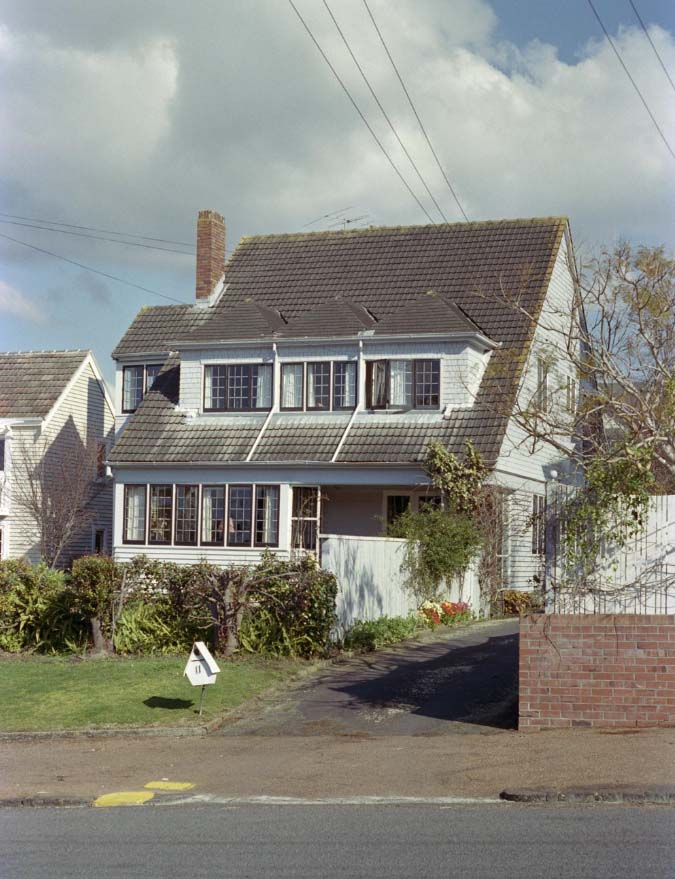
Binney House. June 1986. Image courtesy of ‘Sir George Grey Special Collections, Auckland Libraries. Record ID 1052-H4-13 | Unknown | Auckland Libraries

List Entry Information

Overview

Status
Listed

List Entry Status
Historic Place Category 2

Access
Private/No Public Access

List Number
595

Date Entered
26th November 1981

Date of Effect
26th November 1981

City/District Council
Auckland Council

Region
Auckland Council

Extent of List Entry

Extent includes the land described as Pt Lot 39 DP 21631 (RT NA662/39), North Auckland Land District, and the buildings and structures known as Binney House thereon.

Legal description

Pt Lot 39 DP 21631 (RT NA662/39), North Auckland Land District

Detailed List Entry

Construction Professional

Name

Bloomfield, W S R

Type

Architect

Biography

William Swanson Read Bloomfield (1885-1968), of Ngāti Kahungunu, has been considered likely to be the first person of Māori descent to have attended an architecture school and practised as a Western-style architect. Born into a prominent Gisborne family in Manutuke in 1885, his parents were Thomas E. Read Bloomfield and Mary Swanson - the latter being the daughter of Auckland timber merchant William Swanson and Ani Rangitunoa from Hawkes Bay. He was the second of five children to Thomas and Mary. Thomas had emigrated from England as a child in the 1860s and received an inheritance from his wealthy uncle George Edward Read, an English whaler and sea captain who settled in Poverty Bay. Thomas’ legacy funded the building of Riverslea, now known as Opou, a substantial homestead at Manutuke. In 1883 Thomas married Mary Swanson, the daughter of Ani Rangitunoa of Ngāti Kahungungu, and William Swanson, prominent Auckland timber merchant and 40-year politician progressing from the Provincial Council to the House of Representatives and finally the Legislative Council. William Bloomfield’s father died when he was five and his mother did not remarry, so his grandfather William Swanson is thought to have been a key male influence in his early life. William Bloomfield graduated from the University of Pennsylvania’s School of Architecture in 1913 and is reported to have been studying architecture in England when the First World War (1914-18) broke out. Joining the Royal Flying Corps soon after the conflict started, he was shot down over enemy lines in 1917 and was held captive for the remainder of the war. After repatriation from Germany, Bloomfield returned to New Zealand and married Audrey Gribbin in 1920. From the mid-1920s, he practised in Auckland as part of the firm Bloomfield and Hunt, and then Bloomfield, Owen and Morgan. He was responsible for several notable buildings in the city during this period, including Yorkshire House (1926-8); the Queen’s Arcade in Queen Street (1928-9) and the Masonic Temple in St Benedict’s Street (1929-30). Work undertaken in 1930 included the Hotel Titirangi - or Lopdell House - in Titirangi; the Station Hotel in Beach Road; and the Auckland Aero Club clubhouse. Also in 1930, Bloomfield’s design for St Augustine’s Church in Devonport was erected as a memorial to local men who had died in the First World War. Those commemorated included his brother-in-law, Gunner R. L. Gribbin. During the Second World War (1939-45), Bloomfield served in the Royal New Zealand Air Force as squadron leader and North Island divisional commander. His later work as an architect encompassed numerous domestic designs, many of which featured in Home and Building. He retired from practice in 1959. Source: NZ Heritage List Report for Hotel Titirangi (Former), Te Uru Gallery and the Treasure House (Former), 6 November 2020, Martin Jones.

Name

W. Brownlee

Type

Builder

Biography

No biography is currently available for this construction professional

Construction Details

Start Year

1935

Type

Original Construction

Description

House and garage

Start Year

1944

Type

Modification

Description

Porch windows lowered (first floor)

Start Year

1944

Type

Addition

Description

Lean-to added to garage

Reference

Completion Date

3rd December 2015

Report Written By

Elizabeth Cox

Information Sources

Auckland Star

Auckland Star

Bloomfield, 1934

Bloomfield, W.R.S., ‘House for Mrs Binney Awatea Rd Parnell, W R S Bloomfield’, Nov. 1934, Bloomfield Collection (BM2), Architecture Archives, University of Auckland.

Creative New Zealand, 2012

‘Creative New Zealand salutes creator of some of New Zealand’s most distinct landscape and wildlife paintings’, 17 Sep 2012. URL http://www.creativenz.govt.nz/news/creative-new-zealand-salutes-the-creator-of-some-of-new-zealand-s-most-distinct-landscape-and-wildlife-paintings

McGahey, 2000

McGahey, Kate, The Concise Dictionary of New Zealand Artists: Painters, Printmakers, Sculptors, Wellington, 2000

Report Written By

This place was identified as significant under previous legislation with different information requirements. It remains significant under the current legislation. There is opportunity under our legislation and policies to add to this information. Further information about this place may be available from the Northern Regional Office of Heritage New Zealand Pouhere Taonga. Please note that entry on the New Zealand Heritage List/Rarangi Korero identifies only the heritage values of the property concerned, and should not be construed as advice on the state of the property, or as a comment of its soundness or safety, including in regard to earthquake risk, safety in the event of fire, or insanitary conditions. A fully referenced upgrade report is available on request from the Northern Region Office of Heritage New Zealand

Further Information

Current Usages

Uses: Accommodation

Specific Usage: House

Former Usages

General Usage:: Accommodation

Specific Usage: House

Themes

Web Links

Overview

Status

Listed

List Entry Status

Historic Place Category 2

Access

Private/No Public Access

List Number

595

Date Entered

26th November 1981

Date of Effect

26th November 1981

City/District Council

Auckland Council

Region

Auckland Council

Extent of List Entry

Extent includes the land described as Pt Lot 39 DP 21631 (RT NA662/39), North Auckland Land District, and the buildings and structures known as Binney House thereon.

Legal description

Pt Lot 39 DP 21631 (RT NA662/39), North Auckland Land District

Status

Listed

List Entry Status

Historic Place Category 2

Access

Private/No Public Access

List Number

595

Date Entered

26th November 1981

Date of Effect

26th November 1981

City/District Council

Auckland Council

Region

Auckland Council

Extent of List Entry

Extent includes the land described as Pt Lot 39 DP 21631 (RT NA662/39), North Auckland Land District, and the buildings and structures known as Binney House thereon.

Legal description

Pt Lot 39 DP 21631 (RT NA662/39), North Auckland Land District

Construction Information

Construction Professional

Name

Bloomfield, W S R

Type

Architect

Biography

William Swanson Read Bloomfield (1885-1968), of Ngāti Kahungunu, has been considered likely to be the first person of Māori descent to have attended an architecture school and practised as a Western-style architect. Born into a prominent Gisborne family in Manutuke in 1885, his parents were Thomas E. Read Bloomfield and Mary Swanson - the latter being the daughter of Auckland timber merchant William Swanson and Ani Rangitunoa from Hawkes Bay. He was the second of five children to Thomas and Mary. Thomas had emigrated from England as a child in the 1860s and received an inheritance from his wealthy uncle George Edward Read, an English whaler and sea captain who settled in Poverty Bay. Thomas’ legacy funded the building of Riverslea, now known as Opou, a substantial homestead at Manutuke. In 1883 Thomas married Mary Swanson, the daughter of Ani Rangitunoa of Ngāti Kahungungu, and William Swanson, prominent Auckland timber merchant and 40-year politician progressing from the Provincial Council to the House of Representatives and finally the Legislative Council. William Bloomfield’s father died when he was five and his mother did not remarry, so his grandfather William Swanson is thought to have been a key male influence in his early life. William Bloomfield graduated from the University of Pennsylvania’s School of Architecture in 1913 and is reported to have been studying architecture in England when the First World War (1914-18) broke out. Joining the Royal Flying Corps soon after the conflict started, he was shot down over enemy lines in 1917 and was held captive for the remainder of the war. After repatriation from Germany, Bloomfield returned to New Zealand and married Audrey Gribbin in 1920. From the mid-1920s, he practised in Auckland as part of the firm Bloomfield and Hunt, and then Bloomfield, Owen and Morgan. He was responsible for several notable buildings in the city during this period, including Yorkshire House (1926-8); the Queen’s Arcade in Queen Street (1928-9) and the Masonic Temple in St Benedict’s Street (1929-30). Work undertaken in 1930 included the Hotel Titirangi - or Lopdell House - in Titirangi; the Station Hotel in Beach Road; and the Auckland Aero Club clubhouse. Also in 1930, Bloomfield’s design for St Augustine’s Church in Devonport was erected as a memorial to local men who had died in the First World War. Those commemorated included his brother-in-law, Gunner R. L. Gribbin. During the Second World War (1939-45), Bloomfield served in the Royal New Zealand Air Force as squadron leader and North Island divisional commander. His later work as an architect encompassed numerous domestic designs, many of which featured in Home and Building. He retired from practice in 1959. Source: NZ Heritage List Report for Hotel Titirangi (Former), Te Uru Gallery and the Treasure House (Former), 6 November 2020, Martin Jones.

Name

W. Brownlee

Type

Builder

Biography

No biography is currently available for this construction professional

Construction Details

Start Year

1935

Type

Original Construction

Description

House and garage

Start Year

1944

Type

Modification

Description

Porch windows lowered (first floor)

Start Year

1944

Type

Addition

Description

Lean-to added to garage

Construction Professional

Name

Bloomfield, W S R

Type

Architect

Biography

William Swanson Read Bloomfield (1885-1968), of Ngāti Kahungunu, has been considered likely to be the first person of Māori descent to have attended an architecture school and practised as a Western-style architect. Born into a prominent Gisborne family in Manutuke in 1885, his parents were Thomas E. Read Bloomfield and Mary Swanson - the latter being the daughter of Auckland timber merchant William Swanson and Ani Rangitunoa from Hawkes Bay. He was the second of five children to Thomas and Mary. Thomas had emigrated from England as a child in the 1860s and received an inheritance from his wealthy uncle George Edward Read, an English whaler and sea captain who settled in Poverty Bay. Thomas’ legacy funded the building of Riverslea, now known as Opou, a substantial homestead at Manutuke. In 1883 Thomas married Mary Swanson, the daughter of Ani Rangitunoa of Ngāti Kahungungu, and William Swanson, prominent Auckland timber merchant and 40-year politician progressing from the Provincial Council to the House of Representatives and finally the Legislative Council. William Bloomfield’s father died when he was five and his mother did not remarry, so his grandfather William Swanson is thought to have been a key male influence in his early life. William Bloomfield graduated from the University of Pennsylvania’s School of Architecture in 1913 and is reported to have been studying architecture in England when the First World War (1914-18) broke out. Joining the Royal Flying Corps soon after the conflict started, he was shot down over enemy lines in 1917 and was held captive for the remainder of the war. After repatriation from Germany, Bloomfield returned to New Zealand and married Audrey Gribbin in 1920. From the mid-1920s, he practised in Auckland as part of the firm Bloomfield and Hunt, and then Bloomfield, Owen and Morgan. He was responsible for several notable buildings in the city during this period, including Yorkshire House (1926-8); the Queen’s Arcade in Queen Street (1928-9) and the Masonic Temple in St Benedict’s Street (1929-30). Work undertaken in 1930 included the Hotel Titirangi - or Lopdell House - in Titirangi; the Station Hotel in Beach Road; and the Auckland Aero Club clubhouse. Also in 1930, Bloomfield’s design for St Augustine’s Church in Devonport was erected as a memorial to local men who had died in the First World War. Those commemorated included his brother-in-law, Gunner R. L. Gribbin. During the Second World War (1939-45), Bloomfield served in the Royal New Zealand Air Force as squadron leader and North Island divisional commander. His later work as an architect encompassed numerous domestic designs, many of which featured in Home and Building. He retired from practice in 1959. Source: NZ Heritage List Report for Hotel Titirangi (Former), Te Uru Gallery and the Treasure House (Former), 6 November 2020, Martin Jones.

Name

W. Brownlee

Type

Builder

Biography

No biography is currently available for this construction professional

Construction Details

Start Year

1935

Type

Original Construction

Description

House and garage

Start Year

1944

Type

Modification

Description

Porch windows lowered (first floor)

Start Year

1944

Type

Addition

Description

Lean-to added to garage

Reference

Historical and Associated Iwi / Hapū / Whānau

Completion Date

3rd December 2015

Report Written By

Elizabeth Cox

Information Sources

Auckland Star

Auckland Star

Bloomfield, 1934

Bloomfield, W.R.S., ‘House for Mrs Binney Awatea Rd Parnell, W R S Bloomfield’, Nov. 1934, Bloomfield Collection (BM2), Architecture Archives, University of Auckland.

Creative New Zealand, 2012

‘Creative New Zealand salutes creator of some of New Zealand’s most distinct landscape and wildlife paintings’, 17 Sep 2012. URL http://www.creativenz.govt.nz/news/creative-new-zealand-salutes-the-creator-of-some-of-new-zealand-s-most-distinct-landscape-and-wildlife-paintings

McGahey, 2000

McGahey, Kate, The Concise Dictionary of New Zealand Artists: Painters, Printmakers, Sculptors, Wellington, 2000

Other Information

This place was identified as significant under previous legislation with different information requirements. It remains significant under the current legislation. There is opportunity under our legislation and policies to add to this information. Further information about this place may be available from the Northern Regional Office of Heritage New Zealand Pouhere Taonga. Please note that entry on the New Zealand Heritage List/Rarangi Korero identifies only the heritage values of the property concerned, and should not be construed as advice on the state of the property, or as a comment of its soundness or safety, including in regard to earthquake risk, safety in the event of fire, or insanitary conditions. A fully referenced upgrade report is available on request from the Northern Region Office of Heritage New Zealand

Historical and Associated Iwi / Hapū / Whānau

Completion Date

3rd December 2015

Report Written By

Elizabeth Cox

Information Sources

Auckland Star

Auckland Star

Bloomfield, 1934

Bloomfield, W.R.S., ‘House for Mrs Binney Awatea Rd Parnell, W R S Bloomfield’, Nov. 1934, Bloomfield Collection (BM2), Architecture Archives, University of Auckland.

Creative New Zealand, 2012

‘Creative New Zealand salutes creator of some of New Zealand’s most distinct landscape and wildlife paintings’, 17 Sep 2012. URL http://www.creativenz.govt.nz/news/creative-new-zealand-salutes-the-creator-of-some-of-new-zealand-s-most-distinct-landscape-and-wildlife-paintings

McGahey, 2000

McGahey, Kate, The Concise Dictionary of New Zealand Artists: Painters, Printmakers, Sculptors, Wellington, 2000

Other Information

This place was identified as significant under previous legislation with different information requirements. It remains significant under the current legislation. There is opportunity under our legislation and policies to add to this information. Further information about this place may be available from the Northern Regional Office of Heritage New Zealand Pouhere Taonga. Please note that entry on the New Zealand Heritage List/Rarangi Korero identifies only the heritage values of the property concerned, and should not be construed as advice on the state of the property, or as a comment of its soundness or safety, including in regard to earthquake risk, safety in the event of fire, or insanitary conditions. A fully referenced upgrade report is available on request from the Northern Region Office of Heritage New Zealand

Further Information

Current Usages

Uses: Accommodation

Specific Usage: House

Former Usages

General Usage: Accommodation

Specific Usage: House

Current Usages

Uses: Accommodation

Specific Usage: House

Former Usages

General Usage: Accommodation

Specific Usage: House

Location

Loading
Stay up to date with Heritage this month
