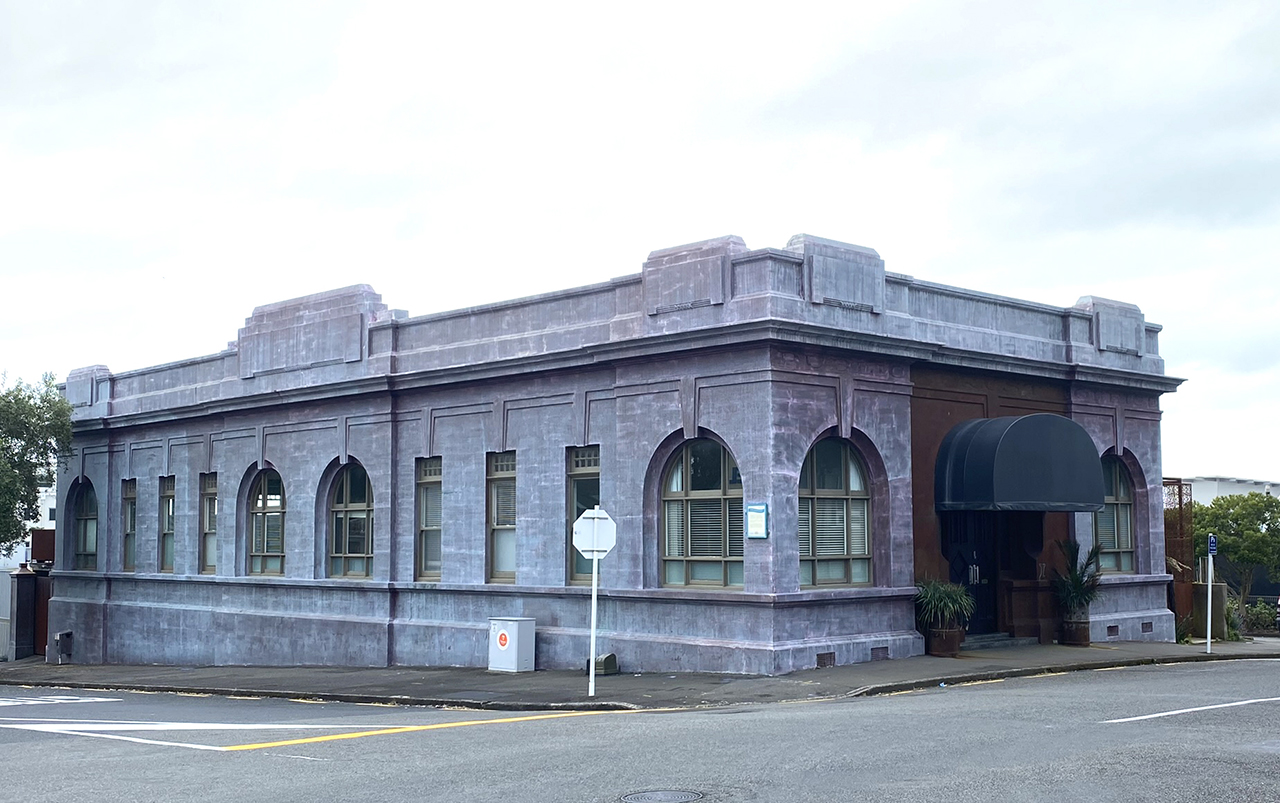
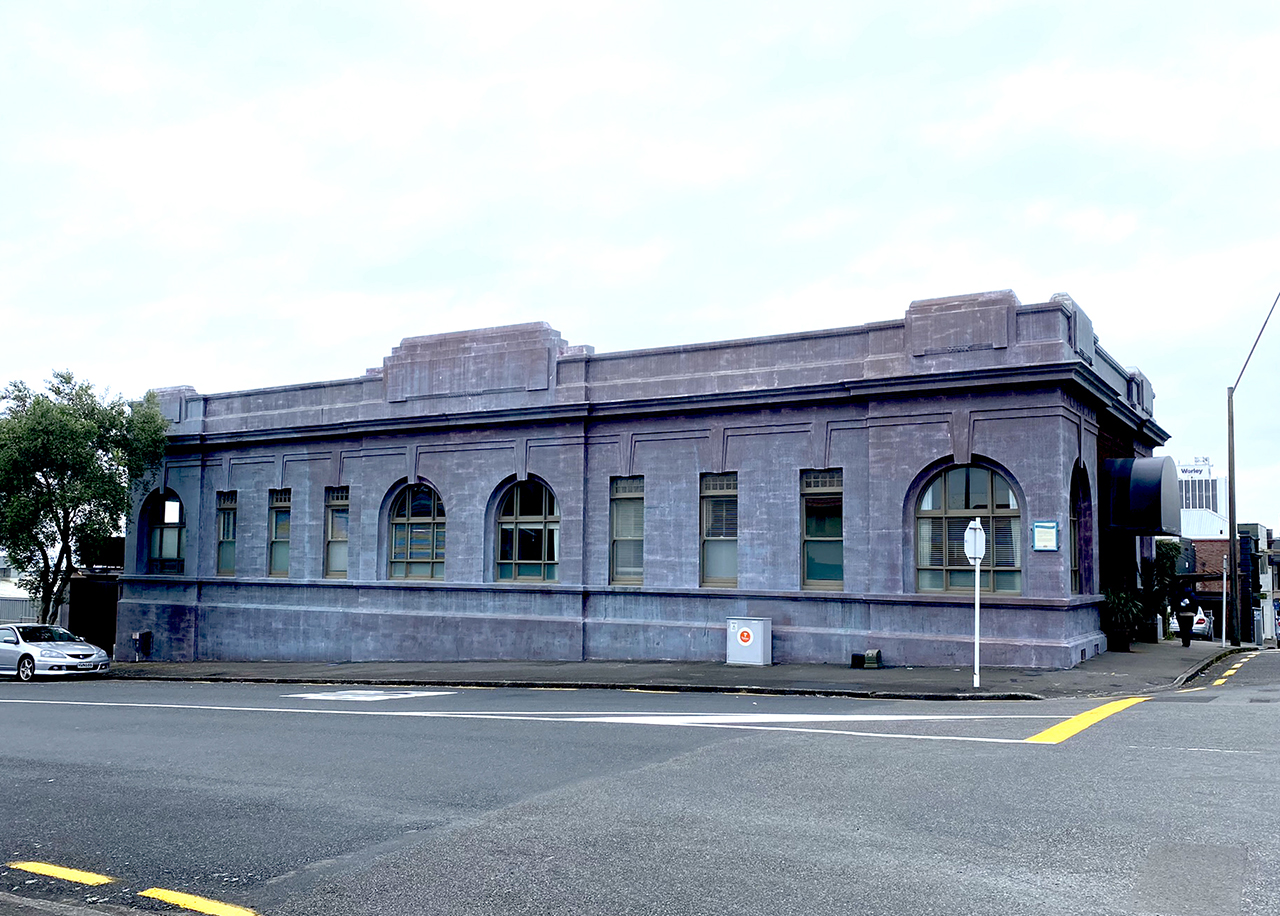
The Public Trust Office was established by the government in 1873 to provide estate, will and trustee administrative services. By the early 1890s New Plymouth was served by a local agent, and got its own district public trustee in 1919 during a period of decentralisation from the head office in Wellington to the regions. Decentralisation required ‘new and more commodious buildings’ and the New Plymouth office was one of many built throughout the country in the 1920s. Thomas Bates, the town’s leading commercial architect, designed the stripped beaux-arts classical style reinforced concrete building in early 1920 and construction was complete by October 1921. A 1925 addition enhanced and extended the symmetry of the existing building along the Queen Street elevation and doubled the building’s floor area.
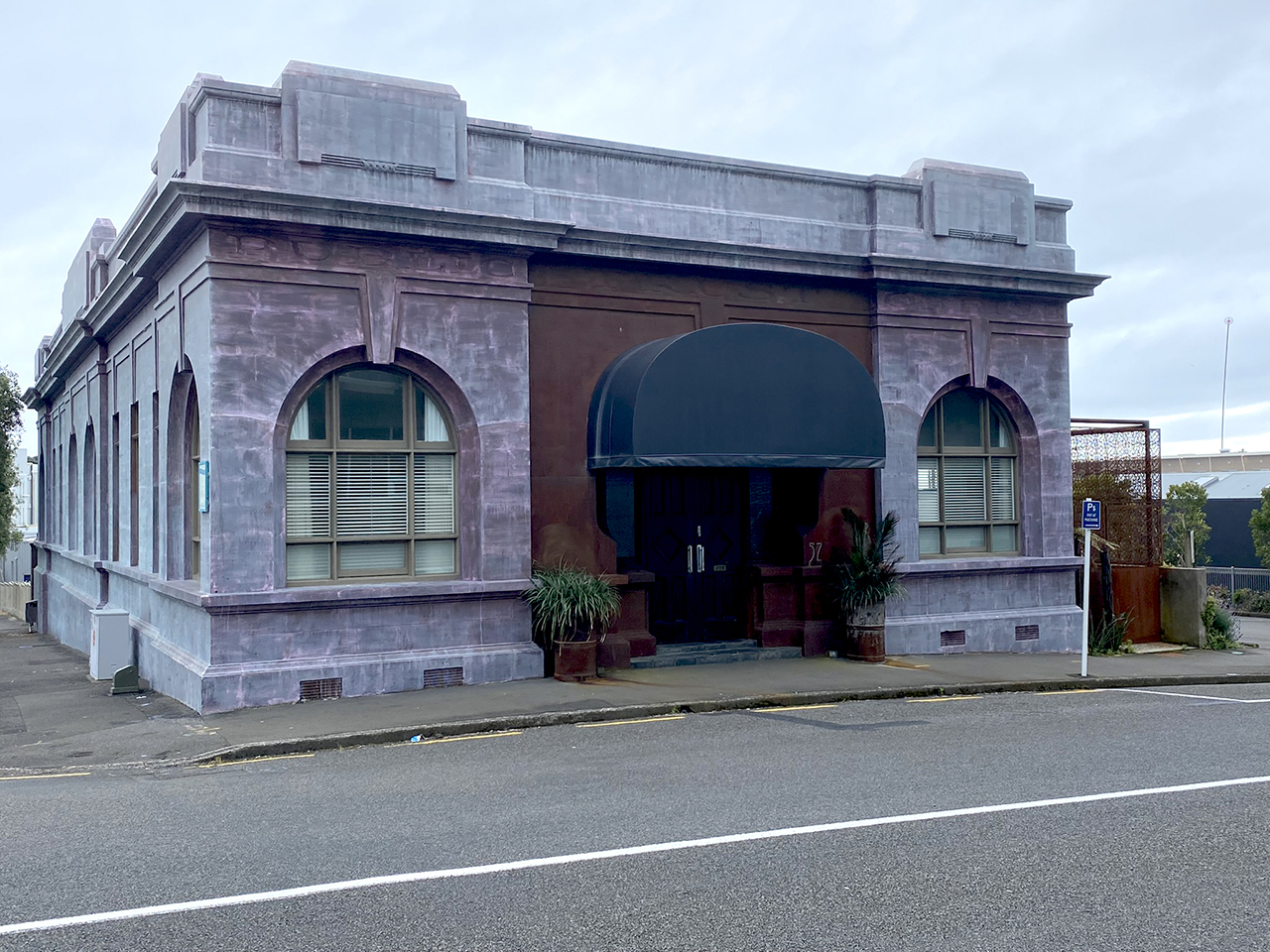
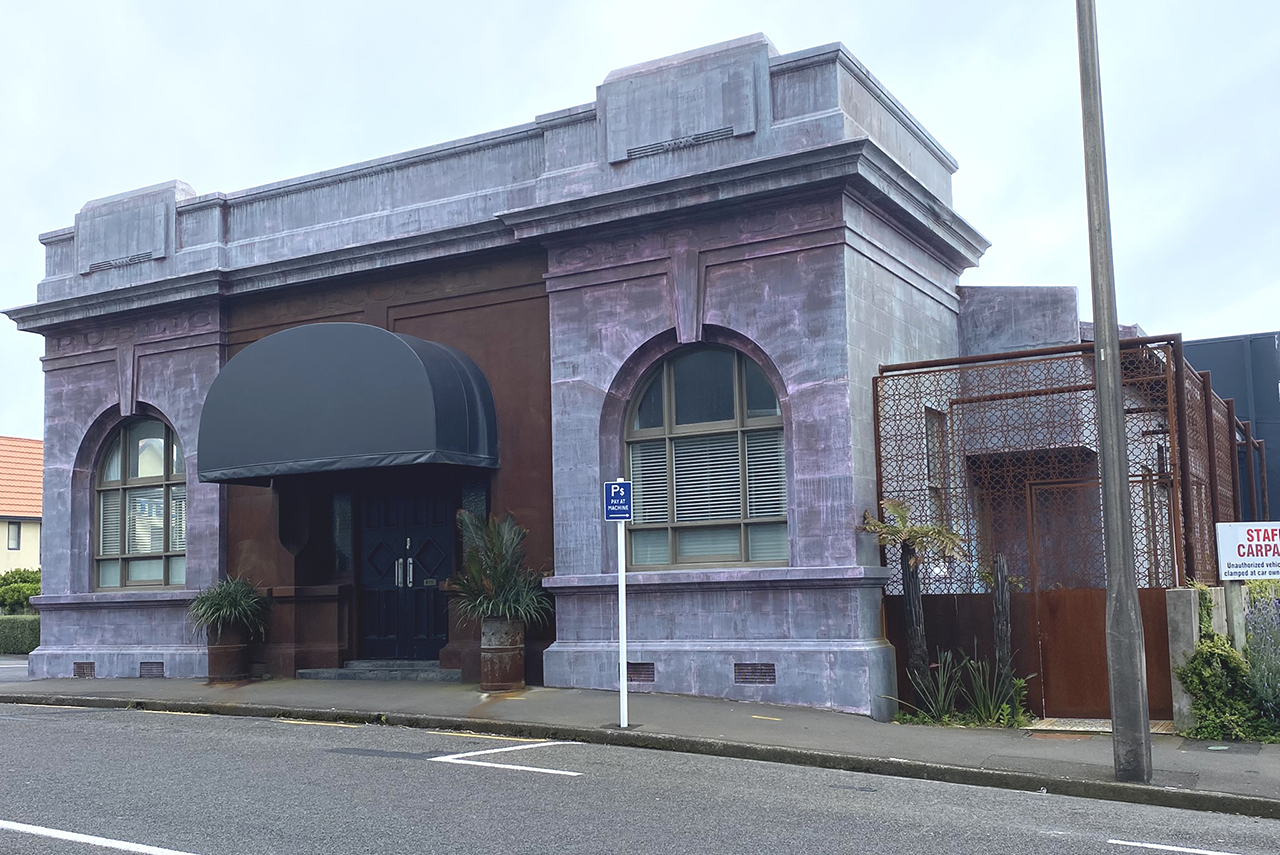
The King Street front elevation has a centrally located entrance flanked by two segmented semi-circular windows. Compared to other Public Trust buildings of similar age (such as the Public Trust Building in Napier, List No.1167) the New Plymouth office is modest in size and appearance, with the only exterior decorative elements being the keystones adorning the tops of the windows, a moulded cornice line, and parapets with blank rectangular escutcheons. Michael Fowler described its architecture as evoking confidence and comfort to its clients through its ‘no-nonsense frontage and ... inspired and confident lettering’, which proclaimed the building’s name and function on the front facade. It is one of five Bates buildings in a one block radius.
In 1983 the interior of the building was altered to accommodate commercial offices. Ten years later it was threatened by a proposed K-Mart development; this did not eventuate and the building was sold by the Public Trust in 1995. Demolition loomed again from 2003-2005 when the owner proposed building a three storey apartment on the site. These plans did not gain traction with the public and it was resolved to retain the historic façade and convert the building for residential use. In 2007 it was sold as a gutted shell and converted the following year into a residence with two self-contained units rented as boutique accommodation.

List Entry Information
Status
Listed
List Entry Status
Historic Place Category 2
Access
Private/No Public Access
List Number
7237
Date Entered
14th July 1995
Date of Effect
14th July 1995
City/District Council
New Plymouth District
Region
Taranaki Region
Extent of List Entry
Extent includes the land described as Lot 1 DP 3831 (RT TN97/272), Taranaki Land District and the building known as Public Trust Building (Former) thereon. Refer to the extent map tabled at the Rārangi Kōrero Committee meeting on 30 April 2019.
Legal description
Lot 1 DP 3831 (RT TN97/272), Taranaki Land District
Status
Listed
List Entry Status
Historic Place Category 2
Access
Private/No Public Access
List Number
7237
Date Entered
14th July 1995
Date of Effect
14th July 1995
City/District Council
New Plymouth District
Region
Taranaki Region
Extent of List Entry
Extent includes the land described as Lot 1 DP 3831 (RT TN97/272), Taranaki Land District and the building known as Public Trust Building (Former) thereon. Refer to the extent map tabled at the Rārangi Kōrero Committee meeting on 30 April 2019.
Legal description
Lot 1 DP 3831 (RT TN97/272), Taranaki Land District
Why is this place significant?
Cultural Significance
This historic place was registered under the Historic Places Act 1993. The following text is from the original Recommendation for Registration considered by the NZHPT Board at the time of registration. Cultural: The building represents the continuity of the Public Trust Office, a company serving as a significant national public institution. Social: The Public Trust Office represents a distinctive aspect of the way of life of New Zealanders, in providing a sense of security and continuity for those people whose estates it administered.
Historic Significance
Historical Significance or Value This historic place was registered under the Historic Places Act 1993. The following text is from the original Recommendation for Registration considered by the NZHPT Board at the time of registration. The building exemplifies a social policy which has had a decisive influence on the development of this country.
Physical Significance
This historic place was registered under the Historic Places Act 1993. The following text is from the original Recommendation for Registration considered by the NZHPT Board at the time of registration. Aesthetic: The design of the building presents a "no-nonsense" solid frontage to inspire confidence in clients Architectural: The design is an example of New Zealand provincial Beaux-Arts classicism
Why is this place Category 1 / Category 2?
Detail Of Assessed Criteria
This historic place was registered under the Historic Places Act 1993. The following text is from the original Recommendation for Registration considered by the NZHPT Board at the time of registration. The following comments are made in relation to the criteria identified under S.23(2) of the Historic Places Act 1993. a) The extent to which the place reflects important or representative aspects of New Zealand history: The Public Trust Office was established in New Zealand in 1872 when the Public Trustee Bill, instigated by Julius Vogel, became law. The main function of the Public Trustee was to administer the estates of deceased persons who named the Public Trustee as executor of their will, and of those people who died intestate. From about 1910 the Public Trust Office experienced a period of expansion, reorganisation and political criticism. In 1912 provision was made for the appointment for four local Deputy Public Trustees in the four major centres. Expansion continued after 1912 with the setting up of local branch offices in the main provincial centres. Built c1923 the Public Trust Office, New Plymouth, is one such branch. b) The association of the place with events, persons, or ideas of importance in New Zealand history: In 1872 the Public Trust legislation was novel and was to have a decisive influence on New Zealand's development. The Public Trust provided a significant service to New Zealanders, and provided a sense of security and continuity. g) The technical accomplishment or value, or design of the place: The Public Trust Office, New Plymouth, was designed by Thomas Bates in 1920 and built c1923. It may best be described as an example of New Zealand provincial Beaux-Arts classicism. The design is not elaborate but it is essentially in the Baroque tradition which inspired the design of the earlier Public Trust Office in Wellington. The style often incorporated large motifs enclosed in a small scale structure. The Baroque tradition is apparent in the building in the segmented headed windows, which are divided at the apex by oversized keystones. These, plus the moulded cornice line and the parapets with blank rectangular escutcheons, are really the only tangible evidence of a Beaux-Arts inspiration in an otherwise plain and uninspired design. The architect, however, has extrapolated these modest elements. The King Street (front) facade has large segmental headed windows which flank the main entrance and are enlivened by glazing bars. This facade succeeds in conveying the sentiments accurately expressed by Michael Fowler, viz: "the solidity and certainty of this small branch office building in New Plymouth, the non-nonsense frontage and the inspired and confident lettering must be a comfort to clients". Bates' original design was a more correct interpretation of Baroque than is the building today. The original plans show that the main entrance had a matching fanlight intersected by a keystone. The fanlight and original doors with bolection mouldings have been removed and replaced by a canopy and glass doors respectively. This modification has diminished the architectural integrity of the building. Only two years after the office was built plans had been prepared which doubled the size of the building and gave it the symmetry apparent in the side facades today. In 1985 alterations were made to the interior of the building. Thomas Herbert Bates moved to New Zealand. He worked in Auckland until 1916, and about this time he was approached to supervise the construction of New Plymouth's AMP Buildings for the Wellington architect Frederick de Jersey Clere. Bates then established his own practice in New Plymouth. He was for some years architect to the Bank of New Zealand and in addition designed the impressive but now demolished New Plymouth branch of the Bank of New South Wales. The work of Thomas Bates appears to have been well received in his day and at one time there were many of his buildings in the province. k) The extend to which the place forms part of a wider historical and cultural complex or historical and cultural landscape: The Public Trust Office, New Plymouth, occupies part of a block bounded by Queen Street, King Street and Egmont Street. Within the block three other buildings can be identified as historic and form what could be regarded as an historical and cultural landscape to which the Public Trust Office makes a contribution. The other three buildings are the former RSA Building, the Arnold H White Building and the Hooker Brothers Building. The latter was also designed by Thomas Bates. On the other side of King Street are two more Bates' buildings, Victoria House and the State Fire Insurance Building. Conclusion: The Public Trust Office, New Plymouth, is recommended for registration as a Category II as a place of historical and cultural heritage significance and value. It is a good representative example of a building purpose built to serve a public institution. It has historical significance as a result of its association with the institution of the Public Trust Office during the time of expansion. It is a good example of a provincial Public Trust Office, a building type which was often designed to look solid and reliable through the manipulation of classical architecture elements. In short, the building can be described as symbolic of the conservative preferences of its time.
Why is this place significant?
Cultural Significance
This historic place was registered under the Historic Places Act 1993. The following text is from the original Recommendation for Registration considered by the NZHPT Board at the time of registration. Cultural: The building represents the continuity of the Public Trust Office, a company serving as a significant national public institution. Social: The Public Trust Office represents a distinctive aspect of the way of life of New Zealanders, in providing a sense of security and continuity for those people whose estates it administered.
Historic Significance
Historical Significance or Value This historic place was registered under the Historic Places Act 1993. The following text is from the original Recommendation for Registration considered by the NZHPT Board at the time of registration. The building exemplifies a social policy which has had a decisive influence on the development of this country.
Physical Significance
This historic place was registered under the Historic Places Act 1993. The following text is from the original Recommendation for Registration considered by the NZHPT Board at the time of registration. Aesthetic: The design of the building presents a "no-nonsense" solid frontage to inspire confidence in clients Architectural: The design is an example of New Zealand provincial Beaux-Arts classicism
Why is this place Category 1 / Category 2?
Detail Of Assessed Criteria
This historic place was registered under the Historic Places Act 1993. The following text is from the original Recommendation for Registration considered by the NZHPT Board at the time of registration. The following comments are made in relation to the criteria identified under S.23(2) of the Historic Places Act 1993. a) The extent to which the place reflects important or representative aspects of New Zealand history: The Public Trust Office was established in New Zealand in 1872 when the Public Trustee Bill, instigated by Julius Vogel, became law. The main function of the Public Trustee was to administer the estates of deceased persons who named the Public Trustee as executor of their will, and of those people who died intestate. From about 1910 the Public Trust Office experienced a period of expansion, reorganisation and political criticism. In 1912 provision was made for the appointment for four local Deputy Public Trustees in the four major centres. Expansion continued after 1912 with the setting up of local branch offices in the main provincial centres. Built c1923 the Public Trust Office, New Plymouth, is one such branch. b) The association of the place with events, persons, or ideas of importance in New Zealand history: In 1872 the Public Trust legislation was novel and was to have a decisive influence on New Zealand's development. The Public Trust provided a significant service to New Zealanders, and provided a sense of security and continuity. g) The technical accomplishment or value, or design of the place: The Public Trust Office, New Plymouth, was designed by Thomas Bates in 1920 and built c1923. It may best be described as an example of New Zealand provincial Beaux-Arts classicism. The design is not elaborate but it is essentially in the Baroque tradition which inspired the design of the earlier Public Trust Office in Wellington. The style often incorporated large motifs enclosed in a small scale structure. The Baroque tradition is apparent in the building in the segmented headed windows, which are divided at the apex by oversized keystones. These, plus the moulded cornice line and the parapets with blank rectangular escutcheons, are really the only tangible evidence of a Beaux-Arts inspiration in an otherwise plain and uninspired design. The architect, however, has extrapolated these modest elements. The King Street (front) facade has large segmental headed windows which flank the main entrance and are enlivened by glazing bars. This facade succeeds in conveying the sentiments accurately expressed by Michael Fowler, viz: "the solidity and certainty of this small branch office building in New Plymouth, the non-nonsense frontage and the inspired and confident lettering must be a comfort to clients". Bates' original design was a more correct interpretation of Baroque than is the building today. The original plans show that the main entrance had a matching fanlight intersected by a keystone. The fanlight and original doors with bolection mouldings have been removed and replaced by a canopy and glass doors respectively. This modification has diminished the architectural integrity of the building. Only two years after the office was built plans had been prepared which doubled the size of the building and gave it the symmetry apparent in the side facades today. In 1985 alterations were made to the interior of the building. Thomas Herbert Bates moved to New Zealand. He worked in Auckland until 1916, and about this time he was approached to supervise the construction of New Plymouth's AMP Buildings for the Wellington architect Frederick de Jersey Clere. Bates then established his own practice in New Plymouth. He was for some years architect to the Bank of New Zealand and in addition designed the impressive but now demolished New Plymouth branch of the Bank of New South Wales. The work of Thomas Bates appears to have been well received in his day and at one time there were many of his buildings in the province. k) The extend to which the place forms part of a wider historical and cultural complex or historical and cultural landscape: The Public Trust Office, New Plymouth, occupies part of a block bounded by Queen Street, King Street and Egmont Street. Within the block three other buildings can be identified as historic and form what could be regarded as an historical and cultural landscape to which the Public Trust Office makes a contribution. The other three buildings are the former RSA Building, the Arnold H White Building and the Hooker Brothers Building. The latter was also designed by Thomas Bates. On the other side of King Street are two more Bates' buildings, Victoria House and the State Fire Insurance Building. Conclusion: The Public Trust Office, New Plymouth, is recommended for registration as a Category II as a place of historical and cultural heritage significance and value. It is a good representative example of a building purpose built to serve a public institution. It has historical significance as a result of its association with the institution of the Public Trust Office during the time of expansion. It is a good example of a provincial Public Trust Office, a building type which was often designed to look solid and reliable through the manipulation of classical architecture elements. In short, the building can be described as symbolic of the conservative preferences of its time.
Construction Professional
Name
Bates, Thomas Herbert
Type
Architect
Biography
No biography is currently available for this construction professional
Construction Details
Finish Year
1921
Type
Original Construction
Description
Original construction completed
Finish Year
1925
Type
Addition
Description
Extension completed
Finish Year
1983
Type
Modification
Description
Interior alterations
startYearCirca
Finish Year
2005
Type
Modification
Description
Interior of the building gutted for proposed apartment conversion
Finish Year
2008
Type
Modification
Description
Converted into a residential home with guest accommodation
Construction Professional
Name
Bates, Thomas Herbert
Type
Architect
Biography
No biography is currently available for this construction professional
Construction Details
Finish Year
1921
Type
Original Construction
Description
Original construction completed
Finish Year
1925
Type
Addition
Description
Extension completed
Finish Year
1983
Type
Modification
Description
Interior alterations
startYearCirca
Finish Year
2005
Type
Modification
Description
Interior of the building gutted for proposed apartment conversion
Finish Year
2008
Type
Modification
Description
Converted into a residential home with guest accommodation
Historical and Associated Iwi / Hapū / Whānau
Completion Date
22nd March 2019
Report Written By
Jessica McDonnell-Buwalda and Kerryn Pollock
Information Sources
Vennell, 1973
C. W. Vennell, A Century of Trust, a history of the New Zealand Public Trust Office, 1873-1973, Auckland, 1973
New Zealand House & Garden
Urbis
Urbis
Other Information
A fully referenced upgrade report is available on request from the Central Regional Office of Heritage New Zealand. A copy of the original report is available from the NZHPT Central Region office Please note that entry on the New Zealand Heritage List/Rarangi Korero identifies only the heritage values of the property concerned, and should not be construed as advice on the state of the property, or as a comment of its soundness or safety, including in regard to earthquake risk, safety in the event of fire, or insanitary conditions.
Historical and Associated Iwi / Hapū / Whānau
Completion Date
22nd March 2019
Report Written By
Jessica McDonnell-Buwalda and Kerryn Pollock
Information Sources
Vennell, 1973
C. W. Vennell, A Century of Trust, a history of the New Zealand Public Trust Office, 1873-1973, Auckland, 1973
New Zealand House & Garden
Urbis
Urbis
Other Information
A fully referenced upgrade report is available on request from the Central Regional Office of Heritage New Zealand. A copy of the original report is available from the NZHPT Central Region office Please note that entry on the New Zealand Heritage List/Rarangi Korero identifies only the heritage values of the property concerned, and should not be construed as advice on the state of the property, or as a comment of its soundness or safety, including in regard to earthquake risk, safety in the event of fire, or insanitary conditions.
Current Usages
Uses: Accommodation
Specific Usage: Boarding/ Guest House
Uses: Accommodation
Specific Usage: House
Former Usages
General Usage: Government
Specific Usage: Public Trust Office
General Usage: Trade
Specific Usage: Office building/Offices
Current Usages
Uses: Accommodation
Specific Usage: Boarding/ Guest House
Uses: Accommodation
Specific Usage: House
Former Usages
General Usage: Government
Specific Usage: Public Trust Office
General Usage: Trade
Specific Usage: Office building/Offices
Location
Sign up to hear more
Get the latest heritage news, features and events delivered
straight to your inbox.

