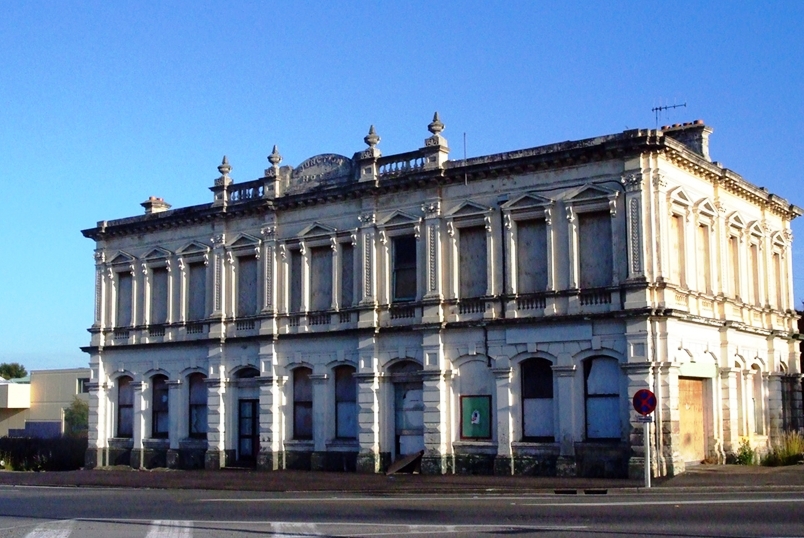
Built in 1879 for John McKay, the Junction Hotel is a significant landmark on the southern State Highway entrance to Oamaru. In design and decoration, it is similar in style to the Oamaru stone buildings which the town is renowned for. The story it tells of financial difficulty and bankruptcy of owners is one not always evident in stories of the colonial past. Its subsequent history and particularly the de-licensing as a result of the vote for ‘No License’ in 1906 gives an interesting indication of the effects of prohibition – with the building rendered useless as a licensed premises for the next fifty years.
The Waitaki area is traditionally associated with the Kāhui-tipua, Te Rapuwai, Waitaha and Kāti Māmoe peoples. The Waitaki River was an ara tawhito (traditional travel route) for Kāi Tahu into the interior of Te Wai Pounamu and there are many kāika nohoka (seasonal settlements) and kāika mahika kai (food gathering sites) along the river. The land around the Waitaki River mouth shows evidence of extensive settlement, while Moeraki was one of the early cradles of knowledge for Waitaha and Kāti Māmoe histories. Key coastal settlements were at Makotukutuku (Cape Wanbrow), Moeraki, Shag Point, Waikouaiti, and Huriawa (the Karitane Peninsula). Following the arrival of Pākehā in number, Māori were alienated from their land. By the mid-1860s the development of Oamaru was in full swing, with the population of the town almost doubling between 1864 and 1867. By the end of the 1860s the southern entry to the town was completed to about the foot of Thames Street, the heart of the town. Hotels were in high demand during this period of the region’s development, with the associated slow travel and short journeys. The advancement of the town slowed in the late 1860s as wool prices fell. However, by 1878 a resurgence of fortunes made Oamaru ninth in population among New Zealand towns. John MacKay’s Junction Hotel is referred to as early as September 1876, although this is likely to have been a previous building on or near the site, which is said to have burned down shortly afterwards.
To finance the build McKay was said to have borrowed a large sum from the Scottish and New Zealand Investment Company. Historian W.H.S. Roberts described the Hotel as, “a handsome stone hotel containing 34 rooms and every convenience.” Roberts describes how McKay failed to service the mortgage, and the hotel became the property of the mortgagees. In April of 1885, the hotel was sold to Patrick Corcoran.
On 16 June 1904 there was a fire at the hotel. Damage to the building was considerable, particularly as the water pressure for the fire appliances was so poor, that the fire brigade was unable to confine the fire. The fire gained hold in the old 10-roomed wooden building to the rear of the stone hotel before spreading to the main building.
The conflagration was timely in the context of national and local campaigns for prohibition. In the poll of 1905 no-licence was carried. The decision took effect on 30 June 1906 when the ten hotels in town closed their bars, with the no-licence remaining for over fifty years. However, it is likely that the Junction Hotel continued as a ‘dry’ establishment well into the 20th century – in 1905, Patrick Corcoran advertised the Junction Hotel, describing it as ‘new and commodious’, adding that he hoped to see ‘old patrons and visitors…who, he assures, will in the future, as in the past, receive all comfort and attention’. Following Corcoran’s death in 1919, a ‘Mrs. Hastings’ began advertising the services of the Junction Hotel – describing the business in 1922 as a ‘hotel and grocery store’ with ‘24 rooms…in one of the nicest situations in Oamaru’. Mrs. Hastings’ name can be seen adorning the upper façade of the building in photographs said to be taken in the 1930s. As late as 1953-4, the property was noted as ‘Junction Htl, stre’ (abbreviations probably meaning ‘Hotel, Store’) in Wise’s Post Office Directory. During late-20th century the building appears to have been used as a commercial premises (a dairy, a vegetable store, a bottle store, and second hand bookshop), but by the turn of the 20th century was unused. In 2019, the building was bought by its current owner who is noted by the Otago Daily Times as ‘renovating [the building] as his home.’ This renovation was aided by the successful application for the Waitaki District Heritage Fund and Heritage New Zealand’s National Heritage Preservation Incentive Fund.