The Raglan-Whaingaroa Harbour area was part of the rohe of Tainui iwi Ngati Mahanga when Europeans first made contact in the early 19th century. The closest known pre-European contact occupation site to the Raglan School (Former) is on the shore of the Opotoru Inlet a few hundred metres away.
The survey ship Fanny called at Raglan in 1836, and subsequently traders brought small ships into the harbour. Methodist missionary Reverend James Wallis was stationed at Raglan first in 1835 and permanently from 1838. Rangatira Wiremu Neera [William Naylor] Te Awaitaia became a mission teacher after converting to Christianity in the early 1830s. During the 1850s and early 1860s Te Awaitaia and others sold parcels of land in and around Raglan to European settlers and to the government, allowing the settlement by Europeans earlier than in most of the Waikato. The first general store opened in c.1854. Raglan functioned as a bicultural community from these early days, with a Maori policeman being elected by the runanga in 1862 and serving alongside the Pakeha officer. Many of the ships using the harbour in the mid 19th century were Maori-owned.
Although Raglan was relatively isolated from the rest of the Waikato by the Hakarimata range and Mount Pirongia, the colonial government established a military outpost there at New Year 1864 to defend their troops from attack from the west during the Waikato War. At that time Raglan was a town with three stores, three hotels, stables, European settlers and about 100 of Te Awaitaia's men. There were no military engagements in the immediate area, but none the-less the Waikato wars had a major impact on the settlement as many local people evacuated the town and storemen and farmers suffered from troops and others pillaging, ruining crops and killing their stock. Wesleyan missionary Reverend Cort Schnackenberg, who had replaced Wallis in 1863, continued to hold church services during the Waikato war and ran a Sunday School and a day school in Raglan. Raglan School (Former) is closely associated with Schnackenberg, a man who had a major influence on the establishment of Christianity in the west coast of the greater Waikato region. Schnackenberg established several mission schools for Maori and part-Maori children and adults: Mokau in 1844, others at Kawhia and Aotea and Karakariki during the late 1850s-early 1860s. He also established or helped to establish secular schools at Waitetuna (1870) and Whatawhata (1877) and served on the Raglan School Committee until his death in August 1880.
In 1866 the Whaingaroa Highways Board was established as the first local body in the district. Also in 1866 the first secular school at Raglan was begun; this was a fee-charging school run by Mrs Corlett with a tent as the schoolroom. George H. Holmes was school master at Raglan from 1869-74, teaching in the Wesleyan chapel with 'only his wife assisting with the sewing' according to grandson T.S. Holmes. On 21 March 1873 a meeting was held in the chapel for the purpose of electing the school committee in accordance with the terms of the new Education Act 1872. Messrs Powell, Gilmour and Graham and Dr Harsant, the resident magistrate, were elected, with Rev. Schnackenberg elected as chairman. Dr Walter Harsant (1811-1897) moved to Raglan with his family in 1858 where as well as being a medical practitioner, he was Commissioner of Oaths, Registrar of Births, Deaths and Marriages, and in 1863 was appointed Emigration Officer. Some of his children attended the first school.
The committee got off to a bad start as some members did not approve of the teacher, George Holmes, and Powell removed his children from the school even though the nearest alternative was at Ruapuke, about 16km away. Schnackenberg wrote to the Education Board to have the school committee dissolved and a commissioner appointed; after two further elections for the school committee a new committee was elected.
By 1874 Raglan was a township of 52 dwellings housing a population of 112 men, women and children. A wharf was built in 1874 to service the town which continued to grow to such an extent that when Raglan County was constituted in 1876, Raglan was its centre. The district's main industries were flax milling, timber, fishing and sheep farming, with dairying developing from the 1890s.
In May 1874 Mr J.N. Pegler, Schnackenberg's brother-in-law, was appointed as teacher and his wife as teacher of needlework. At that time the roll was 23 pupils. As chairman of the school committee Rev. Schnackenberg agitated for a new school building, writing to the Central Board of Control on 2 February 1877 asking for funds for the building of a school house and a teacher's residence.
In 1879 ownership of Allotment 12 in Stewart Street was transferred to the Education Board District of Auckland; this land had been granted in fee simple to Walter Harsant in February 1874 and appears to have been in private owner-ship before this.
Many people were not happy with the teacher, Pegler: 'At Raglan in 1880, the parents lost confidence in their teacher; as an advertisement in the Waikato Times stated that 'unless the Schoolmaster made a Public Apology and consented to have his nose pulled for the malicious reports he had been circulating, legal proceedings would follow.' In 1881 Pegler resigned, the chapel lease expired, and the school went into recess for three months. Mr Horsey was appointed as school teacher and the school moved into the council room of the Raglan Highways Board. By then the roll was 40 pupils. In 1881 Mr Mita Karaka Ngatipane was elected to the school committee in Raglan the first Maori to be so elected.
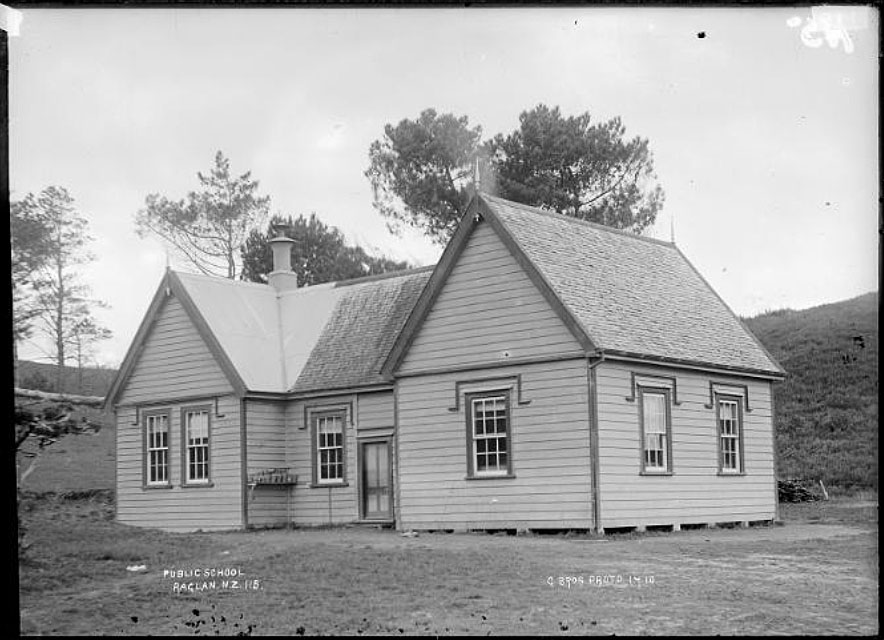
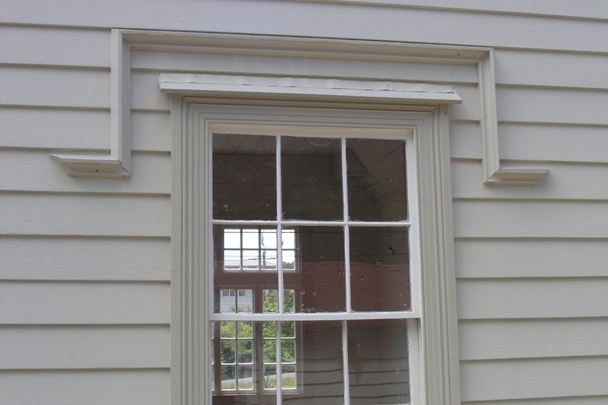
In 1883 Raglan School, the first purpose-built secular school in the settlement, was built. It was sited on a slope on the poorly-formed Stewart Street with its frontage facing north-east. The school was a simple wooden structure, an example of the type described by Warwick Kellaway as the ‘classical period 1877-1892' for school buildings in New Zealand. Such schools consisted of a single room, with ‘a 50° high pitched gable roof giving a particularly ecclesiastical effect', usually of heart kauri with puriri piles and split kauri shingled roofs. Interiors were austere with close-boarded floors, walls and ceilings and a domestic-looking fireplace with mantelpiece. Ventilators in the ceiling were controlled by pulleys and lines. Plumbing usually consisted of a 400-gallon (1818.4 litres) square iron tank that collected rain water from the roof. These schools usually had a boot scraper by the porch door and wrought iron pegs in the porch for hanging hats and coats. While some of this detail is not confirmed for Raglan School, most is evident, including indications of the original open fireplace.
The architect of the school is not known, although it is highly probable that it was Henry Allright. Research undertaken by architect Warwick Kellaway found that ‘the early schools built by the Auckland Board of Education seem to have been undocumented; there is no indication of any Architect or Designer' except for a Board report from 1891 that recorded that ‘Mr Allright retired from the position of Architect of school buildings after 14 years'. Kellaway found some evidence for work having been undertaken for the Board prior to 1877 by Henry Allright, a civil engineer of Auckland, and that he had input into at least three Waikato schools between 1878 and 1880. Builder Jim Pearce built Raglan's first schoolroom and porch 1883; with Joseph Pretty he built Okete Congregational Church also.
A problematic issue right from the school's inception was a religion v. secular one. The new Education Act 1877 required public schools to be secular but Schnackenberg felt that as the chapel was used as the school it was appropriate to have at least the Lord's Prayer said at the beginning of the day. Other members of the first committee called for this practice to cease. Nonetheless Christianity was a strong influence at Raglan School. In 1887 half an hour a week was to be devoted to Temperance lessons and in 1896 Rev C.A. Lyon was granted permission to conduct Bible classes once a week. Former teacher Mrs C. Peart noted: ‘the previous headmaster, Mr Breach [1936-1938] had provided Bibles for every pupil in the school and I continued the practice instituted by my predecessor, Miss McIver, of starting the day by each pupil reading a verse of scripture... this procedure was followed for 2 years when pressure was brought to bear to cease the Bible-reading.'
The school played a central role in the small town, as evidenced by the farewell organised for Mr Horsey, headmaster from 1881-88:
‘all the local folk gathered at 6 p.m. for a meal at the hall ...followed by a school concert, a play ... lots of speeches and a presentation to the guests. Folk then danced until daylight... The evening was intended as a benefit for the teacher and his family. However, the expenses were so great that little was left to hand over.'
Not all memories of Mr Horsey were fond ones however, as he was known for the discipline learnt in his previous army service: ‘Boys were drilled twice a week. He also believed in character building and severely punished such faults as lying and obscenity.'
The next headmaster, James LaTrobe (1889-1903), brought practical skills from his previous work as a farmer, sawyer, flax miller, and overseer to the Highways Board as well as being a lay preacher in the Church of England. When Elsie Fitzwilliam began school in 1898, Raglan School was a one-room, one-teacher school run by LaTrobe. Her memories include being made to stand on a table wearing a tall white dunce's cap, standing in the corner with a ‘Silence' placard around her neck as punishment for talking and at one time running away from the draconian measures employed by Mr LaTrobe. She recounts that her ‘last impression of those early years at school is of Mr LaTrobe standing at the porch door, ringing a large handbell ... calling the pupils into class; and me to quiet misery'.
Helping with the sewing seems to have been standard for the master's wife in the early decades, as Mesdames Holmes, Pegler and LaTrobe each in their turn took on this role.
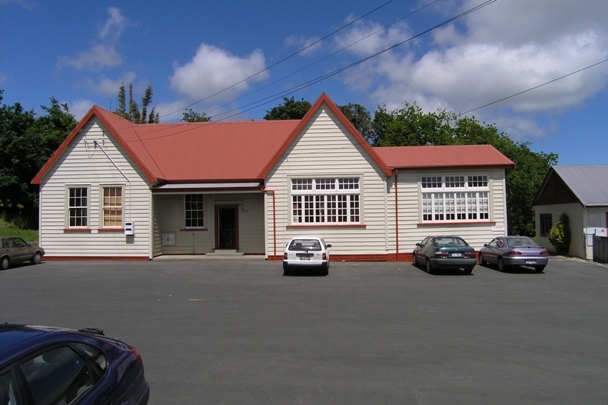
The one-room school served the community's needs for 20 years. Initially the roll dropped but rose again in 1885 to 38, although the school inspector re-ported on very bad attendance. In 1886 a tender for 14/- was accepted by the School Committee for digging a drain around the school and cutting of fire-wood. In 1892 hundreds of trees were planted on Arbour Day, and in 1903 pine trees were planted on the hill side. By 1903 the growth of pupil numbers led to the enlargement of the small porch on the south-east side to form a sec-ond room of 13 x 18 feet (4 x 5.5 metres). At this time a five-bedroom house was built for the teacher in the adjacent section in Stewart Street. A local man, J Rowe, built the teacher's house and the first porch extension for £495. In 1906, when the roll had risen to 64, a new classroom was added, to the south-east side of the porch/classroom. This was the same size as the original room, built in similar style and materials to form a building symmetrical in floor plan and front and rear elevations, but with a corrugated iron roof, unlike the original shingle roof. At this time the open fireplace and chimney were removed and pot-bellied stoves were installed in the two main classrooms.
A 1910 photograph shows the front yard of the school was grassed, although the grass is worn away near the building itself; former pupils recall the mud that prevailed after rain. There were no retaining walls at this stage. There was a flag pole sited in the front yard. According to former pupil Ivy Bates, who was at the school some time after 1906: ‘after the age of 8 years we all had a small plot each to garden. Prizes were given for the best garden.' Another pupil from the 1930s, Joan White, recalled that the garden plots were inside the front gate.
Former pupil Ivy Bates (later Barnett) recalled that when she started school (some time between 1906 and 1917) ‘the teachers had a room each ... we stayed in Mr Blackett's room for two years and went into the other room to Standard 1 and stayed there for the rest of our school days. We started at 8.00 am. First singing the National Anthem and saluting the flag ... after which we marched into school...'.
Spouses and families of teaching staff also played their part in the community. For instance, Mrs Blackett, wife of a retired headmaster, was in charge of the temporary hospital set up in the school during the 1918-19 influenza epidemic. She was a nurse whose help ‘was freely available to those in need.' A few teachers married local people and stayed in the district.
Former teacher Connie Bernard recalled that when she was appointed in 1922, Raglan School was staffed by two teachers, plus two pupil teachers. In 1923 the pupil teachers were replaced by a fulltime assistant, Loveday Keam. ‘I taught the primers and Loveday had Standards 1 and 2. We were all in the same room with a curtain down the middle. When I had a loud lesson she had a quiet one and vice versa. Mr [W.R.] Moore taught the upper standards in the other room.' Moore was headmaster at Raglan School for 18 years except for two years' war service.
A third room was added in 1929 when the roll reached 100. This room was in a different style, with the gable roof set at right angles to the original room; the pitch of the roof was also lower. The addition necessitated several changes to the 1883 classroom, including shifting the side windows, replacing the front window with wider windows in the newer style of the addition, shortening the length of the 1883 room by making the rear into a corridor and re-lining the rear wall to match those in the addition. In 1932 there were three teachers, one woman taking a combined Standard 1, 2 and 3 class. In 1933 a Maori whare was erected in the school grounds at the request of the headmaster.
By 1938 only standards 1 and 2 were combined, space having been freed up by the shifting of the seniors to the old Anglican Parish hall in 1937. The senior school started with 18 girls and one boy in the charge of Mr A.S. Reynolds. By the end of the year there were enough pupils to elevate the school to District High School status.
In 1938 the Auckland Education Board purchased land for a new school in Norrie Street, Raglan, and in May 1939 a grant was approved for the erection of two classrooms there. When the new school for the senior students was opened in 1940, at first the primer classes and standards 1 and 2 remained at Stewart Street with two teachers. Kauroa School amalgamated with Raglan in 1941 and their buildings were shifted to the new site. Former principal T.S. Holmes recalls that when he assumed charge in 1947 there were again three teachers at the Stewart Street School, two in the Kauroa building and three in the high school building.
During the Second World War, the Home Guard used the school for exercises. Former teacher Mrs C. Peart recalls being at the Stewart Street School: ‘We were there during the war years, so had to drill the children in air raid precautions. At the ringing of a handbell they had to be marched out and rush helter skelter to any shelter they could find - under trees, in ditches or under hedges ... The children thought the exercises great fun'. In 1942 an air raid shelter was to be constructed at the infant school by deepening the existing drain. Many former pupils from Raglan School served New Zealand during overseas conflicts. Those serving in World War Two have had their names recorded with pride on a Roll of Honour. In 1948 the school was closed for three months because of a polio epidemic.
Despite the continuing growth of the township and the school, it was many years before new buildings were erected to accommodate the primary and infant classes. In 1961 tenders were called for phase 1 of a new primary school at the Norrie street campus. In 1962 some primary students were still being taught at the old Stewart Street site but in 1963 the new buildings were officially opened and the original school buildings were closed.
In late 1967 the land was vested in Her Majesty the Queen and soon after set aside as a recreation reserve vested in the County of Raglan. The Raglan School (Former) building was empty for many years, being used at times as a storeroom then in 1975 as a ‘smoko' room [tea room] and office for the Council depot staff. In 1988 the school building was saved from impending demolition and restored by volunteers as the Whaingaroa Arts and Work Centre, a com-bined group of the Raglan Community Arts Council and the Whaingaroa Work Co-operative (later the Kokiri Centre). Maori land activist Tuaiwa (Eva) Rickard, a past pupil, was one of the many supporters who saved the school from demo-lition and later re-opened the building as the Whaingaroa Arts and Work Cen-tre. After her death in 1997 the then Raglan School principal, Clive Hamill, said: ‘The passing of kuia, nana and friend of the school Mrs Eva Rickard has been a big loss to the school. Aunt Eva has been very supportive of the school over a long period of time in a host of different capacities.' Tuaiwa (Eva) Rickard achieved national renown as a promoter of Maori land rights, in particular regarding the land used as the Raglan golf course.
The land status was revised under the Reserves Act 1977 to local purpose (community use) reserve on 11 August 1989. The Kokiri Centre moved out in 1994 and management of the building passed to the Raglan Community Arts Council. In 2000 the local Lions Club adopted the building as their headquarters and installed the kitchen in the entry-room. Since then it has been the venue for a regular creative market, summer art programmes, weaving classes run by Te Wananga o Aotearoa, talks and exhibitions with funding coming from a variety of sources. It was re-named as the Old School Arts Centre in 2005. The Rag-lan School (Former) building continues to be part of community activities, with a Raglan Community Arts Council representative stating recently that ‘The central focus of our being is this building'. The pride and affection with which the school is regarded is seen by the several anniversary reunions and celebrations that have been held: for the New Zealand centennial in 1940, the school centennial (1966) and the 125th anniversary (1991).
The Community Arts Council commissioned a conservation plan which was funded by a grant from the Lotteries Heritage Fund. The conservation plan was undertaken by Ros Empson, Auburn Design, and approved by the Historic Places Trust on 25 July 2007.
The date for the erection of the toilet block is unknown. It is situated on the slope to the south of the 1906 classroom and comprises water closets. It is pre-sumed that earth closets would have existed on site in the school's earliest days, but their location has not been established.