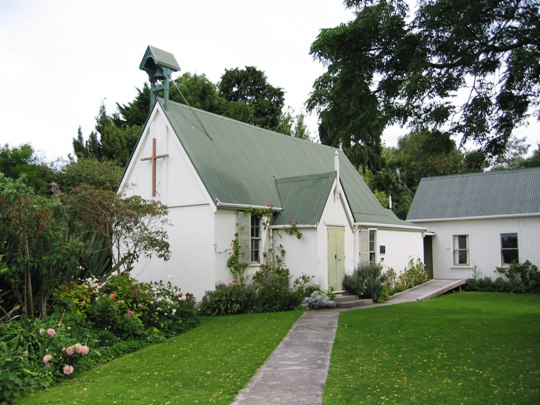
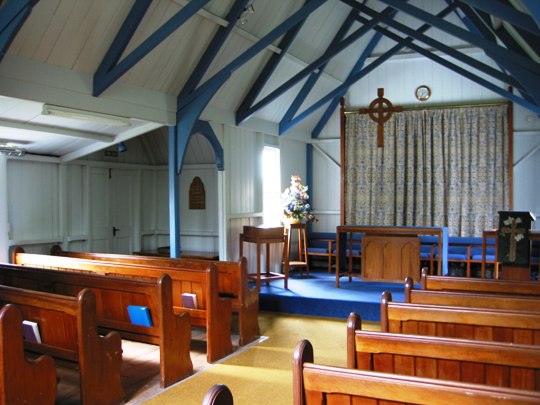
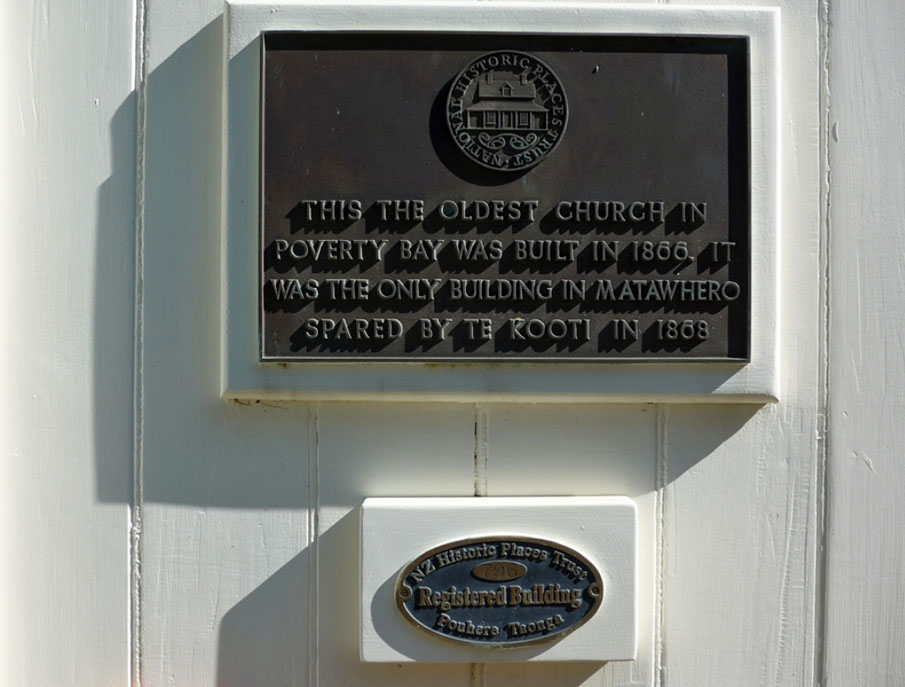
Matawhero Church was built as a simple, one-roomed structure in 1865 or 1866 by the Anglican Church for use as a school. At this time Poverty Bay district was being settled by Europeans, but many irregularities over land ownership existed and contradictory claims to sovereignty prevailed in the area. One of the land issues involved Te Kooti Arikirangi Te Turuki (Te Kooti) whose actions led to the devastation of most of the buildings in the Matawhero and Makaraka districts and the deaths of many residents, both European and Maori, on 10-11 November 1868. Matawhero Church was one of the very few buildings spared in this event and as a result, it has become the focus for recounting the events of the 'Poverty Bay Massacre', as Te Kooti's raid became known.
Soon after the community was re-established, the need for a church was felt by followers of the Presbyterian denomination. The former schoolroom was purchased in 1872 and has been used continuously for this purpose until the present day. The history of the Matawhero Church is seen as closely following the fortunes and misfortunes of the European settlers of Poverty Bay.
Matawhero, Poverty Bay, is a locality seven kilometres (km) northwest of Gisborne on the flood plain of the Waipaoa River within one of the major bends formed by its winding course. The Waipaoa River flows into the sea towards the southwest end of the Bay via the Awapuni Lagoon. A nineteenth-century account describes Poverty Bay as 'a circlet of hills bound[ing] the interior ... [it] consists of a fertile plain, which stretches for about 25 miles [40 km] inland, and averages from six to eight miles [10-13 km] in breadth. The plain is traversed by several rivers, navigable for a few miles by small craft.' Immediately to the east of Matawhero is the locality Makaraka. Makaraka is bounded on the east by the Taruheru River which flows into Poverty Bay at Turanganui (Gisborne).
By the nineteenth century the northern part of Poverty Bay, or Turanga as it was known, was the rohe of Te Aitanga-a-Mahaki with Ngati Porou to the northeast and Rongowhakaata to the south. There were abundant natural resources in the sea, swamps, rivers and bush, and there was easy access from the coast into the interior. The soil was fertile and the climate warm enough for cultivating sub-tropical crops. The large population of Maori were based in kainga and pa located on the coast, and by the rivers, on the low country near the foothills of the ranges, particularly in the southwest end of the Bay. The defended kainga Te Pa-o-Kahu on the shore of Awapuni Lagoon was said to be one mile long (1.6 km). By 1832 the tangata whenua were well-supplied with European goods and produce, with sufficient firearms to repel an invasion of Whakatohea at that time. As in other parts of the country, the firearms and European goods were acquired by a vigorous trade in locally-grown potatoes, flax and pigs. One of the earliest European traders to settle in the Bay was John Williams Harris, who did so in 1831 under the protection of chief Paratene Potiti (also known as Paratene Turangi). Harris had trading establishments at Turanganui and at Opou, on the Waipaoa River, the latter land having been acquired through his first wife's whanau.
From the 1830s onwards, several Europeans settled on the Waipaoa plain. Some households included mixed-marriages, some were solely European. They included traders with stores selling imported goods and produce, farmers and support trades such as blacksmiths and saddlers - their customers were the European settlers and Maori. Often their land tenure was uncertain, some of the European men having been given access to land through their wife's whanau but because of cultural misunderstandings regarding land ownership difficulties ensued. The chief, Kahutia, of Te Whanau-a-Iwi hapu led a 'redemption' movement, 'which from 1851 sought to take back lands that had been alienated at Turanga and to return the payments'. The first of many official land claim hearings to sort out the Poverty Bay land issues was held in 1859.
The Anglican Church, under the auspices of the Church Missionary Society (CMS), had begun evangelising in the Poverty Bay-East Coast region in 1834 and in 1840 William Williams established the first Poverty Bay mission on the Turanganui River at what is now called Gisborne. The third and most successful mission was established at Waerenga-a-Hika, seven km inland from Matawhero, on land granted to the CMS by Rongowhakaata. William Williams' son William Leonard Williams, who assisted his father in his missionary work in Poverty Bay, reported that wheat and freight for the building of Waerenga-a-Hika was conveyed by river as far as Matawhero, from whence it went overland: this implies that Matawhero was the limit for some water craft. There was a ford across the Waipaoa River just to the west of Matawhero and trading stores situated nearby. Waerenga-a-Hika mission station became a large educational establishment with four schools and sufficient produce from the farms to be self-supporting.
However, by late 1864 missionaries of the new religion Pai Marire, whose followers were commonly called Hauhau, had begun recruiting in Poverty Bay. By March 1865 a high proportion of the Maori population had become adherents and had abandoned, or were at least uncertain of, their previous loyalties and the Christian faith. On 31 March 1865 William Williams (then Bishop of Waiapu with an extensive diocese covering much of the eastern North Island) abandoned Waerenga-a-Hika in the face of threats from Hauhau that he would suffer the same fate as Rev. C.S. Volkner in Opotiki.
W. Leonard Williams stayed in the district after his father's departure and the closure of the mission station, and while he was based in Turanganui for safety, he still ministered to the people (Pakeha and Maori) of the district. Leonard Williams refers in his diaries to subscribers to the Matawhero schoolroom fund, an indication that not only was the community sufficiently large to warrant a local school, the people were working together to establish it. It is probable that the school was intended for children of the European settlers only. Williams was apparently the organiser of the erection of the school building at Matawhero, as this entry indicates:
On May 2nd, 1865, at 11 o'clock, Mr Harris came by special arrangement, that he might accompany me to have an interview with Gibson about the Matawhero schoolroom .... Mr Gibson had the timber there since January, and Gibson said he had not put a plane on it... because of the unsettled state of the district...
After disputes between the community group and the builder Gibson, and later the replacement builder Williamson (the latter was also a contributor to the fund), an arrangement was made for the money for the timber to be paid back minus Williamson's £1/10/- subscription. On 20 May Williams noted: 'Newham now offers to cut the timber for the schoolroom, if we like to employ him.' Just who did build the schoolroom, and when, has not been ascertained, but it is generally held to have been built in late 1865 or 1866. It is also held that Captain Read, a trader in Turanganui (Gisborne), actually got the schoolhouse erected. The original building measured only 25 feet by 15 feet 6 inches [7.6 metres x 4.7 metres]. Even though small, it was the only gathering place for the Matawhero community as the other buildings were small farmhouses, often temporary ones on sleds, and places of work such as smithies and saddleries.
Archaeological excavation of the front lawn and two other small areas to the southwest and northwest of the Church in 2003 found 59 fragments of drawing slates, 25 pieces of slate pencils and two complete ink bottles that probably relate to this period.
Pai Marire's activities in the Poverty Bay-East Coast region accelerated to such an extent that on 11 October Lieutenant (later Major) Reginald Biggs, James Fraser (later Lieutenant-Colonel), and Ngati Porou chief Ropata [Rapata] Wahawaha led a force that captured 500 Hauhau at Hungahungatoroa. Biggs killed one of the prisoners, a leader of Te Aitanga-a-Mahaki named Pita Tamaturi, in cold blood; Te Kooti was subsequently asked by Tamaturi's people to avenge his death. The remaining Hauhau returned to Poverty Bay and built three large pa, the strongest being Waerenga-a Hika overlooking the sacked and abandoned mission station. A long siege at Waerenga-a Hika pa from 17 to 22 November 1865 resulted in the capture of 200 Pai Marire (Hauhau) men. Also arrested, on a charge of supplying cartridges to the defenders of Waerenga-a Hika pa, was Te Kooti Arikirangi Te Turuki (Te Kooti).
Te Kooti was born in approximately 1832 in the Ngati Maru settlement Te Pa-o-Kahu near the mouth of the Waipaoa River. Ngati Maru was a hapu of Rongowhakaata. He was taught at the Anglican mission at Whakato, Poverty Bay, between 1850 and 1853, during which time he was baptised. The missionaries' experiences of him differed widely, from William Williams seeing him as a drunk too keen on worldly matters, to Thomas Grace employing him as a shepherd and encouraging Te Kooti's aspiration to become a minister. During his first marriage Te Kooti converted to the Roman Catholic faith. By early 1852 Te Kooti was one of a group living at Makaraka with the chief Kahutia; this group protested over land rights and enacted acts of revenge through plundering and stealing of settlers' stock, horses and alcohol. Te Kooti became known as bloodthirsty, powerful, an adulterer and a thief. He alienated many of his own iwi and hapu but also gained many followers seeking justice over land issues and independence from the colonial government.
Soon after his arrest at Waerenga-a-Hika, Te Kooti was released, but he was arrested again on 3 March 1866 and transported to the Chatham Islands and held prisoner there. The rationale for Te Kooti's reprisal in 1868 is embedded in his treatment by the government agents and individuals such as Biggs, Wilson and Paratene Potiti (the latter is said to have kicked him with contempt) - all three would be executed during the raid on Matawhero.
During his incarceration on the Chathams Te Kooti received a series of divine inspirations and from these developed a new faith that became known as Ringatu or 'Upraised Hand', a mixture of Maori cosmology and values with the teachings of the Old Testament and Christianity. During this time parcels of land to which he had rights were alienated. This included land at Matawhero. On 10 July 1868 Te Kooti and nearly 300 followers, having escaped from their incarceration in the Chatham Islands, landed at Whareongaonga south of Poverty Bay. The party had their first encounter with colonial forces including the Poverty Bay Mounted Rifles under Captain Biggs at Paparatu on 20-21 July 1868. The colonial forces were severely routed with many wounded. Te Kooti began a campaign to exact revenge for the many misdeeds he had suffered; his attack on Matawhero and Makaraka in November 1868 dealt with several grievances at once but embroiled him in direct confrontation with the colonial government. After years of guerrilla warfare being pursued by government forces, Te Kooti retreated into the King Country. He was pardoned in 1883 and after another period of defiance retired to Ohiwa Harbour in the Bay of Plenty where he died in 1893. Te Kooti became a legend, with such widely disparate opinions of him as admiration for his intelligence and leadership and respect for his Ringatu faith to seeing him as a fear-invoking violent fanatic rampaging through the country. He was usually described in ghoulish terms in such language as 'he commenced to write his name in letters of blood over the face of the country'. More recently, his actions have been put in context of the frustration and strong sense of ill-usage he felt with the colonisation of his land and the perceived mistreatments of himself and his iwi.
In 1867 the population of Poverty Bay:
... consisted of about 500 Maoris and 150 Europeans of all ages. Matawhero was situated about five miles [eight kilometres] from the sea, in the heart of the district. Many people resided there in houses surrounded with gardens and orchards.
Gisborne was still a relatively small settlement in the late 1860s, although it did by then possess a hotel, trading stores, courthouse and post office. Two redoubts were built across the river to provide for the residents' safety if required. In 1868 'there were only some twenty or thirty white people living in Turanga, the majority of the people living out on the flats at Makaraka, the Resident Magistrate (Capt. R. Biggs) living at Matawhero.'
The Matawhero schoolroom was used as a temporary military hospital after the Paparatu engagement in July 1868. Leonard Williams recorded:
I met Dr. Brown who was enquiring for Dr. Watling and who also asked me about the schoolroom being used as a hospital for the wounded, Major Whitmore having arranged that the poor fellows be placed under Dr. Watling's charge. The next day, July 22nd, I rode up again to Matawhero ... and found the doctor attending to the patients.
Leonard Williams supplied an iron bedstead and mattress to the hospital. He returned on 23 July, and again on 30 July with his wife Sarah, plus 'money and more mattresses'.
Te Kooti retreated into the Urewera during the winter and the militia and Whitmore's forces disbanded. Despite some unease amongst Maori and Pakeha residents in Poverty Bay, life returned to normal and Biggs and Captain Wilson returned to their homes at Matawhero. Leonard Williams continued with his ministrations to both his Maori and Pakeha congregations. A happier event at the Matawhero Church in August 1868 was the wedding of Robert Atkins and Jane Sharp.
However, in November word reached Turanga that Te Kooti was moving towards Poverty Bay, but the authorities gave little weight to the reports. Leonard Williams recorded for Sunday 8 November 1868: 'After the English service at Matawhero I had a little chat with Captain Briggs [sic]'. Williams elaborated on this in his retrospective account, that after he had finished giving a service at Manutuke, he heard a report that Te Kooti was on his way to Poverty Bay and that: 'I stopped for an English service at Matawhero where Biggs was then living' and that Biggs told him he had scouts on the lookout. On the following day he advised Biggs of a fresh report, but again Biggs seemed to place full reliance on waiting for official word before acting. Williams states: 'In little more than twelve hours after my conversation with Major Biggs he and his wife and infant child were numbered among the dead'.
Soon after midnight on 10 November 1868 Te Kooti and his followers launched a major raid on the Matawhero area, killing residents (both Maori and Pakeha), looting and burning buildings. The dispersed nature of the settlement allowed some people to escape, fleeing to Turanganui or south to Muriwai. Some were warned or assisted by Maori loyal to, ambivalent about or wavering in their allegiance to the colonial government. Assessments of the numbers killed vary but by the morning 29 Europeans were killed, and Mrs Alice Wilson was mortally wounded. At least 22 (possibly 32) Maori died, also executed by Te Kooti either in revenge for their loyalty to the colonial government or those who had personally offended Te Kooti and his cause. The attack was well-planned and very specific, with Te Kooti stating precisely who was to be killed, namely those Europeans or part-Maori now occupying George Read's claim to which Te Kooti had rights. Also, 'the Maori deaths were ... no more random than those of the Europeans'. Amongst them was Paratene Potiti.
Leonard Williams recorded that: 'the only four buildings left at Makaraka and Matawhero: viz. the Schoolroom, a building lately occupied by Fergusson, Espie's old store, and an outhouse at Newham's. There were at least 25 buildings burnt, and everyone who remains in the place will have to begin all over again.' A few more people were killed the following day. Te Kooti did not immediately leave the area, but returned to loot and burn remaining property. On 16 November 'Jimmy Wilson lay hidden in Bloomfield's house and saw Hau Hau [sic] go by in great numbers. They burnt all the remaining houses at Matawhero, with the exception of the schoolroom'. Jimmy Wilson was en route to get help for his severely wounded mother, Alice. The story of Alice Wilson's survival after lying for four days in an outhouse is one of the often-repeated stories relating to the raid. Another boy claimed as a hero was Charles James who acted 'in a daring and most noble manner' by running from Biggs' house to give warning of the raid.
The raid was described as 'a series of shocking atrocities memorable in New Zealand history as the Poverty Bay massacres'. A belief that the Matawhero Church was used as a refuge during the raid 'is without foundation'. Intensive research by Mackay of each resident European's fate revealed that people had either passed through Matawhero some hours before the raid or had hidden in or close to their own homes or had fled.
Williams retrieved the harmonium from Matawhero and put it into the Gisborne courthouse for safe storage. The harmonium's lid had been wrenched off and a pig had been incarcerated in the schoolroom's vestry which was in 'a great mess'. Williams records that on 22 February 1869 'Messrs. Harris and Goldsmith came over this morning to a meeting of the Matawhero Schoolroom Committee. The accounts are just square'. Apart from one further reference to the harmonium, Williams' diary entries regarding Matawhero cease.
The sparing of the school-church is believed to have been deliberate as it had been built with Kahutia's permission. Its connection with the Anglican Church may also have been a factor.
The schoolroom continued its connection with the history of Te Kooti when it was used by the militia as a camp area from 21 to 30 March 1870. The Kempthorne diaries record that hay, horses and men were sheltered and housed there while awaiting news of Te Kooti on another of his sorties towards Poverty Bay. By 1872 Matawhero was again a relatively concentrated settlement of European farms and a few businesses including a hotel.
On 11 May 1872 a Presbyterian minister purchased the Matawhero schoolroom for use as the first Presbyterian Church in Poverty Bay.
In contrast to the introduction of the Methodist and Anglican denominations in New Zealand, 'Presbyterianism reached New Zealand ... not as a missionary movement, but as a settler faith ... a transplantation of Scottish religion and culture...'. In 1840, under the auspices of the New Zealand Company, John Macfarlane, a member of the Established Church of Scotland, arrived in Port Nicholson. Macfarlane established the first settler congregation in the colony and officiated at the opening of the first Scots Church in New Zealand in January 1844. The Hawke's Bay Presbytery was founded in 1865. By the 1860s Presbyterianism in New Zealand was well-established in its several forms of the Scottish Church, Irish Church and the Free Church of Scotland. One factor was the close-knit sense of community of the smaller more remote districts: 'Everywhere the real driving force in providing the land, buildings, finance and support ... was the determination and generosity of a few influential, reasonably prosperous lay people.' This was certainly the case in Poverty Bay, as during 1872 the Presbytery of Auckland considered the matter of establishing a church in the Poverty Bay area, at the request of the residents in Gisborne and the Matawhero district who had been influenced by Rev. George Morice. Morice was the second minister of St Paul's Church, Napier who after he retired settled in Poverty Bay where he held the first Presbyterian services in the district. Poverty Bay,
though within the province of the Auckland Presbytery, has been placed under the care of the Hawke's Bay Presbytery, for the double reason that it lies nearer to them, and will be the means of strengthening them so soon as it becomes a settled charge. Through the exertions of the late Moderator - the Rev. Mr Morice - a Church has been secured, as also there have been secured ten acres of land for a glebe; and the Committee hope soon to see the members of our Church there gladdened by the appointment of a minister over them.
The purchase of the ten acres and the Matawhero schoolroom, 'on May 11th, 1872 ... plus one acre of land around it, part of Matawhero No.4 Block, and owned by Capt. Read, was purchased by the church, Rev. J. [sic] Morice advancing the money himself'. It is believed that Read was using the building as a storehouse; Morice paid £50 for the building and an acre of land and later donated land to the church so that it could gain an income from it.
The first Presbyterian minister of the Poverty Bay charge was Rev. W. Heningham Root who arrived on 25 February 1873. Root gave his first service at Matawhero Church on 2 March 1873 at 3 p.m. Although based at Matawhero he also held services at Gisborne (in the courthouse), Patutahi and Ormond. The services in Gisborne were attended by other Protestant denominations. The congregation grew to such an extent that in October 1874, another church, St Andrew's, was opened in Gisborne. There was also discussion at this time about shifting the Matawhero Church into Gisborne. Having decided to leave it at Matawhero, further discussion ensued regarding whether the manse should be at Matawhero or Gisborne. The manse was built in Gisborne, at the rear of St Andrew's Church in 1876 and Rev. Root then lived there until leaving the district in 1878.
Matawhero was also thriving as land issues were settled and legalised through the Land Courts; it essentially remained a farming district. The Matawhero Aerated Waters factory was established by 1874 and the post office in 1893. In 1896 most of the residents at Matawhero were described as farmer or contractor, with a cheese factory manager, two blacksmiths, a schoolmaster, an interpreter and two hotelkeepers amongst the occupations listed. By 1901 they had a telephone bureau, a butter factory and an abattoir and in 1903 a fellmonger and wool works. The Matawhero stock saleyards served the farming district for many decades and its 'fortnightly and monthly sales are so largely attended that the prices realised are said to govern the value of stock throughout Poverty Bay'. In May 1875 there was a public meeting to discuss setting up a school, the evening classes being not sufficient. The public school was established about 1880 and by 1902 had an average attendance of 112 of the 150 pupils on its roll.
The Matawhero Church must have continued serving as a school for a few years, as 'the Education Board was still paying £10 per year for use of the building as a school till 1878'.
In 1880 several maintenance and construction works were undertaken: Agnew Brown paid for the erection of a fence around the church grounds; the building was painted at a cost of £7/7/6 for labour - the costs to be taken from 'funds in hand from the soiree'; and alterations were made on the church. Although these were not specified in the church records, the alterations are presumed to be the additions of the transepts so that the floor plan became a cross.
FOR THE REMAINDER OF THIS HISTORICAL DESCRIPTION PLEASE REFER TO THE REGISTRATION REPORT HELD AT THE (NORTHERN REGION) TAURANGA OFFICE OF NZHPT.