Early development of Opotiki
The development of Opotiki has been influenced by Maori, Pakeha and other cultures. Parts of the modern township lie on the site of a significant Maori settlement known as Pakowhai, which was located beside the Otara River at its convergence with the larger Waioeka River. In May 1840, a version of the Treaty of Waitangi was signed in, or close to the settlement by several Whakatohea leaders. During the early colonial period, Opotiki supplied produce for the emerging Pakeha markets further north, when both Catholic and Anglican protestant missionaries established stations in the immediate vicinity. Following the killing of one these missionaries - the Anglican Carl Volkner (1819-1865) - due to suspicions that he was passing on information to government authorities during Pai Marire protests of the 1860s, the settlement was taken by colonial troops in 1865. Large amounts of surrounding land in the eastern Bay of Plenty were also confiscated by the Crown.
A township was subsequently laid out in a regular grid with its administrative buildings located a short distance to the south of the earlier settlement, symbolically close to the pre-existing Anglican mission church (now known as the Church of St Stephen the Martyr/ Hiona St Stephens). By the early 1880s, the town had a courthouse, a post office, and a population of at least 800, reflecting its status as the main administrative centre for the eastern Bay of Plenty. The township was formally surveyed into military and commercial sectors, incorporating one-acre lots to the south to be granted to militiamen - mostly from the 1st Waikato Regiment - and smaller, one-rood lots to the north for commercial and other use. Wharves and depots subsequently developed in the latter part of town, linked to the import and exportation of goods by river and sea. Lying on the site of the earlier Maori settlement, the commericial sector retained its likely traditional associations with water transport, as indicated by the gazetting of a landing reserve at the Otamarau Kapa Creek, which separated two parts of the pre-existing pa. Sections in this part of town also remained in Maori hands during the later nineteenth century and beyond.
Allotments 4 and 5, Section 1
Allotments 4 and 5 of Section 1, lay in the south-western corner of the commercial township, adjacent to the administrative centre of the settlement. Fronting an arm of the Waioeka River, just south of the earlier pa, the site may have been part of a military encampment next to the Anglican mission church in the mid to late 1860s, when the church lay within a fortified redoubt. In October 1871, Allotments 4 and 5 were granted by the Crown to William Kelly (1840-1907), an early entrepreneur and Opotiki's first member of the House of Representatives, as part of a larger allocation that also included Allotments 2, 3, 6 and 48 of Section 1. Kelly's land occupied a prime area between the Waioeka River and Church Street - already the main commercial thoroughfare of Opotiki - on either side of what became known as Kelly Street.
During the late 1870s, Kelly subdivided his land, selling Allotment 5 to Henry Penny in 1875 and Allotment 4 to Charles Bockett in 1877. Both Penny and Bockett owned businesses - a brewery and flour mill respectively - on the outskirts of Opitiki. Bockett was also a solicitor, secretary of the Mechanics Institute and chairman of Whakatane County Council. While Bockett may have retained Allotment 4 for some time, Penny subdivided Allotment 5 in 1878, selling the eastern two thirds to Richard Wright, an early storekeeper and another county councillor. It is likely that buildings were erected on Allotments 4 and 5 at, or before, this time. In the 1880 street directory for Opotiki, Bockett's land fronting Wharf Street appears to have contained a flour and grain store, while Wright's property on the corner of Church and Kelly Streets (occupying the northeastern corner of the current shop complex) was evidently operating as a general store. The latter may survive within the complex currently proposed for registration.
Wright went bankrupt by 1890 when Opotiki, like the rest of New Zealand, was undergoing an economic depression. His part of Allotment 5 was subsequently bought and resold in rapid succession by: i) Robert Isaacs, storekeeper (bought 1890), ii) Eunice Bell, wife of John Bell, storekeeper (1895), iii) Elizabeth Dowling, wife of Patrick Dowling, ?carrier (1900), iv) John Arthur, painter (1902) and Edward Webb, storekeeper of Omaio (1903). References that Isaacs should insure buildings on the property to the value of £150 in 1890 may indicate that timber structures erected by Wright were still in existence, while the similar value of the property in both 1890 and 1895 could imply a lack of significant improvements or rebuilding during this period. Ongoing ownership of the property by storekeepers until 1900 also suggests that the building continued in use as a store for much of this time.
Shalfoon Brothers and their premises
Following the end of the depression of the late 1880s and 1890s, a number of migrants arrived in Opotiki to take advantage of its economic potential. Unlike other settlements further north, the town lay in close proximity to areas - notably the East Coast and Ureweras - that were still largely owned and occupied by Maori, retaining a strong frontier culture combining both Maori and Pakeha influences. One of the new arrivals was George Shalfoon (?-1943), who is believed to have migrated to Opotiki by 1899. Said to have been born in Batroun on the Lebanese coast, Shalfoon was one of several young male family members who left for Canada and New Zealand during the 1890s, including his brother Anthony, and cousins Stephen and Charles Shalfoon. Large numbers of migrants left the Lebanon in the late nineteenth century due to difficult economic conditions, with the majority going to Latin America and tropical Africa, although some also departed for North America and Australia. New Zealand was a comparatively unusual choice for Lebanese migrants, where they were officially referred to as 'Syrians' until at least 1926. Other Lebanese who came to New Zealand at a similar time included Assid Corban, who became a prominent Auckland-based winemaker.
George Shalfoon is believed to have disembarked in the mid to late 1890s, initially working in Auckland as a traveling draper. He was soon joined from the Lebanon by his cousin Stephen (1874?-1942), and the pair moved to Opotiki as the depression of the late 1880s and 1890s lifted. The cousins first hawked clothing from packhorses between Matata and Cape Runaway among mainly Maori communities, with whom George - perhaps as an outsider to British colonial culture - is said to have had a strong affinity. They later occupied the store on the corner of Church and Kelly Street, using it initially as a depot.
Immediately prior to their occupation, the shop is said to have been used as a residence, perhaps during the period from 1900 to 1902 when it was successively owned by a carrier and a painter (see above). If so, it is likely to have been re-converted to a shop by 1903, when both George and Stephen were naturalized as citizens and described as 'storekeepers' in official records. The store was also listed in directories as a drapery under the name of Shalfoon Brothers in the same year.
It is possible that seaborne supplies to the Opotiki business were initially chanelled through Stephen's brother Charles (1871-1946), who had opened a draper's shop in Auckland by 1904, having followed his brother to New Zealand four years previously. Business was evidently profitable enough for George and Stephen Shalfoon to purchase the land on which their shop was located in 1905. By this time, Opotiki's main wharf had been relocated from the end of Elliott to Kelly Street as a result of river silting, placing the building in a prime commercial location next to the main access point in and out of Opotiki.
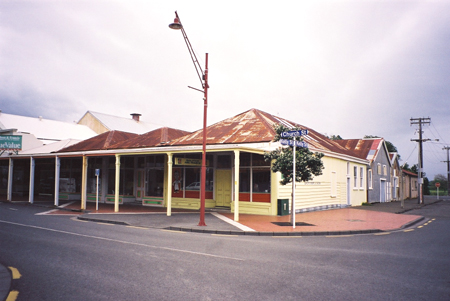
Photographs taken before 1906 show the timber store as being of single-storey residential proportions, with a hipped corrugated iron roof, a window in its northern side and a brick chimney towards the rear. The front of the building contained a large name board with lettering advertising 'Shalfoon Bros' and had a large canopy covering the pavement, supported on large timber posts. The canopy enabled passers-by to scrutinise goods displayed the large plate-glass windows in congenial conditions, while also protecting valuable products from the sun. To the rear of the store, there was a small gabled structure, possibly an office or outhouse, orientated east-west and apparently lying within a low-fenced yard. Land immediately to the south of the store on Church Street seems to have been vacant, although that to the west fronting Wharf Street (now Potts Avenue) was occupied by another store and several gabled warehouses. Surviving details in the ceiling of Shalfoon's shop indicates that it incorporated a large space at the front for commercial use and two private rooms at the rear, possibly utilised as a bedroom and kitchen/living area, divided by a central corridor.
Although George and Stephen Shalfoon's business started with a focus on drapery, it rapidly expanded into that of a general store. Generally subject to fierce competition, draperies were at the forefront of new retail techniques, expanding their range of wares firstly into furnishings and furniture, and subsequently into more general goods. Prior to May 1906 the shop was extended, presumably as the firm diversified, mirroring on a small scale the transformation of traditional specialist drapers into department stores, a development that occurred in big urban centres such as London during the second half of the nineteenth century. The emergence of such stores has been linked to the twin processes of industrialization and urbanization, with an expanding range of cheaper goods being supplied to larger populations. Imported ironmongery, crockery and groceries were sold at Shalfoon Brothers', as well as clothing, footwear and possibly their own furniture.
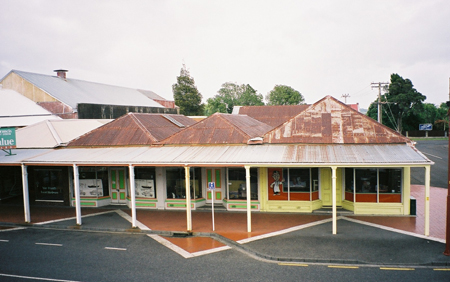
Modifications included the doubling of the shop frontage through the addition of a southern extension on Church Street, and the construction of a large gabled storage area fronting Kelly Street, adjoining the western side of the shops. New signage on the front of the building advertised Shalfoon Brothers as 'General Storekeepers', while also proclaiming 'Naumai' (welcome) in te reo Maori on the side facing Kelly Street. The latter looked out towards parts of the town traditionally associated with Maori, as well as in the direction from which travelers to Opotiki would have arrived via the Kelly Street wharf. Draperies were noted for their prominent approaches to advertising and other innovations in retail sale, a tradition followed by their department store successors..
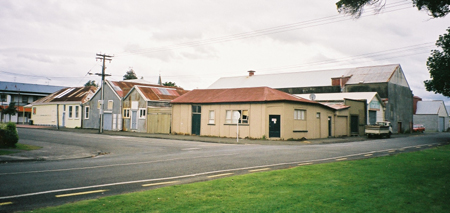
By 1915 the complex was further extended, doubling the shop frontage along Church Street yet again to a total of four bays. The complex now consisted of four shops selling different ranges of products, each with their own entrance but linked by an interconnecting passage. Large warehousing fronting Wharf Street (now Potts Avenue) was constructed, augmenting the store or workshop that had been previously built. A large firewall may have been erected around the property at the same time, enclosing a yard containing a possible cool room, and - later - a powder room for explosive materials. Expansion enabled the construction of an internal office at the back of the shops, next to the alleyway leading into the yard. These modifications are likely to have been created after 1912, when the northern part of Allotment 4 was purchased by George and Stephen Shalfoon. The additions are absent from a survey carried out in December 1913, suggesting a construction date in the following year.
Continued diversification of the business into the small town equivalent of a department store is not only reflected in the architecture of the shop buildings, but also in the expansion of Shalfoons' activities to incorporate the manufacture of timber furniture using kauri imported by boat from Kaitaia. This was sold to other shops as well as being retailed by Shalfoons. While it is unclear if their furniture-making began in 1906 or later, painted lettering spelling 'Shalfoon Bros Furniture Factory' on the back of the door of the pre-May 1906 storage building perhaps suggests the former. Other support for this date is that George's brother Anthony (1879?-1945) worked in Kaitaia prior to joining Shalfoon Brothers, evidently by early 1906. Charles Shalfoon also moved to Opotiki as the business expanded, although his shop in Auckland remained in his name until at least 1909. Both Anthony and Charles went on to found other draperies in Opotiki.
Early customers
Many of Shalfoon Brothers' customers were Maori, as indicated on the earliest surviving photographs of the store. George Shalfoon had himself married Raria (Mary) Hopa - who was descended from the six major hapu of Te Whakatohea, and notably Ngai Tamahaua - in 1904. They went on to have ten children. Patrons included the Tuhoe prophet Rua Kenana (1868/1869?-1937), who is said to have made regular trips with his wives to purchase supplies from Shalfoons. Rua was a follower of Te Kooti Arikirangi Te Turuki (?-1893), establishing his authority after Te Kooti's death through prophetic visions with the aim of gaining the redemption of land for Maori. Gaining numerous supporters of his own, Rua purchased goods in large quantities, presumably as part of his role as leader and provider, although it is said that he would not physically enter a shop because of his tapu. Other shopkeepers refer to him having wares taken into backyards for his inspection.
In 1906, Rua embarked on a pilgrimage with many of his supporters to Gisborne, where he prophesied that he would 'ascend the throne' and meet the king, Edward VII, thereby peacefully restoring authority to Maori. On 11 May, he passed through Opotiki with many of his followers, riding a white horse. A photograph of him on this journey shows him standing immediately outside Shalfoons' store, surrounded by a large gathering of supporters and approaching a policeman. Large cloths are draped in front of goods in the plate glass windows of the shop frontage. It is unknown if Rua stopped at Shalfoons to purchase goods on this occasion, although his followers may have expected food to have been provided during their travels.
George Shalfoon's relationship with his Maori customers was strengthened when he gained a Second Grade interpreter's licence in 1907 and a First Grade licence in 1914. This enabled him to formally translate deeds and other documents from English to te reo Maori and vice versa, prepare claims for old age pensions, and to act as an interpreter in courts of law including the Supreme Court, Magistrate's Court, Native Land Court and Native Appellate Court. A koruru-type carving with two tongues - currently held in the building - is believed to have been used to advertise his skills by being externally mounted on the Kelly Street façade, possibly on the apex of the warehouse. In 1916, Shalfoon is said to have been seconded as an interpreter to the police expedition sent into the Urewera Mountains to arrest Rua, following the latter's establishment of a City of God at Maungapohatu and the laying of charges against him for the illicit sale of alcohol. During his arrest on the marae, two of Rua's followers were killed, representing the worst clash between the police and a Maori community in twentieth-century history. Other interpreters appear to have been taken on the expedition.
George Shalfoon is also said to have been very friendly with the family of Sir Apirana Ngata (1874-1950). Ngata's father, Paratene, was an East Coast storekeeper and a Native Land Court assessor. Apirana Ngata himself was at the forefront of efforts to achieve social and economic reforms for Maori in the late nineteenth and early twentieth centuries, becoming a Member of Parliament in 1905 and Native Minister from 1928. The exact nature of the relationship between Shalfoon and the Ngata family is unclear. However, having similar commercial and other involvements in adjacent districts, Shalfoon and Paratene Nagata may have come into contact.
Subsequent history
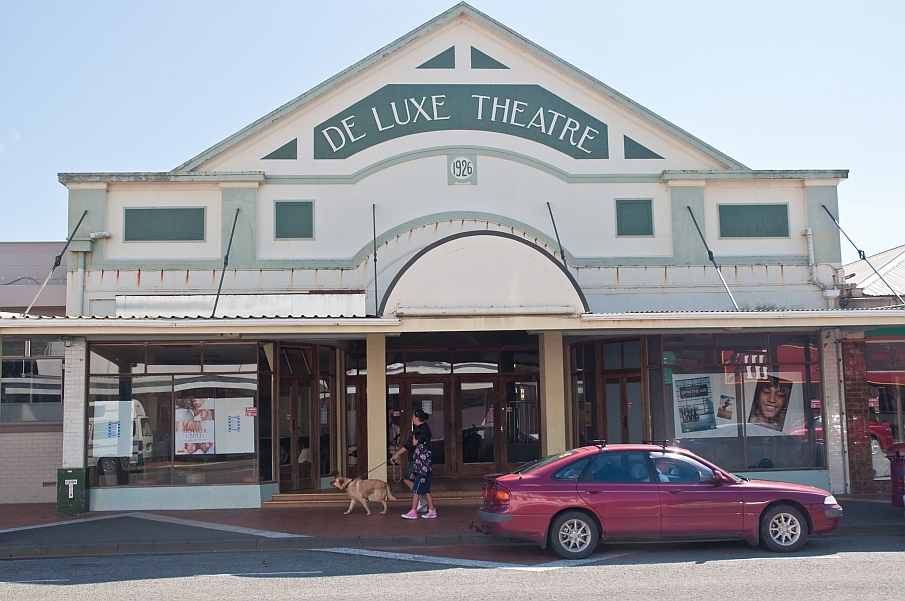
Imaginative steps were taken by Shalfoon Brothers to attract custom during and after the First World War (1914-1918). From about 1915, customers were brought in from the East Cape aboard the firm's own vessels - named Te Kaha and Tikirau - and were provided with free passage on the return leg on condition that they purchased goods at the store. The cousins also constructed the De Luxe Theatre (NZHPT Registration # 3498, Category II historic place) in 1926 immediately next door to their expanded store, which may have attracted additional custom both to the town and more specifically to their shops. The De Luxe subsequently formed one of the earliest cinemas in the Kerridge chain after being re-named the Regent.
Both developments may have been partly in response to the rise in motor transportation and the expansion of commercial activity in the southern part of the town, potentially drawing custom away from the shops. George and Stephen Shalfoon were active in local body politics at this time, with George being on the first borough council in 1911 and Stephen a borough councillor for many years until his death in 1943. Part of the borough's responsibilities involved maintaining the wharves, with the Kelly Street structure being upgraded in 1913. This broadly coincided with the Shalfoons' transportation venture and the expansion of their premises in 1914. It is likely that the frontage of the southernmost shop was remodeled in 1926, adopting a similar up-to-date style as the De Luxe Theatre frontage next door. Its more ornate features and larger windows, doors and display areas demonstrate an ever-increasing trend to entice customers into shops through favourable presentation, and also reflect the rising status of the southern end of the store, which lay closer to the newer commercial centre.
1926 also marked the last expansion of the shop complex, with the purchase of part of a secondary yard previously used by a neighbouring business, which was located immediately to the west on Kelly Street. A pre-existing timber building in this yard appears to have been adopted as an additional warehouse or workshop.
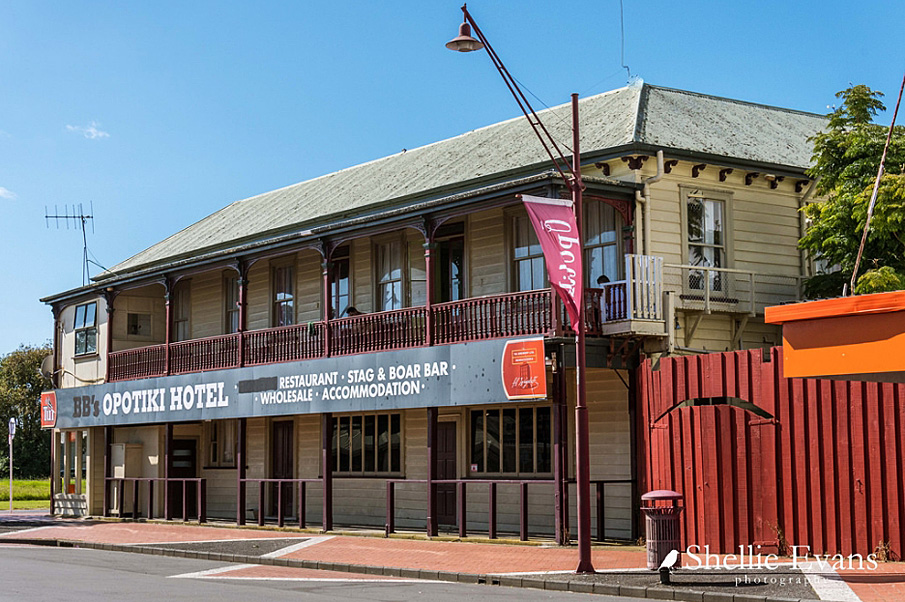
Apart from the first generation of Shalfoons, other family members to work in the store included George's eldest son Gareeb (Epi) Shalfoon (1904-1953), before he became a nationally renowned musician with his band the Melody Boys. The earliest filmed music promotion in New Zealand - made in 1930 - featured Epi Shalfoon and his band, with the soundtrack also being considered the earliest recording of jazz in the country. Epi was an executive member of the Auckland Musician's Union from 1939-1948, continuing to perform until his death in Auckland in 1953. In the same year that the De Luxe Theatre opened (1926), he married Yvonne Hawkins, whose family owned the Opotiki Hotel (NZHPT Registration # 3499, Category II historic place), immediately opposite the store. Epi also ran a music shop inside the De Luxe for a period.
In 1937, following the Great Depression, the Shalfoon Brothers' business was transferred to George Shalfoon junior (1916?-2002) and Edward Francis, who were respectively a nephew and nephew-in-law of the original owners. Renamed Shalfoon and Francis, the business' changing clientele included dairy farmers and, later, kiwifruit growers. The business expanded to incorporate several dairy farms between Opotiki and Waimana, while the shop sold ploughs and other agricultural goods as well as more conventional products. Partly because of its size and mixture of clientele - including customers from out of town - the shop was a popular place to gather and to exchange conversation, making it an important informal meeting place in the community. Workshops were used to repair items inside some of the warehouses, with extensive areas of timber benching created for such purposes. Chalk graffiti dating to 1936 survives in one of these areas, depicting 'Popeye the Sailor', a popular cartoon character of the time noted for his physical strength.
Shalfoon and Francis retained many fixtures and fittings in the shops installed by their predecessors, including long kauri counters and floor to ceiling timber shelves decorated with matching egg and dart decoration, said to have been created when Shalfoon Brothers established their furniture business in the early 1900s. These were rearranged and modified when fibrolite panelling was installed, possibly in the 1940s or 1950s, and affixed less systematically. Other items were retained, including a 1920s cash register, an 'in-out' board advising of George and Stephen Shalfoon's movements. Shalfoon and Francis also purchased more up-to-date items such as a Ford V8 delivery truck in 1938, which was still being used for deliveries in 1974.
With the eventual closing of their furniture factory, the drapery and furnishing departments were removed, although the store continued to stock a broad range of otherwise similar items. In 1959, the shore was divided up into a grocer's at its northern end, an ironmongery in the central two shops, and a furniture, kitchen goods and gifts department at its southern end. In the 1980s, it still held products such as sulphur, copper sulphate and red lead powder, sold in bulk or small amounts, as well as rope pulled out of holes in the kauri benches, oakum for caulking ships, horseshoes in various sizes and numerous other goods. The office created in 1914 continued to be used by George Shalfoon jnr, who kept large quantities of paperwork linked to the business, including ledgers and a stocktake dating back to February 1938, which is when he may have formally taken over the store. Personal items such as photographs, his certificate of service in the Second World War (1939-1945), and grocer's aprons were also held there. A second office may have been created in the 1930s or 1940s, and was later used by secretarial staff. This held further papers and items linked to the organisation of the business, including an early Remington typewriter, with the doorway to this office incorporating a counter for the payment of bills.
The shops operated commercially until 2000, when George Shalfoon jnr retired at the age of 84. The property and its large number of chattels were subsequently acquired by the Opotiki Heritage and Agricultural Society (OHAS) for use as a museum. The purchased chattels mostly remain in the building - those in the main office essentially undisturbed - while OHAS has brought in other material while a new museum building is being constructed. Members of the public have access to the interior during volunteer opening hours.
The building has twice been affected by flooding, once in 1918 and again in 1964.