The town of Stratford lies at the base of the eastern slopes of Taranaki Maunga, also known to Māori as Pukehaupapa or Pukeonaki. Traditions tell of the mountain’s defeat by Tongariro in a competition to win the beautiful Pīhanga’s heart, and retreat from the central North Island to its present location, carving the Whanganui River in its trail. Taranaki Maunga is of immense cultural and spiritual significance to the iwi of the region.
Stratford is located in an area that has a particular association with Ngāti Ruanui, whose ancestor Ruanui’s grandfather Turi landed with his people in the Aotea waka. They settled at the mouth of the Pātea River, which runs through Stratford on its journey south from the maunga. The western half of Stratford town is overlapped by the rohe of Ngāruahine, who share ancestry with those who came on the Aotea and Te Rangiamutu waka. The rohe of Ngāti Maru extends from inland Taranaki across the northern part of the town. Ngāti Maru trace their origins to Maruiwi of the original tangata whenua people, and Maruwharanui, whose ancestors arrived on the Aotea and Tainui waka.
Previously thickly forested, there is little evidence of permanent Māori settlements in the vicinity of Stratford, although the area was traversed by many tribes. A few kilometres east of the future town site ran the Taranaki region’s most prominent north-south pathway, used for centuries. This was known as the Whakaahurangi track, named from Ngāti Ruanui chieftainess Ruaputahanga’s mid-sixteenth century journey back to her South Taranaki home as she fled unhappy marriages. She followed an old war-trail south, and camped for the night near modern Stratford, where her party observed that she slept on her back: ‘whaka-ahurangi’ means ‘facing the heavens’. Another tradition relates the name to her looking at the sky when snaring ducks. Today this connection is remembered through the name of Stratford’s Whakaahurangi Marae, established in the 1970s by the Ahitahi hapū of Ngāti Ruanui.
In 1842 agents of the New Zealand Company cut a bridle path along the Whakaahurangi track, to connect the fledgling colonial settlements of New Plymouth, Wanganui and Wellington. Major General Trevor Chute’s imperial forces also travelled along this route on their infamous ‘forest march’ in 1866. Tensions between Māori and Europeans had been simmering in the region since the establishment of New Plymouth in 1842 put pressure on Māori to sell their land. Outright war between the Crown and Te Ātiawa erupted in March 1860. Taranaki Māori joined Te Ātiawa in defending Māori land, and fierce fighting occurred around the region, including Chute’s devastating ‘scorched earth’ campaign of retaliation in South Taranaki.
In 1863 the Crown enacted the New Zealand Settlements Act, allowing for the confiscation of Māori land without compensation. Three confiscation districts which covered most of Taranaki were created, formalising colonial encroachments despite continued fighting. Stratford would lie within Confiscation District 2, the Ngatiawa district. Although tensions lasted into the 1870s, the colonial government took control of the province, negotiated cession of the Waipuku-Patea Block from the Ahitahi hapū, and in 1874 vested the land around Stratford with the Taranaki Waste Lands Board for distribution.
Early Stratford
From 1873 improved transport links, and Julius Vogel’s public works and assisted immigration scheme helped attract more settlers. In June 1877, the Taranaki Waste Lands Board ordered the survey of 600 acres of bush for a town at the Mountain Road’s junction with the Pātea River, to service the growing agricultural community. The name ‘Stratford-upon-Patea’ was suggested by Board member William Crompton - a fan of English poets - and many of the streets were named after Shakespearean characters.
In October 1878 the first permanent building on Broadway (the main north-south thoroughfare through the town centre) was built. The railway reached Stratford in 1879, and the town’s population grew. Stratford’s first boom was during the 1890s, when ‘the population increased almost six-fold, and new buildings and businesses mushroomed’. Photos from the turn of the twentieth century show a streetscape of predominantly timber Victorian buildings. Stratford’s commercial and public building stock began to transform to masonry in the 1910s, as export commodity prices boomed during the First World War. This overall period of growth for Stratford was due to its steadily increasing population, its rail junction being a hub for the regional economy, technological advances that increased farm productivity, and a program of civic improvements that boosted local confidence.
Entertaining the population
Public entertainment in Stratford took a leap forward when the first Town Hall – also a performance venue – opened in 1884. A lively culture of performing arts including theatre, music, storytelling and illustrated lectures had developed in colonial New Zealand since the early 1840s. The exhibition of projected moving pictures was added to recreational options after the first public screenings using the ‘kinematograph’ in 1896. Travelling exhibitors regularly toured the country with projectors and screens, setting up in local halls.
By 1910 ‘picture shows’ were prominent around the country and had moved from being an item in a programme of otherwise live performance to events in their own right. While theatres and halls were still used for movie screenings, the first purpose-built ‘picture house’ - Wellington’s King’s Theatre (1910) - heralded a new age of cinema-going in Aotearoa.
Garnet Saunders is credited with first bringing silent movies to Stratford in 1910, and soon three companies were screening regular picture shows there. Venues included the Town Hall, and particularly His Majesty’s Theatre on Broadway, which made movies the focus of its programme from 1911. However, both buildings had been adapted for the purpose. His Majesty’s Theatre was reportedly built as stables, and when the ‘cinema operating box’ was removed from the Town Hall in May 1914 the restoration of the Dress Circle to its ‘normal appearance’ was celebrated by those who had considered the addition a ‘hideous eyesore’.
The King’s Theatre
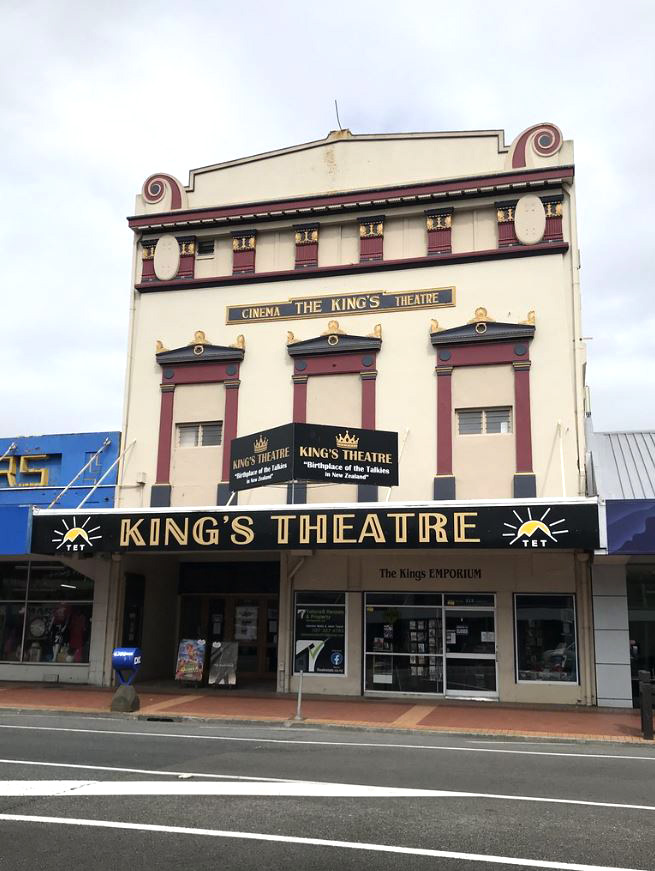
A purpose-built, modern ‘cinema house’ was required, and so on 27 June 1916 a group of businessmen met with that purpose in mind. Stratford Pictures and Amusements Ltd (SPA) was formed, and immediately made arrangements ‘for the erection of an up-to-date picture theatre to be commenced at once’. They purchased and cleared a site on central Broadway.
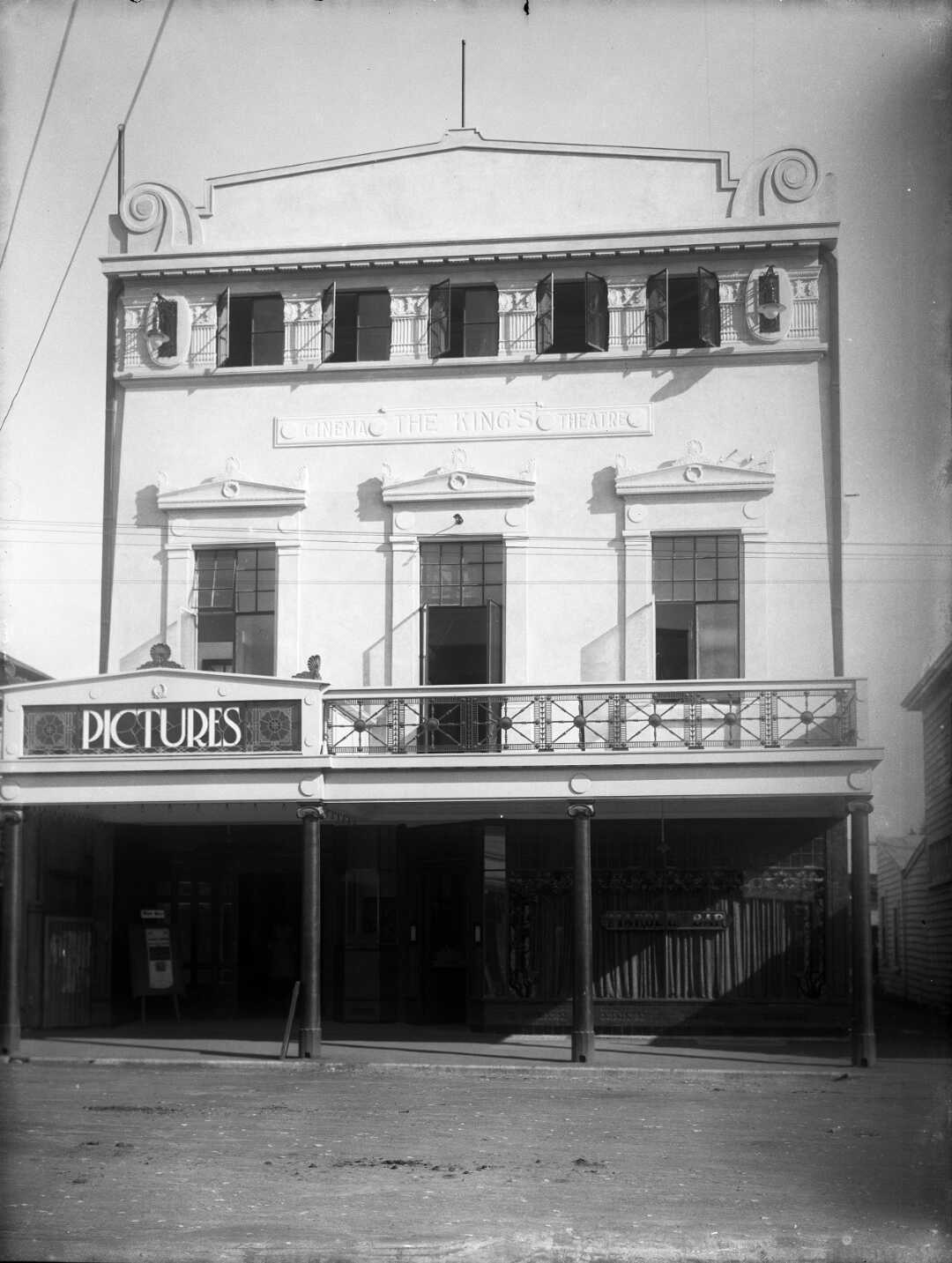
Auckland architects Grierson and Aimer were commissioned to design the new picture house. They had recently completed the ‘Everybody’s Theatre’ (the Mayfair) in New Plymouth, but would become most celebrated for the Auckland War Memorial Museum. Familiar with the special requirements for cinema design, at The King’s Theatre they provided a screened compartment for the orchestra in the front of the pit and sited the projection box in the centre of the theatre seating (rather than the extreme rear), to improve projection quality.
Grierson and Aimer called for construction tenders on 16 December 1916, and the main contract was awarded to Auckland firm Johns and Son for £7134. ‘The King’s Theatre’ was decided as the name by April 1917, and the press reported construction milestones as anticipation for the new theatre grew. Despite ‘many unforeseen difficulties, largely due to war conditions [placing] obstacles in the way of the completion of the work’, a New Years’ Eve grand opening was scheduled. Not the least obstacle would have been both the architects’ involvement in active military service, so Mr G.S. Goldsboro supervised the project’s finish.
On 31 December 1917 Stratford turned out in force to celebrate the cinema’s opening, with all proceeds donated to the Wounded Soldiers’ Fund. The building’s architectural prominence, ferro-concrete construction and ‘artistic’ furnishings were lauded, while the concealed interior lighting, plaster screen, tip-up raked seating, ventilation and inset radiator heating were considered thoroughly modern. Many of the 720 seats were filled with patrons who enjoyed the inaugural programme of Cactus Nell and Madcap Madge (‘a sparkler, written round the doings of the most unruly minx ever caught by the camera’), and the Stratford Municipal Band’s balcony performance.
Musical accompaniment for the silent features required skill and immense agility to provide unrehearsed sound. The orchestra was usually a handful of musicians playing the piano, violin, cello, woodwind and drums. The orchestra leader had music available for all scenarios and often made the music selection just from reading a synopsis of the film’s plot, as time did not allow for a pre-run of each show. Talented percussionists used a large kit (including a pistol that fired blanks) to provide on-the-spot sound effects.
In the shopfront adjoining the theatre’s street entrance, the Marble Bar refreshment room opened a week later to cater for cinema patrons and the general public. Marble Bars were a trend that became popular in Aotearoa in the 1910s, serving ‘the latest Americanised refreshments’. Stratford’s featured two service counters and modern conveniences including an underground plant for the manufacture of ice creams, an automatic soda dispenser, water filter, and dishwasher.
Grierson & Aimer’s 1917 design places the building as a reasonably modest and early example of a ‘picture palace’ in historian Nerida Campbell’s analysis of New Zealand cinema design. An architectural phase that flourished in the mid-1920s, ‘picture palaces’ feature distinctive architecture and dining/lounge areas to enhance the experience of ‘going out’; creating ‘a complete entertainment environment in which patrons were effectively transported beyond the burdens of everyday life.’ This moved beyond the simple ‘embellished hall for entertainment’ of first-phase (1910-1916) purpose-built movie theatres.
The King’s Theatre makes history: sound film
In late 1924 The King’s Theatre hosted a milestone in Aotearoa cinema history, being the first place where New Zealanders’ experienced ‘talkies’ (movies with synchronised soundtracks technologically coupled to the film). Chairman of SPA, former mayor William P. Kirkwood, was a future-focused individual who had kept an eye on international developments in cinema-sound technology. After enquiries in England, the United States and Europe, Kirkwood elected to back Dr Lee De Forest’s ‘Phonofilm’ system. De Forest’s method recorded sound vibrations as light waves at the side of the same strip of film as the photographic action, solving the synchronisation issues of earlier gramophone-accompanied techniques. Kirkwood purchased the Australasian rights to Phonofilm in July 1924, and in late December the test equipment arrived in Stratford.
On the morning of 30 December 1924 a group witnessed the first trial and marvelled at short films of a xylophone performance and a man speaking about De Forest’s invention. Screenings to larger invited groups were held on 16 and 23 January, and 2 and 16 February 1925, where they enjoyed a performance of a singing dog among other clips. Kirkwood then toured the equipment for demonstrations in Wellington, Dunedin and Australia. Fully public demonstrations were held at The King’s Theatre the following year, in late March 1926.
It took some years, however, until The King’s Theatre was ready for regular commercial screenings of ‘talkies’. The movie production industry had to adopt and refine the technology. And the cinema building had to be adapted: its poor acoustic performance had been noted at the first De Forest demonstrations. Walls were padded and thick felted curtains hung to reduce echoes. A new perforated screen was built, with a sound-tower behind; and the operating box was enlarged for the new equipment. The cinema was redecorated to match the new blue and gold drapery, and the façade refurbished to look its best under new floodlighting. And the Western Electric sound system, which arrived in 40 cases, was installed over a week in early November 1929.
On 9 November 1929 regular ‘talkies’ kicked off. The impact of ‘talkies’ was demonstrated by a huge jump in the cinema’s annual takings: from £5423 in 1929, to £8281 in 1930. While Wellington’s Paramount Theatre was New Zealand’s first cinema to commercially screen talkies (from March 1929), Ngā Taonga Sound & Vision has acknowledged Stratford’s King’s Theatre as the location of the first operation of the technology in Australasia, four years earlier.
Decades of entertainment
By the 1950s, apart from a month’s closure during the 1918 influenza pandemic, the cinema had operated continuously, including during World War Two when it was an important conduit for news. Events such as 1927’s Paramount Week competition, the donation of tickets to the unemployed during the 1930s Depression, and the filming and screening of local Stratford events in a Kings Cinema Review segment on Saturday nights ‘made people feel like the cinema was theirs.’
Unfortunately, the building was showing signs of age. Water damage caused small chunks of plaster from the decorative ceiling to fall on some patrons, and the Stratford Borough Council closed the building for repairs during 1950-1951. Much of the ornate Carrara plasterwork was removed from the auditorium during these works, including the replacement of the two ceiling domes with a solid plaster ceiling.
The 1950s also saw a change of ownership. Stratford had two cinemas by this time. The Plaza had been built in 1934 by Stratford Theatres Ltd, a company directed by notable Wellington theatre owner William Kemball. Stratford Theatres Ltd also took over The King’s Theatre lease in 1934, and staff were shared between the two cinemas. In 1943 Kemball sold his theatre chain to cinema mogul Robert Kerridge, hence Kerridge first became associated with The King’s. Kerridge formed Kerridge-Odeon in 1948, by which time he controlled 70 percent of Aotearoa’s cinema industry, owning 130 movie theatres plus companies controlling film distribution, equipment and confectionary retail. By 1960 SPA’s finances were suffering. The King’s Theatre was sold to Kerridge’s Fullers Theatre Corporation in 1961 and Stratford Pictures and Amusements was wound up.
Changing times for cinemas
1953 was one of the peak years for New Zealand cinemas, with 589 movie theatres serving a population of 2 million. However, the rise of television in the 1960s drastically affected cinema attendance. The average person went to the movies 19.3 times a year in 1950, but only 4.6 times a year by 1970, the year after state broadcasting had commenced. The Plaza closed down in 1967, and the King’s Theatre, by this time a run-down B-movie theatre colloquially known as ‘the Bughouse’, may have also temporarily closed down around this time.
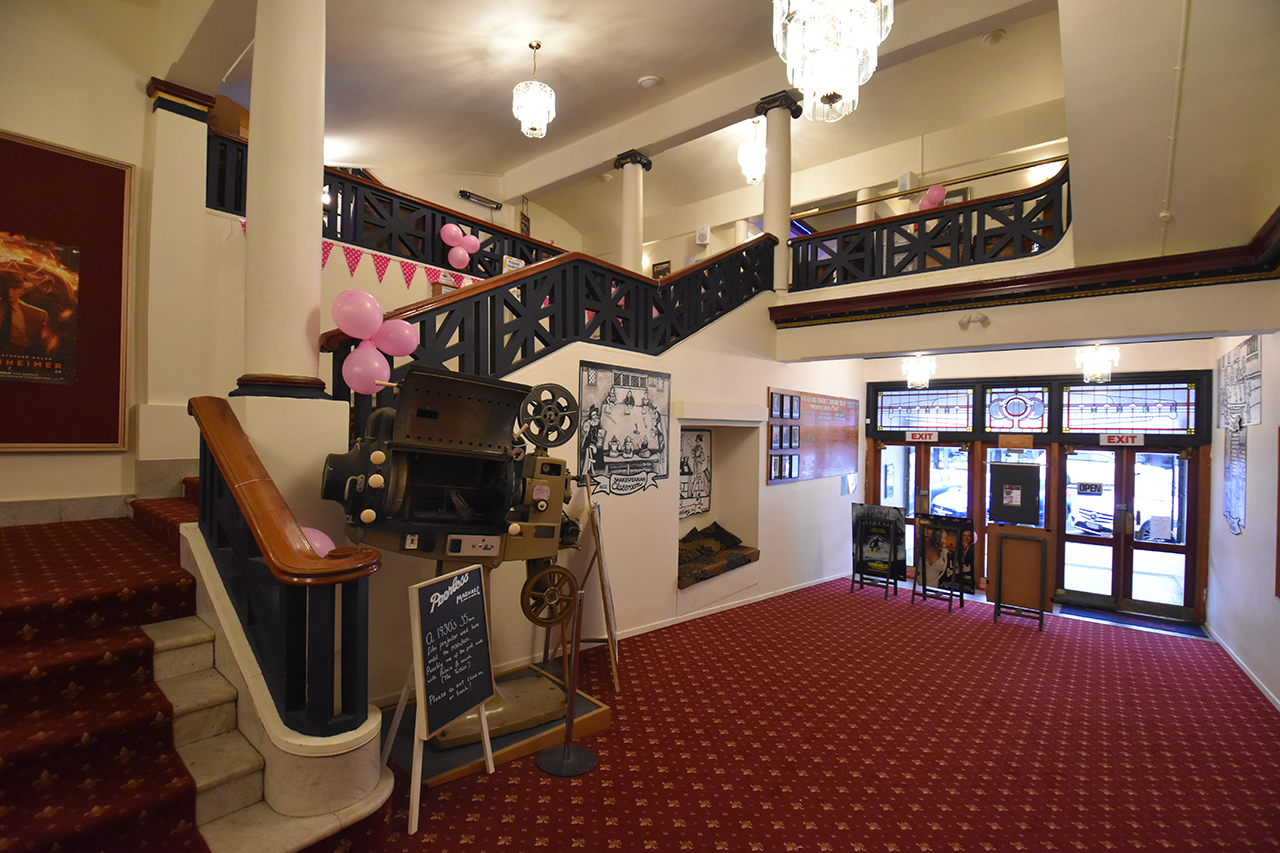
Nevertheless, Kerridge-Odeon fought the tides with a major ‘modernisation’ of the King’s Theatre in the late 1960s. Architects Rigby Mullan converted the two tiers of seating to a single ‘stadium-style’ sloping floor with 320 seats – halving the number of staff needed. The solid marble entrance staircase was covered with carpeting, and the ‘union jack’ balustrading was enclosed in plain board panelling (apparently to preserve the modesty of mini-skirt wearers). Other changes alluded to by the mayor in his official reopening speech on 7 November 1969, included reroofing, and alterations to the entrance, proscenium and screen, and mezzanine/toilet facilities. The renovated cinema was rebranded ‘The Regent’.
Business continued, albeit more quietly than in its heyday, until the mid-1980s. From 1974-1986 it was managed with flair by Gwelfa Burgess (1925-2019), recognised as one of the longest serving ushers in New Zealand cinemas, who worked in to her 80s. The sense of community Gwelfa and her team created throughout this period of stability was boosted by the theatre’s popular resident cat, Precious Kerridge. By 1986, however, attendances had fallen again and the Regent had been running at a loss for some time. The cinema was finally forced to close in January 1988, and the projection equipment was moved to Whakatane.
A new era: the rescue of The King’s Theatre
Two years later, Stratford’s Shakespearean connection would prove a lifesaver for the building. The town had long shown pride in its relationship to William Shakespeare’s birthplace and works through its active relationships with other Stratfords of the World, and its regular Shakespeare performances and competitions. May 1990’s successful Shakespeare Festival sparked motivation for the town to have a theatre once again to serve its resurgent performing arts community, led by the Stratford Shakespeare Society and Stratford Theatre Group.
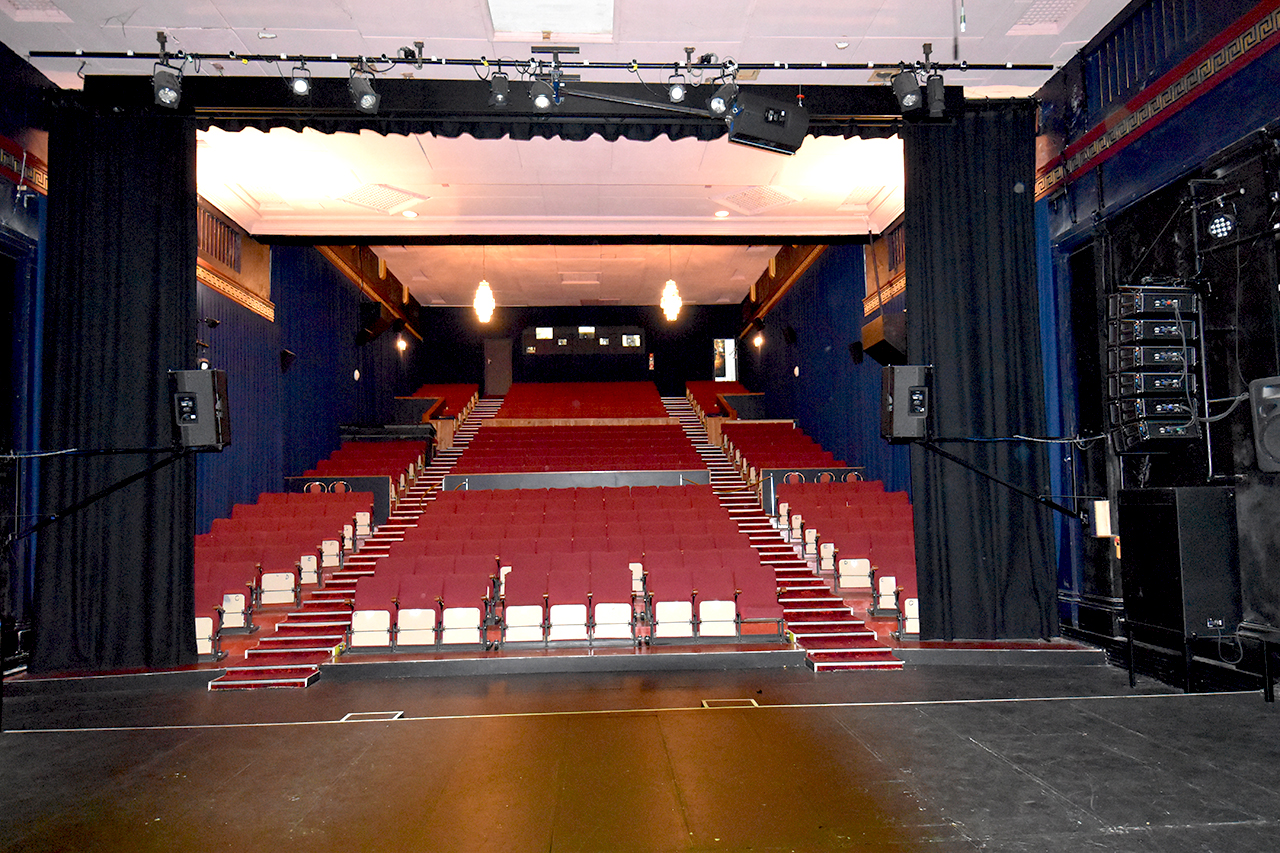
The Stratford District Theatre Trust formed in 1991 to purchase the neglected cinema and convert it into a multi-purpose venue. A four-stage restoration plan was devised. Fundraising events, sponsorships and grants from many individuals and businesses, including rates assistance from Stratford District Council, achieved the Stage 1 aim of opening the theatre for its first live performance (Worzel Gummidge) in November 1991. The following January, the projectors were retrieved from Whakatane and movie screenings recommenced. Stage 2 afforded the extension of the stage and orchestra pit for live performances, and improved dressing rooms.
Public response was overwhelmingly positive. In its first full year of use, 20,000 patrons came through the doors: twice the population of the Stratford district. Corporate sponsorship and grants in 1992 from Petrocorp, the TSB Community Trust, Taranaki Electricity Trust and NZ Lotteries Commission allowed for Stage 3’s facilities upgrades. Dame Malvina Major and the Ars Nova Choir praised the now world-class acoustic properties of the auditorium after their November performance. The next few years saw further improvements including restoration of the decorative ‘union jack’ balustrades, installation of a new sound system, upgrade of cinema equipment, and refurbishment of foyers, mezzanine, and auditorium. 2000 saw a further name change to honour the Taranaki Electricity Trust’s corporate sponsorship.
The cinema now screens a mix of mainstream and arthouse films, and hosts live events, including distinguished performers Sir Dave Dobbyn and Sir Ian McKellen. It was a principal venue in 2023’s revived Shakespeare Festival. The King’s also provides education about film history through film club patronage and tours of its own Film and Equipment Archive, which includes news reels and historical footage of local events, and examples of early camera/projection technology. Locals with an interest are welcomed to learn hands-on about the operation and maintenance of this historic equipment.
The building and equipment require regular maintenance and upgrades. Funding is innovatively sourced by the Stratford District Theatre Trust committee, including the successful fundraising book shop, The King’s Emporium, opened in the 2010s in the former Marble Bar. The theatre’s snack bar, with lollies bagged by volunteers in the evenings, contributes revenue. Like many of Aotearoa’s masonry buildings from the time period, the building has been found to be potentially earthquake prone. Evolving structural strengthening requirements remain a challenge.
Currently (2023), the only paid staff member is a part-timer who organises the film programming. All other roles are filled by a cast of around 30 volunteers on behalf of the community, and a ‘Roll of Honours’ board of numerous donors and sponsors in the foyer demonstrates how the community has responded in kind. Former staff stay in touch, and a ‘grand reunion’ in 1993 gathered around fifty former employees, including an orchestra member from the silent-movie era. Connections continue to be made through patronage by local theatre, music and dance groups, and district schools as it is the Taranaki venue for the annual SGCNZ University of Otago Sheilah Winn Shakespeare Festival. A documentary on the theatre, filmed in July 2023 noted: ‘Talking to people we realise just how big a part of people’s lives [the King’s Theatre] has played over the years’. Over 100 submitters to the New Zealand Heritage List/Rārangi Kōrero proposal provided further evidence of how cherished the theatre is. Common sentiments were their pride in a rare and special historic theatre, fond memories as audience, staff or cast/crew members, and appreciation of the palpable atmosphere that decades of positive experiences have imbued in the building.