Early Napier
Māori settled in the Hawke’s Bay area relatively early in New Zealand’s history. Settlement would have been encouraged by food sources which were plentiful both inland, in the lagoon, and along the coast. Whatumamoa, Rangitāne, Ngāti Awa and Ngāi Tara became established in the areas of Pētane, Te Whanganui-a-Orotū and Waiohiki. From the 16th century these iwi were displaced by Ngāti Kahungunu, whose influence eventually spread from Poverty Bay to as far south as Wellington. In the 1840s and 50s contact between these iwi and Europeans was limited to the whalers, missionaries and itinerant traders who plied their trade along the coast, but in 1851 a key land deal was struck. The Ahuriri Purchase was negotiated by Land Commissioner Donald McLean on behalf of the Crown. It was followed by other smaller land purchases in the area. Europeans settled in the region to grow crops and farm animals and the township of Napier was founded in 1855. Other land in the area changed hands and by 1859, the Crown had purchased an estimated 1,404,700 acres (568,462 hectares) of land from iwi in the area.
Napier, in its early days, was an area nearly entirely surrounded by swamp and sea. It was described as ‘a precipitous island of barren, uninhabited ridges, covered with fern and rough grass, dissected by gorges and ravines, with a narrow strip of shingle skirting the cliffs, and joined to the mainland south by a five mile shingle bank… A hopeless spot for a town site’. Despite this inauspicious assessment, Napier developed to become a busy port town servicing the Hawke’s Bay area and exporting meat, wool and dairy from those working the land. Napier grew steadily to become the administrative, commercial, and social hub for the area. It formally changed its status from borough to city in 1950 when its population hit 20,000.
Victorian Napier
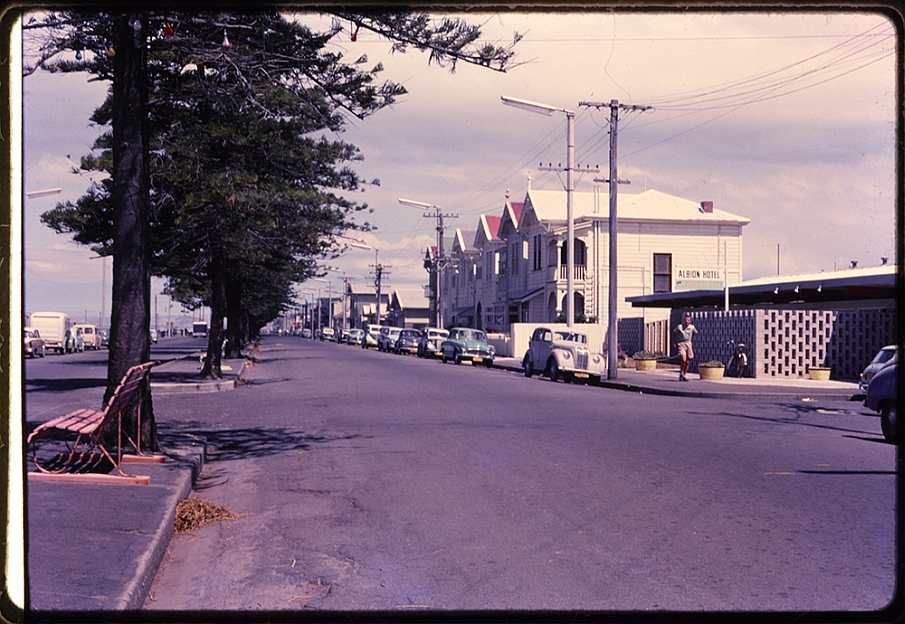
As Napier prospered, Marine Parade (originally called Beach Road) became a feature of its waterfront. The township was threatened by encroaching waves during bad weather; in 1877 the Napier Municipal Council began the construction of a seawall to address the problem, with variable success. Yet Mayor George Swan (1833-1913) described a vision he had for the Marine Parade – that of a ‘grand esplanade’ inspired by the promenades of iconic British seaside towns. To this end, he had Norfolk pines planted along the foreshore, footpaths built and a band rotunda constructed. His vision for Marine Parade required a solid seawall to eventuate and in 1888 the problem of the inadequacies of the seawall was again before the council. Eventually further sections of a new seawall (List No. 1164) were undertaken, with a concrete parapet above the road level, constructed with prison labour. The final section was finished in 1892 and allowed further development along the foreshore.
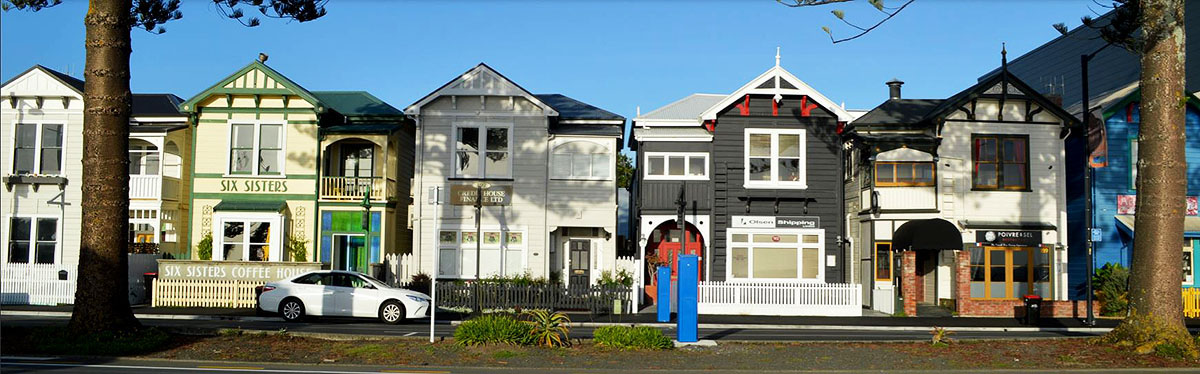
It is widely believed that the Six Sisters were built to a design by architect Robert Lamb. English born Lamb arrived in Napier in 1879, seeking a temperate climate to improve his ill-health. A versatile architect, he designed a wide range of buildings, influenced by Gothic Revival style. He turned his hand to country homesteads, community halls, churches and townhouses, including Balquhidder House for Captain McGregor, Tintagel for JD Ormond, St Patrick’s Roman Catholic Church, and renovations to Ben Lomond House. Lamb, like Swan, had ‘a bold scheme’ for development of the Marine Parade. A drawing by Lamb in 1889 expresses his vision for the development of Marine Parade. Lamb designed a group of Victorian villas on Marine Parade, which later became known as the Six Sisters, the year before his death in 1895, and the start of the construction to his design probably began a year or two after that.
The popularity of villas as a design choice in urban centres between 1895 and 1910 was not only because they were fashionable, but also because they met the needs of New Zealand’s speculative builders and developers. They were usually single storey detached buildings constructed in native timbers built in groups to the same design, closely spaced and located on narrow sites. Typical characteristics include front verandas, high ceilings, sash windows, wide hallways and a lean-to extension at the rear for kitchen, scullery and laundry. There were numerous variations of plans for villas in New Zealand, some being constructed using pattern books and others were designed by architects. Even for those timber houses built between the 1860s and 1910 which did not share an identical plan, the designs were similar as, for timber villas, ‘the recipe remained basically the same’.
Six Sisters
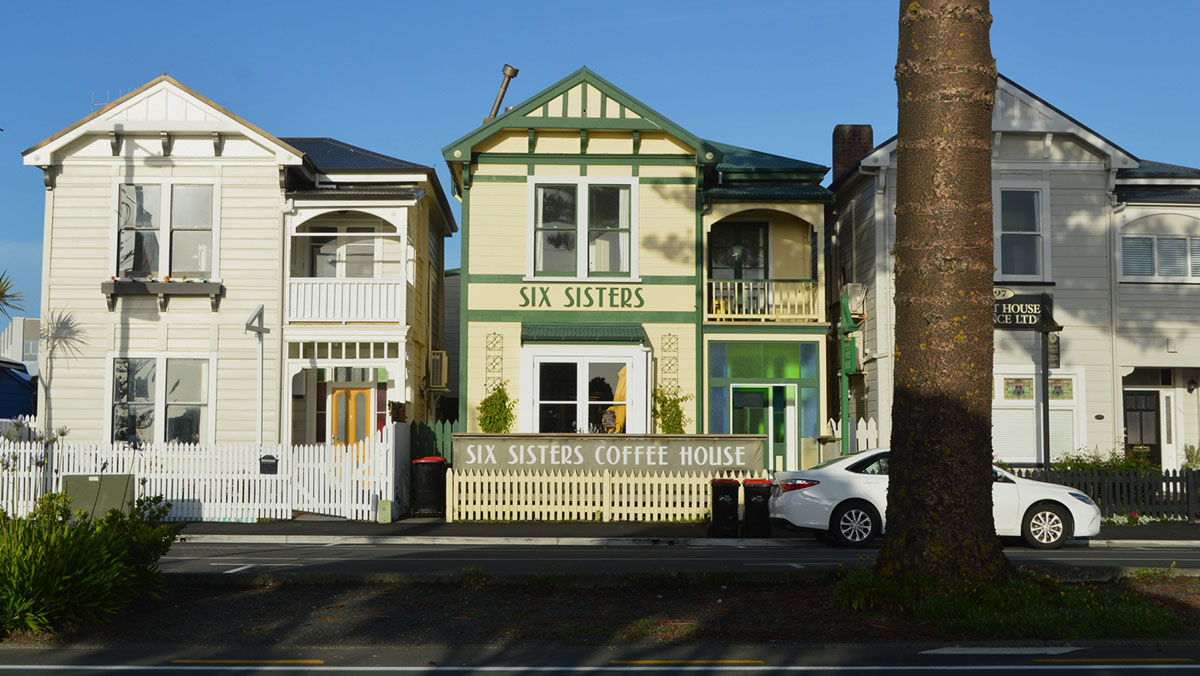
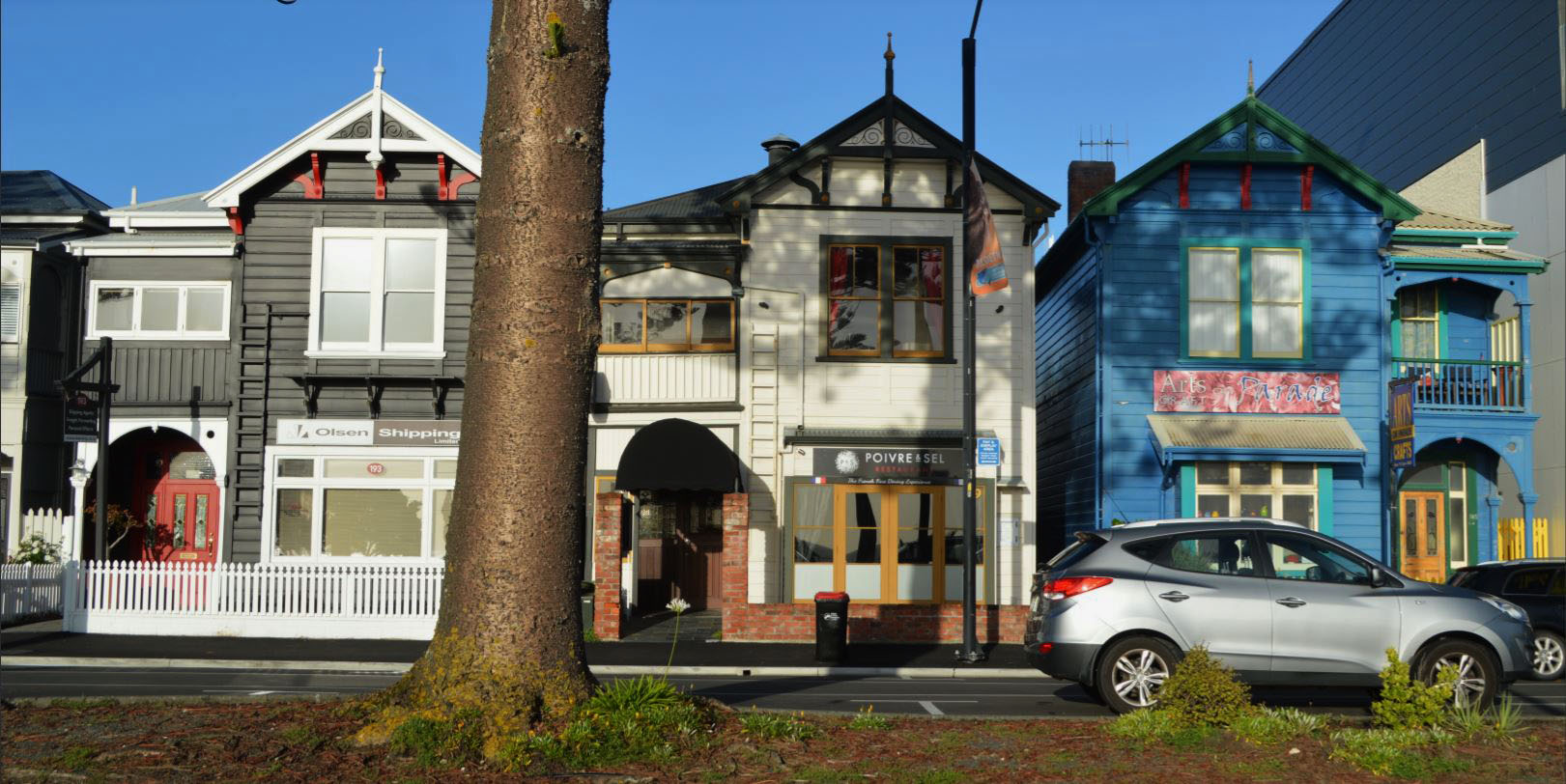
The Six Sisters were constructed to the same plan and look very similar. Some of the differences visible today were part of the original plan and others were later modifications. For two of the houses – 193 Marine Parade and 189 Marine Parade – the plan was identical but reversed. Robert Lamb’s great-granddaughter Eleanor Holmes explains that the Six Sisters were built in two groups, the first probably in the early 1900s. Later changes were made to the entranceways, several verandas were enclosed, fencing added and colour schemes chosen. While obviously a set, these differences make each building unique within the group.
In New Zealand the design of the villa reflected their owners’ ‘social position and material achievement’. The Six Sisters were sometimes occupied by owners, but many housed tenants. The Wises New Zealand Post Office Directories record the panoply of predominantly working class occupants. From the 1910s and 1920s occupants included clerk Samuel Sharp, engineer Isaac Fisk, nurses Isabella Campbell and Lottie Donald, a government inspector of machinery William Douglas, photographer Leslie Deighton and motorman Boyd Mitchell. By the 1930s the occupants included warehouseman Claude Lodge, packer Jason Lock, labourer William Adams and carpenter Aubrey Crabtree. At the southernmost building (now known as 205 Marine Parade), Minnie Plunkett operated a small boarding house for at least 20 years though the 1940s and 1950s, during which time other occupants included French furniture polisher Arthur Stowell, pastry chef Jason Campbell, barman Donald Seaton and hairdresser Leila Mellor. Throughout there was a number of widows, an early example being Mrs Bridget Johnson in 1915.
The Howse family at 201 Marine Parade were also residents of note. David Howse, a company manager, and his wife Mary’s home gained an international connection when it became the ‘unofficial embassy’ of Pitcairn Island in New Zealand. Their son, Murray Howse, worked as a schoolmaster on Pitcairn Island between 1959 and 1962. He returned to the island again with his wife Rita, their three children and an archaeological team led by Peter Gathercole from 1963 to 1964. The connection of Number 201 Marine Parade to the island continued throughout this period and ended in the early 1980s when the Howse family moved away.
The properties were all designed as residential homes, but in the 1980s and through into the 1990s there was a marked transition from residential to commercial use. This included the opening at various times of art galleries, a property management company, an arts collective, a financial service provider, souvenir shops and, at 189 Marine Parade, a succession of restaurants from Pickwick’s to Poivre et Sel. The upstairs space of these ventures was frequently used as modest flats which accommodated the operators of a business below. They reconfigured the ground floor space by removing walls to open up a central space suitable for commercial use. The demolition of the rear lean-to was undertaken on most of the properties and new rear extensions were added. In just one example, ‘Gemini’ opened at 189 Marine Parade in 1982, selling souvenirs, handicrafts and memorabilia to tourists meandering along the foreshore. This change to commercial use was invigorated by the growth of Napier and the houses’ proximity to the city’s commercial centre and location on the waterfront promenade.
The regard for and location of these buildings has made them desirable real estate, lending prestige to the businesses within. At 193 Marine Parade major changes were undertaken by the owners to convert the building from residential accommodation to office space. Olsen Shipping Limited, like the building, had its origins in the late 1800s, shipping cargo from the Port of Napier to destinations around the globe. In 1999 they chose this building for their head office as they believed that the building could positively reflect the stature of their company. Proximity to the port was also an advantage, as was the upstairs level which provided a lookout of the sea view enabling staff to see ships approaching and departing from the port. In 2000 the company converted both levels of the building to purpose-built office space. They removed the rear kitchen and washhouse entirely and replaced them with a major new extension designed by Stuart Angus Associates. This addition doubled the footprint of the ground level of the building. Olsen Shipping have been able to create a space that takes advantage of the prestige of the building’s original design and front elevation, but put it to use as a functional and modern office space.
In 1984 architectural firm Hoogerbrug, Magdalinos & Williams opened its doors at 205 Marine Parade. They painted the building’s exterior a bold green with blue and pale yellow trim, the interior with bright primary colours and furnished it with ‘modern linear furniture’. Originally they formed a partnership between Dutch-born Len Hoogerburg, structural engineer Bruce Williams and Paris Magdalinos, but by 1989 Magdalinos was practicing independently. A charismatic architect and believed to be New Zealand’s first of Greek descent, Magdalinos arrived here as a refugee in 1953. He trained at Auckland University and went on to specialise in local large-scale commercial and top-end residential projects, carrying out his work with ‘vision, zeal and inimitable flair’. In 1990 he received national acclaim when he was awarded the New Zealand Institute of Architects Award of Honour for his ‘outstanding contribution and dedicated service to the profession’. In 2002 Magdalinos moved his architectural practice to new premises at 93 Station Street in Napier and 205 Marine Parade passed to new ownership.
Unlike Lamb’s architectural records, these buildings survived both the Hawke’s Bay Earthquake in 1931 and the devastating central business district fires which ensued. The only subsequent calamity of note was a kitchen fire which occurred at 201 Marine Parade in 2002 causing fire and smoke damage which was repaired.
There is a thriving and still evolving lore and legend surrounding the early history of these buildings. Locals recount to tourists the story of six houses designed for the six daughters of architect Robert Lamb (or in another version, a prosperous businessman and, in yet another version, a wealthy sea captain). Lamb’s great-granddaughter Eleanor Holmes assures us that these oft-repeated stories have no basis in fact. Lamb, she explains, only had four daughters, none of whom ever lived at the property. Magdalinos also contributed a story; noticing the difference in the gable between the first northern three buildings and the second southern set of three, he suggested in a magazine feature that the finials of the three northernmost buildings gave them ‘masculine connotations’, and suggested renaming them the Three Sisters and Three Brothers.
For many these buildings are wrapped up in the nostalgia for the past. Like others of their type, the Six Sisters can be considered as ‘icons – visual metaphors which evoke and capture an historic European presence in this land’. Their proximity to the sea, and their sometimes jaunty colour scheme and the opportunity to purchase coffee from the Six Sisters Café contribute to the seaside ambiance. These photogenic buildings contribute to the Marine Parade seascape and countless visitors have posed in front of the buildings; they also have inspired many magazine articles. The Six Sisters’ contribution to tourism in Napier is also evident in the assortment of merchandise available from the Six Sisters Café at 201 Marine Parade, Arts on Parade at 185 Marine Parade and the nearby Napier iSITE Visitor Centre. Merchandise artwork makes use of the distinctive exteriors and strong architectural lines to produce both black and white and more colourful artwork which sits alongside Art Deco merchandise for the perusal of visiting tourists looking to purchase mementos of their Napier holiday experience.