

List Entry Information
Status
Listed
List Entry Status
Historic Place Category 1
Access
Private/No Public Access
List Number
116
Date Entered
16th November 1989
Date of Effect
16th November 1989
City/District Council
Auckland Council
Region
Auckland Council
Extent of List Entry
Extent includes the land described as Pt Allot 61 Sec 10 Suburbs of Auckland (RT NA970/157), North Auckland Land District, and the building and structures - including grave monuments and markers - known as St Andrew's Church (Anglican) thereon
Legal description
Pt Allot 61 Sec 10 Suburbs of Auckland (RT NA970/157), North Auckland Land District
Status
Listed
List Entry Status
Historic Place Category 1
Access
Private/No Public Access
List Number
116
Date Entered
16th November 1989
Date of Effect
16th November 1989
City/District Council
Auckland Council
Region
Auckland Council
Extent of List Entry
Extent includes the land described as Pt Allot 61 Sec 10 Suburbs of Auckland (RT NA970/157), North Auckland Land District, and the building and structures - including grave monuments and markers - known as St Andrew's Church (Anglican) thereon
Legal description
Pt Allot 61 Sec 10 Suburbs of Auckland (RT NA970/157), North Auckland Land District
Why is this place significant?
Historic Significance
Historical Significance or Value St Andrews has had a long association with Epsom. An earlier much smaller church (1846) was built on land purchased by Bishop Selwyn in 1844. Selwyn anticipated Epsom would quickly grow into a suburban settlement but until the early 20th century it remained predominantly rural. The church is most closely connected with Rev Dr John Kinder. As the vicar and architect, a contributor and fund raiser he was the principal force in the establishment of his church. He was also responsible for embellishing the interior, at his own expense, and setting a standard of design and decoration that has been followed to this day. As one of Auckland's earliest established churches and a parish in its own right since 1910 St Andrews is rightly considered one of Auckland's most historic churches.
Physical Significance
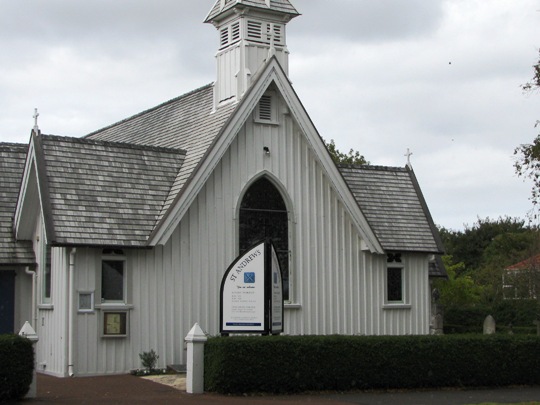
ARCHITECTURAL SIGNIFICANCE: St Andrew's is one of Auckland's best known examples of the Selwyn style, the form of architecture introduced by New Zealand's most famous early prelate. Selwyn's requirements for church design followed that of the Cambridge Camden (later Ecclesiological) Society which outlined precepts of architectural design and championed the use of the Gothic style. Kinder was a founding committee member of the society and through his extensive study of English church architecture was more than capable of designing St Andrews. Although little remains of Kinder's original design the present structure displays the unusual level of sensitivity and skill that has maintained the original character of the church. It is an interesting contrast with the near original Selwyn churches of St John's College Chapel (1846) and All Saints, Howick (1847) and in the attractive continuity of its design an obvious parallel with Old St Pauls, Wellington (1866). TOWNSCAPE/LANDMARK SIGNIFICANCE: Today the much enlarged church has mature trees in its grounds so that its street impact is pleasant but limited in its extent.
Why is this place significant?
Historic Significance
Historical Significance or Value St Andrews has had a long association with Epsom. An earlier much smaller church (1846) was built on land purchased by Bishop Selwyn in 1844. Selwyn anticipated Epsom would quickly grow into a suburban settlement but until the early 20th century it remained predominantly rural. The church is most closely connected with Rev Dr John Kinder. As the vicar and architect, a contributor and fund raiser he was the principal force in the establishment of his church. He was also responsible for embellishing the interior, at his own expense, and setting a standard of design and decoration that has been followed to this day. As one of Auckland's earliest established churches and a parish in its own right since 1910 St Andrews is rightly considered one of Auckland's most historic churches.
Physical Significance
ARCHITECTURAL SIGNIFICANCE: St Andrew's is one of Auckland's best known examples of the Selwyn style, the form of architecture introduced by New Zealand's most famous early prelate. Selwyn's requirements for church design followed that of the Cambridge Camden (later Ecclesiological) Society which outlined precepts of architectural design and championed the use of the Gothic style. Kinder was a founding committee member of the society and through his extensive study of English church architecture was more than capable of designing St Andrews. Although little remains of Kinder's original design the present structure displays the unusual level of sensitivity and skill that has maintained the original character of the church. It is an interesting contrast with the near original Selwyn churches of St John's College Chapel (1846) and All Saints, Howick (1847) and in the attractive continuity of its design an obvious parallel with Old St Pauls, Wellington (1866). TOWNSCAPE/LANDMARK SIGNIFICANCE: Today the much enlarged church has mature trees in its grounds so that its street impact is pleasant but limited in its extent.
Construction Professional
Name
Wood, Reader Gilson
Type
Architect
Biography
Reader Gilson Wood (1821-1895) was born in England and his education in England included study under William Flint, architect and surveyor. Wood arrived in New Zealand in 1844 and from May 1846 shared accommodation with Frederick Thatcher assisting in his work for St John's College including the supervision of the Chapel (1847). Wood remained at St John's for a short time and then took a government appointment. The Selwynian influence can be seen in his later works such as the Melanesian Mission at Mission Bay, Auckland (1859). Wood carried out a large number of commissions, but displayed little originality. He had a notable career, however, which included service as a prominent local government official (1848-61) and as a member of the House of Representatives for Parnell (1861-65 and 1870-78) and for Waitemata, (1879-81). He retired from politics in 1881, and became Chairman of the Auckland Gas Company and a trustee of the Auckland Savings Bank.
Name
Kinder, Rev Dr John
Type
Architect
Biography
The Reverend Dr John Kinder (1819-1903) was born and educated in England graduating with an MA from Trinity College, Cambridge. While at university he took an interest in ecclesiastical architecture and was an active member of the Camden Society. Soon after his arrival in Auckland 1855 Bishop Selwyn appointed him headmaster of the Church of England Grammar School in Parnell. In 1865 Kinder accepted the oversight of St Andrew's Epsom and was responsible for the design of the 1867 building with some expert assistance from Reader Wood. Kinder was highly regarded for his painting of early New Zealand scenes and he was a pioneer photographer of note. These works are now highly valued for their historical content.
Construction Details
Start Year
1867
Type
Original Construction
Start Year
1896
Type
Modification
Description
The chancel was moved eastwards to allow for the incorporation of a transept running north-south. The chancel was raised slightly in order to give a better view of the rood screen.
Start Year
1914
Type
Modification
Description
Side aisles were added to widen the nave. A column and beam structure was used to support the nave rafters. The transepts were extended northwards and southwards.
Start Year
1914
Type
Modification
Description
The original porch and vestry were removed and a new, larger porch was added to the west front. The chancel was moved further eastwards to incorporate a vestry and a choir.
Start Year
1914
Type
Modification
Description
An additional bay was added to each side of the rood screen.
Start Year
1926
Type
Modification
Description
Another larger transept (running north-south) was added to the west of the first transept. The chancel was widened to line up with the choir, and the roof line of the nave was continued over the sanctuary.
Start Year
1926
Type
Modification
Description
The porch was removed from the west front and two smaller porches were returned to the sides of the nave.
Start Year
1926
Type
Modification
Description
The square headed windows of the main facades of the transepts and the west front were replaced by Gothic Revival style windows
Start Year
1952
Type
Modification
Description
A war memorial chapel was formed in the south-east corner.
Start Year
1956
Type
Modification
Description
The room on the south-east corner was enlarged by three metres.
Start Year
1872
Type
Modification
Description
Rood screen installed
Construction Materials
Timber framing, board and batten cladding. Shingled roof and spire. Timber trusses.
Notable Features
The chancel (rood) screen. The font.
Construction Professional
Name
Wood, Reader Gilson
Type
Architect
Biography
Reader Gilson Wood (1821-1895) was born in England and his education in England included study under William Flint, architect and surveyor. Wood arrived in New Zealand in 1844 and from May 1846 shared accommodation with Frederick Thatcher assisting in his work for St John's College including the supervision of the Chapel (1847). Wood remained at St John's for a short time and then took a government appointment. The Selwynian influence can be seen in his later works such as the Melanesian Mission at Mission Bay, Auckland (1859). Wood carried out a large number of commissions, but displayed little originality. He had a notable career, however, which included service as a prominent local government official (1848-61) and as a member of the House of Representatives for Parnell (1861-65 and 1870-78) and for Waitemata, (1879-81). He retired from politics in 1881, and became Chairman of the Auckland Gas Company and a trustee of the Auckland Savings Bank.
Name
Kinder, Rev Dr John
Type
Architect
Biography
The Reverend Dr John Kinder (1819-1903) was born and educated in England graduating with an MA from Trinity College, Cambridge. While at university he took an interest in ecclesiastical architecture and was an active member of the Camden Society. Soon after his arrival in Auckland 1855 Bishop Selwyn appointed him headmaster of the Church of England Grammar School in Parnell. In 1865 Kinder accepted the oversight of St Andrew's Epsom and was responsible for the design of the 1867 building with some expert assistance from Reader Wood. Kinder was highly regarded for his painting of early New Zealand scenes and he was a pioneer photographer of note. These works are now highly valued for their historical content.
Construction Details
Start Year
1867
Type
Original Construction
Start Year
1896
Type
Modification
Description
The chancel was moved eastwards to allow for the incorporation of a transept running north-south. The chancel was raised slightly in order to give a better view of the rood screen.
Start Year
1914
Type
Modification
Description
Side aisles were added to widen the nave. A column and beam structure was used to support the nave rafters. The transepts were extended northwards and southwards.
Start Year
1914
Type
Modification
Description
The original porch and vestry were removed and a new, larger porch was added to the west front. The chancel was moved further eastwards to incorporate a vestry and a choir.
Start Year
1914
Type
Modification
Description
An additional bay was added to each side of the rood screen.
Start Year
1926
Type
Modification
Description
Another larger transept (running north-south) was added to the west of the first transept. The chancel was widened to line up with the choir, and the roof line of the nave was continued over the sanctuary.
Start Year
1926
Type
Modification
Description
The porch was removed from the west front and two smaller porches were returned to the sides of the nave.
Start Year
1926
Type
Modification
Description
The square headed windows of the main facades of the transepts and the west front were replaced by Gothic Revival style windows
Start Year
1952
Type
Modification
Description
A war memorial chapel was formed in the south-east corner.
Start Year
1956
Type
Modification
Description
The room on the south-east corner was enlarged by three metres.
Start Year
1872
Type
Modification
Description
Rood screen installed
Construction Materials
Timber framing, board and batten cladding. Shingled roof and spire. Timber trusses.
Notable Features
The chancel (rood) screen. The font.
ARCHITECT/ENGINEER OR DESIGNER: Rev Dr John KINDER (1819-1903) Reader Gilson WOOD (1821-1895) ADDITIONS: 1872 Edward RUMSEY (1824-1909) 1896 Ernest Lee McKINSTRY (1857-1939) 1914 Benjamin Charles CHILWELL 1926 CHILWELL & Cecil TREVETHICK 1952 GUMMER & FORD 1956 W.R. HAVESNAPE ARCHITECTURAL DESCRIPTION (STYLE): This church started modestly as a 12 X 6 metre structure with a rectangular nave, an entrance porch and vestry, a small chancel and apse and typically Selwyn - like high pitched roof and board and batten cladding. The windows were square headed. The belfry and spire (now slightly modified) were also a feature of the church in its original form. The church today owes its style and to a lesser extent its form to Kinder's original design. However, numerous additions (see Modifications) have enlarged the church to the point where very little of Kinder's church remains. The nave has been substantially enlarged, transepts and vestries added and the apse extended. The addition of a number of arched windows has given the church a more Gothic appearance. The interior is graced with numerous fittings the most notable being a five bay rood screen (the Kinder Screen). Originally three bays wide until extended in 1914 by Kinder's wife Celia, the screen was donated by Kinder himself in 1872. A stone font, erected to the memory of Arthur Grundy, a young half caste Maori artist, and also donated by Kinder, was made in England and sent out in 1869.
ARCHITECT/ENGINEER OR DESIGNER: Rev Dr John KINDER (1819-1903) Reader Gilson WOOD (1821-1895) ADDITIONS: 1872 Edward RUMSEY (1824-1909) 1896 Ernest Lee McKINSTRY (1857-1939) 1914 Benjamin Charles CHILWELL 1926 CHILWELL & Cecil TREVETHICK 1952 GUMMER & FORD 1956 W.R. HAVESNAPE ARCHITECTURAL DESCRIPTION (STYLE): This church started modestly as a 12 X 6 metre structure with a rectangular nave, an entrance porch and vestry, a small chancel and apse and typically Selwyn - like high pitched roof and board and batten cladding. The windows were square headed. The belfry and spire (now slightly modified) were also a feature of the church in its original form. The church today owes its style and to a lesser extent its form to Kinder's original design. However, numerous additions (see Modifications) have enlarged the church to the point where very little of Kinder's church remains. The nave has been substantially enlarged, transepts and vestries added and the apse extended. The addition of a number of arched windows has given the church a more Gothic appearance. The interior is graced with numerous fittings the most notable being a five bay rood screen (the Kinder Screen). Originally three bays wide until extended in 1914 by Kinder's wife Celia, the screen was donated by Kinder himself in 1872. A stone font, erected to the memory of Arthur Grundy, a young half caste Maori artist, and also donated by Kinder, was made in England and sent out in 1869.
Historical and Associated Iwi / Hapū / Whānau
Information Sources
Auckland Star
Auckland Star
Auckland Waikato Historical Society Journal
Auckland Waikato Historical Society Journal
Cyclopedia of New Zealand, 1902
Cyclopedia Company, Industrial, descriptive, historical, biographical facts, figures, illustrations, Wellington, N.Z, 1897-1908, Vol.2, Christchurch, 1902
Dixon, 1978
Roger Dixon & Stefan Muthesius, 'Victorian Architecture', London, 1978
Knight, 1972
Cyril Knight, The Selwyn Churches of Auckland, Auckland, 1972.
New Zealand Herald
New Zealand Herald, 12 July 1932, p. 6; 28 September 1933, p. 6.
Scholefield, 1940
G. H. Scholefield, A Dictionary of New Zealand Biography, Department of Internal Affairs, Wellington, 1940
Stacpoole, 1971
John Stacpoole, William Mason: The First New Zealand Architect, Auckland, 1971
Stacpoole, 1976
John Stacpoole, Colonial Architecture in New Zealand, Wellington, 1976
University of Auckland
University of Auckland
Willis, 1946
F P de L Willis. A Record of St Andrew's Church and Parish from its beginning in 1843, Epsom 1946
Manukau Progress
Manukau Progress
Historic Places in New Zealand
Historic Places in New Zealand
Auckland City Council
Auckland City Council
Other Information
This historic place was registered under the Historic Places Act 1980. This report includes the text from the original Building Classification Committee report considered by the NZHPT Board at the time of registration. Please note that entry on the New Zealand Heritage List/Rarangi Korero identifies only the heritage values of the property concerned, and should not be construed as advice on the state of the property, or as a comment of its soundness or safety, including in regard to earthquake risk, safety in the event of fire, or insanitary conditions.
Historical and Associated Iwi / Hapū / Whānau
Information Sources
Auckland Star
Auckland Star
Auckland Waikato Historical Society Journal
Auckland Waikato Historical Society Journal
Cyclopedia of New Zealand, 1902
Cyclopedia Company, Industrial, descriptive, historical, biographical facts, figures, illustrations, Wellington, N.Z, 1897-1908, Vol.2, Christchurch, 1902
Dixon, 1978
Roger Dixon & Stefan Muthesius, 'Victorian Architecture', London, 1978
Knight, 1972
Cyril Knight, The Selwyn Churches of Auckland, Auckland, 1972.
New Zealand Herald
New Zealand Herald, 12 July 1932, p. 6; 28 September 1933, p. 6.
Scholefield, 1940
G. H. Scholefield, A Dictionary of New Zealand Biography, Department of Internal Affairs, Wellington, 1940
Stacpoole, 1971
John Stacpoole, William Mason: The First New Zealand Architect, Auckland, 1971
Stacpoole, 1976
John Stacpoole, Colonial Architecture in New Zealand, Wellington, 1976
University of Auckland
University of Auckland
Willis, 1946
F P de L Willis. A Record of St Andrew's Church and Parish from its beginning in 1843, Epsom 1946
Manukau Progress
Manukau Progress
Historic Places in New Zealand
Historic Places in New Zealand
Auckland City Council
Auckland City Council
Other Information
This historic place was registered under the Historic Places Act 1980. This report includes the text from the original Building Classification Committee report considered by the NZHPT Board at the time of registration. Please note that entry on the New Zealand Heritage List/Rarangi Korero identifies only the heritage values of the property concerned, and should not be construed as advice on the state of the property, or as a comment of its soundness or safety, including in regard to earthquake risk, safety in the event of fire, or insanitary conditions.
Current Usages
Uses: Religion
Specific Usage: Church
Former Usages
General Usage: Religion
Specific Usage: Church
Web Links
description:
Current Usages
Uses: Religion
Specific Usage: Church
Former Usages
General Usage: Religion
Specific Usage: Church
Web Links
description:
