DonateSupporterVisit Heritage
  • Tūrangawaewae
    Places
  • Tira Māori
    Māori Heritage
  • Poutairangahia
    Archaeology
  • Rauemi
    Resources
  • Mō Tātou
    About Us
  • New Zealand Heritage List
  • Nominate and submit
  • Explore the List
  • National Historic Landmarks
  • Plaques
  • Rainbow List Project
  • Lost heritage
  • Visit Heritage
  • Our properties
  • Turnbull House Project
  • Collections
  • Shop
  • Tohu Whenua
  • Tira Māori
  • Conserving Māori heritage
  • Marae built heritage
  • Māori heritage on the List
  • Hinemihi—Te Hokinga Mai
  • What is archaeology?
  • Is there a site on my property?
  • What are my legal requirements?
  • Affecting an archaeological site
  • Declaring an archaeological site
  • Archaeology FAQs
  • Archaeology Digital Library
  • Archaeology guidelines and templates
  • Resources
  • Funding
  • Publications
  • Sustainable management guides
  • Disaster recovery
  • Podcasts & digital resources
  • Education Hub
  • Conservation plans
  • About
  • Board
  • Māori Heritage Council
  • Senior Staff
  • Offices
  • Contact us
  • Careers
  • Covenants
  • Fast-track
  • Corporate documents
  • Currently consulting on
  • Our submissions
  • News
  • Covid-19 response
Quick links
Rārangi Kōrero | The List
Explore the List
National Historic Landmarks
Ngā Manawhenua o Aotearoa me ōna Kōrero Tūturu
Quick links
Tapuwae
A Vision for Places of Māori Heritage
Funding for Māori Heritage
Resources
Quick links
Archaeological Authority Portal
Applying for an archaeological authority
Archaeology FAQs
Browse the most frequently asked questions about archaeological authorities and the archaeological process.
Quick links
Quick links
Contact us
Offices
DonateSupporterVisit Heritage
  • Tūrangawaewae
    Places
  • Tira Māori
    Māori Heritage
  • Poutairangahia
    Archaeology
  • Rauemi
    Resources
  • Mō Tātou
    About Us
  • New Zealand Heritage List
  • Nominate and submit
  • Explore the List
  • National Historic Landmarks
  • Plaques
  • Rainbow List Project
  • Lost heritage
  • Visit Heritage
  • Our properties
  • Turnbull House Project
  • Collections
  • Shop
  • Tohu Whenua
  • Tira Māori
  • Conserving Māori heritage
  • Marae built heritage
  • Māori heritage on the List
  • Hinemihi—Te Hokinga Mai
  • What is archaeology?
  • Is there a site on my property?
  • What are my legal requirements?
  • Affecting an archaeological site
  • Declaring an archaeological site
  • Archaeology FAQs
  • Archaeology Digital Library
  • Archaeology guidelines and templates
  • Resources
  • Funding
  • Publications
  • Sustainable management guides
  • Disaster recovery
  • Podcasts & digital resources
  • Education Hub
  • Conservation plans
  • About
  • Board
  • Māori Heritage Council
  • Senior Staff
  • Offices
  • Contact us
  • Careers
  • Covenants
  • Fast-track
  • Corporate documents
  • Currently consulting on
  • Our submissions
  • News
  • Covid-19 response
Quick links
Rārangi Kōrero | The List
Explore the List
National Historic Landmarks
Ngā Manawhenua o Aotearoa me ōna Kōrero Tūturu
Quick links
Tapuwae
A Vision for Places of Māori Heritage
Funding for Māori Heritage
Resources
Quick links
Archaeological Authority Portal
Applying for an archaeological authority
Archaeology FAQs
Browse the most frequently asked questions about archaeological authorities and the archaeological process.
Quick links
Quick links
Contact us
Offices
  • Places
  • Nominate and submit
  • National Historic Landmarks
  • Places
  • Nominate and submit
  • National Historic Landmarks
  • Tira Māori
  • Conserving Māori heritage
  • Marae built heritage
  • Tira Māori
  • Conserving Māori heritage
  • Marae built heritage
  • Archaeological authorities
  • Archaeology Digital Library
  • Archaeological authorities
  • Archaeology Digital Library
  • All resources
  • Publications
  • Funding
  • All resources
  • Publications
  • Funding
  • FAQs
  • FAQs
Follow us on:
Places
  • Places
  • Nominate and submit
  • National Historic Landmarks
Tira Māori
  • Tira Māori
  • Conserving Māori heritage
  • Marae built heritage
Archaeology
  • Archaeological authorities
  • Archaeology Digital Library
Resources
  • All resources
  • Publications
  • Funding
FAQs
  • FAQs
Follow us on
HomePrivacyTerms and conditionsAbout this site
© Heritage New Zealand Pouhere Taonga 2026.
 
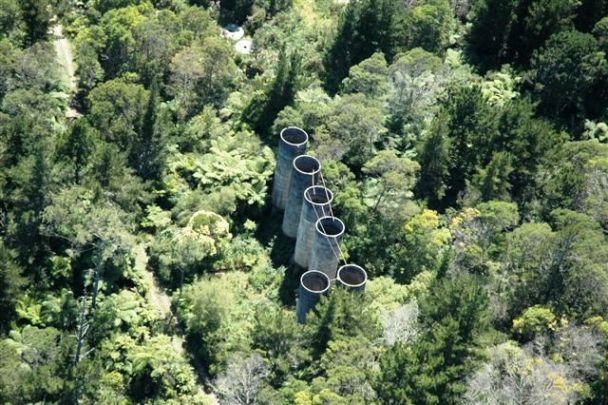
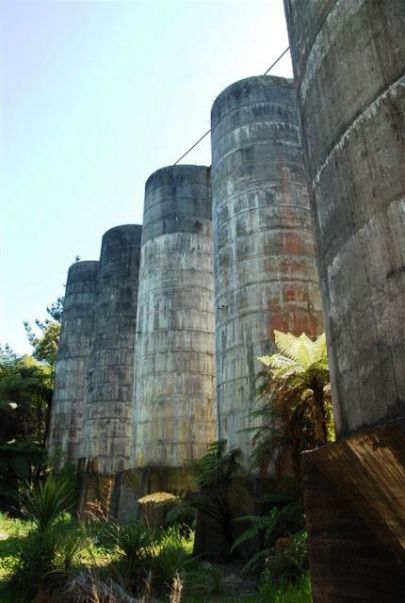
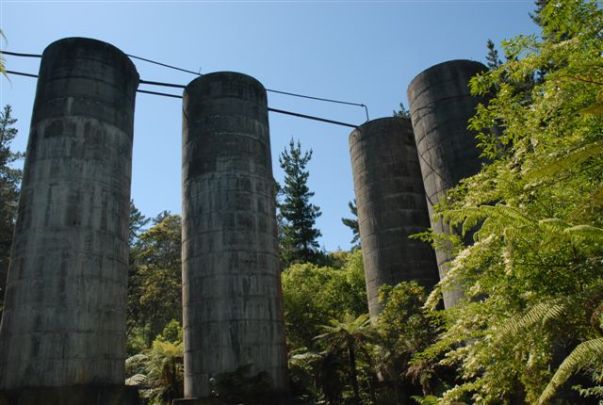
Waihi Gold Mining Company Cyanide Tanks

Union Hill, Barry Rd, WAIHI

Private

Historic Place Category 1

List No. 135

Quick links:
List GalleryLocationDetails
The cyanide process for the extraction of gold from crushed ore made possible the economic operation of non-alluvial goldfields in New Zealand, and elsewhere e.g. Australia, United States, Mexico and South Africa. The world's first field trials of the process were held at Karangahake in 1889, and the patent was acquired by the New Zealand Government in 1897. So successful was the process that the Government, through the charging of a small royalty, had recovered its initial outlay by 1905. The process involves the mixing in the tanks of the finely-ground goldbearing ore in a solution of potassium cyanide. The suspension or slime was continually agitated by compressed air. It was then trickled over a bed of coarse metallic zinc on which the dissolved gold was precipitated, to be recovered by mechanical washing. In New Zealand and Australia the tanks were known generally as B & M tanks after their developers, Brown and McMiken, but elsewhere they are commonly referred to as Pachuca tanks.
Cyanide Tanks | 07/02/2006 | Newmont Waihi Gold
Cyanide Tanks | 14/11/2008 | Newmont Waihi Gold
Cyanide Tanks | 07/02/2006 | Newmont Waihi Gold
Cyanide Tanks | 14/11/2008 | Newmont Waihi Gold

List Entry Information

Overview

Status
Listed

List Entry Status
Historic Place Category 1

Access
Private/No Public Access

List Number
135

Date Entered
15th February 1990

Date of Effect
15th February 1990

City/District Council
Hauraki District

Region
Waikato Region

Legal description

Pt Sec 356 Blk XVI OSD

Detailed List Entry
Significance

Historic Significance

Historical Significance or Value These tanks are a spectacular physical reminder of the leading role played by New Zealand mining engineers in the development at the turn of the century of a new method of gold extraction from low grade ores. It enabled the Coromandel-Thames-Ohinemuri fields to be more fully exploited, and for a time, to figure as some of the highest producing gold mines in the world. The process was widely employed elsewhere in the world.

Physical Significance

ARCHITECTURAL QUALITY: These cylindrical concrete tanks are the only examples of this type of construction and size in New Zealand. TOWNSCAPE/LANDMARK VALUE: These huge concrete cylinders which dominate the site of the former gold workings have a considerable landmark value.

Construction Professional

Name

Brown, C F

Type

Designer

Biography

When he designed and built the first cyanide tanks to use the agitation process for the extraction of gold from low grade ores from cyanide solution, C.F. Brown was general manager of the Komata Gold Mines, Ohinemuri.

Construction Details

Start Year

1905

Type

Original Construction

Construction Materials

Concrete

Notable Features

Size and material of construction.

Physical Description

ARCHITECTURAL DESCRIPTION: These six concrete cylinders are the largest cyanide tanks remaining in New Zealand. The cylinders are 16.7 metres (55ft) high and 3.66 metres (12ft) in diameter. Cyanide tanks elsewhere were smaller in size and variously made of wood, iron or steel.

Reference

Information Sources

McAra, J. B., 1988

J B McAra, Gold Mining at Waihi 1878-1952, Waihi, 1988

Barber, 1985

L Barber, 1985, No Easy Riches : a History of Ohinemuri County, Paeroa and Waihi 1855-1935, Ohinemuri County Council and Richards Publishers

Porter, 1983 (2)

Frances Porter (ed.), Historic Buildings of New Zealand: North Island (2nd edn.), Auckland, 1983

Report Written By

This historic place was registered under the Historic Places Act 1980. This report includes the text from the original Building Classification Committee report considered by the NZHPT Board at the time of registration. Please note that entry on the New Zealand Heritage List/Rarangi Korero identifies only the heritage values of the property concerned, and should not be construed as advice on the state of the property, or as a comment of its soundness or safety, including in regard to earthquake risk, safety in the event of fire, or insanitary conditions.

Further Information

Current Usages

Former Usages

Themes

Web Links

description: IPENZ Engineering Heritage

url: http://www.ipenz.org.nz/heritage/itemdetail.cfm?itemid=91

Overview

Status

Listed

List Entry Status

Historic Place Category 1

Access

Private/No Public Access

List Number

135

Date Entered

15th February 1990

Date of Effect

15th February 1990

City/District Council

Hauraki District

Region

Waikato Region

Legal description

Pt Sec 356 Blk XVI OSD

Status

Listed

List Entry Status

Historic Place Category 1

Access

Private/No Public Access

List Number

135

Date Entered

15th February 1990

Date of Effect

15th February 1990

City/District Council

Hauraki District

Region

Waikato Region

Legal description

Pt Sec 356 Blk XVI OSD

Significance

Why is this place significant?

Historic Significance

Historical Significance or Value These tanks are a spectacular physical reminder of the leading role played by New Zealand mining engineers in the development at the turn of the century of a new method of gold extraction from low grade ores. It enabled the Coromandel-Thames-Ohinemuri fields to be more fully exploited, and for a time, to figure as some of the highest producing gold mines in the world. The process was widely employed elsewhere in the world.

Physical Significance

ARCHITECTURAL QUALITY: These cylindrical concrete tanks are the only examples of this type of construction and size in New Zealand. TOWNSCAPE/LANDMARK VALUE: These huge concrete cylinders which dominate the site of the former gold workings have a considerable landmark value.

Why is this place significant?

Historic Significance

Historical Significance or Value These tanks are a spectacular physical reminder of the leading role played by New Zealand mining engineers in the development at the turn of the century of a new method of gold extraction from low grade ores. It enabled the Coromandel-Thames-Ohinemuri fields to be more fully exploited, and for a time, to figure as some of the highest producing gold mines in the world. The process was widely employed elsewhere in the world.

Physical Significance

ARCHITECTURAL QUALITY: These cylindrical concrete tanks are the only examples of this type of construction and size in New Zealand. TOWNSCAPE/LANDMARK VALUE: These huge concrete cylinders which dominate the site of the former gold workings have a considerable landmark value.

Construction Information

Construction Professional

Name

Brown, C F

Type

Designer

Biography

When he designed and built the first cyanide tanks to use the agitation process for the extraction of gold from low grade ores from cyanide solution, C.F. Brown was general manager of the Komata Gold Mines, Ohinemuri.

Construction Details

Start Year

1905

Type

Original Construction

Construction Materials

Concrete

Notable Features

Size and material of construction.

Construction Professional

Name

Brown, C F

Type

Designer

Biography

When he designed and built the first cyanide tanks to use the agitation process for the extraction of gold from low grade ores from cyanide solution, C.F. Brown was general manager of the Komata Gold Mines, Ohinemuri.

Construction Details

Start Year

1905

Type

Original Construction

Construction Materials

Concrete

Notable Features

Size and material of construction.

Physical Description

ARCHITECTURAL DESCRIPTION: These six concrete cylinders are the largest cyanide tanks remaining in New Zealand. The cylinders are 16.7 metres (55ft) high and 3.66 metres (12ft) in diameter. Cyanide tanks elsewhere were smaller in size and variously made of wood, iron or steel.

ARCHITECTURAL DESCRIPTION: These six concrete cylinders are the largest cyanide tanks remaining in New Zealand. The cylinders are 16.7 metres (55ft) high and 3.66 metres (12ft) in diameter. Cyanide tanks elsewhere were smaller in size and variously made of wood, iron or steel.

Reference

Historical and Associated Iwi / Hapū / Whānau

Information Sources

McAra, J. B., 1988

J B McAra, Gold Mining at Waihi 1878-1952, Waihi, 1988

Barber, 1985

L Barber, 1985, No Easy Riches : a History of Ohinemuri County, Paeroa and Waihi 1855-1935, Ohinemuri County Council and Richards Publishers

Porter, 1983 (2)

Frances Porter (ed.), Historic Buildings of New Zealand: North Island (2nd edn.), Auckland, 1983

Other Information

This historic place was registered under the Historic Places Act 1980. This report includes the text from the original Building Classification Committee report considered by the NZHPT Board at the time of registration. Please note that entry on the New Zealand Heritage List/Rarangi Korero identifies only the heritage values of the property concerned, and should not be construed as advice on the state of the property, or as a comment of its soundness or safety, including in regard to earthquake risk, safety in the event of fire, or insanitary conditions.

Historical and Associated Iwi / Hapū / Whānau

Information Sources

McAra, J. B., 1988

J B McAra, Gold Mining at Waihi 1878-1952, Waihi, 1988

Barber, 1985

L Barber, 1985, No Easy Riches : a History of Ohinemuri County, Paeroa and Waihi 1855-1935, Ohinemuri County Council and Richards Publishers

Porter, 1983 (2)

Frances Porter (ed.), Historic Buildings of New Zealand: North Island (2nd edn.), Auckland, 1983

Other Information

This historic place was registered under the Historic Places Act 1980. This report includes the text from the original Building Classification Committee report considered by the NZHPT Board at the time of registration. Please note that entry on the New Zealand Heritage List/Rarangi Korero identifies only the heritage values of the property concerned, and should not be construed as advice on the state of the property, or as a comment of its soundness or safety, including in regard to earthquake risk, safety in the event of fire, or insanitary conditions.

Further Information

Web Links

description: IPENZ Engineering Heritage

url: http://www.ipenz.org.nz/heritage/itemdetail.cfm?itemid=91

Web Links

description: IPENZ Engineering Heritage

url: http://www.ipenz.org.nz/heritage/itemdetail.cfm?itemid=91

Location

Loading
Sign up to hear more

Get the latest heritage news, features and events delivered
straight to your inbox.

Subscribe