DonateMembershipVisit Heritage
  • Tūrangawaewae
    Places
  • Tira Māori
    Māori Heritage
  • Poutairangahia
    Archaeology
  • Rauemi
    Resources
  • Mō Tātou
    About Us
  • New Zealand Heritage List
  • Nominate and submit
  • Explore the List
  • National Historic Landmarks
  • Plaques
  • Rainbow List Project
  • Lost heritage
  • Visit Heritage
  • Our properties
  • Turnbull House Project
  • Collections
  • Shop
  • Tohu Whenua
  • Tira Māori
  • Conserving Māori heritage
  • Marae built heritage
  • Māori heritage on the List
  • Hinemihi—Te Hokinga Mai
  • What is archaeology?
  • Is there a site on my property?
  • What are my legal requirements?
  • Affecting an archaeological site
  • Declaring an archaeological site
  • Archaeology FAQs
  • Archaeology Digital Library
  • Archaeology guidelines and templates
  • Resources
  • Funding
  • Publications
  • Sustainable management guides
  • Disaster recovery
  • Podcasts & digital resources
  • Education Hub
  • Conservation plans
  • About
  • Board
  • Māori Heritage Council
  • Senior Staff
  • Offices
  • Contact us
  • Careers
  • Covenants
  • Fast-track
  • Corporate documents
  • Currently consulting on
  • Our submissions
  • News
  • Covid-19 response
Quick links
Rārangi Kōrero | The List
Explore the List
National Historic Landmarks
Ngā Manawhenua o Aotearoa me ōna Kōrero Tūturu
Quick links
Tapuwae
A Vision for Places of Māori Heritage
Funding for Māori Heritage
Resources
Quick links
Archaeological Authority Portal
Applying for an archaeological authority
Archaeology FAQs
Browse the most frequently asked questions about archaeological authorities and the archaeological process.
Quick links
Quick links
News
News Keep up to date with Heritage New Zealand Pouhere Taonga
Membership
Membership Find out more and sign up today
DonateMembershipVisit Heritage
  • Tūrangawaewae
    Places
  • Tira Māori
    Māori Heritage
  • Poutairangahia
    Archaeology
  • Rauemi
    Resources
  • Mō Tātou
    About Us
  • New Zealand Heritage List
  • Nominate and submit
  • Explore the List
  • National Historic Landmarks
  • Plaques
  • Rainbow List Project
  • Lost heritage
  • Visit Heritage
  • Our properties
  • Turnbull House Project
  • Collections
  • Shop
  • Tohu Whenua
  • Tira Māori
  • Conserving Māori heritage
  • Marae built heritage
  • Māori heritage on the List
  • Hinemihi—Te Hokinga Mai
  • What is archaeology?
  • Is there a site on my property?
  • What are my legal requirements?
  • Affecting an archaeological site
  • Declaring an archaeological site
  • Archaeology FAQs
  • Archaeology Digital Library
  • Archaeology guidelines and templates
  • Resources
  • Funding
  • Publications
  • Sustainable management guides
  • Disaster recovery
  • Podcasts & digital resources
  • Education Hub
  • Conservation plans
  • About
  • Board
  • Māori Heritage Council
  • Senior Staff
  • Offices
  • Contact us
  • Careers
  • Covenants
  • Fast-track
  • Corporate documents
  • Currently consulting on
  • Our submissions
  • News
  • Covid-19 response
Quick links
Rārangi Kōrero | The List
Explore the List
National Historic Landmarks
Ngā Manawhenua o Aotearoa me ōna Kōrero Tūturu
Quick links
Tapuwae
A Vision for Places of Māori Heritage
Funding for Māori Heritage
Resources
Quick links
Archaeological Authority Portal
Applying for an archaeological authority
Archaeology FAQs
Browse the most frequently asked questions about archaeological authorities and the archaeological process.
Quick links
Quick links
News
News Keep up to date with Heritage New Zealand Pouhere Taonga
Membership
Membership Find out more and sign up today
  • Places
  • Nominate and submit
  • National Historic Landmarks
  • Places
  • Nominate and submit
  • National Historic Landmarks
  • Tira Māori
  • Conserving Māori heritage
  • Marae built heritage
  • Tira Māori
  • Conserving Māori heritage
  • Marae built heritage
  • Archaeological authorities
  • Archaeology Digital Library
  • Archaeological authorities
  • Archaeology Digital Library
  • All resources
  • Publications
  • Funding
  • All resources
  • Publications
  • Funding
  • FAQs
  • FAQs
Follow us on:
Places
  • Places
  • Nominate and submit
  • National Historic Landmarks
Tira Māori
  • Tira Māori
  • Conserving Māori heritage
  • Marae built heritage
Archaeology
  • Archaeological authorities
  • Archaeology Digital Library
Resources
  • All resources
  • Publications
  • Funding
FAQs
  • FAQs
Follow us on
HomePrivacyTerms and conditionsAbout this site
© Heritage New Zealand Pouhere Taonga 2026.
 
Homewood

50 Homewood Avenue, Karori, WELLINGTON

Private

Historic Place Category 1

List No. 1368

Quick links:
List GalleryLocationDetails
The summary below is from the Upgrade Report for Homewood, completed in 2013.

Homewood, in Wellington’s northern suburb of Karori, is one of the city’s celebrated houses. Its associations since 1847 with high profile persons from the legal, political, commercial, social life of Wellington and New Zealand, and important Commonwealth connections as the residence of British High Commissioners since the mid twentieth century, give it special historical significance. Homewood has architectural value as an impressive house combining characteristic aspects of several different popular early Edwardian styles, particularly Scottish Baronial, with some fabric remaining from the early colonial cottage it grew out of.

In 1844 Henry Samuel Chapman (1803-1881), the Supreme Court for the Southern Division of New Zealand’s first judge, bought 118 acres in Karori. In 1847 he designed a cottage for the property, which was built by Samuel Duncan Parnell. The building was a typical early colonial house with verandah, constructed in native timbers and with an upper storey within a steeply pitched gable featuring dormer windows. When Chapman accepted the position of colonial secretary of Van Diemen's Land (Tasmania) in 1852, Homewood was sold to John (1809-1881) and Henrietta Johnston.

John was a successful merchant who became involved in public affairs. He was a member of the Wellington Provincial Council (1855-72) and of the Legislative Council from 1857. On his death the property was transferred to his son, Sir Charles John Johnston (1845-1918), also a merchant. Charles was elected Mayor of Wellington in 1889 and became a member of the Legislative Council in 1891. Befitting their social and economic status the Johnstons commissioned a substantial enlargement of Homewood in 1903.

This building project integrated the early cottage into the now dominant section of the building. Homewood is a mix of common early Edwardian architectural styles constructed in timber. Architect Joshua Charlesworth incorporated characteristic aspects of Scottish Baronial style architecture at Homewood, including a tower and repeated use of crenellations. Italianate influence is present in stylized Corinthian capital columns and corbelling under eaves and some upper storey windows. The stickwork on some gable ends is an aspect of American Eastern Stick style. Interior features, such as the carved archways and main stairwell balustrade, demonstrate the superior craftsmanship of Frederick Hunt’s building company.

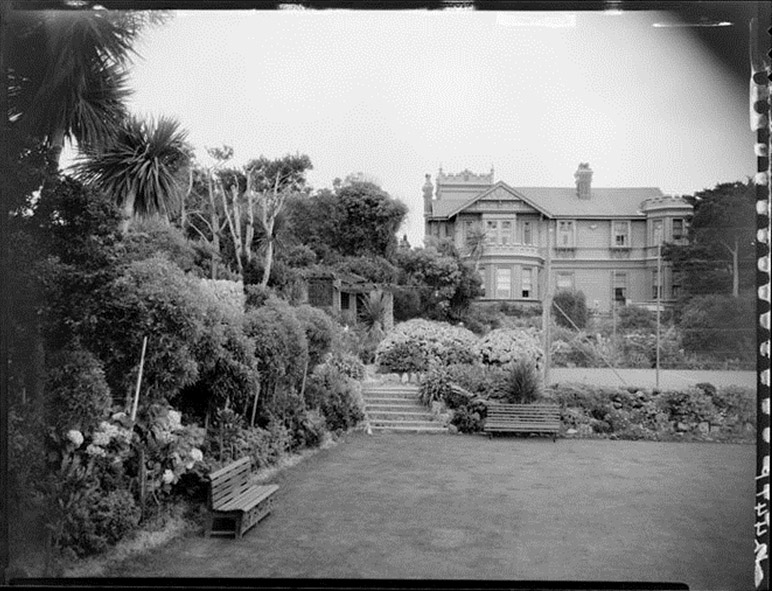
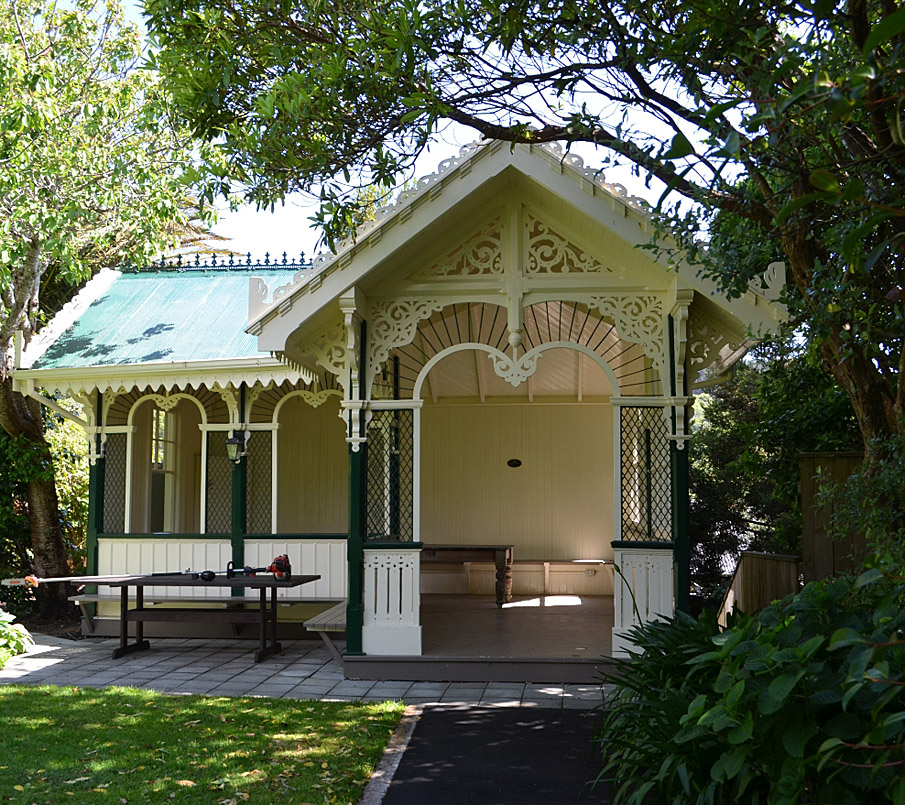
While the Johnstons had sold some of the original land, the current residential section was mostly formed through Charles Francis Pulley subdividing the property from about 1925. In 1932 Benjamin and Lucy Sutherland took ownership of the remaining two acre house section. It was then that Homewood’s impressive landscaped gardens largely took shape, although features such as the Croquet Pavilion (Category 1 historic place, Register no.1369) already existed.

Sutherland's Self Help Co-operative Limited was a successful New Zealand grocery stores chain. Open days and other events were often staged at Homewood as part of the Sutherlands’ charitable efforts. Sutherland’s widow sold the property to the British Government as the residence of the British High Commissioner to New Zealand in 1958 and this use continues.
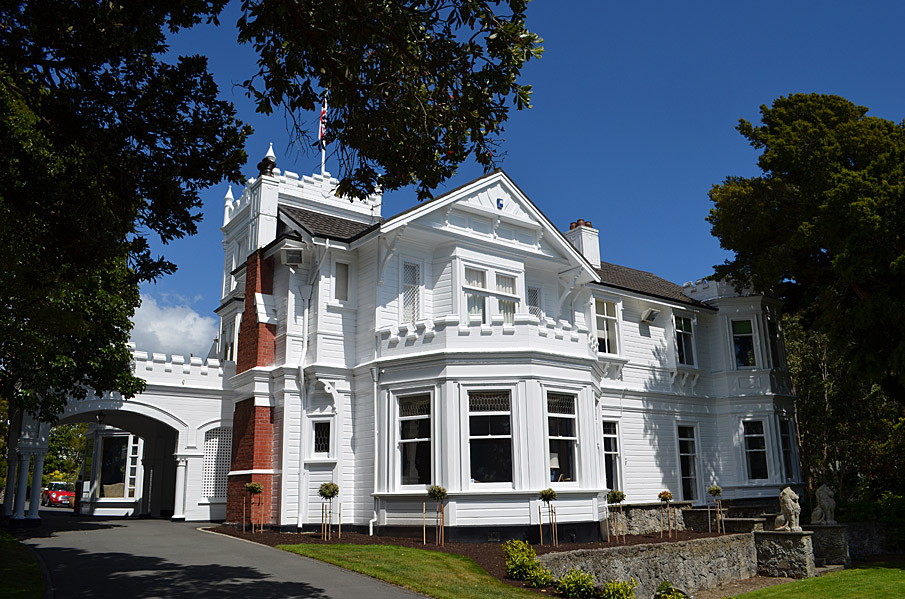
Homewood | A Dangerfield | 03/12/2012 | NZ Historic Places Trust
House and grounds, Homewood, Karori, Wellington, 1936. Crown Studios Ltd: Negatives and prints. Ref: 1/1-038571-F. Alexander Turnbull Library, Wellington, New Zealand. http://natlib.govt.nz/records/23175208. Permission of the Alexander Turnbull Library, Wellington, New Zealand, must be obtained before any re-use of this image | Crown Studios Ltd | Alexander Turnbull Library, Wellington
Homewood | A Dangerfield | 03/12/2012 | NZ Historic Places Trust
House and grounds, Homewood, Karori, Wellington, 1936. Crown Studios Ltd: Negatives and prints. Ref: 1/1-038571-F. Alexander Turnbull Library, Wellington, New Zealand. http://natlib.govt.nz/records/23175208. Permission of the Alexander Turnbull Library, Wellington, New Zealand, must be obtained before any re-use of this image | Crown Studios Ltd | Alexander Turnbull Library, Wellington

List Entry Information

Overview

Status
Listed

List Entry Status
Historic Place Category 1

Access
Private/No Public Access

List Number
1368

Date Entered
28th June 1990

Date of Effect
28th June 1990

City/District Council
Wellington City

Region
Wellington Region

Extent of List Entry

Extent includes part of the land described as Lot 2 DP 83090 (RT WN49C/934), Wellington Land District and the building known as Homewood thereon.

Legal description

Lot 2 DP 83090 (RT WN49C/934), Wellington Land District

Detailed List Entry
Significance

Historic Significance

Historical Significance or Value This historic place was registered under the Historic Places Act 1980. The information below is from the original Building Classification Committee report considered by the NZHPT Board at the time of registration. Homewood from its beginning has been associated with a succession of leading figures in the legal, political, commercial, social and diplomatic life of Wellington and New Zealand. It is now the official residence of the British High Commission.

Physical Significance

This historic place was registered under the Historic Places Act 1980. The information below is from the original Building Classification Committee report considered by the NZHPT Board at the time of registration. ARCHITECTURAL QUALITY: The earlier portion of Homewood, which is believed to have been built in 1847, would be one of the oldest surviving examples of domestic architecture in Wellington. Homewood represents a vernacular interpretation of a standard set in England by Edwardian architects and proponents of the Arts and Crafts movement. Being in New Zealand its design is expressed not in brick, plaster and stone but in wood. It is an eclectic design in which regular elements are consciously put together in an irregular fashion. Neo-classicism is reflected in the use of columns, interior and exterior, while such interior features as the stained glass in the inglenook, the dado panelling and the carved staircase reflect the influence of the Arts and Crafts movement. The baronical feeling of the Norman crenellations express the wealth and self image of the Johnstone family who erected the 1903 additions. The main entrance hall is one of the finest such spaces in New Zealand domestic architecture. The house reflects the skills of the builder of the 1903 portion, Frederick Hunt, and its architect Joshua Charlesworth who created a similar style at Brancepeth in the Wairarapa where he was again responsible for substantial additions to a timber house. TOWNSCAPE/LANDMARK VALUE: Extensive planting hides the building from the street. The grounds increase the feeling of grandeur exuded by the house.

Construction Professional

Name

Parnell, Samuel Duncan

Type

Builder

Biography

No biography is currently available for this construction professional

Name

F. Hunt and J. McDonald

Type

Builder

Biography

No biography is currently available for this construction professional

Name

Charlesworth, Joshua

Type

Architect

Biography

Charlesworth (1861-1925) was born in Yorkshire and the first record of his practice in Wellington was in the New Zealand Post Office Directory of 1885-87. He won a competition for the design of the Home for the Aged and Needy in June, 1887, and in the same year won another for the design of the Nelson Town Hall. Charlesworth set up practice in Wellington in his early twenties, designing many institutional buildings and showing command of the revival styles of architecture. His work includes the Wellington Town Hall (1901), Brancepeth Station Homestead addition, Wairarapa (1905), Te Aro Post Office (1908), St Hilda's Church, Upper Hutt (1909), and seventeen branch banks for the Bank of New Zealand, situated throughout the country (1907-17). Charlesworth was elected a Fellow of the New Zealand Institute of Architects in 1905, and became a life member of the Institute. He was its vice-president in 1909-10, and was the first chairman of a society of architects which was formed in 1912. Charlesworth also belonged to the Yorkshire Society in Wellington and was its president for many years.

Name

Chapman, Judge Henry Samuel

Type

Designer

Biography

Henry Samuel Chapman (1803-1881), the first judge of the Supreme Court for the Southern Division of New Zealand, in 1844 bought 118 acres in Karori. Homewood, the first portion of which he designed in 1847, stands on a residual 2 acres of this land. Information added from NZHPT paper HP197/1990 - Proposal for Classification, Buildings Classification Committee Report, Homewood Residence. (Christen McAlpine, NZHPT, 23 June 2010)

Construction Details

Start Year

1903

Type

Addition

Description

Enlargement of Homewood

Start Year

1930

Finish Year

1939

Type

Modification

Description

Removal of walls between bedrooms on first floor

Start Year

1930

Finish Year

1939

Type

Modification

Description

End of billiard room opened out to match the other crenulated bays of the house

Start Year

1961

Type

Other

Description

Ballroom restored to original small bedrooms

Start Year

1964

Type

Other

Description

Removal of conservancy adjoining to dining room

Start Year

1973

Type

Modification

Description

Verandah boxed in to enlarge kitchen and provide a bathroom

Start Year

1847

Type

Original Construction

Description

Construction of cottage by Henry Samuel Chapman

Start Year

1973

Type

Modification

Description

Removal of the 1961 wall between the first two of the small bedrooms Replacement of corrugated iron roof with pressed metal chip-coated tiles.

Type

Addition

Description

Addition of conservatory

Period

Date Unknown

Construction Materials

Timber framed, rusticated weatherboards. Floors mostly heart matai with some kauri. Interior walls, rimu panelling. Zinc ceilings. Roof now pressed steel chip-coated tiles.

Notable Features

The tower, porte cochere and bays, with crenellations; hall, staircase and interior finishing.

Physical Description

This historic place was registered under the Historic Places Act 1980. The information below is from the original Building Classification Committee report considered by the NZHPT Board at the time of registration. ARCHITECTURAL DESCRIPTION: Homewood is a large timber house, partly crenallated and incorporating Norman and Arts and Crafts features. It consists of two distinguishable portions. The smaller of these, an L shaped wing at the south west of the house, is believed to be part of the original 1847 Homewood cottage. Like the second and larger portion, built 1903, it is two storeyed, but has a more steeply pitched roof and noticeably lower ceiling studs. Some unity between the two portions is achieved through their both being clad in rusticated weatherboards with pressed steel tiles. A verandah on the north-west facade also adds continuity by running from one structure to the other without a change in height. Identical coupled posts support the verandah at both ends. The 1903 portion of the house is dominated by a square three-storeyed crenellated tower. A crenellated porte-cochere, supported by wooden columns with Corinthian capitals, echoes the tower at a lower level. The battlement theme is reinforced by crenellated bays on three facades both at ground and upper storey level. In contrast to these Norman characteristics, pitched roofs punctuated by chimneys, run in the direction of both axes of the building giving height and interest to the roof line. The porte-cochere gives formality to the south-east entrance. The vestibule has rimu panelling and doors, with windows of stained glass and handpainted pictures of English cottages, also on glass. The fine staircase hall has carved wooden columns, flat arches, extensive rimu panelling, coloured leadlights and an inglenook complete with classical pediment carved in wood. The hall gives access to all the reception rooms while upstairs are the bedrooms. The staircase is embellished with carved newels and decorative fretwork. Passage from the main bedroom wing to the servant's quarters is marked by a three step drop in floor level and a noticeable lowering of ceiling height.

Reference

Completion Date

24th January 2013

Report Written By

Karen Astwood

Information Sources

Dominion

Dominion, 16 Jul 1915, p. 9.

Evening Post

Evening Post, 27 Jun 1919, p.7.

Salmond, 1986

Jeremy Salmond, Old New Zealand Houses 1800-1940, Auckland, 1986, Reed Methuen

Smedly, 1980

Beryl Smedly, Homewood and its Families, Wellington, 1980

Air New Zealand Inflight Magazine

Air New Zealand Inflight Magazine

Karori News

Karori News

Report Written By

A fully referenced Upgrade Report is available from the NZHPT Central Region Office. Please note that entry on the New Zealand Heritage List/Rarangi Korero identifies only the heritage values of the property concerned, and should not be construed as advice on the state of the property, or as a comment of its soundness or safety, including in regard to earthquake risk, safety in the event of fire, or insanitary conditions.

Further Information

Current Usages

Uses: Accommodation

Specific Usage: House

Former Usages

General Usage:: Accommodation

Specific Usage: House

Themes

Web Links

Overview

Status

Listed

List Entry Status

Historic Place Category 1

Access

Private/No Public Access

List Number

1368

Date Entered

28th June 1990

Date of Effect

28th June 1990

City/District Council

Wellington City

Region

Wellington Region

Extent of List Entry

Extent includes part of the land described as Lot 2 DP 83090 (RT WN49C/934), Wellington Land District and the building known as Homewood thereon.

Legal description

Lot 2 DP 83090 (RT WN49C/934), Wellington Land District

Status

Listed

List Entry Status

Historic Place Category 1

Access

Private/No Public Access

List Number

1368

Date Entered

28th June 1990

Date of Effect

28th June 1990

City/District Council

Wellington City

Region

Wellington Region

Extent of List Entry

Extent includes part of the land described as Lot 2 DP 83090 (RT WN49C/934), Wellington Land District and the building known as Homewood thereon.

Legal description

Lot 2 DP 83090 (RT WN49C/934), Wellington Land District

Significance

Why is this place significant?

Historic Significance

Historical Significance or Value This historic place was registered under the Historic Places Act 1980. The information below is from the original Building Classification Committee report considered by the NZHPT Board at the time of registration. Homewood from its beginning has been associated with a succession of leading figures in the legal, political, commercial, social and diplomatic life of Wellington and New Zealand. It is now the official residence of the British High Commission.

Physical Significance

This historic place was registered under the Historic Places Act 1980. The information below is from the original Building Classification Committee report considered by the NZHPT Board at the time of registration. ARCHITECTURAL QUALITY: The earlier portion of Homewood, which is believed to have been built in 1847, would be one of the oldest surviving examples of domestic architecture in Wellington. Homewood represents a vernacular interpretation of a standard set in England by Edwardian architects and proponents of the Arts and Crafts movement. Being in New Zealand its design is expressed not in brick, plaster and stone but in wood. It is an eclectic design in which regular elements are consciously put together in an irregular fashion. Neo-classicism is reflected in the use of columns, interior and exterior, while such interior features as the stained glass in the inglenook, the dado panelling and the carved staircase reflect the influence of the Arts and Crafts movement. The baronical feeling of the Norman crenellations express the wealth and self image of the Johnstone family who erected the 1903 additions. The main entrance hall is one of the finest such spaces in New Zealand domestic architecture. The house reflects the skills of the builder of the 1903 portion, Frederick Hunt, and its architect Joshua Charlesworth who created a similar style at Brancepeth in the Wairarapa where he was again responsible for substantial additions to a timber house. TOWNSCAPE/LANDMARK VALUE: Extensive planting hides the building from the street. The grounds increase the feeling of grandeur exuded by the house.

Why is this place significant?

Historic Significance

Historical Significance or Value This historic place was registered under the Historic Places Act 1980. The information below is from the original Building Classification Committee report considered by the NZHPT Board at the time of registration. Homewood from its beginning has been associated with a succession of leading figures in the legal, political, commercial, social and diplomatic life of Wellington and New Zealand. It is now the official residence of the British High Commission.

Physical Significance

This historic place was registered under the Historic Places Act 1980. The information below is from the original Building Classification Committee report considered by the NZHPT Board at the time of registration. ARCHITECTURAL QUALITY: The earlier portion of Homewood, which is believed to have been built in 1847, would be one of the oldest surviving examples of domestic architecture in Wellington. Homewood represents a vernacular interpretation of a standard set in England by Edwardian architects and proponents of the Arts and Crafts movement. Being in New Zealand its design is expressed not in brick, plaster and stone but in wood. It is an eclectic design in which regular elements are consciously put together in an irregular fashion. Neo-classicism is reflected in the use of columns, interior and exterior, while such interior features as the stained glass in the inglenook, the dado panelling and the carved staircase reflect the influence of the Arts and Crafts movement. The baronical feeling of the Norman crenellations express the wealth and self image of the Johnstone family who erected the 1903 additions. The main entrance hall is one of the finest such spaces in New Zealand domestic architecture. The house reflects the skills of the builder of the 1903 portion, Frederick Hunt, and its architect Joshua Charlesworth who created a similar style at Brancepeth in the Wairarapa where he was again responsible for substantial additions to a timber house. TOWNSCAPE/LANDMARK VALUE: Extensive planting hides the building from the street. The grounds increase the feeling of grandeur exuded by the house.

Construction Information

Construction Professional

Name

Parnell, Samuel Duncan

Type

Builder

Biography

No biography is currently available for this construction professional

Name

F. Hunt and J. McDonald

Type

Builder

Biography

No biography is currently available for this construction professional

Name

Charlesworth, Joshua

Type

Architect

Biography

Charlesworth (1861-1925) was born in Yorkshire and the first record of his practice in Wellington was in the New Zealand Post Office Directory of 1885-87. He won a competition for the design of the Home for the Aged and Needy in June, 1887, and in the same year won another for the design of the Nelson Town Hall. Charlesworth set up practice in Wellington in his early twenties, designing many institutional buildings and showing command of the revival styles of architecture. His work includes the Wellington Town Hall (1901), Brancepeth Station Homestead addition, Wairarapa (1905), Te Aro Post Office (1908), St Hilda's Church, Upper Hutt (1909), and seventeen branch banks for the Bank of New Zealand, situated throughout the country (1907-17). Charlesworth was elected a Fellow of the New Zealand Institute of Architects in 1905, and became a life member of the Institute. He was its vice-president in 1909-10, and was the first chairman of a society of architects which was formed in 1912. Charlesworth also belonged to the Yorkshire Society in Wellington and was its president for many years.

Name

Chapman, Judge Henry Samuel

Type

Designer

Biography

Henry Samuel Chapman (1803-1881), the first judge of the Supreme Court for the Southern Division of New Zealand, in 1844 bought 118 acres in Karori. Homewood, the first portion of which he designed in 1847, stands on a residual 2 acres of this land. Information added from NZHPT paper HP197/1990 - Proposal for Classification, Buildings Classification Committee Report, Homewood Residence. (Christen McAlpine, NZHPT, 23 June 2010)

Construction Details

Start Year

1903

Type

Addition

Description

Enlargement of Homewood

Start Year

1930

Finish Year

1939

Type

Modification

Description

Removal of walls between bedrooms on first floor

Start Year

1930

Finish Year

1939

Type

Modification

Description

End of billiard room opened out to match the other crenulated bays of the house

Start Year

1961

Type

Other

Description

Ballroom restored to original small bedrooms

Start Year

1964

Type

Other

Description

Removal of conservancy adjoining to dining room

Start Year

1973

Type

Modification

Description

Verandah boxed in to enlarge kitchen and provide a bathroom

Start Year

1847

Type

Original Construction

Description

Construction of cottage by Henry Samuel Chapman

Start Year

1973

Type

Modification

Description

Removal of the 1961 wall between the first two of the small bedrooms Replacement of corrugated iron roof with pressed metal chip-coated tiles.

Type

Addition

Description

Addition of conservatory

Period

Date Unknown

Construction Materials

Timber framed, rusticated weatherboards. Floors mostly heart matai with some kauri. Interior walls, rimu panelling. Zinc ceilings. Roof now pressed steel chip-coated tiles.

Notable Features

The tower, porte cochere and bays, with crenellations; hall, staircase and interior finishing.

Construction Professional

Name

Parnell, Samuel Duncan

Type

Builder

Biography

No biography is currently available for this construction professional

Name

F. Hunt and J. McDonald

Type

Builder

Biography

No biography is currently available for this construction professional

Name

Charlesworth, Joshua

Type

Architect

Biography

Charlesworth (1861-1925) was born in Yorkshire and the first record of his practice in Wellington was in the New Zealand Post Office Directory of 1885-87. He won a competition for the design of the Home for the Aged and Needy in June, 1887, and in the same year won another for the design of the Nelson Town Hall. Charlesworth set up practice in Wellington in his early twenties, designing many institutional buildings and showing command of the revival styles of architecture. His work includes the Wellington Town Hall (1901), Brancepeth Station Homestead addition, Wairarapa (1905), Te Aro Post Office (1908), St Hilda's Church, Upper Hutt (1909), and seventeen branch banks for the Bank of New Zealand, situated throughout the country (1907-17). Charlesworth was elected a Fellow of the New Zealand Institute of Architects in 1905, and became a life member of the Institute. He was its vice-president in 1909-10, and was the first chairman of a society of architects which was formed in 1912. Charlesworth also belonged to the Yorkshire Society in Wellington and was its president for many years.

Name

Chapman, Judge Henry Samuel

Type

Designer

Biography

Henry Samuel Chapman (1803-1881), the first judge of the Supreme Court for the Southern Division of New Zealand, in 1844 bought 118 acres in Karori. Homewood, the first portion of which he designed in 1847, stands on a residual 2 acres of this land. Information added from NZHPT paper HP197/1990 - Proposal for Classification, Buildings Classification Committee Report, Homewood Residence. (Christen McAlpine, NZHPT, 23 June 2010)

Construction Details

Start Year

1903

Type

Addition

Description

Enlargement of Homewood

Start Year

1930

Finish Year

1939

Type

Modification

Description

Removal of walls between bedrooms on first floor

Start Year

1930

Finish Year

1939

Type

Modification

Description

End of billiard room opened out to match the other crenulated bays of the house

Start Year

1961

Type

Other

Description

Ballroom restored to original small bedrooms

Start Year

1964

Type

Other

Description

Removal of conservancy adjoining to dining room

Start Year

1973

Type

Modification

Description

Verandah boxed in to enlarge kitchen and provide a bathroom

Start Year

1847

Type

Original Construction

Description

Construction of cottage by Henry Samuel Chapman

Start Year

1973

Type

Modification

Description

Removal of the 1961 wall between the first two of the small bedrooms Replacement of corrugated iron roof with pressed metal chip-coated tiles.

Type

Addition

Description

Addition of conservatory

Period

Date Unknown

Construction Materials

Timber framed, rusticated weatherboards. Floors mostly heart matai with some kauri. Interior walls, rimu panelling. Zinc ceilings. Roof now pressed steel chip-coated tiles.

Notable Features

The tower, porte cochere and bays, with crenellations; hall, staircase and interior finishing.

Physical Description

This historic place was registered under the Historic Places Act 1980. The information below is from the original Building Classification Committee report considered by the NZHPT Board at the time of registration. ARCHITECTURAL DESCRIPTION: Homewood is a large timber house, partly crenallated and incorporating Norman and Arts and Crafts features. It consists of two distinguishable portions. The smaller of these, an L shaped wing at the south west of the house, is believed to be part of the original 1847 Homewood cottage. Like the second and larger portion, built 1903, it is two storeyed, but has a more steeply pitched roof and noticeably lower ceiling studs. Some unity between the two portions is achieved through their both being clad in rusticated weatherboards with pressed steel tiles. A verandah on the north-west facade also adds continuity by running from one structure to the other without a change in height. Identical coupled posts support the verandah at both ends. The 1903 portion of the house is dominated by a square three-storeyed crenellated tower. A crenellated porte-cochere, supported by wooden columns with Corinthian capitals, echoes the tower at a lower level. The battlement theme is reinforced by crenellated bays on three facades both at ground and upper storey level. In contrast to these Norman characteristics, pitched roofs punctuated by chimneys, run in the direction of both axes of the building giving height and interest to the roof line. The porte-cochere gives formality to the south-east entrance. The vestibule has rimu panelling and doors, with windows of stained glass and handpainted pictures of English cottages, also on glass. The fine staircase hall has carved wooden columns, flat arches, extensive rimu panelling, coloured leadlights and an inglenook complete with classical pediment carved in wood. The hall gives access to all the reception rooms while upstairs are the bedrooms. The staircase is embellished with carved newels and decorative fretwork. Passage from the main bedroom wing to the servant's quarters is marked by a three step drop in floor level and a noticeable lowering of ceiling height.

This historic place was registered under the Historic Places Act 1980. The information below is from the original Building Classification Committee report considered by the NZHPT Board at the time of registration. ARCHITECTURAL DESCRIPTION: Homewood is a large timber house, partly crenallated and incorporating Norman and Arts and Crafts features. It consists of two distinguishable portions. The smaller of these, an L shaped wing at the south west of the house, is believed to be part of the original 1847 Homewood cottage. Like the second and larger portion, built 1903, it is two storeyed, but has a more steeply pitched roof and noticeably lower ceiling studs. Some unity between the two portions is achieved through their both being clad in rusticated weatherboards with pressed steel tiles. A verandah on the north-west facade also adds continuity by running from one structure to the other without a change in height. Identical coupled posts support the verandah at both ends. The 1903 portion of the house is dominated by a square three-storeyed crenellated tower. A crenellated porte-cochere, supported by wooden columns with Corinthian capitals, echoes the tower at a lower level. The battlement theme is reinforced by crenellated bays on three facades both at ground and upper storey level. In contrast to these Norman characteristics, pitched roofs punctuated by chimneys, run in the direction of both axes of the building giving height and interest to the roof line. The porte-cochere gives formality to the south-east entrance. The vestibule has rimu panelling and doors, with windows of stained glass and handpainted pictures of English cottages, also on glass. The fine staircase hall has carved wooden columns, flat arches, extensive rimu panelling, coloured leadlights and an inglenook complete with classical pediment carved in wood. The hall gives access to all the reception rooms while upstairs are the bedrooms. The staircase is embellished with carved newels and decorative fretwork. Passage from the main bedroom wing to the servant's quarters is marked by a three step drop in floor level and a noticeable lowering of ceiling height.

Reference

Historical and Associated Iwi / Hapū / Whānau

Completion Date

24th January 2013

Report Written By

Karen Astwood

Information Sources

Dominion

Dominion, 16 Jul 1915, p. 9.

Evening Post

Evening Post, 27 Jun 1919, p.7.

Salmond, 1986

Jeremy Salmond, Old New Zealand Houses 1800-1940, Auckland, 1986, Reed Methuen

Smedly, 1980

Beryl Smedly, Homewood and its Families, Wellington, 1980

Air New Zealand Inflight Magazine

Air New Zealand Inflight Magazine

Karori News

Karori News

Other Information

A fully referenced Upgrade Report is available from the NZHPT Central Region Office. Please note that entry on the New Zealand Heritage List/Rarangi Korero identifies only the heritage values of the property concerned, and should not be construed as advice on the state of the property, or as a comment of its soundness or safety, including in regard to earthquake risk, safety in the event of fire, or insanitary conditions.

Historical and Associated Iwi / Hapū / Whānau

Completion Date

24th January 2013

Report Written By

Karen Astwood

Information Sources

Dominion

Dominion, 16 Jul 1915, p. 9.

Evening Post

Evening Post, 27 Jun 1919, p.7.

Salmond, 1986

Jeremy Salmond, Old New Zealand Houses 1800-1940, Auckland, 1986, Reed Methuen

Smedly, 1980

Beryl Smedly, Homewood and its Families, Wellington, 1980

Air New Zealand Inflight Magazine

Air New Zealand Inflight Magazine

Karori News

Karori News

Other Information

A fully referenced Upgrade Report is available from the NZHPT Central Region Office. Please note that entry on the New Zealand Heritage List/Rarangi Korero identifies only the heritage values of the property concerned, and should not be construed as advice on the state of the property, or as a comment of its soundness or safety, including in regard to earthquake risk, safety in the event of fire, or insanitary conditions.

Further Information

Current Usages

Uses: Accommodation

Specific Usage: House

Former Usages

General Usage: Accommodation

Specific Usage: House

Current Usages

Uses: Accommodation

Specific Usage: House

Former Usages

General Usage: Accommodation

Specific Usage: House

Location

Loading
Related listings
Homewood Croquet Pavilion/ Summerhouse
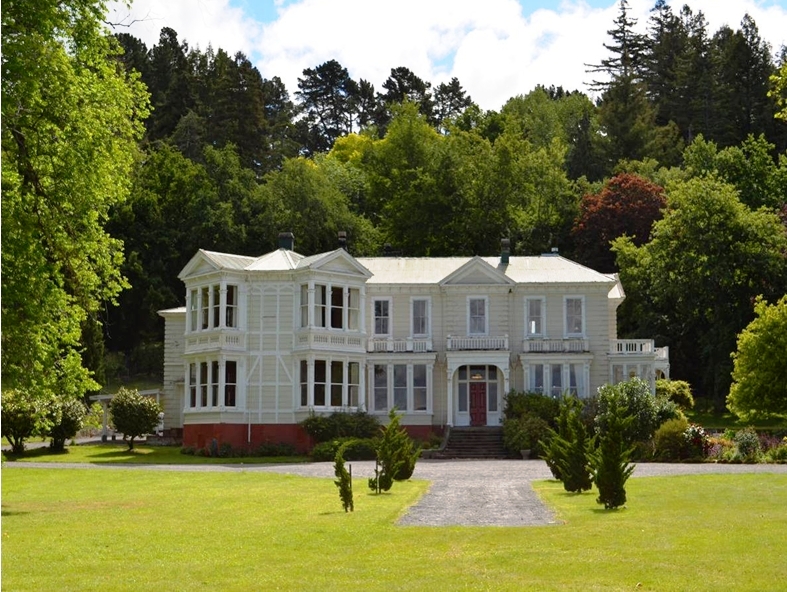
Oruawharo, Takapau. Image kindly supplied by the Lauder family (owners) 2025
Oruawharo
Oruawharo, Takapau. Image kindly supplied by the Lauder family (owners) 2025
Oruawharo
Homewood Croquet Pavilion/ Summerhouse
Stay up to date with Heritage this month