At this date, the West Coast gold rushes had brought great numbers of prospectors to the largely unexplored and unsettled area and George Dobson (1840-1866), was engaged in the development of routes through the region. He had previously worked with his brother Arthur and their father Edward, engineer to the Canterbury Provincial Council, in creating the link between Canterbury and the West Coast - Arthurs Pass - which was opened just two months before his death. While checking the track between Lake Brunner and Greymouth, a gang of notorious bushrangers mistook him for a well laden gold buyer, known to be travelling the same route.
The murder shocked the local people and the whole nation as the story of this well respected young man's death became known. The gang had proceeded to Nelson where they killed five men at the Mt. Maungatapu gold field, resulting in their name, the 'Maungatapu Murderers'. Although two were hung for that crime there was never certainty over who had killed Dobson.
Dobson was one of several government employees who had lost their lives working on the West Coast and his murder motivated the Westland District Council to provide a monument to him and three others in Hokitika, the first such public monument on the West Coast when it was erected early in 1868.
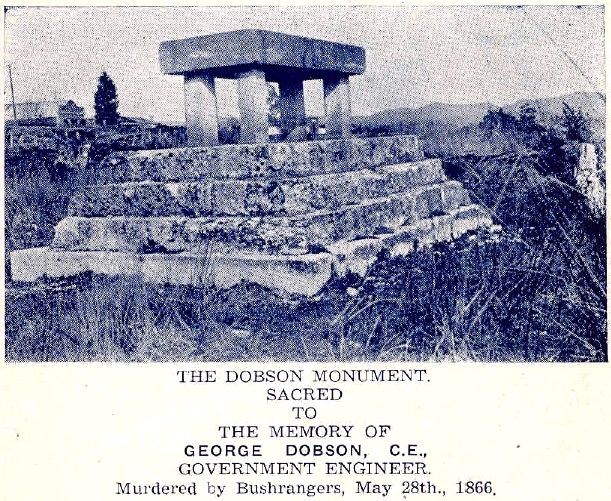
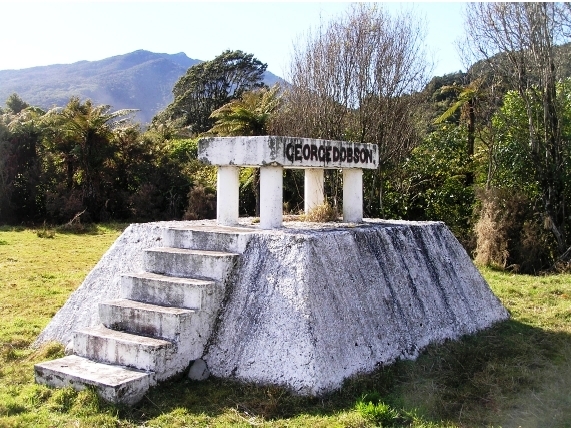
At the site of Dobson's death a tin plate had been nailed to a tree. The details of the decision to provide a more permanent memorial here are unclear but it is recorded that around 1872 a bricklayer from Greymouth constructed the simple structure. An inscribed stone slab was supported by four columns on a stepped stone base. In 1947, because the structure was deteriorating, concrete columns were inserted and the whole base was concreted over. The local community has continued to ensure that this memorial is retained


List Entry Information
Status
Listed
List Entry Status
Historic Place Category 2
Access
Able to Visit
List Number
1682
Date Entered
4th April 2008
Date of Effect
4th April 2008
City/District Council
Grey District
Region
West Coast Region
Extent of List Entry
Extent includes part of the land described as SO 4885 (NZ Gazette, 1896, p.1199), Westland Land District and the structure known as Dobson Monument thereon. (Refer to extent map tabled at Rārangi Kōrero meeting 9 June 2022)
Legal description
SO 4885 (NZ Gazette, 1896, p.1199), Westland Land District
Status
Listed
List Entry Status
Historic Place Category 2
Access
Able to Visit
List Number
1682
Date Entered
4th April 2008
Date of Effect
4th April 2008
City/District Council
Grey District
Region
West Coast Region
Extent of List Entry
Extent includes part of the land described as SO 4885 (NZ Gazette, 1896, p.1199), Westland Land District and the structure known as Dobson Monument thereon. (Refer to extent map tabled at Rārangi Kōrero meeting 9 June 2022)
Legal description
SO 4885 (NZ Gazette, 1896, p.1199), Westland Land District
Why is this place significant?
Cultural Significance
CULTURAL SIGNIFICANCE OR VALUE: The Dobson Monument has cultural significance through its association with the Dobson township, named after George Dobson, (1840-1866) who is commemorated by the monument. This monument erected by the local Westland people reflects their high esteem for Dobson and his work. The nation felt horror over the unlawful killing of this young man, leading to action being taken to ensure that he was commemorated at the place where he met his death.
Historic Significance
Historical Significance or Value The Dobson Monument has historical significance in commemorating George Dobson, a person of importance in the history of Canterbury and the West Coast because of the major role he played as an explorer and surveyor opening up routes through these regions. Dobson's murder in 1866 was an event that shocked this nation and was also publicised in Britain. In a perverse way, it also has an association with the notorious bushrangers who committed the murder. Known as the Burgess Gang, or the Maungatapu Murderers, they had a reputation that was the nearest equivalent in New Zealand to that of the Kelly Gang in Australia.
Why is this place Category 1 / Category 2?
Detail Of Assessed Criteria
Category of historic place (section 23(2)): Category II (Two) Criteria: b, e, h b)The association of the place with events, persons, or ideas of importance in New Zealand history. The Dobson Monument is associated with a notable individual, George Dobson, the eldest son of Edward Dobson who served as the Canterbury Provincial Engineer from 1854. As young men, George and his brother Arthur trained as engineers and surveyors with their father and by the 1860s the family worked together exploring the countryside, seeking the best routes between Canterbury and the West Coast. George had done major work in West Canterbury, as Westland was first known, and on the various passes. Because of his short life he is not as well known as his father and brother, but he was held in high regard by West Coast settlers. His murder on 28 May, 1866 was an event that caused alarm and distress in the district and a major stir nationally. The monument also provides a connection with an even more sensational multiple murder at Maungatapu in the Nelson region that led to the execution of three bushrangers who were also considered to be responsible for killing Dobson. e)The community association or public esteem for the place. There is a strong community association with the monument, particularly in Dobson township which was named after the victim. At the time of the murder there was no established township where Dobson died but the location took on his name after his death and the town which developed in association with the industrial activities at Brunner formally continued use of the name. In early 1868 the Westland County Council decided that a suitable memorial to Dobson should be provided in Hokitika. This illustrates the widespread public esteem in which Dobson was held at that time. In March 1868 a large obelisk made from Sydney sandstone and referred to as the 'Dobson Memorial', arrived from Melbourne. It was inscribed with plaques commemorating the untimely deaths of four of Westland's early explorers. At Dobson itself, the precise location of the event and Dobson's original burial site had been initially marked by a tin plate nailed to an adjacent tree and soon local people demonstrated their reverence for the place by building a permanent, inscribed stone memorial. It was modified in 1947 in order to enhance its longevity and it survives intact today. The present community ensure its maintenance and continue to regard the place as one of special significance. h)The symbolic or commemorative value of the place. The monument was constructed with the objective of commemorating George Dobson, a pioneering colonist held in high esteem for his work as explorer, surveyor and road engineer. Its erection shortly after his death illustrates the local community's determination that his work and the horrific circumstances of his death should be remembered. Located close to what has continued as a main road alongside the Grey River, the monument is clearly visible as a reminder to locals and an indicator for visitors and newcomers of this notable settler's life and tragic death.
Why is this place significant?
Cultural Significance
CULTURAL SIGNIFICANCE OR VALUE: The Dobson Monument has cultural significance through its association with the Dobson township, named after George Dobson, (1840-1866) who is commemorated by the monument. This monument erected by the local Westland people reflects their high esteem for Dobson and his work. The nation felt horror over the unlawful killing of this young man, leading to action being taken to ensure that he was commemorated at the place where he met his death.
Historic Significance
Historical Significance or Value The Dobson Monument has historical significance in commemorating George Dobson, a person of importance in the history of Canterbury and the West Coast because of the major role he played as an explorer and surveyor opening up routes through these regions. Dobson's murder in 1866 was an event that shocked this nation and was also publicised in Britain. In a perverse way, it also has an association with the notorious bushrangers who committed the murder. Known as the Burgess Gang, or the Maungatapu Murderers, they had a reputation that was the nearest equivalent in New Zealand to that of the Kelly Gang in Australia.
Why is this place Category 1 / Category 2?
Detail Of Assessed Criteria
Category of historic place (section 23(2)): Category II (Two) Criteria: b, e, h b)The association of the place with events, persons, or ideas of importance in New Zealand history. The Dobson Monument is associated with a notable individual, George Dobson, the eldest son of Edward Dobson who served as the Canterbury Provincial Engineer from 1854. As young men, George and his brother Arthur trained as engineers and surveyors with their father and by the 1860s the family worked together exploring the countryside, seeking the best routes between Canterbury and the West Coast. George had done major work in West Canterbury, as Westland was first known, and on the various passes. Because of his short life he is not as well known as his father and brother, but he was held in high regard by West Coast settlers. His murder on 28 May, 1866 was an event that caused alarm and distress in the district and a major stir nationally. The monument also provides a connection with an even more sensational multiple murder at Maungatapu in the Nelson region that led to the execution of three bushrangers who were also considered to be responsible for killing Dobson. e)The community association or public esteem for the place. There is a strong community association with the monument, particularly in Dobson township which was named after the victim. At the time of the murder there was no established township where Dobson died but the location took on his name after his death and the town which developed in association with the industrial activities at Brunner formally continued use of the name. In early 1868 the Westland County Council decided that a suitable memorial to Dobson should be provided in Hokitika. This illustrates the widespread public esteem in which Dobson was held at that time. In March 1868 a large obelisk made from Sydney sandstone and referred to as the 'Dobson Memorial', arrived from Melbourne. It was inscribed with plaques commemorating the untimely deaths of four of Westland's early explorers. At Dobson itself, the precise location of the event and Dobson's original burial site had been initially marked by a tin plate nailed to an adjacent tree and soon local people demonstrated their reverence for the place by building a permanent, inscribed stone memorial. It was modified in 1947 in order to enhance its longevity and it survives intact today. The present community ensure its maintenance and continue to regard the place as one of special significance. h)The symbolic or commemorative value of the place. The monument was constructed with the objective of commemorating George Dobson, a pioneering colonist held in high esteem for his work as explorer, surveyor and road engineer. Its erection shortly after his death illustrates the local community's determination that his work and the horrific circumstances of his death should be remembered. Located close to what has continued as a main road alongside the Grey River, the monument is clearly visible as a reminder to locals and an indicator for visitors and newcomers of this notable settler's life and tragic death.
Construction Professional
Name
Walton, J
Type
Builder
Biography
Built The Dobson Monument.
Construction Details
Start Year
1870
startYearCirca
Type
Original Construction
Description
Monument to Dobson erected by J. Walton.
Start Year
1866
Type
Other
Description
George Dobson murdered by bushrangers, 28th May.
Start Year
1947
startYearCirca
Type
Modification
Description
Concrete base, steps and support built by William Carse and others.
Construction Materials
Concrete base, supports and steps, stone top.
Construction Professional
Name
Walton, J
Type
Builder
Biography
Built The Dobson Monument.
Construction Details
Start Year
1870
startYearCirca
Type
Original Construction
Description
Monument to Dobson erected by J. Walton.
Start Year
1866
Type
Other
Description
George Dobson murdered by bushrangers, 28th May.
Start Year
1947
startYearCirca
Type
Modification
Description
Concrete base, steps and support built by William Carse and others.
Construction Materials
Concrete base, supports and steps, stone top.
The Dobson Monument commemorates Assistant District Engineer for Westland, George Dobson, who was murdered by a notorious gang in 1866. George Dobson, born in London in 1840, was the eldest son of Edward Dobson and Mary Ann Lough. In 1850 Edward Dobson emigrated to Canterbury, New Zealand, taking his two eldest sons, George and Arthur, along with him. Mary Ann and the remaining children joined them the following year. The two boys spent three years, 1851-3, in Tasmania with their uncle Rev. Charles Dobson while their education continued. In 1854, Edward Dobson was appointed as Canterbury Provincial Engineer and the two boys who had been working at odd jobs including milking cows and collecting firewood both trained with him, learning building skills, surveying and engineering. In the following years they worked both together and separately, exploring the Canterbury province. Westland was included as part of Canterbury until 1867 when the Westland Council was formed and then in 1873 it was given status as a separate province. With the West Coast gold rushes in progress and a practical route from Canterbury being sought, George reported on the feasibility of a track over the Southern Alps through what he referred to as Arthur's Pass as it had been first investigated by his brother Arthur. Arthur and George's father Edward, as provincial engineer, made the decision on George's recommendation that this should be the main route between Canterbury and the West Coast and the road opened on 29 March, 1866. At the top of this pass which remains as a principal route between the two provinces, there is also a 'Dobson monument' which commemorates its discovery by Arthur Dudley Dobson, aided by local Maori, in 1864. George continued working as engineer for the roading that was being constructed and in January 1866 he was appointed Assistant District Engineer for West Canterbury, as the area was still known. On 28th May 1866, as part of his normal professional programme, Dobson headed alone for Greymouth from Lake Brunner via the Arnold Track which he had surveyed the previous year. His purpose was to assess the track's condition. A gang of Australian bushrangers, Joseph Sullivan, Richard Burgess and Thomas Noon (Kelly), recently arrived on the West Coast from the Otago Goldfields, committed a number of violent crimes in the Ross/Hokitika region. They believed that a lucrative target, a diggings gold-buyer named Edward Fox, would be travelling in the Grey River area and Dobson was mistaken for him. He was killed so he could not give evidence of his attack. It was some time before it was realised that he was missing and meantime, the culprits made their way to Nelson. A detailed search was made for Dobson by police, assisted by a large number of volunteers and a reward was offered for information. On 12 June the gang's most horrendous crime occurred when they murdered five men at the diggings at Mt. Maungatapu near Nelson. To help his own position, Sullivan had turned Queen's evidence against his three accomplices but confessed to association with Dobson's killing and told the authorities where the body had been buried in a shallow grave some 30 yards (27.5 metres) off the Arnold track. On 5 July the grave was found, the body exhumed and on 7 July it was buried in the Greymouth cemetery. In pouring rain, the ceremony and procession to the cemetery at Greymouth's south beach was led by the Bishop of Christchurch with Edward Dobson, who had been assisting with the search, among the large crowd of mourners. He had requested that his son be buried between his fellow surveyors, Whitcombe and Townsend. These two early government employees had suffered the more typical 'national death' by drowning in West Coast rivers. There always has been doubt about who committed the murder. Richard Burgess, one of the trio that Sullivan had turned against, claimed that Sullivan had told him how he and an accomplice had dragged Dobson into the bush beside the track and strangled him. However, Burgess was trying to implicate Sullivan in retaliation for his treachery in turning Queen's evidence. Burgess and the two others were subsequently hanged while Sullivan went free. A man named Wilson was charged with Dobson's murder, with Sullivan giving evidence against him, but was acquitted. When Sullivan was brought to Hokitika in 1866 for this case he was fortunate to avoid lynching by an angry crowd of townspeople. The public perception of his guilt remained and he was kept under police protection until he could be removed from the country. It is believed that he lived in hiding in Ballarat, Victoria, where he eventually died in misery. Nobody else was ever charged over the murder and whether it was Sullivan alone or in partnership with Kelly and Burgess was never established. Philip May in his book The West Coast Gold Rushes, p.298 states that 'Murder was rare on the West Coast diggings'. He continues to recount the story of Dobson's death and explains that only two other premeditated murders were known to have occurred in these times in the West Coast area. David Burton, editor of Confessions of Richard Burgess :the Maungatapu murders and other grisly crime, pp.9-13, reaches similar conclusions about crime on the New Zealand goldfields. There were numerous unlawful deeds on the goldfields which Burton explains was not surprising, but more surprising is that there were not more. He further comments that, 'compared to the goldfields of Australia and California, the New Zealand goldfield were remarkably orderly'. The irony of Dobson's murder was that this particularly vicious gang mistook him for the known gold buyer returning to Greymouth with his purchases and killed him not for gain, but to ensure he could not identify them. By 1867 the recently established Westland Council voted to provide a suitable monument to commemorate Dobson. It was agreed that three other recently deceased officials also be remembered - Henry Whitcombe, road surveyor, Charles Townsend, government agent and Charlton Howith, explorer - and a grand Sydney sandstone obelisk was commissioned to be made in Melbourne. It was the first and only stone monument in Westland when it was erected on 23 March, 1868. The memorial to Dobson at the site of his death appears to have been erected in the early 1870s by a Mr J. Walton. Bill Carse, a long time resident of Dobson, said in 1947 that he had been told by Mr Walton's son that his father had built it about 75 years before. A photo (appendix 3) shows it was a four-stepped stone structure with four vertical timber posts supporting the engraved stone. Mr Carse further noted that the under-structure had recently weathered to the point where it was considered a danger to visitors, so he and others had replaced it with a concrete structure that would 'last for all time'. He also said that when he was a boy (probably about the late 19th century) he recalled the then surviving adjacent tree, with a tin plate nailed to it to indicate where the murder had been committed. The original permanent memorial was of stone construction and of similar appearance. It is likely that the work done in c.1947 simply concreted over the original base structure and replaced the eroding posts with concrete ones to support the surmounting stone slab. Although various other information sources have been searched, no further facts have been found about who made the decision or financed the erection of this monument. His brother in the reminiscences he wrote in 1930 makes no mention of commemoration of his brother's death so it cannot be concluded that the family erected the monument. It was probably a low key initiative by a group of locals wanting to ensure that apart from the official memorials at Hokitika and in the Greymouth cemetery, a fitting marker should identify the place of Dobson's death. The Dobson Monument remains as a landmark for travellers in the Grey River valley along State Highway 7 at the Dobson township. It continues as a reminder of the tragic death of the 26 year old road engineer and surveyor whose work contributed so much to the early development of Westland.
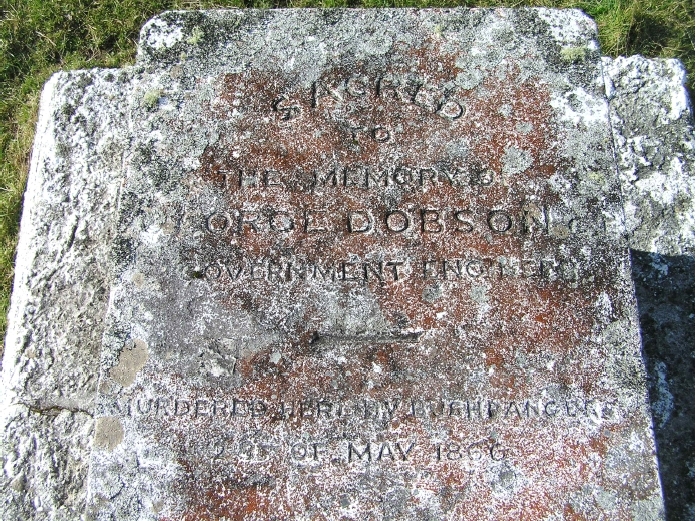
The Dobson Monument stands on a grassed section north-west of Dobson township, between the Greymouth-Stillwater railway line and the Grey River. It is clearly visible to those travelling north from Greymouth on State Highway 7, being located on the left side of the road on a relatively narrow stretch of open land. The monument consists of the original horizontal stone slab (1870s) that has since 1947 been mounted on four concrete posts resting on a concrete plinth. The slab has the appearance of a large headstone and is 184 centimetres x 92 centimetres and 25 centimetres thick. The top of the stone is inscribed: SACRED TO THE MEMORY OF GEORGE DOBSON GOVERNMENT ENGINEER MURDERED HERE BY BUSHRANGERS 28th OF MAY, 1866 The stone also has 'GEORGE DOBSON' along the south-eastern edge. The slab is mounted on four vertical concrete posts, 57 centimetres high and 67 centimetres in circumference. The concrete plinth is 27 metres x 2 metres at the top, bevelling to 4 metres x 3 metres at the base with five steps .920 metres wide on the south-western face. The plinth has a roughcast finish.
Historical and Associated Iwi / Hapū / Whānau
Completion Date
19th March 2008
Report Written By
Pam Wilson, Les Wright
Information Sources
Burton, 1983
David Burton, Confessions of Richard Burgess, A.H. & A.W. Reed Ltd., 1983.
Dobson, 1930
A Dobson. Reminiscences of Arthur Dudley Dobson: Engineer 1841-1930. Second edition. Whitcombe and Tombs Limited. 1930
Furkert, 1953
Frederick William Furkert, Early New Zealand Engineers, Wellington, 1953
Wood, 2004
Wood, Brian, The Heritage and Environment of Coal Gorge and the Brunner Suspension Bridge, Greymouth, 2004.
May, 1962
Philip Ross May. The West Coast Gold Rushes, 1962.
Other Information
A fully referenced registration report is available from the NZHPT Southern Region office Please note that entry on the New Zealand Heritage List/Rarangi Korero identifies only the heritage values of the property concerned, and should not be construed as advice on the state of the property, or as a comment of its soundness or safety, including in regard to earthquake risk, safety in the event of fire, or insanitary conditions.
Historical and Associated Iwi / Hapū / Whānau
Completion Date
19th March 2008
Report Written By
Pam Wilson, Les Wright
Information Sources
Burton, 1983
David Burton, Confessions of Richard Burgess, A.H. & A.W. Reed Ltd., 1983.
Dobson, 1930
A Dobson. Reminiscences of Arthur Dudley Dobson: Engineer 1841-1930. Second edition. Whitcombe and Tombs Limited. 1930
Furkert, 1953
Frederick William Furkert, Early New Zealand Engineers, Wellington, 1953
Wood, 2004
Wood, Brian, The Heritage and Environment of Coal Gorge and the Brunner Suspension Bridge, Greymouth, 2004.
May, 1962
Philip Ross May. The West Coast Gold Rushes, 1962.
Other Information
A fully referenced registration report is available from the NZHPT Southern Region office Please note that entry on the New Zealand Heritage List/Rarangi Korero identifies only the heritage values of the property concerned, and should not be construed as advice on the state of the property, or as a comment of its soundness or safety, including in regard to earthquake risk, safety in the event of fire, or insanitary conditions.
Current Usages
Uses: Civic Facilities
Specific Usage: Statue/public art
Uses: Commemoration
Specific Usage: Memorial - Particular person or group
Former Usages
General Usage: Civic Facilities
Specific Usage: Statue/public art
General Usage: Commemoration
Specific Usage: Memorial - Particular person or group
Current Usages
Uses: Civic Facilities
Specific Usage: Statue/public art
Uses: Commemoration
Specific Usage: Memorial - Particular person or group
Former Usages
General Usage: Civic Facilities
Specific Usage: Statue/public art
General Usage: Commemoration
Specific Usage: Memorial - Particular person or group
Location
Stay up to date with Heritage this month