The Courthouse at Reefton on the West Coast has been a distinctive feature of the small town since it was constructed in 1872. Reefton was founded after the discovery of quartz reefs in the surrounding Inangahua region in 1870. The Inangahua quartz field became the most important goldfield in New Zealand after the Hauraki field declined and between 1870-1914 produced nearly five million pounds worth of gold. As with other towns that owe their origins to the discovery of gold, the first formal representation of colonial law in Reefton was the appointment of a resident warden. Wardens issued miners' rights, registered mine leases and settled mining disputes. Charles Broad, Reefton's first resident warden, who later acted as the resident magistrate, recommended the construction of the courthouse soon after the town was laid out in 1872.
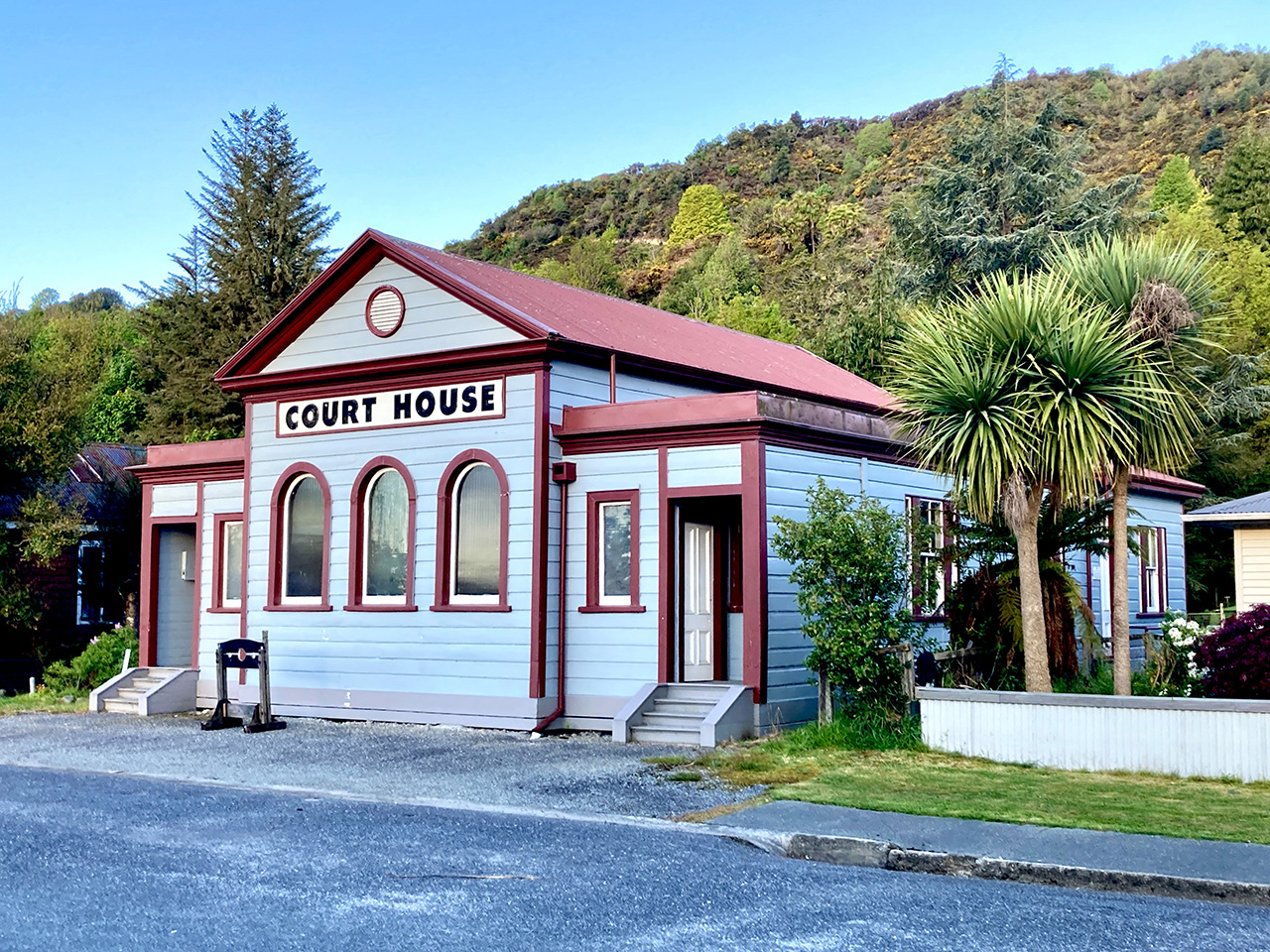
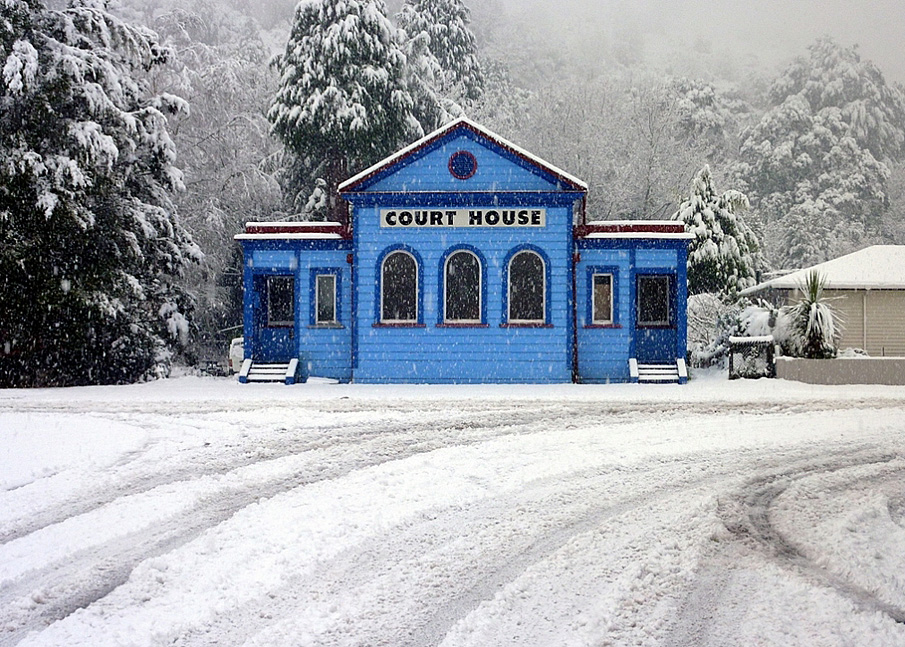
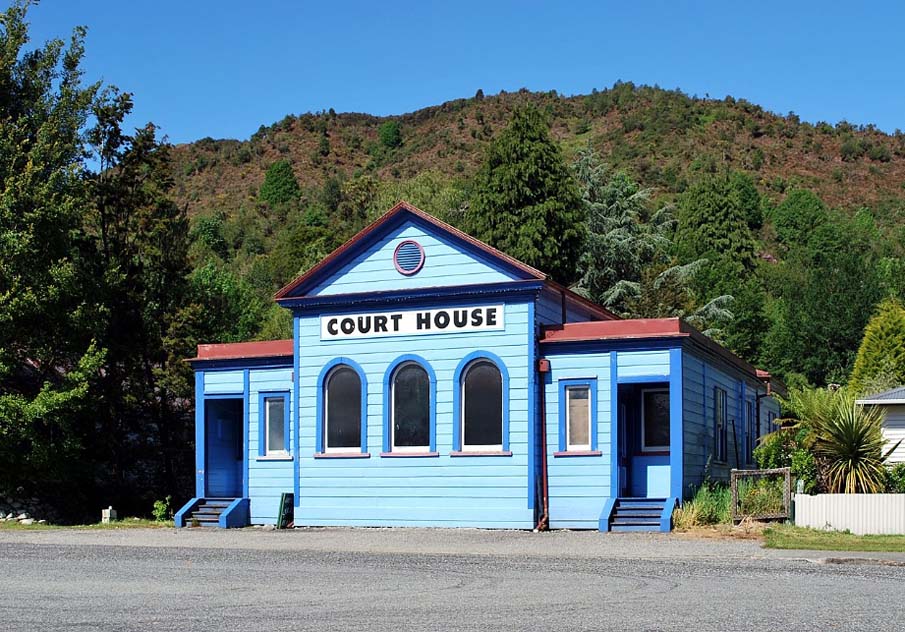
The Reefton Courthouse is a single-storey building, with a central courtroom with a gable roof, flanked by two small, flat-roofed wings. These side wings originally comprised the main entrances to the court as well as offices for the magistrate, lawyers and witnesses who appeared before the court. A circular ventilator under the main gable, three round-headed windows and a simple cornice provide a decorative effect to the front façade. The courtroom was fitted out with a judge's bench, dock, witness stand and jury recess and was lit by clerestory windows. The jury recess is of particular interest being a small alcove with a raised floor and a curved rear wall, which projects into the two offices behind it. Later additions, erected around 1897, added offices, a brick strong room, a public inquiries counter and a waiting room to the rear of the building. The only access to these is through an external entrance on the south side of the building. Originally the courthouse was roofed with shingles. These were replaced with corrugated iron at a later date.
The Courthouse was designed under the aegis of William Henry Clayton (1823-1877), New Zealand's only Colonial Architect, from 1869 until his death in 1877. Clayton was responsible for the design of a number of courthouses throughout New Zealand. These typically consisted of a central section with a long low gabled roof, which housed the courtroom and either one or two flanking wings which contained offices for the judge, clerk of the court and so on. These lower wings generally had hipped roofs and the entrance to the building was through a porch located in the side wing. In these small courthouses the Italianate-influenced style that Clayton favoured was expressed in the alternating square and round-headed windows and the decorative timber brackets. Lapped weatherboarding was commonly used as cladding. While the Reefton Courthouse has many of these features, it differs slightly in that the two side wings have flat roofs, there are three round-headed windows on the front façade, the gable is higher and more compact than was typical of Clayton's designs and it is clad in rusticated weatherboards. It is difficult at the moment to confidently assign the design of the Courthouse at Reefton to Clayton, although it was probably produced in his office.
The Courthouse at Reefton served the town for almost 100 years. It closed in 1972 and the hearing of court cases was transferred to either Westport or Greymouth. The building was saved from demolition by the local community and gazetted as an historic reserve in 1979, thus coming under the ownership of the Department of Conservation. The control and management of the courthouse was vested in the Reefton Historic Trust Board, which has maintained and conserved the building, and leased part of it as artists' studios. The main courtroom is used for community events and for meetings by a religious group.
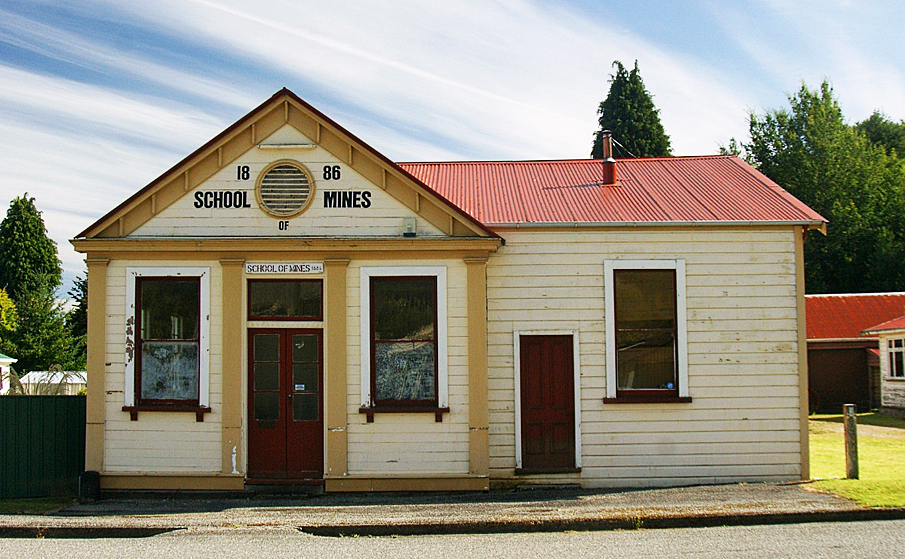
The Reefton Courthouse forms an important part of Reefton's historic townscape, which includes the former surveyor's residence (1871), a former bank (1874), two churches and the School of Mines (1886). As one of the town's earliest buildings it illustrates the important role played by the judiciary in the West Coast mining settlements of the nineteenth century and served as the local courtroom for nearly 100 years. It was designed under the aegis of Colonial Architect William Clayton and contains some interesting variants on his standard designs of small provincial courthouses. The Courthouse is of immense importance to the local community, as witnessed by their endeavours to save, preserve and find a new use for the building since the 1970s. The community's success in this regard has led to an increased interest in Reefton's heritage and the preservation of a number of other historic buildings in the town.
The Reefton Courthouse is a single-storey building, with a central courtroom with a gable roof, flanked by two small, flat-roofed wings. These side wings originally comprised the main entrances to the court as well as offices for the magistrate, lawyers and witnesses who appeared before the court. A circular ventilator under the main gable, three round-headed windows and a simple cornice provide a decorative effect to the front façade. The courtroom was fitted out with a judge's bench, dock, witness stand and jury recess and was lit by clerestory windows. The jury recess is of particular interest being a small alcove with a raised floor and a curved rear wall, which projects into the two offices behind it. Later additions, erected around 1897, added offices, a brick strong room, a public inquiries counter and a waiting room to the rear of the building. The only access to these is through an external entrance on the south side of the building. Originally the courthouse was roofed with shingles. These were replaced with corrugated iron at a later date.
The Courthouse was designed under the aegis of William Henry Clayton (1823-1877), New Zealand's only Colonial Architect, from 1869 until his death in 1877. Clayton was responsible for the design of a number of courthouses throughout New Zealand. These typically consisted of a central section with a long low gabled roof, which housed the courtroom and either one or two flanking wings which contained offices for the judge, clerk of the court and so on. These lower wings generally had hipped roofs and the entrance to the building was through a porch located in the side wing. In these small courthouses the Italianate-influenced style that Clayton favoured was expressed in the alternating square and round-headed windows and the decorative timber brackets. Lapped weatherboarding was commonly used as cladding. While the Reefton Courthouse has many of these features, it differs slightly in that the two side wings have flat roofs, there are three round-headed windows on the front façade, the gable is higher and more compact than was typical of Clayton's designs and it is clad in rusticated weatherboards. It is difficult at the moment to confidently assign the design of the Courthouse at Reefton to Clayton, although it was probably produced in his office.
The Courthouse at Reefton served the town for almost 100 years. It closed in 1972 and the hearing of court cases was transferred to either Westport or Greymouth. The building was saved from demolition by the local community and gazetted as an historic reserve in 1979, thus coming under the ownership of the Department of Conservation. The control and management of the courthouse was vested in the Reefton Historic Trust Board, which has maintained and conserved the building, and leased part of it as artists' studios. The main courtroom is used for community events and for meetings by a religious group.
The Reefton Courthouse forms an important part of Reefton's historic townscape, which includes the former surveyor's residence (1871), a former bank (1874), two churches and the School of Mines (1886). As one of the town's earliest buildings it illustrates the important role played by the judiciary in the West Coast mining settlements of the nineteenth century and served as the local courtroom for nearly 100 years. It was designed under the aegis of Colonial Architect William Clayton and contains some interesting variants on his standard designs of small provincial courthouses. The Courthouse is of immense importance to the local community, as witnessed by their endeavours to save, preserve and find a new use for the building since the 1970s. The community's success in this regard has led to an increased interest in Reefton's heritage and the preservation of a number of other historic buildings in the town.