

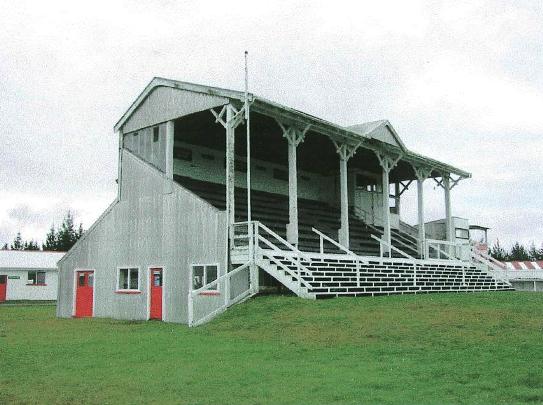
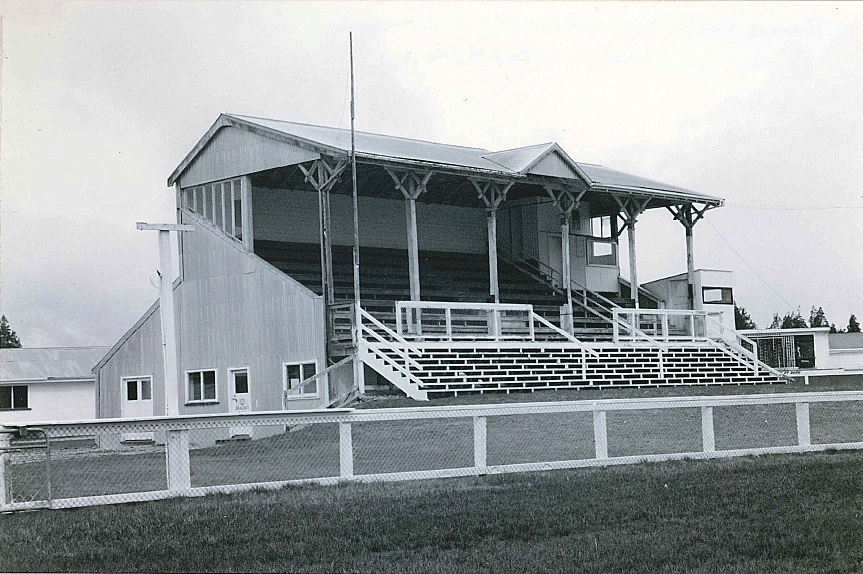
The stand was originally an open structure but was roofed over in 1901 by Mr H. Mordaunt. Following a 1948 report that the stand was unsound, substantial repairs were undertaken and some modernisation was carried out.
The club has battled financial problems throughout its life, and has been threatened with closure on more than one occasion. In both 1905 and 1920, it survived only through the generosity of members. In 1948, the Report of the Royal Commission on Gaming and Racing recommended that the club's licence be revoked. The public rallied around, and the 1949 meeting broke all records. Despite this enthusiasm however, the club continued to struggle against enforced centralisation through the 1960s and 70s. [In the early 1980s Prime Minister Robert Muldoon intervened on behalf of the locals to retain the races at Kumara].
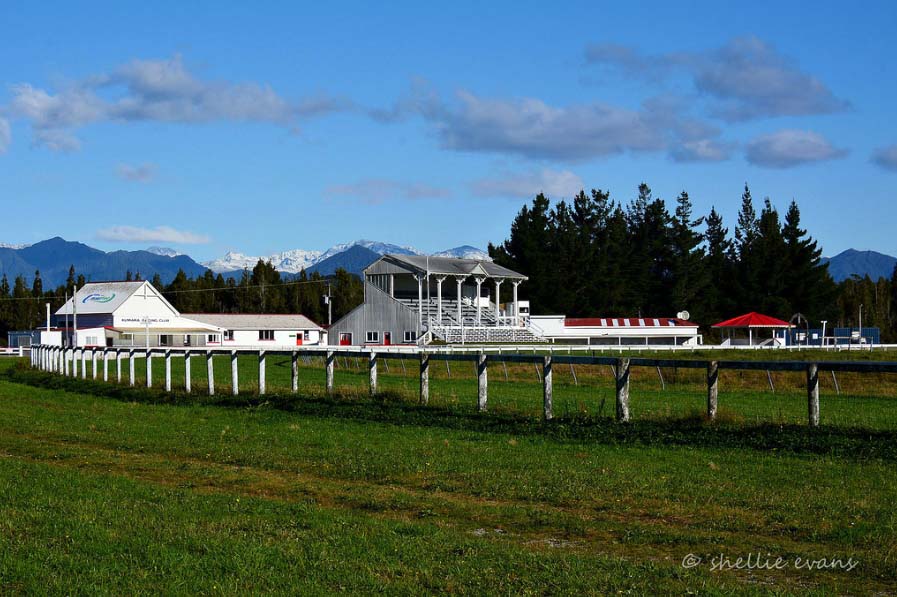
Today the fate of the club rests with the Racing Authority, who hold that if a club is funded and maintained locally, it is not opposed to their continuing. As of 2004, the Kumara Racing Club is still in the running, supported by the entire Kumara community, rather than just racing-focussed persons. The race meeting held on 10th January 2004 reflected the general interest that the event attracts today, with a large crowd patronising what has become an iconic event. Many people journeyed long distances to enjoy the festive, picnic atmosphere. A new feature of the racecourse amenities is the 115 year old band rotunda, donated by the Greymouth Jockey Club and recently relocated from Omoto. The restoration was funded by a former Kumara resident Cushla Martini and her husband Barry Colman (National Business Review owners.) The renowned Kokatahi Band performed here this year as they have done as long as anyone can remember.
The Kumara Racing Club leases the property from the Westland District Council, paying $52 per annum. The club is responsible for the upkeep of all the facilities.
List Entry Information
Status
Listed
List Entry Status
Historic Place Category 2
Access
Private/No Public Access
List Number
1692
Date Entered
2nd April 2004
Date of Effect
2nd April 2004
City/District Council
Westland District
Region
West Coast Region
Extent of List Entry
Extent includes part of the land described Lot 1 DP 404269 (RTs 414745 and 546080), Westland Land District and the building known as Kumara Racecourse Grandstand thereon (refer to map tabled at the Rārangi Kōrero Committee Meeting on 9 June 2022).
Legal description
Lot 1 DP 404269 (RTs 414745 and 546080), Westland Land District
Status
Listed
List Entry Status
Historic Place Category 2
Access
Private/No Public Access
List Number
1692
Date Entered
2nd April 2004
Date of Effect
2nd April 2004
City/District Council
Westland District
Region
West Coast Region
Extent of List Entry
Extent includes part of the land described Lot 1 DP 404269 (RTs 414745 and 546080), Westland Land District and the building known as Kumara Racecourse Grandstand thereon (refer to map tabled at the Rārangi Kōrero Committee Meeting on 9 June 2022).
Legal description
Lot 1 DP 404269 (RTs 414745 and 546080), Westland Land District
Why is this place significant?
Historic Significance
Historical Significance or Value The Kumara Racing Club Grandstand has historical and social significance as a reminder of the important place racing occupied in the communal life of late nineteenth and twentieth century New Zealand.
Why is this place Category 1 / Category 2?
Detail Of Assessed Criteria
(a) it is a fine representative example of grandstands erected by smaller racing clubs throughout New Zealand in the late nineteenth and early twentieth centuries. The stand is a landmark structure on the western approach to the township, and symbolizes the former significance of this once populous gold town. (e) The stand also has strong community associations as a central focus for the racecourse, which has been kept vital through the ongoing efforts of generations of local people.
Why is this place significant?
Historic Significance
Historical Significance or Value The Kumara Racing Club Grandstand has historical and social significance as a reminder of the important place racing occupied in the communal life of late nineteenth and twentieth century New Zealand.
Why is this place Category 1 / Category 2?
Detail Of Assessed Criteria
(a) it is a fine representative example of grandstands erected by smaller racing clubs throughout New Zealand in the late nineteenth and early twentieth centuries. The stand is a landmark structure on the western approach to the township, and symbolizes the former significance of this once populous gold town. (e) The stand also has strong community associations as a central focus for the racecourse, which has been kept vital through the ongoing efforts of generations of local people.
Construction Professional
Name
Morduant, H
Type
Builder
Biography
No biography is currently available for this construction professional
Name
Corbett, James
Type
Builder
Biography
No biography is currently available for this construction professional
Construction Details
Start Year
1887
Type
Original Construction
Start Year
1901
Type
Modification
Description
Canopy added.
Type
Modification
Description
Decorative front balustrading removed.
Period
1950s
Type
Modification
Description
Extra seating added at front, contemporary windows and doors fitted, weatherboards replaced with corrugated iron.
Period
post-1959
Construction Materials
Timber framed, sheathed in corrugated iron.
Construction Professional
Name
Morduant, H
Type
Builder
Biography
No biography is currently available for this construction professional
Name
Corbett, James
Type
Builder
Biography
No biography is currently available for this construction professional
Construction Details
Start Year
1887
Type
Original Construction
Start Year
1901
Type
Modification
Description
Canopy added.
Type
Modification
Description
Decorative front balustrading removed.
Period
1950s
Type
Modification
Description
Extra seating added at front, contemporary windows and doors fitted, weatherboards replaced with corrugated iron.
Period
post-1959
Construction Materials
Timber framed, sheathed in corrugated iron.
This is a utilitarian grandstand with a single tier of seating, covered by a gabled canopy supported on timber posts. The canopy is decorated with a small central gable at right angles to the roof. Timber brackets form a decorative finish on the supporting front posts and originally there was an open timber balustrading along the front of the stand. This was lost when seating was provided down the slope in front of the stand. There have been several further alterations over the years as the local club has sought to upgrade facilities but the basic form and character of the structure remains unchanged. Service rooms fit under the stand and in the lean-to at the rear.
This is a utilitarian grandstand with a single tier of seating, covered by a gabled canopy supported on timber posts. The canopy is decorated with a small central gable at right angles to the roof. Timber brackets form a decorative finish on the supporting front posts and originally there was an open timber balustrading along the front of the stand. This was lost when seating was provided down the slope in front of the stand. There have been several further alterations over the years as the local club has sought to upgrade facilities but the basic form and character of the structure remains unchanged. Service rooms fit under the stand and in the lean-to at the rear.
Historical and Associated Iwi / Hapū / Whānau
Completion Date
7th September 2004
Report Written By
Pam Wilson
Information Sources
Anon, 1987
Anon., An Historical Review to Commemorate 100 Years of Racing by the Kumara Racing Club 1987(?)
New Zealand Historic Places Trust (NZHPT)
New Zealand Historic Places Trust
Other Information
A fully referenced version of this report is available from the NZHPT Southern Region Office. Please note that entry on the New Zealand Heritage List/Rarangi Korero identifies only the heritage values of the property concerned, and should not be construed as advice on the state of the property, or as a comment of its soundness or safety, including in regard to earthquake risk, safety in the event of fire, or insanitary conditions.
Historical and Associated Iwi / Hapū / Whānau
Completion Date
7th September 2004
Report Written By
Pam Wilson
Information Sources
Anon, 1987
Anon., An Historical Review to Commemorate 100 Years of Racing by the Kumara Racing Club 1987(?)
New Zealand Historic Places Trust (NZHPT)
New Zealand Historic Places Trust
Other Information
A fully referenced version of this report is available from the NZHPT Southern Region Office. Please note that entry on the New Zealand Heritage List/Rarangi Korero identifies only the heritage values of the property concerned, and should not be construed as advice on the state of the property, or as a comment of its soundness or safety, including in regard to earthquake risk, safety in the event of fire, or insanitary conditions.
Current Usages
Uses: Civic Facilities
Specific Usage: Horse racing course/track
Former Usages
General Usage: Civic Facilities
Specific Usage: Horse racing course/track
Themes
Sport
Current Usages
Uses: Civic Facilities
Specific Usage: Horse racing course/track
Former Usages
General Usage: Civic Facilities
Specific Usage: Horse racing course/track
Themes
Sport
Location
Sign up to hear more
Get the latest heritage news, features and events delivered
straight to your inbox.
