

Closely associated with this government building boom was the architect John Campbell (1857-1942), who joined the Public Works Department in 1883 and became Draughtsman in Charge of the Architectural Branch of the department from 1889. Campbell was responsible for the design of government buildings throughout New Zealand for over thirty years (until his retirement in 1922), and established Imperial Baroque as the official style for government buildings. The Government Building at Greymouth is an example of his later, more restrained work. While the open-bed pediments and oversized keystones typical of Campbell's design remain, there is little other exterior ornamentation.
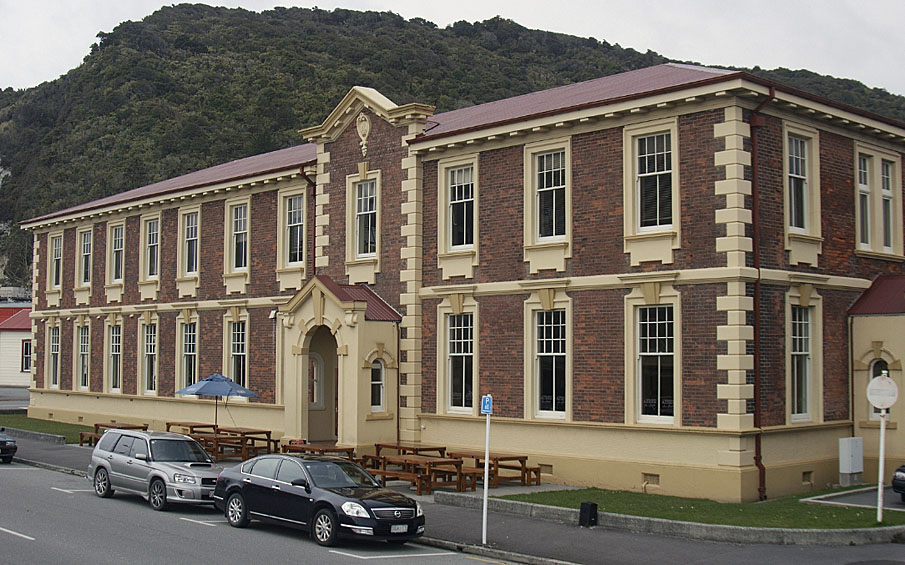
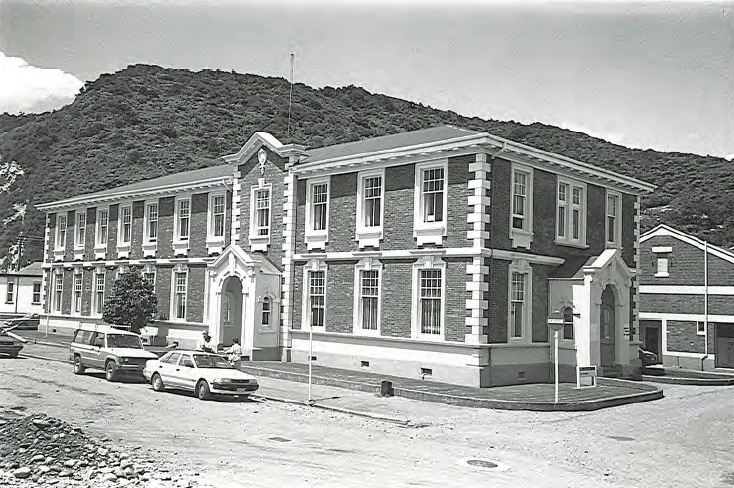
Early photographs show the Government Building standing along the riverfront, distinguished by its separation from the main town and by its size and solidity. The two-storey building is of cavity brick construction and has a hipped roof. When first built the building had a central entrance flanked by three bays on either side. Four more bays were added to the eastern end some time after 1938, thus placing the front entrance off to one side. A second entrance exists at the west end of the building, providing separate access to the upper floor offices. Both entrances have identical concrete porches with gabled roofs and large arched openings under open-bed pediments. Inside, central hallways on both floors provide access to the numerous offices.
Officers of New Zealand Railways and the Public Work Department initially occupied the building. Over the years it has also housed officials from the Ministry of Agriculture and Fisheries and from the Mines and Geological Survey Department. A single-storey building, situated to the rear of the main block, was made from the same materials and used as a store and then as a laboratory.
The Government Building at Greymouth is a distinguished feature of the Greymouth townscape. It stands as a fine example of Campbell's later work and serves as a reminder of both the building programme of the Liberals and of the central government presence throughout New Zealand.
List Entry Information
Status
Listed
List Entry Status
Historic Place Category 1
Access
Private/No Public Access
List Number
1696
Date Entered
28th June 1990
Date of Effect
28th June 1990
City/District Council
Grey District
Region
West Coast Region
Extent of List Entry
Extent includes the land described as Lot 1 DP 2696 and Sec 1 SO 11689 (RT WS8B/300), Westland Land District, and the building known as Government Building (Former) thereon.
Legal description
Lot 1 DP 2696 and Sec 1 SO 11689 (RT WS8B/300), Westland Land District
Status
Listed
List Entry Status
Historic Place Category 1
Access
Private/No Public Access
List Number
1696
Date Entered
28th June 1990
Date of Effect
28th June 1990
City/District Council
Grey District
Region
West Coast Region
Extent of List Entry
Extent includes the land described as Lot 1 DP 2696 and Sec 1 SO 11689 (RT WS8B/300), Westland Land District, and the building known as Government Building (Former) thereon.
Legal description
Lot 1 DP 2696 and Sec 1 SO 11689 (RT WS8B/300), Westland Land District
Why is this place significant?
Historic Significance
Historical Significance or Value Greymouth's Government Building was one of a large number of public buildings erected for the government during an extensive building programme which was initiated by Richard Seddon, when he was Minister of Works (1891-95), and subsequently maintained by his successor, William Hall-Jones (1896-1908).
Physical Significance
ARCHITECTURAL QUALITY: John Campbell had established Edwardian Baroque as the style of government architecture in New Zealand by the 1890s and the Government Building in Greymouth is a good example of the more restrained character of the architect's later work in this style. Featuring the open-bed pediments which are a characteristic of his work, the building is virtually unaltered and stands as a reminder of John Campbell's considerable contribution to government architecture in this country. TOWNSCAPE/LANDMARK VALUE: The Government Building is a distinguished feature of the Greymouth townscape, although the building's location is not a particularly sympathetic one.
Why is this place significant?
Historic Significance
Historical Significance or Value Greymouth's Government Building was one of a large number of public buildings erected for the government during an extensive building programme which was initiated by Richard Seddon, when he was Minister of Works (1891-95), and subsequently maintained by his successor, William Hall-Jones (1896-1908).
Physical Significance
ARCHITECTURAL QUALITY: John Campbell had established Edwardian Baroque as the style of government architecture in New Zealand by the 1890s and the Government Building in Greymouth is a good example of the more restrained character of the architect's later work in this style. Featuring the open-bed pediments which are a characteristic of his work, the building is virtually unaltered and stands as a reminder of John Campbell's considerable contribution to government architecture in this country. TOWNSCAPE/LANDMARK VALUE: The Government Building is a distinguished feature of the Greymouth townscape, although the building's location is not a particularly sympathetic one.
Construction Professional
Name
Campbell, John
Type
Architect
Biography
John Campbell (1857-1942) served his articles under John Gordon (c1835-1912) in Glasgow. He arrived in Dunedin in 1882 and after a brief period as a draughtsman with Mason and Wales joined the Dunedin branch of the Public Works Department in 1883. His first known work, an unbuilt design for the Dunedin Railway Station, reveals an early interest in Baroque architecture. In November 1888 Campbell was transferred to Wellington where in 1889 he took up the position of draughtsman in charge of the Public Buildings Division of the Public Works Department. He remained in charge of the design of government buildings throughout New Zealand until his retirement in 1922, becoming in 1909 the first person to hold the position of Government Architect. Government architecture designed under his aegis evidences a change in style from Queen Anne to Edwardian Baroque. His best-known Queen Anne design is the Dunedin Police Station (1895-8), modelled on Richard Norman Shaw's New Scotland Yard (1887-90). Among his most exuberant Edwardian Baroque buildings is the Public Trust Office, Wellington (1905-09). Although Campbell designed the Dunedin Law Courts (1899-1902) in the Gothic style with a Scottish Baronial inflection, he established Edwardian Baroque as the government style for police stations, courthouses and post offices throughout New Zealand. In 1911 Campbell won the nation-wide architectural competition for the design of Parliament Buildings, Wellington. Although only partially completed, Parliament House is the crowning achievement of Campbell's career.
Construction Details
Start Year
1909
Finish Year
1910
Type
Original Construction
Description
The contract for the Government Building, Greymouth was let on 16 March 1909, to Kelsall and Son of Greymouth. It was due to be completed on 16 December of the same year, but in fact was not completed until 31 January 1910.
Start Year
1938
startYearCirca
Type
Addition
Description
Extra section added to eastern end of building
Construction Materials
Concrete foundations, brick walls and cement trim, corrugated iron roof.
Notable Features
The building is slightly unusual in that all four elevations have been given the same decorative treatment and because there are two main entrances which provide separate access.
Construction Professional
Name
Campbell, John
Type
Architect
Biography
John Campbell (1857-1942) served his articles under John Gordon (c1835-1912) in Glasgow. He arrived in Dunedin in 1882 and after a brief period as a draughtsman with Mason and Wales joined the Dunedin branch of the Public Works Department in 1883. His first known work, an unbuilt design for the Dunedin Railway Station, reveals an early interest in Baroque architecture. In November 1888 Campbell was transferred to Wellington where in 1889 he took up the position of draughtsman in charge of the Public Buildings Division of the Public Works Department. He remained in charge of the design of government buildings throughout New Zealand until his retirement in 1922, becoming in 1909 the first person to hold the position of Government Architect. Government architecture designed under his aegis evidences a change in style from Queen Anne to Edwardian Baroque. His best-known Queen Anne design is the Dunedin Police Station (1895-8), modelled on Richard Norman Shaw's New Scotland Yard (1887-90). Among his most exuberant Edwardian Baroque buildings is the Public Trust Office, Wellington (1905-09). Although Campbell designed the Dunedin Law Courts (1899-1902) in the Gothic style with a Scottish Baronial inflection, he established Edwardian Baroque as the government style for police stations, courthouses and post offices throughout New Zealand. In 1911 Campbell won the nation-wide architectural competition for the design of Parliament Buildings, Wellington. Although only partially completed, Parliament House is the crowning achievement of Campbell's career.
Construction Details
Start Year
1909
Finish Year
1910
Type
Original Construction
Description
The contract for the Government Building, Greymouth was let on 16 March 1909, to Kelsall and Son of Greymouth. It was due to be completed on 16 December of the same year, but in fact was not completed until 31 January 1910.
Start Year
1938
startYearCirca
Type
Addition
Description
Extra section added to eastern end of building
Construction Materials
Concrete foundations, brick walls and cement trim, corrugated iron roof.
Notable Features
The building is slightly unusual in that all four elevations have been given the same decorative treatment and because there are two main entrances which provide separate access.
The building was erected in 1909 and was probably constructed by local contractors supervised by the Public Works Department. New Zealand Railways staff has occupied part of the building since the late 1930s when the nearby station building became too small to house all of the branch's staff.
The building was erected in 1909 and was probably constructed by local contractors supervised by the Public Works Department. New Zealand Railways staff has occupied part of the building since the late 1930s when the nearby station building became too small to house all of the branch's staff.
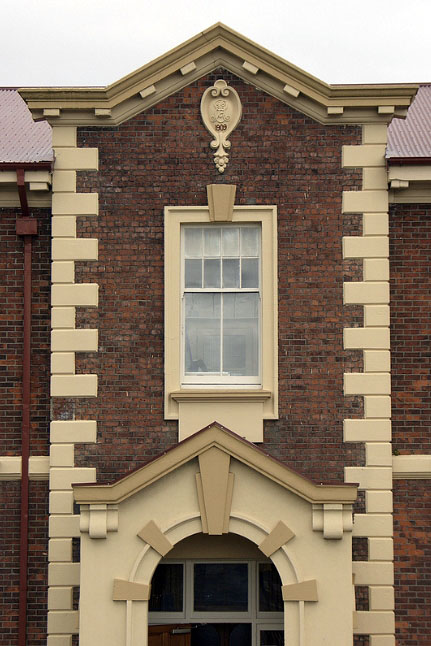
ARCHITECTURAL DESCRIPTION: Standing near the Greymouth Railway Station at the eastern end of township, the Government Building is a two storeyed edifice with a hipped roof and very restrained Edwardian Baroque ornamentation. Eleven bays long and three bays in width, the building has blocked eaves, concrete quoins and window surrounds, and a prominent string course. Large double-hung sash windows light both floors. The lower sash in each is bisected by a single mullion whilst the upper sashes on the ground floor are divided into twelve panes and those on the first floor into eight. A less subtle difference between the two storeys is the use of oversize keystones above the ground floor windows and concrete aprons below those on the first floor. The principal elevation facing Mawhera Quay has an off-centre entrance bay but the regularity of the window treatment, which is repeated on all four elevations, gives the building an ordered, predominantly symmetrical appearance. There are two main entrances to the Government Building, one off Mawhera Quay which provides access to the ground floor offices and another off Custom Street by which one gains entry to the first floor via a dog-leg staircase. Identical porches, which are entirely clad in concrete, shelter both doorways. The porches have gabled roofs, large arched openings beneath open-bed pediments, and are lit by small arched windows with decorative hood moulds. The entrance porch on the Mawhera Quay elevation is set within a bay which projects slightly forward of the building and is framed by quoins. The bay is crowned by an open-bed pediment which rises above the main roof line and below this is a plaster medallion which bears the legend '1909'. Inside the building central hallways extend the length of both floors, providing access to numerous offices and service rooms. Hall arches introduce a decorative element to the interior which is generally more serviceable than ceremonial. A small staircase connects the ground floor with the main staircase and a fire escape from the first floor is provided at the rear of the building. MODIFICATIONS: In recent years a number of internal walls on the first floor have been removed and replaced by partition walls which subdivided some of the larger offices into several smaller ones.
ARCHITECTURAL DESCRIPTION: Standing near the Greymouth Railway Station at the eastern end of township, the Government Building is a two storeyed edifice with a hipped roof and very restrained Edwardian Baroque ornamentation. Eleven bays long and three bays in width, the building has blocked eaves, concrete quoins and window surrounds, and a prominent string course. Large double-hung sash windows light both floors. The lower sash in each is bisected by a single mullion whilst the upper sashes on the ground floor are divided into twelve panes and those on the first floor into eight. A less subtle difference between the two storeys is the use of oversize keystones above the ground floor windows and concrete aprons below those on the first floor. The principal elevation facing Mawhera Quay has an off-centre entrance bay but the regularity of the window treatment, which is repeated on all four elevations, gives the building an ordered, predominantly symmetrical appearance. There are two main entrances to the Government Building, one off Mawhera Quay which provides access to the ground floor offices and another off Custom Street by which one gains entry to the first floor via a dog-leg staircase. Identical porches, which are entirely clad in concrete, shelter both doorways. The porches have gabled roofs, large arched openings beneath open-bed pediments, and are lit by small arched windows with decorative hood moulds. The entrance porch on the Mawhera Quay elevation is set within a bay which projects slightly forward of the building and is framed by quoins. The bay is crowned by an open-bed pediment which rises above the main roof line and below this is a plaster medallion which bears the legend '1909'. Inside the building central hallways extend the length of both floors, providing access to numerous offices and service rooms. Hall arches introduce a decorative element to the interior which is generally more serviceable than ceremonial. A small staircase connects the ground floor with the main staircase and a fire escape from the first floor is provided at the rear of the building. MODIFICATIONS: In recent years a number of internal walls on the first floor have been removed and replaced by partition walls which subdivided some of the larger offices into several smaller ones.
Historical and Associated Iwi / Hapū / Whānau
Completion Date
16th May 2002
Report Written By
Melanie Lovell-Smith
Information Sources
Archives New Zealand (Chch)
Archives New Zealand (Christchurch)
Noonan, 1975
Rosslyn J. Noonan, By Design: A Brief History of the Public Works Department Ministry of Works 1870-1970, Wellington, 1975
Richardson, 1988
Peter Richardson, 'An Architecture of Empire: The Government Buildings of John Campbell in New Zealand', MA Thesis, University of Canterbury, 1988
Richardson, 1997
Peter Richardson, 'Building the Dominion: Government Architecture in New Zealand 1840-1922', PhD thesis, University of Canterbury, 1997
Other Information
The site on which the Government Building stands was part of a reserve of 500 acres set aside for Poutini Ngai Tahu under the 1860 Arahura deed of sale. With the discovery of gold in the area, Poutini Ngai Tahu leased parts of this land to Pakeha merchants. Concern by the government over these 'informal' leasing arrangements led to the Mawhera land being placed under the Native Reserves Act in 1866. The land was thereafter administered by the government through a variety of trustee arrangements. While this was initially acceptable to all, in 1887 21-year perpetually renewable leases were imposed, despite Poutini Ngai Tahu's objections, and fixed rentals for the land were set by the government in 1955. From 1967 it became possible for this land to be sold and some of it was. As a result of the 1973-1975 commission of inquiry into perpetual leases the administration of the Mawhera land was removed the Maori Trustee in 1976 and returned to its owners, Mawhera Incorporation. This historic place was registered under the Historic Places Act 1980. This report includes the text from the original Building Classification Committee report considered by the NZHPT Board at the time of registration. Please note that entry on the New Zealand Heritage List/Rarangi Korero identifies only the heritage values of the property concerned, and should not be construed as advice on the state of the property, or as a comment of its soundness or safety, including in regard to earthquake risk, safety in the event of fire, or insanitary conditions.
Historical and Associated Iwi / Hapū / Whānau
Completion Date
16th May 2002
Report Written By
Melanie Lovell-Smith
Information Sources
Archives New Zealand (Chch)
Archives New Zealand (Christchurch)
Noonan, 1975
Rosslyn J. Noonan, By Design: A Brief History of the Public Works Department Ministry of Works 1870-1970, Wellington, 1975
Richardson, 1988
Peter Richardson, 'An Architecture of Empire: The Government Buildings of John Campbell in New Zealand', MA Thesis, University of Canterbury, 1988
Richardson, 1997
Peter Richardson, 'Building the Dominion: Government Architecture in New Zealand 1840-1922', PhD thesis, University of Canterbury, 1997
Other Information
The site on which the Government Building stands was part of a reserve of 500 acres set aside for Poutini Ngai Tahu under the 1860 Arahura deed of sale. With the discovery of gold in the area, Poutini Ngai Tahu leased parts of this land to Pakeha merchants. Concern by the government over these 'informal' leasing arrangements led to the Mawhera land being placed under the Native Reserves Act in 1866. The land was thereafter administered by the government through a variety of trustee arrangements. While this was initially acceptable to all, in 1887 21-year perpetually renewable leases were imposed, despite Poutini Ngai Tahu's objections, and fixed rentals for the land were set by the government in 1955. From 1967 it became possible for this land to be sold and some of it was. As a result of the 1973-1975 commission of inquiry into perpetual leases the administration of the Mawhera land was removed the Maori Trustee in 1976 and returned to its owners, Mawhera Incorporation. This historic place was registered under the Historic Places Act 1980. This report includes the text from the original Building Classification Committee report considered by the NZHPT Board at the time of registration. Please note that entry on the New Zealand Heritage List/Rarangi Korero identifies only the heritage values of the property concerned, and should not be construed as advice on the state of the property, or as a comment of its soundness or safety, including in regard to earthquake risk, safety in the event of fire, or insanitary conditions.
Former Usages
General Usage: Government
Specific Usage: Government office building
Former Usages
General Usage: Government
Specific Usage: Government office building
Sign up to hear more
Get the latest heritage news, features and events delivered
straight to your inbox.
