

Glentunnel developed as a coalmining and pottery town in the 1870s. The Glentunnel/Homebush Brick, Tile, Terra-Cotta and Pottery Works provided wares used in construction throughout Canterbury and beyond. As the factory and nearby coal mine’s productivity increased, so did the township’s population, bringing with it small businesses, a public school, hotel, town hall and lodges. At the instigation of Glentunnel school master Mr Opie, in 1886 John Deans of nearby Homebush Station agreed to donate the corner parcel land to the citizens of Glentunnel on which to build a library. Money was raised by public subscription for a purpose-built library, and in September 1886 and again in October 1887 the Christchurch architect Samuel Hurst Seager advertised for tenders for the erection of the Glentunnel library in brick. Seager’s architectural career had recently launched with his winning competition design for the grand Christchurch Municipal Chambers in 1885 (erected 1886-87, also utilising Glentunnel brick and terracotta panels). Local man, Thomas Lamport, who had built the Homebush Stables in 1879, is understood to have built the library. The brick gateposts were built by William and James Tarling.
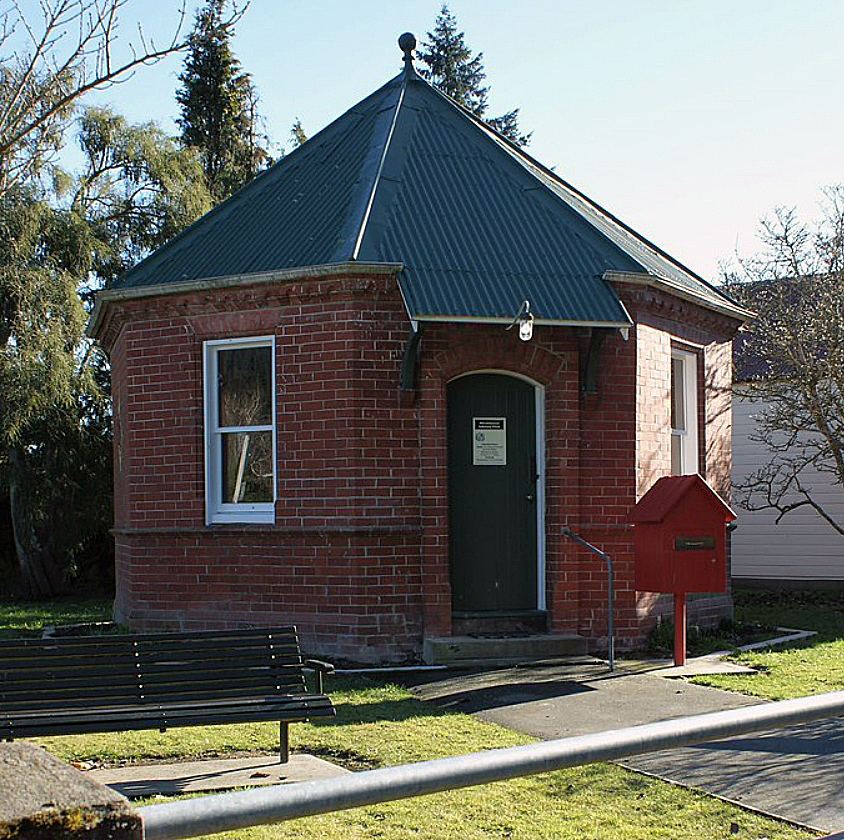
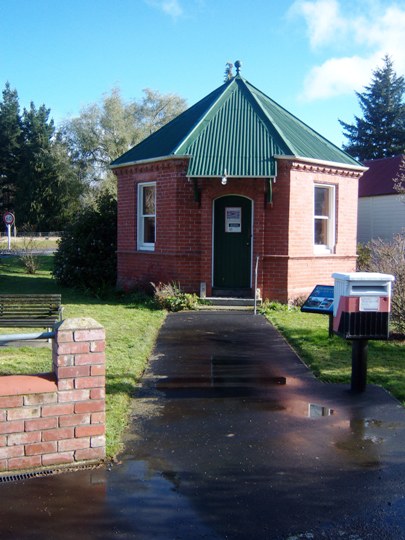
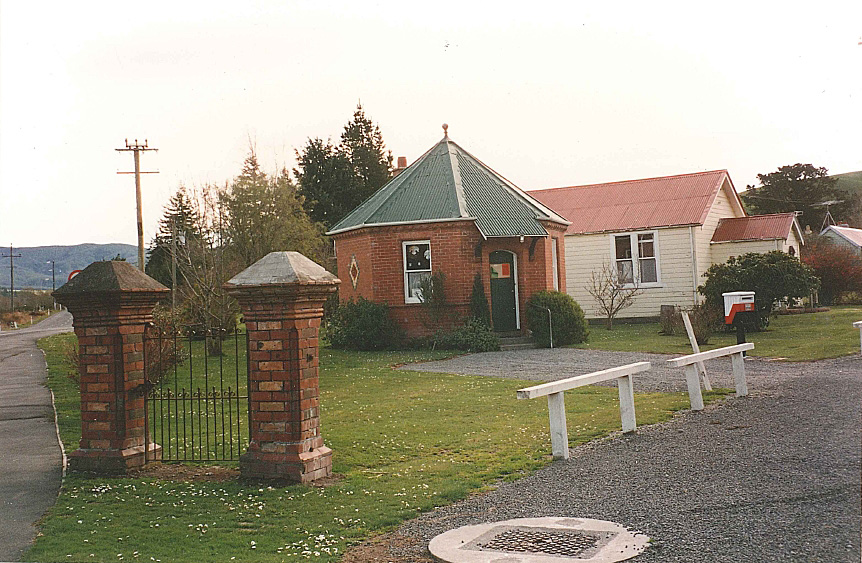
Polychrome brick gateposts with an iron gate mark the corner entry to the small land parcel. The library, set back approximately 15 metres from the gateposts, is a single-storeyed octagonal double-brick building with decorative cornice mouldings supporting an octagonal roof of corrugated steel, surmounted by a round finial. Its entrance door is on the south-east side and four of the eight elevations contain a sash window. The centrepiece of the remaining sides of the exterior incorporate coloured tiles and terracotta decorative features. The west side contains a chimney breast supporting a rebuilt brick chimney. With an open plan of less than five metres at its widest point, the interior of the library allows for easy access to the books on the rimu shelves that line much of the walls. Virtually all the interior is timber lined, including the double coved ceiling.
In 1984 a postal agency was established in the library, providing mail and postal services in addition to the free library service offered to all local residents. Small physical changes have occurred over time. The low brick wall running along much of the east and south sides of the land parcel was only built in circa 2000, but there would have been such a wall in earlier times. Following the Darfield earthquake of 4 September 2010, the chimney on the north-west side was taken down and was later rebuilt as part of a programme of repairs and strengthening of the library in 2014-15.
List Entry Information
Status
Listed
List Entry Status
Historic Place Category 2
Access
Private/No Public Access
List Number
1790
Date Entered
23rd June 1983
Date of Effect
23rd June 1983
City/District Council
Selwyn District
Region
Canterbury Region
Extent of List Entry
Extent includes the land described as Pt RS 14493 (RT CB149/249), Canterbury Land District and the building and structure known as Old Library and Gateposts thereon. Refer to the extent map tabled at the Heritage New Zealand Board meeting on 3 September 2015.
Legal description
Pt RS 14493 (RT CB149/249), Canterbury Land District
Status
Listed
List Entry Status
Historic Place Category 2
Access
Private/No Public Access
List Number
1790
Date Entered
23rd June 1983
Date of Effect
23rd June 1983
City/District Council
Selwyn District
Region
Canterbury Region
Extent of List Entry
Extent includes the land described as Pt RS 14493 (RT CB149/249), Canterbury Land District and the building and structure known as Old Library and Gateposts thereon. Refer to the extent map tabled at the Heritage New Zealand Board meeting on 3 September 2015.
Legal description
Pt RS 14493 (RT CB149/249), Canterbury Land District
Construction Professional
Name
Seager, Samuel Hurst
Type
Architect
Biography
Seager (1855-1933) studied at Canterbury College between 1880-82. He trained in Christchurch in the offices of Benjamin Woolfield Mountfort (1825-1898) and Alfred William Simpson before completing his qualifications in London in 1884. In 1885, shortly after his return to Christchurch, he won a competition for the design of the new Municipal Chambers, and this launched his career. Seager achieved renown for his domestic architecture. He was one of the earliest New Zealand architects to move away from historical styles and seek design with a New Zealand character. The Sign of the Kiwi, Christchurch (1917) illustrates this aspect of his work. He is also known for his larger Arts and Crafts style houses such as Daresbury, Christchurch (1899). Between 1893 and 1903 Seager taught architecture and design at the Canterbury University College School of Art. He was a pioneer in town planning, having a particular interest in the "garden city" concept. Some of these ideas were expressed in a group of houses designed as a unified and landscaped precinct on Sumner Spur (1902-14). He became an authority on the lighting of art galleries. After World War I he was appointed by the Imperial War Graves Commission to design war memorials in Gallipoli, Belgium and France. In New Zealand he designed the Massey Memorial, Point Halswell, Wellington (1925).
Name
Lamport, Thomas
Type
Builder
Biography
No biography is currently available for this construction professional
Name
William and James Tarling
Type
Builder
Biography
No biography is currently available for this construction professional
Construction Details
Start Year
1886
Type
Other
Description
Library building designed
Start Year
2000
startYearCirca
Type
Modification
Description
replica brick walls built on east and south sides
Type
Restoration
Description
Repairs, strengthening and refurbishment of Library
Period
2014-15
Construction Professional
Name
Seager, Samuel Hurst
Type
Architect
Biography
Seager (1855-1933) studied at Canterbury College between 1880-82. He trained in Christchurch in the offices of Benjamin Woolfield Mountfort (1825-1898) and Alfred William Simpson before completing his qualifications in London in 1884. In 1885, shortly after his return to Christchurch, he won a competition for the design of the new Municipal Chambers, and this launched his career. Seager achieved renown for his domestic architecture. He was one of the earliest New Zealand architects to move away from historical styles and seek design with a New Zealand character. The Sign of the Kiwi, Christchurch (1917) illustrates this aspect of his work. He is also known for his larger Arts and Crafts style houses such as Daresbury, Christchurch (1899). Between 1893 and 1903 Seager taught architecture and design at the Canterbury University College School of Art. He was a pioneer in town planning, having a particular interest in the "garden city" concept. Some of these ideas were expressed in a group of houses designed as a unified and landscaped precinct on Sumner Spur (1902-14). He became an authority on the lighting of art galleries. After World War I he was appointed by the Imperial War Graves Commission to design war memorials in Gallipoli, Belgium and France. In New Zealand he designed the Massey Memorial, Point Halswell, Wellington (1925).
Name
Lamport, Thomas
Type
Builder
Biography
No biography is currently available for this construction professional
Name
William and James Tarling
Type
Builder
Biography
No biography is currently available for this construction professional
Construction Details
Start Year
1886
Type
Other
Description
Library building designed
Start Year
2000
startYearCirca
Type
Modification
Description
replica brick walls built on east and south sides
Type
Restoration
Description
Repairs, strengthening and refurbishment of Library
Period
2014-15
Historical and Associated Iwi / Hapū / Whānau
Completion Date
29th August 2016
Report Written By
Robyn Burgess
Information Sources
Cyclopedia of New Zealand, 1903
Cyclopedia Company, Industrial, descriptive, historical, biographical facts, figures, illustrations, Wellington, N.Z, 1897-1908, Vol. 3, Canterbury Provincial District, Christchurch, 1903
Jenner, 2005
Jenner, Margaret, Small Libraries of New Zealand, Bay of Plenty Polytechnic, 2005
Other Information
This place was identified as significant under previous legislation with different information requirements. It remains significant under the current legislation. There is opportunity under our legislation and policies to add to this information. Further information about this place may be available from the Southern Regional Office of Heritage New Zealand Pouhere Taonga. Please note that entry on the New Zealand Heritage List/Rarangi Korero identifies only the heritage values of the property concerned, and should not be construed as advice on the state of the property, or as a comment of its soundness or safety, including in regard to earthquake risk, safety in the event of fire, or insanitary conditions. A fully referenced upgrade report is available on request from the Central region Office of Heritage New Zealand
Historical and Associated Iwi / Hapū / Whānau
Completion Date
29th August 2016
Report Written By
Robyn Burgess
Information Sources
Cyclopedia of New Zealand, 1903
Cyclopedia Company, Industrial, descriptive, historical, biographical facts, figures, illustrations, Wellington, N.Z, 1897-1908, Vol. 3, Canterbury Provincial District, Christchurch, 1903
Jenner, 2005
Jenner, Margaret, Small Libraries of New Zealand, Bay of Plenty Polytechnic, 2005
Other Information
This place was identified as significant under previous legislation with different information requirements. It remains significant under the current legislation. There is opportunity under our legislation and policies to add to this information. Further information about this place may be available from the Southern Regional Office of Heritage New Zealand Pouhere Taonga. Please note that entry on the New Zealand Heritage List/Rarangi Korero identifies only the heritage values of the property concerned, and should not be construed as advice on the state of the property, or as a comment of its soundness or safety, including in regard to earthquake risk, safety in the event of fire, or insanitary conditions. A fully referenced upgrade report is available on request from the Central region Office of Heritage New Zealand
Current Usages
Uses: Civic Facilities
Specific Usage: Gate
Uses: Civic Facilities
Specific Usage: Library
Uses: Communication
Specific Usage: Post Office
Current Usages
Uses: Civic Facilities
Specific Usage: Gate
Uses: Civic Facilities
Specific Usage: Library
Uses: Communication
Specific Usage: Post Office
Location
Sign up to hear more
Get the latest heritage news, features and events delivered
straight to your inbox.
