

In the late nineteenth-century the site was owned by Joseph Poulter Leary, the instigator of the Manawatu Times. Leary's relative, Richard Leary, built a chemist shop on the site in 1877. As Palmerston North continued to expand, the demand for accommodation for travellers increased and in 1888 the shop was demolished to make way for a new hotel. The 'Provincial Hotel' was completed the following year and leased to boardinghouse keeper Martin Creaven. Creaven purchased the hotel in 1896 but, just ten years later, fire engulfed the wooden structure and it burned to the ground. Determined to construct a grand new building in its place, Creaven hired renowned Christchurch architect Joseph Clarkson Maddison (1850-1923) to design a new hotel for the site.
Maddison began designing buildings in Christchurch in the late 1870s. Although best known as a designer of abbatoirs and freezing works, Maddison's close association with the City of Christchurch Licensing Committee produced numerous commissions to design hotels. By the turn of the century he had acquired a nationwide reputation as a specialist in Italian architecture. In 1906 he designed a number of hotels to accommodate the crowds who flocked to Christchurch for the New Zealand International Exhibition and it was shortly after this that he was commissioned to complete the Grand Hotel.
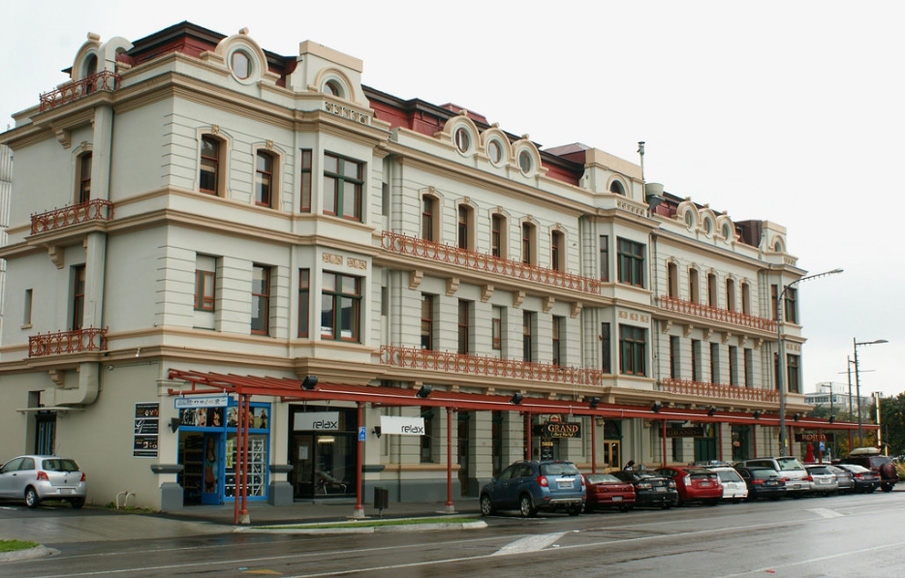
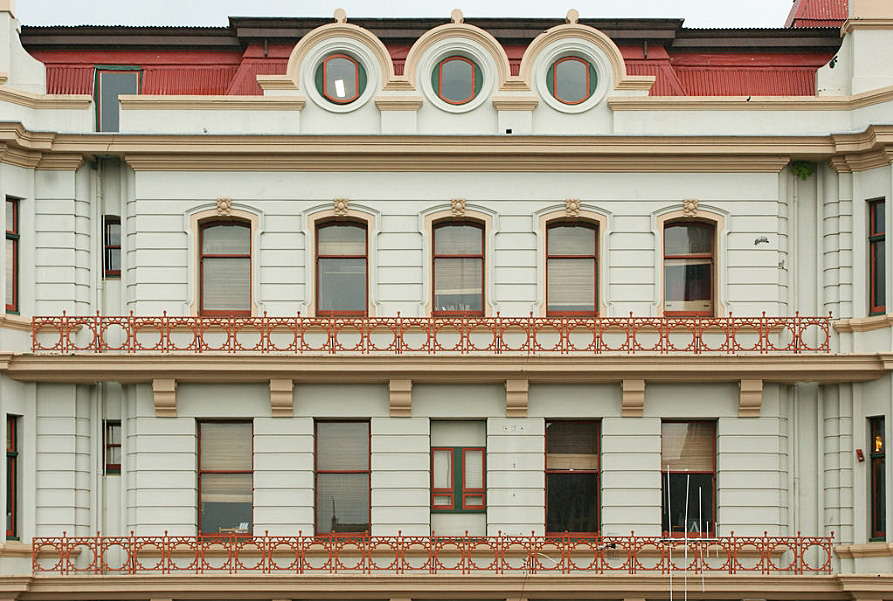
Maddison's design for the Grand Hotel is an excellent example of the Second Empire style, which developed in France during the reconstruction of Paris by Emperor Napoleon III in the late nineteenth century. The Grand Hotel incorporates circular dormer windows and the mansard roof typical of Second Empire architecture. The close association of the style with Classical architecture is apparent in the Grand Hotel's rusticated masonry and its use of columns, pediments and entablatures. The four-storey building was designed to accommodate 66 bedrooms, two conservatories, a large dining room and a shop on the ground floor.
The foundation stone for the building was laid in 1906 by Martin Creaven, whom Maddison presented with a silver trowel in memory of the occasion. The building was erected by the building company Trevor Bros. Two years later Creaven found himself in financial difficulties and sold the building to James Trevor, a partner in Trevor Bros. In 1927, when the building was acquired by Edmund Lionel Barnes, it was selected to accommodate royal visitors to New Zealand, the Duke and Duchess of York.
When Queen Elizabeth II and the Duke of Edinburgh visited New Zealand for the first time twenty-six years later in 1953, the Grand Hotel was selected to house the royal visitors. The Queen was accommodated on the first floor of the building. Large, adoring crowds gathered in the Square below to catch a glimpse of her when she set foot on the small balcony next to her room. The following year the Queen travelled to Christchurch where she was accommodated in another of Maddison's buildings, the Clarendon Hotel (1902).
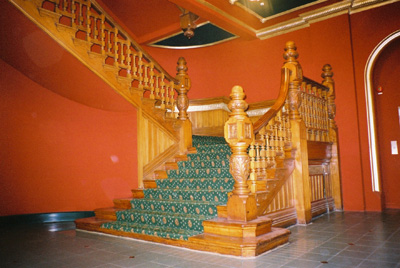
The fortunes of the Grand Hotel declined in the early 1960s. The tower that had dominated the roof of the building was removed in 1963. In 1972 the hotel lost its license and it was closed down later that year. The upper storeys of the building were gradually converted into offices while the ground floor became retail space. The sole reminder on the original interior of the building is the imposing, timber staircase inside what was the main entrance to the hotel.
The Grand Hotel has national historical significance. Used as accommodation for Queen Elizabeth II, the first reigning monarch to visit New Zealand, the building has a strong association with the public memory of the Royal Tour of 1953 -1954. As such, the building is a significant reminder of this important event in the country's history. The building is also architecturally noteworthy as an excellent example of the Second Empire style and a notable example of the work of prominent New Zealand architect Joseph Clarkson Maddison. The Grand Hotel is a landmark in central city Palmerston North and is held in high esteem by the public.
List Entry Information
Status
Listed
List Entry Status
Historic Place Category 1
Access
Private/No Public Access
List Number
192
Date Entered
28th June 1990
Date of Effect
28th June 1990
City/District Council
Palmerston North City
Region
Horizons (Manawatū-Whanganui) Region
Extent of List Entry
Extent includes the land described as Section 677 TN of Palmerston North (RT WNC1/902) and Pt Section 678 Township of Palmerston North (RT WN468/241), Wellington Land District and the building known as the Grand Hotel Building (Former) and its fittings and fixtures.
Legal description
Sec 677 Town of Palmerston North (RT WNC1/902) and Pt Sec 678 Township of Palmerston North (RT WN468/241), Wellington Land District
Location Description
On the Corner of The Square and Church Street, Palmerston North
Status
Listed
List Entry Status
Historic Place Category 1
Access
Private/No Public Access
List Number
192
Date Entered
28th June 1990
Date of Effect
28th June 1990
City/District Council
Palmerston North City
Region
Horizons (Manawatū-Whanganui) Region
Extent of List Entry
Extent includes the land described as Section 677 TN of Palmerston North (RT WNC1/902) and Pt Section 678 Township of Palmerston North (RT WN468/241), Wellington Land District and the building known as the Grand Hotel Building (Former) and its fittings and fixtures.
Legal description
Sec 677 Town of Palmerston North (RT WNC1/902) and Pt Sec 678 Township of Palmerston North (RT WN468/241), Wellington Land District
Location Description
On the Corner of The Square and Church Street, Palmerston North
Construction Professional
Name
Maddison, Joseph Clarkson
Type
Architect
Biography
Joseph Maddison (1850-1923) was born in Greenwich and came to Lyttelton in 1872. He settled in Christchurch and commenced practice as an architect. He designed a large number of public buildings, mainly in Canterbury, including The Church of the Holy Innocents, Amberley, the Anglican Church at Port Levy, Warner's Hotel (1881) and Clarendon Hotel (1902), both in Christchurch, Government Buildings, Christchurch (1913) and numerous private residences. Maddison was well known as an industrial architect and was responsible for the warehouses of the Kaiapoi Woollen Company. His specialty, however, was in the design of freezing works. Among his designs were the Canterbury Freezing Works, Belfast (1883) and the Mataura Freezing Works, Canterbury and he is considered to have been one of the chief exponents in this field during the late nineteeenth century. He was admitted as a Fellow of the Royal Institute of British Architects in 1887.
Construction Details
Start Year
1906
Type
Original Construction
Start Year
1962
Type
Modification
Description
Pediments removed from the roof of the building; alterations to the interior layout of the first and second floor; renovations to the third floor
Start Year
1965
Type
Modification
Description
Alterations to the bar and bottle sales area on the ground floor
Start Year
1982
Finish Year
1983
Type
Modification
Description
Ground floor subdivided into shops; new doors and windows added to retail area on ground floor
Start Year
1984
Type
Modification
Description
Upper floors converted into open plan office space
Start Year
1997
Type
Addition
Description
Verandah added
Construction Materials
Built on a concrete foundation, the building is constructed from load-bearing brick.
Notable Features
The balcony on the first floor The original staircase, including the timber balustrades, newel posts and wall panelling The near original character of the street facade The foundation stone laid on 19 May 1906 on the ground floor of the building on the elevation that faces the Square
Construction Professional
Name
Maddison, Joseph Clarkson
Type
Architect
Biography
Joseph Maddison (1850-1923) was born in Greenwich and came to Lyttelton in 1872. He settled in Christchurch and commenced practice as an architect. He designed a large number of public buildings, mainly in Canterbury, including The Church of the Holy Innocents, Amberley, the Anglican Church at Port Levy, Warner's Hotel (1881) and Clarendon Hotel (1902), both in Christchurch, Government Buildings, Christchurch (1913) and numerous private residences. Maddison was well known as an industrial architect and was responsible for the warehouses of the Kaiapoi Woollen Company. His specialty, however, was in the design of freezing works. Among his designs were the Canterbury Freezing Works, Belfast (1883) and the Mataura Freezing Works, Canterbury and he is considered to have been one of the chief exponents in this field during the late nineteeenth century. He was admitted as a Fellow of the Royal Institute of British Architects in 1887.
Construction Details
Start Year
1906
Type
Original Construction
Start Year
1962
Type
Modification
Description
Pediments removed from the roof of the building; alterations to the interior layout of the first and second floor; renovations to the third floor
Start Year
1965
Type
Modification
Description
Alterations to the bar and bottle sales area on the ground floor
Start Year
1982
Finish Year
1983
Type
Modification
Description
Ground floor subdivided into shops; new doors and windows added to retail area on ground floor
Start Year
1984
Type
Modification
Description
Upper floors converted into open plan office space
Start Year
1997
Type
Addition
Description
Verandah added
Construction Materials
Built on a concrete foundation, the building is constructed from load-bearing brick.
Notable Features
The balcony on the first floor The original staircase, including the timber balustrades, newel posts and wall panelling The near original character of the street facade The foundation stone laid on 19 May 1906 on the ground floor of the building on the elevation that faces the Square
Historical and Associated Iwi / Hapū / Whānau
Completion Date
1st May 2003
Report Written By
Rebecca O'Brien
Information Sources
Buick, 1903 (1975)
T. Lindsay Buick, Old Manawatu, Buick and Young Printers, Palmerston North, 1903 (1975)
Dictionary of New Zealand Biography
Dictionary of New Zealand Biography
Ministry for Culture and Heritage
www.nzhistory.net.nz
Other Information
This place was identified as significant under previous legislation with different information requirements. It remains significant under the current legislation. There is opportunity under our legislation and policies to add to this information. Further information about this place may be available from the Central Regional Office of Heritage New Zealand Pouhere Taonga. A fully referenced registration report is available from the NZHPT Central Region office Please note that entry on the New Zealand Heritage List/Rarangi Korero identifies only the heritage values of the property concerned, and should not be construed as advice on the state of the property, or as a comment of its soundness or safety, including in regard to earthquake risk, safety in the event of fire, or insanitary conditions.
Historical and Associated Iwi / Hapū / Whānau
Completion Date
1st May 2003
Report Written By
Rebecca O'Brien
Information Sources
Buick, 1903 (1975)
T. Lindsay Buick, Old Manawatu, Buick and Young Printers, Palmerston North, 1903 (1975)
Dictionary of New Zealand Biography
Dictionary of New Zealand Biography
Ministry for Culture and Heritage
www.nzhistory.net.nz
Other Information
This place was identified as significant under previous legislation with different information requirements. It remains significant under the current legislation. There is opportunity under our legislation and policies to add to this information. Further information about this place may be available from the Central Regional Office of Heritage New Zealand Pouhere Taonga. A fully referenced registration report is available from the NZHPT Central Region office Please note that entry on the New Zealand Heritage List/Rarangi Korero identifies only the heritage values of the property concerned, and should not be construed as advice on the state of the property, or as a comment of its soundness or safety, including in regard to earthquake risk, safety in the event of fire, or insanitary conditions.
Current Usages
Uses: Trade
Specific Usage: Office building/Offices
Uses: Trade
Specific Usage: Restaurant/cafe/tearoom
Uses: Trade
Specific Usage: Shop
Former Usages
General Usage: Accommodation
Specific Usage: Hotel
Current Usages
Uses: Trade
Specific Usage: Office building/Offices
Uses: Trade
Specific Usage: Restaurant/cafe/tearoom
Uses: Trade
Specific Usage: Shop
Former Usages
General Usage: Accommodation
Specific Usage: Hotel
Location
Sign up to hear more
Get the latest heritage news, features and events delivered
straight to your inbox.
