Before construction began the Timaru Herald (9 March, 1877) commented on the design:
The new courthouse for Timaru will be a striking piece of architecture, and it seems to be well designed for the purposes for which it will be used... Its greatest width will be 75 feet and depth 59 feet. The portion of the building to be used for the Court will be 49 feet long and 25 feet wide, standing end-on to the street, and there will be wings on each side providing the necessary small rooms... In the wings are to be rooms for the judge, the jury, the lawyers, the witnesses, the registrar, and the public; and the fire proof safe is to be situated in one of the wings... The interior of the building will be plastered and a dado will extend along each wall four feet high.. In the front elevation of the Courtroom will be three fine circular headed windows...and the margins of these will be stained glass. The building will be in concrete, with a slate roof, and the ornamentation will be in cement.
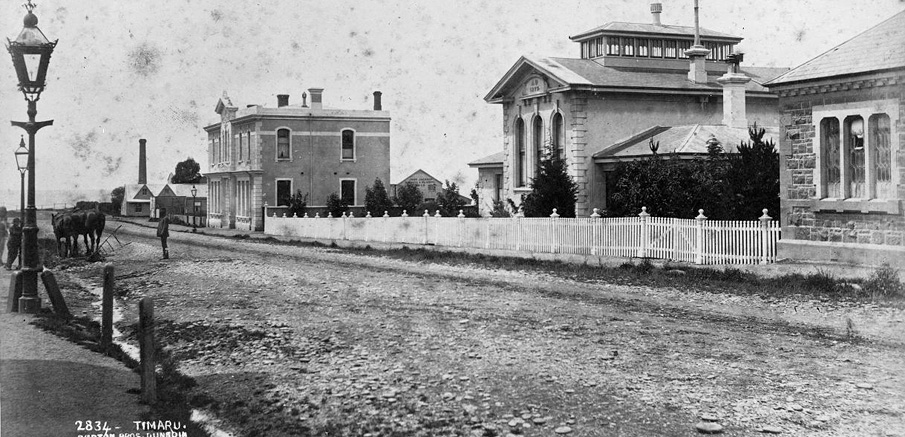
The new building was constructed on the site of the former court offices, taking nearly a year to finish and opening on the 4th March 1878. On the building's completion there was considerable criticism of its design and the unsuitability of the internal planning. The height of the judge's seat obscured his view of the jury, the acoustics were defective and the chimneys smoked badly. Efforts to correct these problems were only partly successful but the building continued in its original form until the 1950s when alterations and additions were made. In 1974 when the building had been in use for 96 years it was indicated that it was time for it to be replaced. However, further alterations and additions along the street frontage were made in 1978, securing the building's future for an extended time. Additions to the North Street frontage were made again in 1983 and the building continues its original use today.
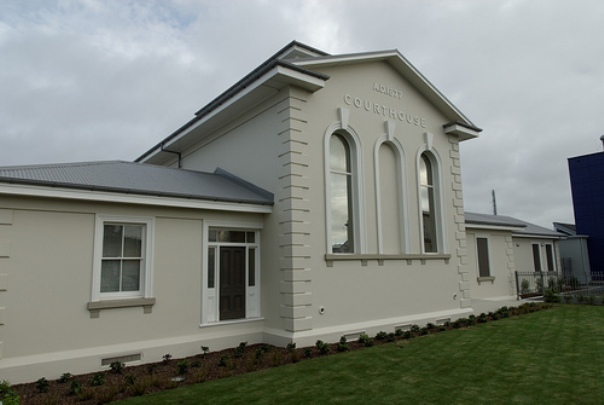
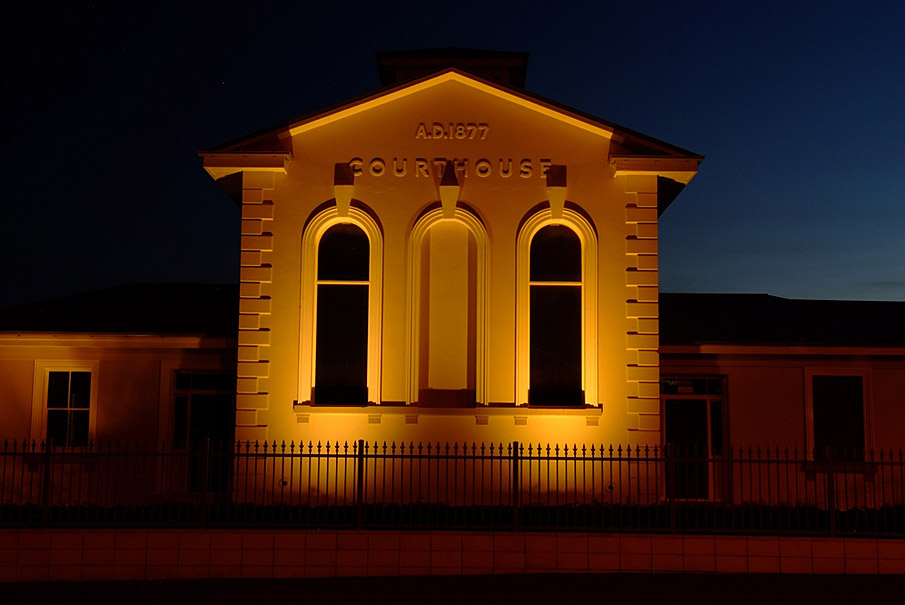
Despite the 1978 additions which have altered the Victorian character of the single storeyed street frontage, the building still makes a major contribution to the streetscape. The courthouse section rises above the flanking wings. Notable features are the roof lantern, the gable detailing and the three arched windows featuring keystones and the quoins.

List Entry Information
Status
Listed
List Entry Status
Historic Place Category 2
Access
Private/No Public Access
List Number
2050
Date Entered
11th December 2003
Date of Effect
11th December 2003
City/District Council
Timaru District
Region
Canterbury Region
Extent of List Entry
Registration includes the building on its site.
Legal description
Lot 2 DP 2779 (NZ Gazette 1994, p.2938), Canterbury Land District
Status
Listed
List Entry Status
Historic Place Category 2
Access
Private/No Public Access
List Number
2050
Date Entered
11th December 2003
Date of Effect
11th December 2003
City/District Council
Timaru District
Region
Canterbury Region
Extent of List Entry
Registration includes the building on its site.
Legal description
Lot 2 DP 2779 (NZ Gazette 1994, p.2938), Canterbury Land District
Why is this place significant?
Historic Significance
Historical Significance or Value The Timaru Court House has significance because of its role within the justice system, an important aspect of New Zealand's history.
Physical Significance
It possesses aesthetic and architectural values for its Victorian styling which is similar to other court buildings from this period. It demonstrates technological accomplishment, is well crafted and demonstrates the application of building materials (concrete), methods and craft skills.
Why is this place Category 1 / Category 2?
Detail Of Assessed Criteria
The building reflects an important aspect of New Zealand's and local history, the justice system. It has been associated with events of great significance to the South Canterbury community with the cases that have been heard here since 1878. Though the building has been altered its integrity has been retained and it is possible for the public to be educated about the past by studying it. The design of the place has value with its typical 19th century classical styling favoured for public buildings and represented in many of Timaru's early buildings. It is also notable as one of the last designs by William Clayton who served the government as Colonial Architect from 1869 to 1877. Completed in 1878 the Courthouse has importance because it is from an early period in New Zealand settlement. It is an early example of government architecture in Timaru, which later acquired a more Edwardian character within its central area. It is fortunate to have been retained in its original use.
Why is this place significant?
Historic Significance
Historical Significance or Value The Timaru Court House has significance because of its role within the justice system, an important aspect of New Zealand's history.
Physical Significance
It possesses aesthetic and architectural values for its Victorian styling which is similar to other court buildings from this period. It demonstrates technological accomplishment, is well crafted and demonstrates the application of building materials (concrete), methods and craft skills.
Why is this place Category 1 / Category 2?
Detail Of Assessed Criteria
The building reflects an important aspect of New Zealand's and local history, the justice system. It has been associated with events of great significance to the South Canterbury community with the cases that have been heard here since 1878. Though the building has been altered its integrity has been retained and it is possible for the public to be educated about the past by studying it. The design of the place has value with its typical 19th century classical styling favoured for public buildings and represented in many of Timaru's early buildings. It is also notable as one of the last designs by William Clayton who served the government as Colonial Architect from 1869 to 1877. Completed in 1878 the Courthouse has importance because it is from an early period in New Zealand settlement. It is an early example of government architecture in Timaru, which later acquired a more Edwardian character within its central area. It is fortunate to have been retained in its original use.
Construction Professional
Name
Clayton, William Henry
Type
Architect
Biography
Born in Tasmania, Clayton (1823-1877) travelled to Europe with his family in 1842. He studied architecture in Brussells and was then articled to Sir John Rennie, engineer to the Admiralty, in London. He returned to Tasmania in 1848 and worked in private practice until he was appointed Government Surveyor in 1852. He resumed private practice in 1855 and was involved with surveying in the Launceston area. In 1857 he was elected an alderman on the Launceston Municipal Council. By the time Clayton immigrated to Dunedin in 1863 he had been responsible for the design of many buildings including churches, banks, a mechanics' institute, a theatre, steam and water mills, breweries, bridges, mansions and villas, in addition to being a land surveyor and road engineer. In 1864 he entered partnership with William Mason. Mason and Clayton were responsible for some important buildings in Dunedin including All Saints Church (1865) and The Exchange (former Post Office) (1865) as well as the Colonial Museum, Wellington (1865). These were two of the most prominent architects of their day in New Zealand. In 1869 Clayton became the first and only Colonial Architect and was responsible for the design of Post and Telegraph offices, courthouses, customhouses, Government department offices and ministerial residences. His acknowledged masterpiece is Government Buildings, Wellington (1876) a stone-simulated wooden building and the largest timber framed building in the Southern Hemisphere. Clayton was a prolific and highly accomplished architect both within the Public Service and in private practice, in New Zealand and Australia. See https://teara.govt.nz/en/biographies/2c20/clayton-william-henry
Construction Details
Start Year
1877
Finish Year
1878
Type
Original Construction
Construction Materials
Concrete, plaster, slate roof
Notable Features
Notable features are the roof lantern, the gable detailing and the three arched windows featuring keystones and the quoins.
Construction Professional
Name
Clayton, William Henry
Type
Architect
Biography
Born in Tasmania, Clayton (1823-1877) travelled to Europe with his family in 1842. He studied architecture in Brussells and was then articled to Sir John Rennie, engineer to the Admiralty, in London. He returned to Tasmania in 1848 and worked in private practice until he was appointed Government Surveyor in 1852. He resumed private practice in 1855 and was involved with surveying in the Launceston area. In 1857 he was elected an alderman on the Launceston Municipal Council. By the time Clayton immigrated to Dunedin in 1863 he had been responsible for the design of many buildings including churches, banks, a mechanics' institute, a theatre, steam and water mills, breweries, bridges, mansions and villas, in addition to being a land surveyor and road engineer. In 1864 he entered partnership with William Mason. Mason and Clayton were responsible for some important buildings in Dunedin including All Saints Church (1865) and The Exchange (former Post Office) (1865) as well as the Colonial Museum, Wellington (1865). These were two of the most prominent architects of their day in New Zealand. In 1869 Clayton became the first and only Colonial Architect and was responsible for the design of Post and Telegraph offices, courthouses, customhouses, Government department offices and ministerial residences. His acknowledged masterpiece is Government Buildings, Wellington (1876) a stone-simulated wooden building and the largest timber framed building in the Southern Hemisphere. Clayton was a prolific and highly accomplished architect both within the Public Service and in private practice, in New Zealand and Australia. See https://teara.govt.nz/en/biographies/2c20/clayton-william-henry
Construction Details
Start Year
1877
Finish Year
1878
Type
Original Construction
Construction Materials
Concrete, plaster, slate roof
Notable Features
Notable features are the roof lantern, the gable detailing and the three arched windows featuring keystones and the quoins.
The large oblong courtroom forms the high central block. It is covered with a pitched roof surmounted by large roof lantern. Single storeyed wings flank the courtroom which presents its gabled end to the street frontage. Entrances are on either side of this central feature which has three high arched windows and plastered quoins. The addition that was made across the building frontage in 1978 is stylistically insignificant.
Historical and Associated Iwi / Hapū / Whānau
Completion Date
6th September 2004
Report Written By
Pam Wilson
Information Sources
Wilson, 1991 (2)
J. Wilson, South Canterbury historical guide : including the towns of Timaru, Temuka, Geraldine, Pleasant Point, Fairlie and Waimate, their surrounding country districts, and the Mackenzie Country, Timaru, 1991.
New Zealand Historic Places Trust (NZHPT)
New Zealand Historic Places Trust
Timaru District Council
Other Information
A fully referenced version of this report is available from the NZHPT Southern Region Office. Please note that entry on the New Zealand Heritage List/Rarangi Korero identifies only the heritage values of the property concerned, and should not be construed as advice on the state of the property, or as a comment of its soundness or safety, including in regard to earthquake risk, safety in the event of fire, or insanitary conditions.
Historical and Associated Iwi / Hapū / Whānau
Completion Date
6th September 2004
Report Written By
Pam Wilson
Information Sources
Wilson, 1991 (2)
J. Wilson, South Canterbury historical guide : including the towns of Timaru, Temuka, Geraldine, Pleasant Point, Fairlie and Waimate, their surrounding country districts, and the Mackenzie Country, Timaru, 1991.
New Zealand Historic Places Trust (NZHPT)
New Zealand Historic Places Trust
Timaru District Council
Other Information
A fully referenced version of this report is available from the NZHPT Southern Region Office. Please note that entry on the New Zealand Heritage List/Rarangi Korero identifies only the heritage values of the property concerned, and should not be construed as advice on the state of the property, or as a comment of its soundness or safety, including in regard to earthquake risk, safety in the event of fire, or insanitary conditions.
Current Usages
Uses: Law Enforcement
Specific Usage: Courthouse
Former Usages
General Usage: Law Enforcement
Specific Usage: Courthouse
Current Usages
Uses: Law Enforcement
Specific Usage: Courthouse
Former Usages
General Usage: Law Enforcement
Specific Usage: Courthouse
Location
Stay up to date with Heritage this month

