Evans’ Atlas Flourmill Company Limited Building (Former), a large building constructed in different phases and styles between the 1880s and the twentieth century at 34-36 Turnbull Street in Timaru, is historically significant in telling the story of the area’s prominent role in the grain and milling trade. The brick buildings constructed in 1888 and 1897 have architectural significance, being designed by well-known Dunedin architect, James Hislop. They have technological value in their early utilisation of roller mills rather than traditional mill stones.
Irishman, William Evans, arrived in New Zealand in 1861 to take part in the Otago gold rush. In 1874 he came to Timaru and selected a site for a grain store, commencing business as a timber, coal and wheat merchant. The store he built ‘on the beach facing the railway yard’ was a large concrete structure. In 1888 a large five storeyed brick mill building, the Atlas Mill, was erected for Evans’ ‘in front of’ his existing concrete store. The largest section of the mill building contained engine room and offices on the ground floor and the milling machinery on the four floors above. Another section contained the wheat cleaning plant; the third section was the boiler house, with dust chamber above. A loose grain elevator lifted grain into a storage bin holding 1000 sacks. Steel rolls were used instead of traditional mill stones – and they processed the wheat, refining it to take the bran out of the flour. The state-of-the-art roller milling machinery was for a 40-ton per day mill, the first bag of flour bearing the ‘Atlas’ brand being produced in January 1889.
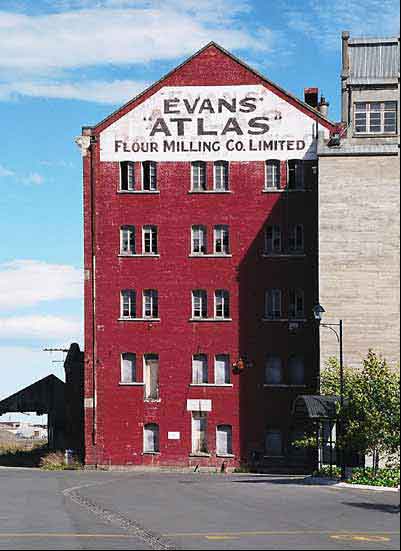
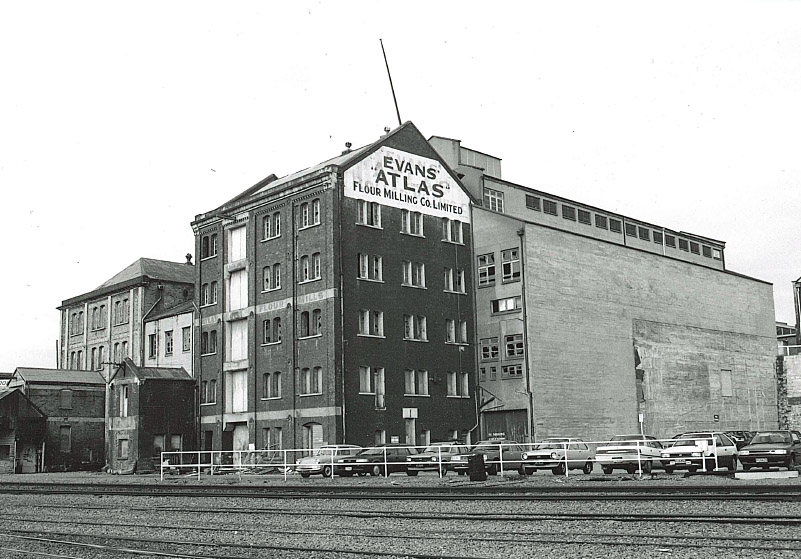
Fronting the raised Turnbull Street at its western elevation and the railway tracks at the eastern side, the Evans’ Atlas Flourmill Company Limited Building (Former), is a collection of adjoining structures of various heights, styles and materials. The brick buildings at the complex are prominent at the eastern, north-eastern and south-eastern sides. Painted lettering on the north elevation of the brick mill building facing the railway station reads EVANS ‘ATLAS’ FLOUR MILLING CO. LIMITED. The tall north-western additions are largely concrete. Roofing materials are corrugated iron and corrugated steel.
In 1897 a second grain store was built on the southern side of the mill, also to the design of architect James Hislop. Described as being an extensive expansion, this four storeyed building was capable of taking grain in both the front at back, and had the capacity to hold 100,000 sacks of grain and milling produce. Wheat was delivered to the mill by two elevators, driven off shafting geared to the existing mill machinery. In circa 1950 a two storeyed addition was constructed adjacent to the west of the brick mill building, on the site of a previous wing (most likely part of the 1888 phase of construction). That north-west corner of the complex has since been added to and extensively altered, forming a larger footprint on the land parcel than the nineteenth century brick buildings. The original concrete store built by William Evans in the late 1870s or early 1880s does not appear to survive . Goodman Fielder manufactured pasta products from the complex for a number of years. After the Timaru Milling Company closed in 2005, new owners Turnbull Holdings Ltd, began a programme of strengthening the buildings.
Irishman, William Evans, arrived in New Zealand in 1861 to take part in the Otago gold rush. In 1874 he came to Timaru and selected a site for a grain store, commencing business as a timber, coal and wheat merchant. The store he built ‘on the beach facing the railway yard’ was a large concrete structure. In 1888 a large five storeyed brick mill building, the Atlas Mill, was erected for Evans’ ‘in front of’ his existing concrete store. The largest section of the mill building contained engine room and offices on the ground floor and the milling machinery on the four floors above. Another section contained the wheat cleaning plant; the third section was the boiler house, with dust chamber above. A loose grain elevator lifted grain into a storage bin holding 1000 sacks. Steel rolls were used instead of traditional mill stones – and they processed the wheat, refining it to take the bran out of the flour. The state-of-the-art roller milling machinery was for a 40-ton per day mill, the first bag of flour bearing the ‘Atlas’ brand being produced in January 1889.
Fronting the raised Turnbull Street at its western elevation and the railway tracks at the eastern side, the Evans’ Atlas Flourmill Company Limited Building (Former), is a collection of adjoining structures of various heights, styles and materials. The brick buildings at the complex are prominent at the eastern, north-eastern and south-eastern sides. Painted lettering on the north elevation of the brick mill building facing the railway station reads EVANS ‘ATLAS’ FLOUR MILLING CO. LIMITED. The tall north-western additions are largely concrete. Roofing materials are corrugated iron and corrugated steel.
In 1897 a second grain store was built on the southern side of the mill, also to the design of architect James Hislop. Described as being an extensive expansion, this four storeyed building was capable of taking grain in both the front at back, and had the capacity to hold 100,000 sacks of grain and milling produce. Wheat was delivered to the mill by two elevators, driven off shafting geared to the existing mill machinery. In circa 1950 a two storeyed addition was constructed adjacent to the west of the brick mill building, on the site of a previous wing (most likely part of the 1888 phase of construction). That north-west corner of the complex has since been added to and extensively altered, forming a larger footprint on the land parcel than the nineteenth century brick buildings. The original concrete store built by William Evans in the late 1870s or early 1880s does not appear to survive . Goodman Fielder manufactured pasta products from the complex for a number of years. After the Timaru Milling Company closed in 2005, new owners Turnbull Holdings Ltd, began a programme of strengthening the buildings.