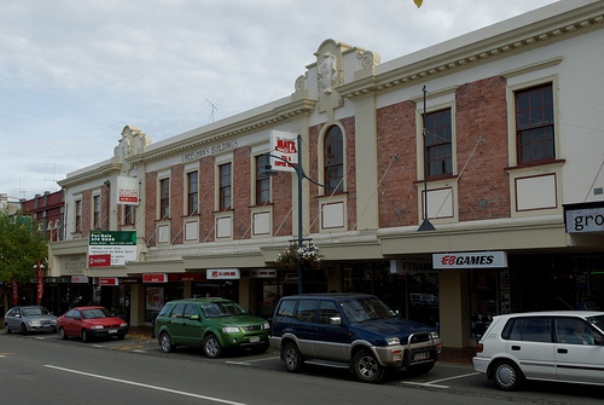
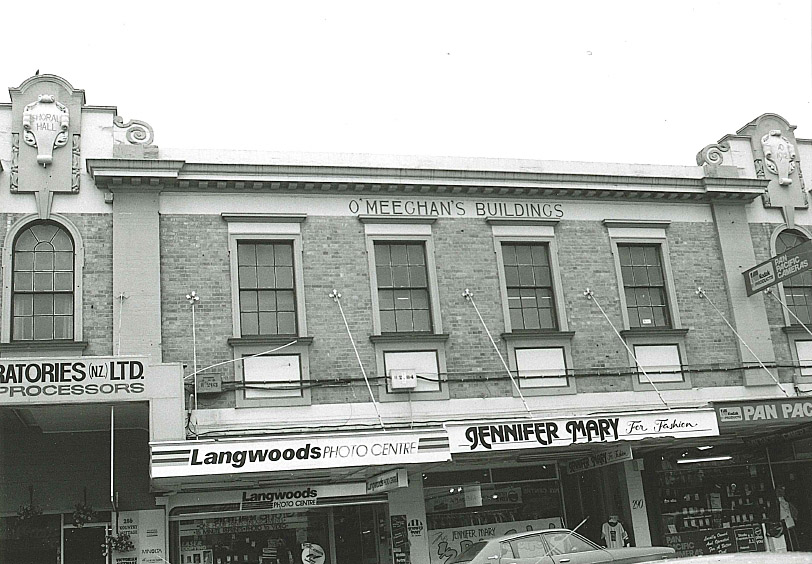
O’Meeghan’s Building was erected in 1912, during a period of accelerated development in Timaru. The building is historically significant for its construction during a building boom in Timaru in the early 20th century, at which time Timaru was promoting itself for city status. It has local social and historical significance as a popular venue for entertainment as a picture theatre and choral hall.
The land on which O’Meeghan’s Building is situated was formerly part of Rural Section (RS) 730, granted by the Crown to George Rhodes and another, probably William Rhodes. In 1853 the Rhodes Brothers had RS 703, and adjoining RS 7555, surveyed as ‘Rhodes Town’ and subdivided sections were sold for commercial and residential occupation. The subject land was formerly Lot 149 and part of Lot 148 of RS 730, transferred to Michael O’Meeghan, a Timaru hotelier, in 1904.
In 1911 O’Meeghan commenced construction of a block of buildings in Stafford Street. This contributed to a construction boom in Timaru, during which time Timaru Borough aspired to city status. The designers and contractors were identified as Moriarty and Lusk of Timaru. The building was completed in March 1912 and it was erected for auctioneers O’Callaghan and LeCren on a 21 year lease. The second storey was dedicated to a Choral Hall, with a stage and dance floor. In 1915 a brick cinema, known as the Grand Theatre was built at the rear of O’Meeghan’s Building for the Timaru Continuous Picture Company. This building was demolished in 2007.
O’Meeghan’s Building is a substantial brick building over two storeys. The prominent façade is the street frontage built in an ‘English Renaissance’ style in plastered brick with Oamaru stone detailing. The street facing façade at ground level is dedicated to shops and features a cantilevered verandah (without supporting posts), which was the first of its kind in Timaru. The underside of the verandah was originally clad with pressed metal sheets, which also featured on the ceiling of the Choral Hall and other interior spaces. Two ornate pediments on the façade contain cartouches showing the date of the building’s construction (‘AD 1912’) and the name ‘Shoral Hall’ [sic], a misspelling of Choral Hall. The name O’Meeghan’s Building is inscribed and over-painted below the cornice.
The internal spaces have been variously modified since its original construction. The main entrance to the Choral Hall and O’Callaghan and LeCren’s auction mart was originally accommodated in a vestibule situated below the southern pediment, and has since been converted to a shop. Through here the furniture showroom and office of O’Callaghan and LeCren were accessed. The Choral Hall was fitted with a stage and a sprung dance floor, but it is not known if these features have been retained.
A number of warehouses and outbuildings probably associated with O’Callaghan and LeCren were situated at the rear of the main building and were demolished as part of the 2007 redevelopment of the building.