DonateSupporterVisit Heritage
  • Tūrangawaewae
    Places
  • Tira Māori
    Māori Heritage
  • Poutairangahia
    Archaeology
  • Rauemi
    Resources
  • Mō Tātou
    About Us
  • New Zealand Heritage List
  • Nominate and submit
  • Explore the List
  • National Historic Landmarks
  • Plaques
  • Rainbow List Project
  • Lost heritage
  • Visit Heritage
  • Our properties
  • Turnbull House Project
  • Collections
  • Shop
  • Tohu Whenua
  • Tira Māori
  • Conserving Māori heritage
  • Marae built heritage
  • Māori heritage on the List
  • Hinemihi—Te Hokinga Mai
  • What is archaeology?
  • Is there a site on my property?
  • What are my legal requirements?
  • Affecting an archaeological site
  • Declaring an archaeological site
  • Archaeology FAQs
  • Archaeology Digital Library
  • Archaeology guidelines and templates
  • Resources
  • Funding
  • Publications
  • Sustainable management guides
  • Disaster recovery
  • Podcasts & digital resources
  • Education Hub
  • Conservation plans
  • About
  • Board
  • Māori Heritage Council
  • Senior Staff
  • Offices
  • Contact us
  • Careers
  • Covenants
  • Fast-track
  • Corporate documents
  • Currently consulting on
  • Our submissions
  • News
Quick links
Rārangi Kōrero | The List
Explore the List
National Historic Landmarks
Ngā Manawhenua o Aotearoa me ōna Kōrero Tūturu
Quick links
Tapuwae
A Vision for Places of Māori Heritage
Funding for Māori Heritage
Resources
Quick links
Archaeological Authority Portal
Applying for an archaeological authority
Archaeology FAQs
Browse the most frequently asked questions about archaeological authorities and the archaeological process.
Quick links
Quick links
Contact us
Offices
DonateSupporterVisit Heritage
  • Tūrangawaewae
    Places
  • Tira Māori
    Māori Heritage
  • Poutairangahia
    Archaeology
  • Rauemi
    Resources
  • Mō Tātou
    About Us
  • New Zealand Heritage List
  • Nominate and submit
  • Explore the List
  • National Historic Landmarks
  • Plaques
  • Rainbow List Project
  • Lost heritage
  • Visit Heritage
  • Our properties
  • Turnbull House Project
  • Collections
  • Shop
  • Tohu Whenua
  • Tira Māori
  • Conserving Māori heritage
  • Marae built heritage
  • Māori heritage on the List
  • Hinemihi—Te Hokinga Mai
  • What is archaeology?
  • Is there a site on my property?
  • What are my legal requirements?
  • Affecting an archaeological site
  • Declaring an archaeological site
  • Archaeology FAQs
  • Archaeology Digital Library
  • Archaeology guidelines and templates
  • Resources
  • Funding
  • Publications
  • Sustainable management guides
  • Disaster recovery
  • Podcasts & digital resources
  • Education Hub
  • Conservation plans
  • About
  • Board
  • Māori Heritage Council
  • Senior Staff
  • Offices
  • Contact us
  • Careers
  • Covenants
  • Fast-track
  • Corporate documents
  • Currently consulting on
  • Our submissions
  • News
Quick links
Rārangi Kōrero | The List
Explore the List
National Historic Landmarks
Ngā Manawhenua o Aotearoa me ōna Kōrero Tūturu
Quick links
Tapuwae
A Vision for Places of Māori Heritage
Funding for Māori Heritage
Resources
Quick links
Archaeological Authority Portal
Applying for an archaeological authority
Archaeology FAQs
Browse the most frequently asked questions about archaeological authorities and the archaeological process.
Quick links
Quick links
Contact us
Offices
  • Places
  • Nominate and submit
  • National Historic Landmarks
  • Places
  • Nominate and submit
  • National Historic Landmarks
  • Tira Māori
  • Conserving Māori heritage
  • Marae built heritage
  • Tira Māori
  • Conserving Māori heritage
  • Marae built heritage
  • Archaeological authorities
  • Archaeology Digital Library
  • Archaeological authorities
  • Archaeology Digital Library
  • All resources
  • Publications
  • Funding
  • All resources
  • Publications
  • Funding
  • FAQs
  • FAQs
Follow us on:
Places
  • Places
  • Nominate and submit
  • National Historic Landmarks
Tira Māori
  • Tira Māori
  • Conserving Māori heritage
  • Marae built heritage
Archaeology
  • Archaeological authorities
  • Archaeology Digital Library
Resources
  • All resources
  • Publications
  • Funding
FAQs
  • FAQs
Follow us on
HomePrivacyTerms and conditionsAbout this site
© Heritage New Zealand Pouhere Taonga 2026.
 
Dr Stephenson’s Residence (Former)

201 High Street, DUNEDIN

Private

Historic Place Category 2

List No. 2200

Quick links:
List GalleryLocationDetails
This house was probably built in 1898-1899 for Annie Forsyth Stephenson, wife of Dunedin medical practitioner Dr Ralph Stephenson. A late Victorian brick residence in an area of High Street with a long association with medical practitioners, the house has architectural, historical and aesthetic significance.

Dr Ralph Stephenson (1866-1903) was a Tasmanian-born medical practitioner, educated in Edinburgh. He specialised in homeopathy, before setting up practice first in St Kilda, near Melbourne, before moving to Dunedin in 1895. In 1899 Stephenson set up the Nordrach Cottage Sanatorium at Whare Flat near Dunedin – a private hospital for ‘open air’ cures for tuberculosis. The hospital was modelled on the Nordrach hospital in Germany – wooden buildings, with separate rooms for patients, arranged to give access to light and fresh air.

This part of High Street had a strong association with medical practitioners. In 1919, the house was sold to Dr Thomas Harrison, retaining its use as a residence and practice rooms. In 1923, Harrison sold to another medical practitioner, Dr Gerald Fitzgerald. In the late 1960s, the house became the offices for the New Zealand Engineering Coachbuilding Aircraft and Related Trades’ Industrial Union of Workers.

James Louis Salmond (1868-1950) was born in North Shields, England. He was educated at Otago Boys' High School and began his career articled to Robert Arthur Lawson (1833-1902). Salmond initially practised on his own account but later rejoined Lawson in partnership. Salmond took over the practice when Lawson died in 1902. Salmond was the architect of over 20 churches in Otago including the Presbyterian churches at Roslyn, Kaikorai, North Dunedin and the Wesleyan church at Mornington. He designed many private residences including Watson Shennan's house at 367 High Street, as well as those at 114 Cargill Street and 14 Pitt Street, all in Dunedin. Salmond was president of the Otago Art Society, and also served a term as president of the New Zealand Institute of Architects. His son Arthur joined the firm having studied in London and his grandson John continues to work in the firm today. It is now known as Salmond Anderson Architects.

Dr Stephenson’s Residence (Former) is a two storey Victorian town house. Built in brick, with contrasting window facings, quoins and a tile roof, it has a strong street presence. In 2016, it remains a residence.
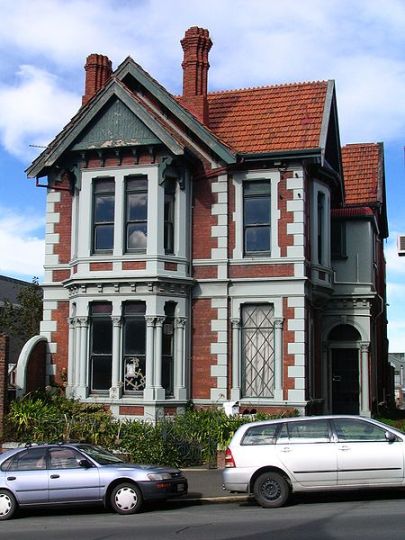
Dr Stephenson’s Residence (Former) | Ben Hill | 24/08/2009 | Wikimedia Commons

List Entry Information

Overview

Status
Listed

List Entry Status
Historic Place Category 2

Access
Private/No Public Access

List Number
2200

Date Entered
2nd July 1982

Date of Effect
2nd July 1982

City/District Council
Dunedin City

Region
Otago Region

Extent of List Entry

Extent includes the land described as Pt Secs 39-40, Town of Dunedin (RT OT13A/703; OT13A/704), Otago Land District, and the building known as Dr Stephenson’s Residence (Former) thereon.

Legal description

Pt Secs 39-40, Town of Dunedin (RT OT13A/703; OT13A/704), Otago Land District

Detailed List Entry

Construction Professional

Name

Salmond, James Louis

Type

Architect

Biography

James Louis Salmond (1868-1950) was born in North Shields, England. He was educated at Otago Boys' High School and began his career articled to Robert Arthur Lawson (1833-1902). Salmond initially practised on his own account but later rejoined Lawson in partnership. Salmond took over the practice when Lawson died in 1902. Salmond was the architect of over 20 churches in Otago including the Presbyterian churches at Roslyn, Kaikorai, North Dunedin and the Wesleyan church at Mornington. He designed many private residences including Watson Shennan's house at 367 High Street, as well as those at 114 Cargill Street and 14 Pitt Street, all in Dunedin. Salmond was president of the Otago Art Society, and also served a term as president of the New Zealand Institute of Architects. His son Arthur joined the firm having studied in London and his grandson John continues to work in the firm today. It is now known as Salmond Anderson Architects.

Construction Details

Start Year

1898

Type

Original Construction

Reference

Completion Date

6th December 2016

Report Written By

Heather Bauchop

Information Sources

Cyclopedia of New Zealand, 1905

Cyclopedia Company, Industrial, descriptive, historical, biographical facts, figures, illustrations, Wellington, N.Z, 1897-1908, Vol. 4 Otago and Southland, Cyclopedia Company, Christchurch, 1905

Report Written By

This place was identified as significant under previous legislation with different information requirements. It remains significant under the current legislation. There is opportunity under our legislation and policies to add to this information. Further information about this place may be available from the Otago/Southland Office of Heritage New Zealand Pouhere Taonga. Please note that entry on the New Zealand Heritage List/Rarangi Korero identifies only the heritage values of the property concerned, and should not be construed as advice on the state of the property, or as a comment of its soundness or safety, including in regard to earthquake risk, safety in the event of fire, or insanitary conditions. A fully referenced upgrade report is available on request from the Otago/Southland Area Office of Heritage New Zealand.

Further Information

Current Usages

Uses: Accommodation

Specific Usage: House

Former Usages

General Usage:: Accommodation

Specific Usage: House

General Usage:: Health

Specific Usage: Doctor’s Surgery

General Usage:: Trade

Specific Usage: Office building/Offices

Themes

Web Links

Overview

Status

Listed

List Entry Status

Historic Place Category 2

Access

Private/No Public Access

List Number

2200

Date Entered

2nd July 1982

Date of Effect

2nd July 1982

City/District Council

Dunedin City

Region

Otago Region

Extent of List Entry

Extent includes the land described as Pt Secs 39-40, Town of Dunedin (RT OT13A/703; OT13A/704), Otago Land District, and the building known as Dr Stephenson’s Residence (Former) thereon.

Legal description

Pt Secs 39-40, Town of Dunedin (RT OT13A/703; OT13A/704), Otago Land District

Status

Listed

List Entry Status

Historic Place Category 2

Access

Private/No Public Access

List Number

2200

Date Entered

2nd July 1982

Date of Effect

2nd July 1982

City/District Council

Dunedin City

Region

Otago Region

Extent of List Entry

Extent includes the land described as Pt Secs 39-40, Town of Dunedin (RT OT13A/703; OT13A/704), Otago Land District, and the building known as Dr Stephenson’s Residence (Former) thereon.

Legal description

Pt Secs 39-40, Town of Dunedin (RT OT13A/703; OT13A/704), Otago Land District

Construction Information

Construction Professional

Name

Salmond, James Louis

Type

Architect

Biography

James Louis Salmond (1868-1950) was born in North Shields, England. He was educated at Otago Boys' High School and began his career articled to Robert Arthur Lawson (1833-1902). Salmond initially practised on his own account but later rejoined Lawson in partnership. Salmond took over the practice when Lawson died in 1902. Salmond was the architect of over 20 churches in Otago including the Presbyterian churches at Roslyn, Kaikorai, North Dunedin and the Wesleyan church at Mornington. He designed many private residences including Watson Shennan's house at 367 High Street, as well as those at 114 Cargill Street and 14 Pitt Street, all in Dunedin. Salmond was president of the Otago Art Society, and also served a term as president of the New Zealand Institute of Architects. His son Arthur joined the firm having studied in London and his grandson John continues to work in the firm today. It is now known as Salmond Anderson Architects.

Construction Details

Start Year

1898

Type

Original Construction

Construction Professional

Name

Salmond, James Louis

Type

Architect

Biography

James Louis Salmond (1868-1950) was born in North Shields, England. He was educated at Otago Boys' High School and began his career articled to Robert Arthur Lawson (1833-1902). Salmond initially practised on his own account but later rejoined Lawson in partnership. Salmond took over the practice when Lawson died in 1902. Salmond was the architect of over 20 churches in Otago including the Presbyterian churches at Roslyn, Kaikorai, North Dunedin and the Wesleyan church at Mornington. He designed many private residences including Watson Shennan's house at 367 High Street, as well as those at 114 Cargill Street and 14 Pitt Street, all in Dunedin. Salmond was president of the Otago Art Society, and also served a term as president of the New Zealand Institute of Architects. His son Arthur joined the firm having studied in London and his grandson John continues to work in the firm today. It is now known as Salmond Anderson Architects.

Construction Details

Start Year

1898

Type

Original Construction

Reference

Historical and Associated Iwi / Hapū / Whānau

Completion Date

6th December 2016

Report Written By

Heather Bauchop

Information Sources

Cyclopedia of New Zealand, 1905

Cyclopedia Company, Industrial, descriptive, historical, biographical facts, figures, illustrations, Wellington, N.Z, 1897-1908, Vol. 4 Otago and Southland, Cyclopedia Company, Christchurch, 1905

Other Information

This place was identified as significant under previous legislation with different information requirements. It remains significant under the current legislation. There is opportunity under our legislation and policies to add to this information. Further information about this place may be available from the Otago/Southland Office of Heritage New Zealand Pouhere Taonga. Please note that entry on the New Zealand Heritage List/Rarangi Korero identifies only the heritage values of the property concerned, and should not be construed as advice on the state of the property, or as a comment of its soundness or safety, including in regard to earthquake risk, safety in the event of fire, or insanitary conditions. A fully referenced upgrade report is available on request from the Otago/Southland Area Office of Heritage New Zealand.

Historical and Associated Iwi / Hapū / Whānau

Completion Date

6th December 2016

Report Written By

Heather Bauchop

Information Sources

Cyclopedia of New Zealand, 1905

Cyclopedia Company, Industrial, descriptive, historical, biographical facts, figures, illustrations, Wellington, N.Z, 1897-1908, Vol. 4 Otago and Southland, Cyclopedia Company, Christchurch, 1905

Other Information

This place was identified as significant under previous legislation with different information requirements. It remains significant under the current legislation. There is opportunity under our legislation and policies to add to this information. Further information about this place may be available from the Otago/Southland Office of Heritage New Zealand Pouhere Taonga. Please note that entry on the New Zealand Heritage List/Rarangi Korero identifies only the heritage values of the property concerned, and should not be construed as advice on the state of the property, or as a comment of its soundness or safety, including in regard to earthquake risk, safety in the event of fire, or insanitary conditions. A fully referenced upgrade report is available on request from the Otago/Southland Area Office of Heritage New Zealand.

Further Information

Current Usages

Uses: Accommodation

Specific Usage: House

Former Usages

General Usage: Accommodation

Specific Usage: House

General Usage: Health

Specific Usage: Doctor’s Surgery

General Usage: Trade

Specific Usage: Office building/Offices

Current Usages

Uses: Accommodation

Specific Usage: House

Former Usages

General Usage: Accommodation

Specific Usage: House

General Usage: Health

Specific Usage: Doctor’s Surgery

General Usage: Trade

Specific Usage: Office building/Offices

Location

Loading
Sign up to hear more

Get the latest heritage news, features and events delivered
straight to your inbox.

Subscribe